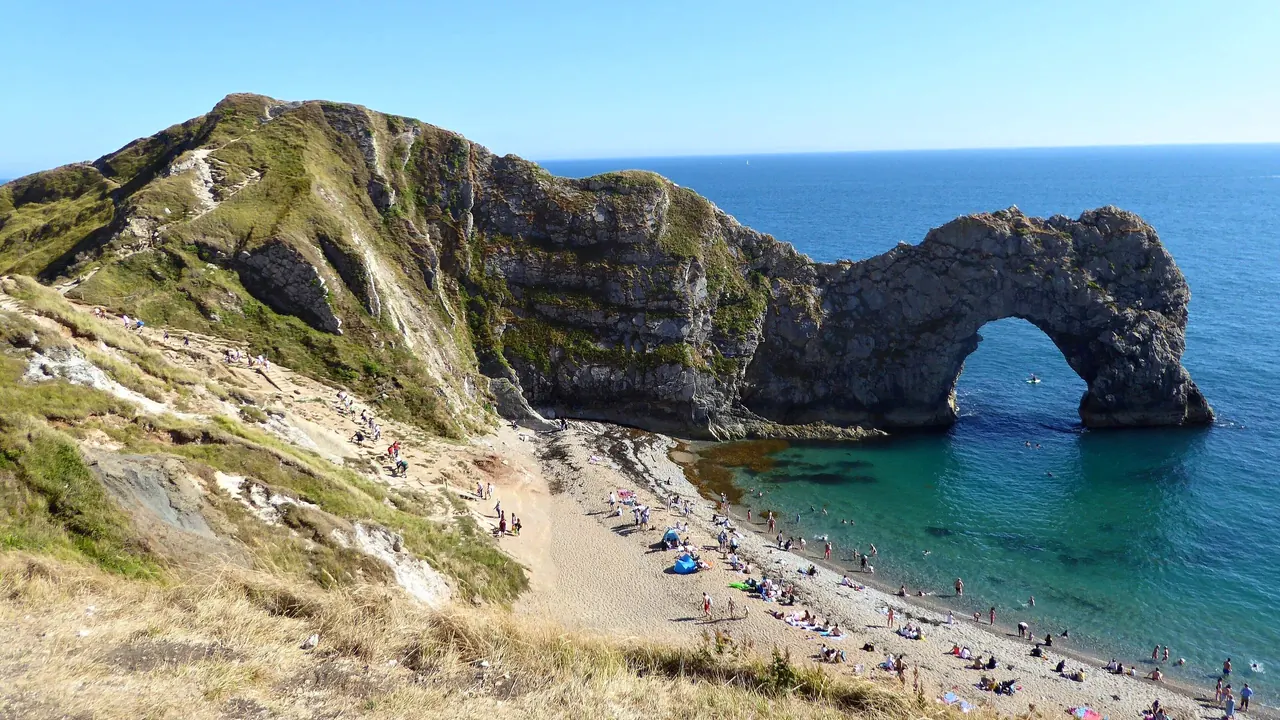
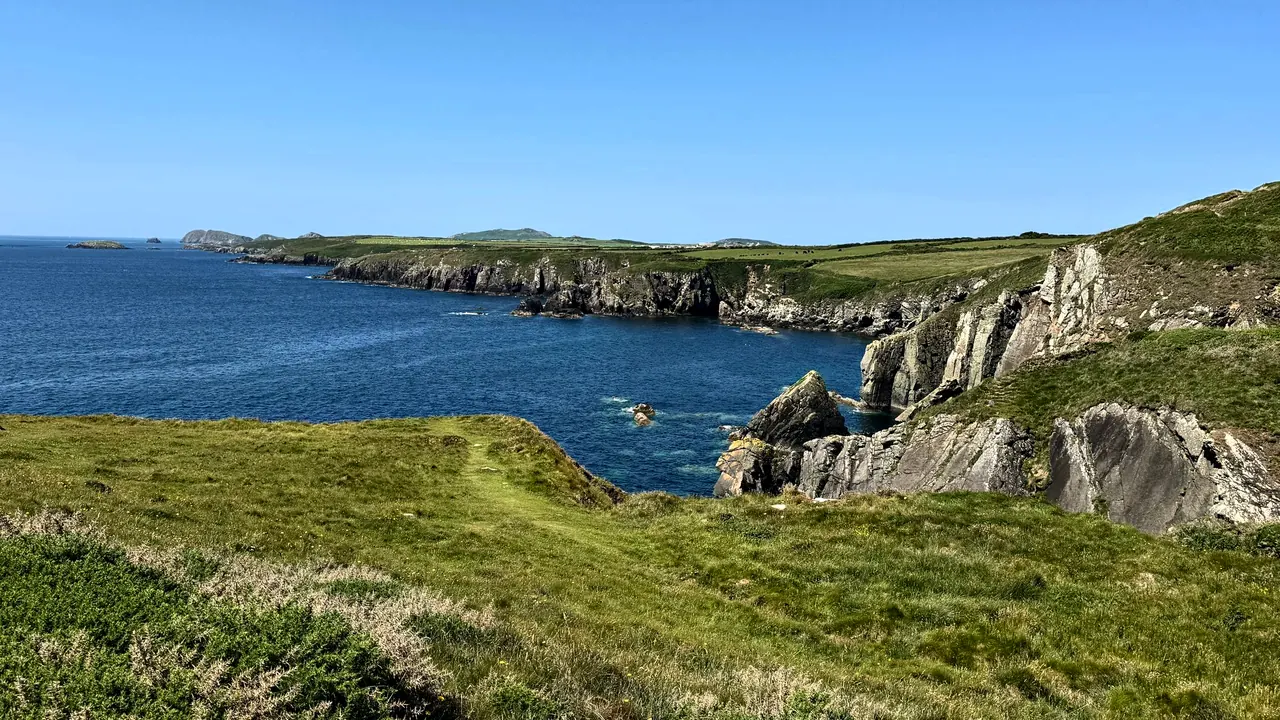
Photos: Jurassic Coast by Ethan Doyle White, CC BY-SA 4.0, cropped; Pembrokeshire by Petra Nesti, Pexels License.
Jurassic Coast or Pembrokeshire?
Our verdict in twelve categories, each scored against the same fixed benchmark cities, and the climate month by month, so you can choose for your trip.
Choose Jurassic Coast for
- day trips
- food and drink
- families
The Jurassic Coast suits travellers who come for the rocks themselves: walking a coastline that shows its geology layer by layer, hunting ammonites on the beaches at Charmouth and Lyme Regis, and seeing Durdle Door and Old Harry Rocks. Its summers are a little warmer and sunnier. It also sits within reach of more substantial inland outings, such as Exeter, Sherborne, Salisbury and Stonehenge, so a week here can mix coast with English country towns.
Choose Pembrokeshire for
- culture and sights
- beaches
- getting around
Pembrokeshire is better if your days centre on sandy beaches and wildlife. It has more and better sand, puffins and seals on its offshore islands, and a richer layer of history in St Davids and its ring of Norman castles. The county is compact enough to cross in an hour, and outside the school summer break it is somewhat kinder on the budget. In return you get cooler, wetter weather.
Scoreboard
Twelve categories on one fixed scale from 0 to 100. The shaded stretch is the gap between the two.
Your match
Pick a travel style or drag the sliders, and both match scores follow your weighting.
Wins on day trips and food and drink with your weighting.
Wins on culture and sights and beaches with your weighting.
What matters to you?
Category by category
What the scores mean for a trip.
Beaches & swimming
Pembrokeshire has the better beaches, and the difference is mostly in the sand. It has town beaches in Tenby, the long open bays of Newgale, Broad Haven and Whitesands, and sheltered coves around Dale and Marloes. With so much more sand to spread across, and lifeguards on more of it, Pembrokeshire is also the easier coast for finding space in August, when the Jurassic Coast's few sandy bays are at their most crowded.
On the Jurassic Coast, the good sand is at the ends, in Studland's dune-backed bay, Weymouth's gently shelving sweep and the red-cliffed beaches of Exmouth and Sidmouth. Lulworth, Durdle Door and Charmouth in the middle are steep shingle. The water is equally cold on both coasts, so neither is a place for long swims.
Food & drink
The two are much alike: both are about local seafood and farm produce rather than restaurants, and both offer a narrow range away from a few towns. On the Jurassic Coast, the best eating is around Bridport and Lyme Bay, with harbour crab shacks, Blue Vinny cheese, cider and sparkling wine from vineyards on the chalk slopes.
Pembrokeshire adds salt-marsh lamb, early potatoes and ice cream made on dairy farms. Its better restaurants are spread between Fishguard, St Davids and Narberth, and its farmers' markets suit anyone self-catering.
Culture & sights
Pembrokeshire has more to see. St Davids is a pilgrims' cathedral city the size of a village, with the roofless Bishop's Palace beside the cathedral. Pembroke Castle, where Henry VII was born, leads a ring of Norman fortresses, and the Preseli Hills hold Pentre Ifan and the source of some of Stonehenge's bluestones.
The Jurassic Coast's heritage is lighter and mostly about fossils: Mary Anning's Lyme Regis, the Charmouth centre and the ruins of Corfe Castle. For more, you head inland to Hardy's Dorchester and the ramparts of Maiden Castle.
Nightlife
Neither is a place for a night out, and both have a single livelier town. Weymouth has a seafront strip of bars and a couple of late venues, popular with stag and hen groups. In Pembrokeshire it is the harbour pubs inside Tenby's old walls on summer weekends. Everywhere else on both coasts, evenings are a village pub, perhaps a folk session, and quiet by eleven. Only the Jurassic Coast has a proper fallback, in Bournemouth just beyond Studland.
Nature & outdoors
Both are among Britain's great coastlines, but they reward different interests. The Jurassic Coast is about geology. Along about 150km of cliffs, the rock runs in order from red Devon sandstone to Purbeck chalk, with Durdle Door, Chesil Beach and fossil hunting as the highlights, plus sea-cliff climbing on Portland and sailing in Weymouth Bay.
Pembrokeshire's strength is wildlife and the sea itself. You can see puffins on Skomer, seals on Ramsey, gannets on Grassholm and dolphins in the bays. It has twice the length of coast path, surf at Freshwater West, the cliffs where coasteering began, and open moorland in the Preselis.
Day trips
The Jurassic Coast has the better day trips, because England's country towns are close by. Exeter's cathedral and quayside are near the western end, Sherborne and Shaftesbury are within an hour of Weymouth, and Salisbury with Stonehenge makes a longer day from Purbeck. Closer to hand are the ferry to Brownsea Island and the Swanage steam railway.
Pembrokeshire's outings are pleasant but smaller. Choices include a boat to the monks' island of Caldey, Aberaeron's painted harbour, dolphin watching at New Quay and Dylan Thomas's boathouse at Laugharne, with Gower and Swansea about two hours away.
Good for families
Both are classic British seaside choices for children, with a cold sea and the risk of rained-off days. The Jurassic Coast has a little more to do. There are guided fossil walks at Charmouth, donkey rides and a sea-life centre in Weymouth, shallow water at Studland, and on wet days the Bovington tank museum and the steam railway. Falling rock means small children need watching on the cliff beaches.
Pembrokeshire's days are simpler: rock pools, crabbing off harbour walls, boat trips to see seals and puffins, and a farm park with an indoor funfair. Tenby and Saundersfoot, with beaches in town, make easy bases.
Getting around
You need a car on both, but Pembrokeshire is easier because it is compact: the whole county takes about an hour to cross, and seasonal coastal buses make one-way walks along the coast path easy. The cost is single-track lanes where you pull in to pass.
The Jurassic Coast is long and slow by comparison, about two and a half hours by road from Exmouth to Studland, on lanes that clog in summer. Its buses work in stages with changes around Lyme Regis or Axminster, so without a car it is best to stay in one town.
Shopping & style
Shopping is small and local on both coasts, with no fashion streets on either. On the Jurassic Coast the best is Bridport, with its big street market and antiques quarter, plus polished ammonites in Lyme Regis and Charmouth. In Pembrokeshire it is Narberth's delis and interiors shops, and the most worthwhile thing to take home is a blanket or throw woven at one of the county's woollen mills.
Affordability
Both charge peak British rates in July and August, but Pembrokeshire is easier on the budget overall, and in spring and early autumn it is noticeably cheaper. On the Jurassic Coast, cottages in Lyme Regis, Purbeck and the prettier villages are the most expensive and book up early. Weymouth and the caravan parks are the cheaper bases. Parking at the busy spots is an extra cost that soon adds up. On both coasts the main attractions are free: the beaches and the coast path.
Live music & performing arts
There is little live performance on either coast. Pembrokeshire has the one event worth planning around: the classical music festival held each early summer inside St Davids Cathedral. The Jurassic Coast has a seafront pavilion theatre in Weymouth with touring comedy and summer shows, and small folk and literary festivals in its market towns. For anything larger, you go to Poole or Exeter.
Wellness & relaxation
Neither coast has a spa or bathing tradition. On both, relaxing means a quiet cottage, a day on the coast path and a pub in the evening, with a few hotel spas and yoga retreats. The differences are small. The Jurassic Coast has cold-water sea swimming groups and the slow pace of villages like Beer, Charmouth and the Purbeck hamlets. Pembrokeshire is emptier outside August, with farmhouse retreats and lanes that see little traffic.
When should you go?
Pick your month. The climate figures are measured averages, not a forecast.
Jurassic Coast in July
Pembrokeshire in July
Daytime high, °C
Rainfall in the month, mm
Where the figures come from
Jurassic Coast's temperatures are measured 66 km from the centre, at Bournemouth Airport.
Jurassic Coast has no rain gauge within 25 km of the centre, so its rainfall comes from a gridded climate dataset read at the destination rather than from a gauge further away.
Pembrokeshire's temperatures are measured 46 km from the centre, at Aberporth.
Pembrokeshire has no rain gauge within 25 km of the centre, so its rainfall comes from a gridded climate dataset read at the destination rather than from a gauge further away.
Temperature and rainfall are climate normals, averaged over the years shown. Jurassic Coast: 1991-2020 normals, Bournemouth Airport (65.7 km from centre). Pembrokeshire: 1991-2020 normals, Aberporth (46.2 km from centre).
The Jurassic Coast is the warmer and brighter of the two in summer. Around its main resorts, afternoons reach about 22°C in July and August, against about 18°C on the Pembrokeshire coast, and it gets clearly more sunshine through high summer. The sea is equally cold on both, peaking at about 17°C in August and September. That makes July to September the beach season on both coasts, and swims are brisk even then.
Pembrokeshire is the wetter of the two in every month. Its rain builds through August and is heaviest from October to December, reaching about 121mm in November. On both coasts the wet, grey stretch runs from October into January. From March to May it is drier, and April and May bring long sunny days for walking. They are especially good in Pembrokeshire, where spring and early summer are the best time for seabirds. March is still cool on both, though. On the Jurassic Coast, winter is fossil-hunting season, when storms wash fresh finds out of the cliffs.
Which traveller are you?
On a beach and sun trip, Pembrokeshire has the better beaches: long sandy bays like Newgale and Whitesands, Barafundle's dune cove and lifeguards on many of them. The Jurassic Coast offers warmer, sunnier days, but much of its shore is steep shingle.
For a culture and arts trip, Pembrokeshire gives more to see. It has St Davids Cathedral beside the Bishop's Palace, Pembroke and its chain of Norman castles, and prehistoric sites in the Preseli Hills. The Jurassic Coast's heritage is thinner and more scattered.
For fossil hunters, the Jurassic Coast is the clear choice. The beaches at Charmouth and Lyme Regis give up ammonites after winter storms, guided walks show you where to look, and the museums and heritage centre explain what you have found. Pembrokeshire has nothing comparable.
Before you go
| Measure | Jurassic Coast | Pembrokeshire |
|---|---|---|
| Official language | English | English |
| Currency | Pound Sterling (GBP) | Pound Sterling (GBP) |
| Sockets | G230 V, 50 Hz | G230 V, 50 Hz |
| Driving side | Left | Left |
| Time zone | UTC, UTC+1 in summer | UTC, UTC+1 in summer |
| Emergency number | 112 or 999 | 112 or 999 |
| Main airport | Exeter International Airport (EXT)25 non-stop destinations | Cardiff International Airport (CWL)32 non-stop destinations |
| Public holidays this year | 8 days | 8 days |
By the numbers
| Measure | Jurassic Coast | Pembrokeshire |
|---|---|---|
| Population | - | 125,818 |
| People per km² | - | 78 |
| Swim season, months above 21 °C | None | None |
Where else could you go?
Every comparison below shares a destination with this one, so you can follow Jurassic Coast or Pembrokeshire somewhere new.
- Devonvs Jurassic Coast
- Isle of Wightvs Jurassic Coast
- Cotswoldsvs Jurassic Coast
- Cornwallvs Pembrokeshire
- Snowdoniavs Pembrokeshire
- Cornwallvs Jurassic Coast