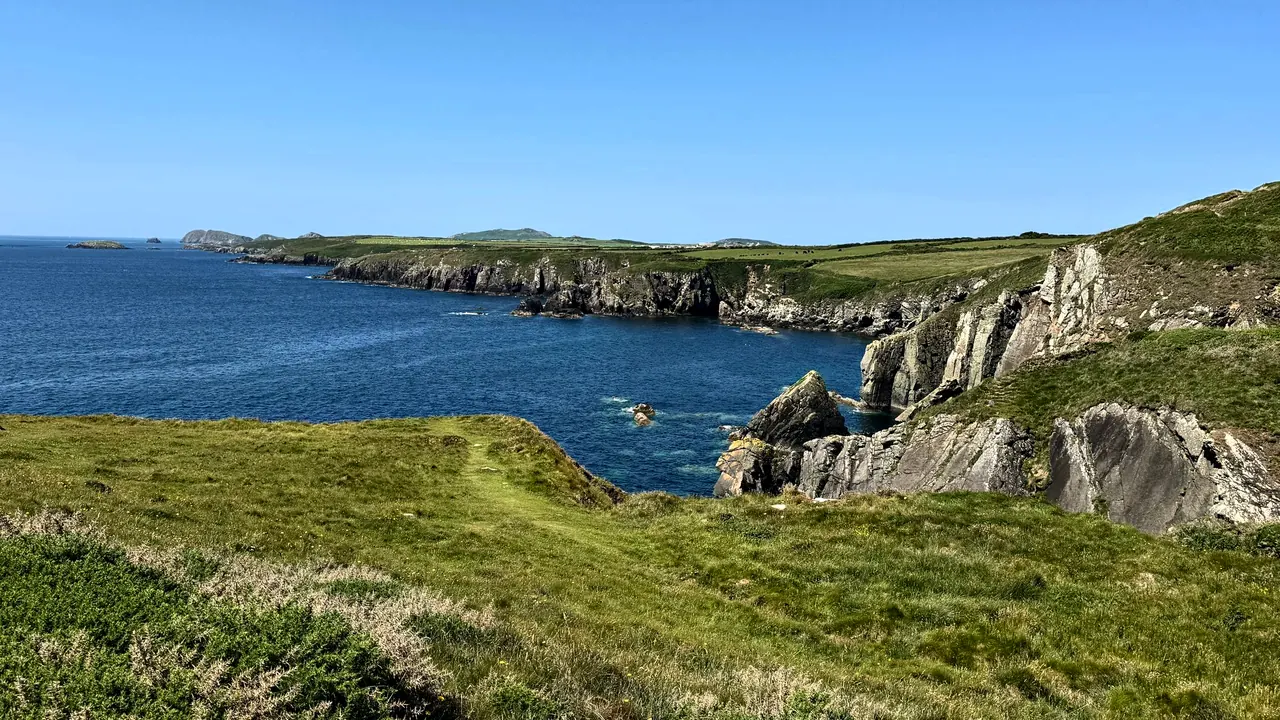
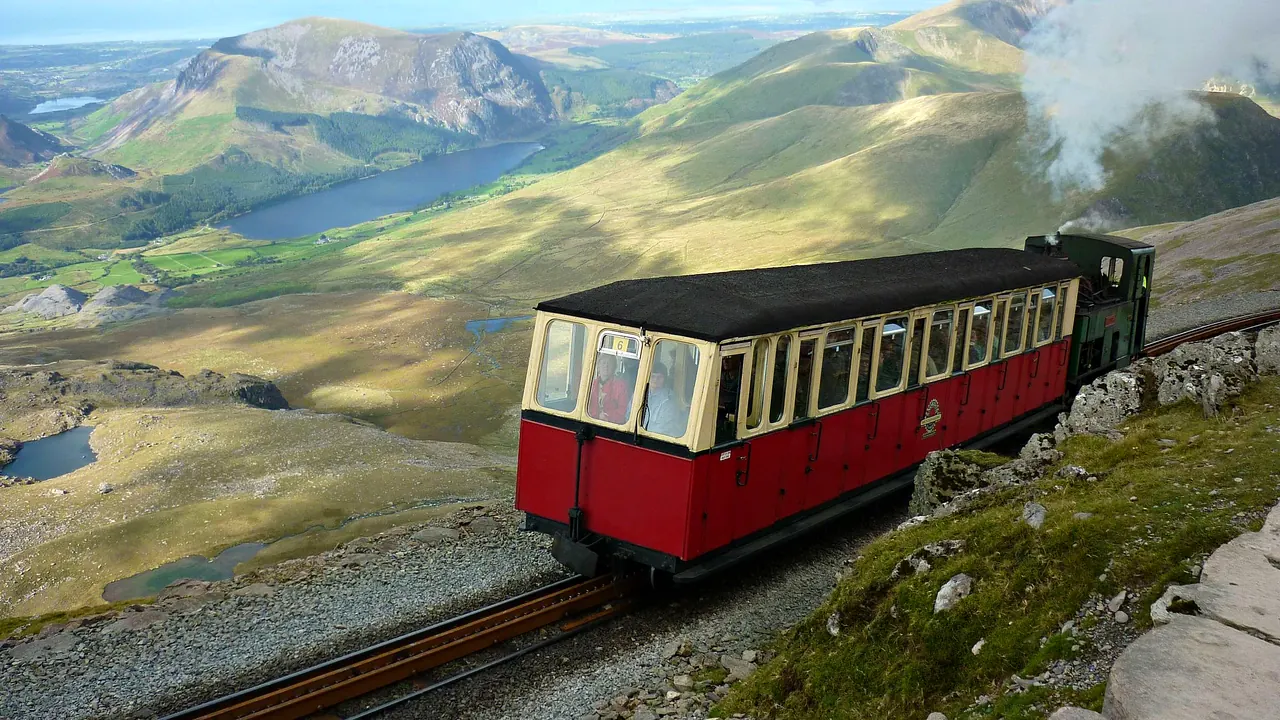
Photos: Pembrokeshire by Petra Nesti, Pexels License; Snowdonia by Porius1, CC BY-SA 3.0, cropped.
Pembrokeshire or Snowdonia?
Our verdict in twelve categories, each scored against the same fixed benchmark cities, and the climate month by month, so you can choose for your trip.
Choose Pembrokeshire for
- beaches
- nightlife
- shopping
Pembrokeshire suits a coastal trip built around sand, cliffs and seabirds. Its beaches are the reason to go, from Barafundle's dune-backed cove to the long surf beaches near St Davids, and the coast path links them all. It also gives you a little more to eat and do in the evenings, and Tenby and Saundersfoot make easy, walkable bases for young families. Choose it if you want the sea at the centre of the week and hills only in the background.
Choose Snowdonia for
- day trips
- nature and the outdoors
Walkers, scramblers and anyone who wants proper mountains will be happier in Snowdonia. Yr Wyddfa, Tryfan and the Glyderau give it a scale Pembrokeshire's coast cannot match, and the edges of the park hold far stronger outings: the Edwardian castles at Caernarfon and Conwy, Anglesey, Llandudno and Bodnant Garden. In return you get thinner food, quieter nights and more rain, and the beaches are something for a fine afternoon rather than the reason for the trip.
Scoreboard
Twelve categories on one fixed scale from 0 to 100. The shaded stretch is the gap between the two.
Your match
Pick a travel style or drag the sliders, and both match scores follow your weighting.
Wins on beaches and nightlife with your weighting.
Wins on day trips and nature and the outdoors with your weighting.
What matters to you?
Category by category
What the scores mean for a trip.
Beaches & swimming
Pembrokeshire is the beach region of the two. You can choose between town sands at Tenby, the walk-in cove at Barafundle, the long surf beaches of Newgale and Whitesands and the sheltered bays around Dale and Marloes, and there are enough of them to find space even in August.
Snowdonia's coast has real assets in Harlech's dunes below the castle and the broad expanse of Black Rock Sands. Still, there are fewer of them, the sea is a touch colder and the wind is more persistent. In Snowdonia a beach fills a fine afternoon, while in Pembrokeshire it can fill most of the week.
Food & drink
Pembrokeshire eats better, mainly because of its sea produce: crab and lobster from the small harbours, salt-marsh lamb, early potatoes and farm-made ice cream. It also has a few restaurants worth booking in St Davids, Narberth and Fishguard, and farm shops for anyone self-catering.
Snowdonia's food is fuel for the hills. Expect pub lamb and beef, cawl, bara brith in tea rooms and big breakfasts in the walkers' cafés of Llanberis and Capel Curig. The best seafood is on the fringes, at Conwy and the Menai Strait, and village kitchens often close early outside summer.
Culture & sights
The two are broadly level, but their history is of different kinds. Pembrokeshire's is medieval and prehistoric: the cathedral and ruined Bishop's Palace at St Davids, a ring of Norman castles led by Pembroke, and the Pentre Ifan burial chamber and bluestone country of the Preseli Hills.
Snowdonia's history is industrial and Welsh. There is Harlech on its crag, but also the slate quarries and villages of a World Heritage landscape, the slate museum at Llanberis, the narrow-gauge railways and the oddity of Portmeirion. Welsh is spoken every day in the villages, which gives the region a living identity that Pembrokeshire's south coast lacks.
Nightlife
Pembrokeshire at least has Tenby. On summer weekends the harbour pubs fill, groups crowd the old town streets and a few bars stay open late. Snowdonia has nothing like it. Its evenings are climbers' inns in Llanberis or Capel Curig, drying boots by the fire before an early start, and by closing time the villages are quiet.
Nature & outdoors
Both are first-rate, and the difference is coast against mountain. Pembrokeshire's national park follows the shoreline, with some 300km of path over cliffs and sea stacks, puffins on Skomer, seal pups on Ramsey and the gannets of Grassholm. It also has surf, kayaking and the cliffs where coasteering began.
Snowdonia goes upwards. You can climb Yr Wyddfa, scramble the Crib Goch ridge or Tryfan, climb rock at Idwal or walk the quieter Rhinogydd. It adds mountain biking, white-water rafting and sailing on Llyn Tegid, but it pays for this with more rain and summits that often disappear into cloud.
Day trips
Snowdonia has the better surroundings by a distance. Caernarfon and Conwy, with their great castles and walls, are within an hour, and Beaumaris and Anglesey lie across the Menai. Victorian Llandudno, Bodnant Garden, Penrhyn Castle and even walled Chester are all within reach.
Pembrokeshire's outings are pleasant but on a smaller scale. You can take the boat to the monks' island of Caldey, or drive up the coast to Cardigan and Aberaeron, or east to Dylan Thomas's Laugharne. Gower is about two hours away, but nothing in reach compares with the Edwardian castles of the north.
Good for families
Pembrokeshire has a slight edge for families, mostly because a week there takes less planning. Besides the beaches, it has a large farm park and zoo with an indoor funfair, a wildlife park, and soft-play and activity centres, so a grey morning has an answer close by. The limits are a sea too cold for long paddles and the lack of any big theme park.
Snowdonia's family days are spread across the valleys. That means more driving between them and more rain to plan around. Its gentler side is lake paddling at Llanberis and Bala, woodland adventure parks and the wide sands of Harlech and Black Rock, while the higher walks suit older, fitter children. You will want a car in either region, but Pembrokeshire is more compact, so the journeys between days out are shorter.
Getting around
In practice both need a car, and neither makes driving easy. Pembrokeshire is compact, about an hour across, but the hedge-lined lanes are narrow and beach car parks fill early. Its seasonal coastal buses are useful for one-way walks along the path.
In Snowdonia the bottleneck is the trailheads: Pen-y-Pass and Ogwen fill early, and summer weekends bring queues on the valley roads. On the other hand, the Sherpa'r Wyddfa buses and the Conwy Valley and Cambrian Coast lines give a walker without a car slightly more to work with.
Shopping & style
Pembrokeshire has a real place to browse in Narberth, with independent shops, delis and antiques. Its woollen mills and the coastal galleries round out the county. Snowdonia's shopping is mostly practical: outdoor gear in Betws-y-Coed, slate crafts and Portmeirion pottery. Both sell good Welsh blankets, and neither is a shopping destination.
Affordability
Costs work the same way in both: the landscape is free and the beds are expensive in the school summer break, with spring and autumn noticeably easier. Pembrokeshire keeps daily spending moderate with free beaches, cafés and self-catering.
Snowdonia has more bunkhouses, hostels and campsites for walkers on a tight budget. For families, though, zip lines and railway tickets can push the bill up.
Live music & performing arts
Pembrokeshire has a slight edge thanks to the classical festival held each early summer inside St Davids Cathedral, plus small theatres in Fishguard and Milford Haven. Snowdonia's offer is more distinctly Welsh: male voice choir rehearsals open to visitors and village eisteddfodau. For an actual theatre you have to leave the park for Bangor or Llandudno.
Wellness & relaxation
Neither region has much in the way of spas, and both do their resting outdoors. Pembrokeshire's version is a cottage with a sea view and an evening stroll along the cliffs. Snowdonia's is a stone cottage with a log burner in Beddgelert or by the Mawddach, cold-water swims in the lakes and the deep tiredness that follows a day on the hills.
When should you go?
Pick your month. The climate figures are measured averages, not a forecast.
Pembrokeshire in July
Snowdonia in July
Daytime high, °C
Rainfall in the month, mm
Where the figures come from
Pembrokeshire's temperatures are measured 46 km from the centre, at Aberporth.
Pembrokeshire has no rain gauge within 25 km of the centre, so its rainfall comes from a gridded climate dataset read at the destination rather than from a gauge further away.
Snowdonia's temperatures are measured 52 km from the centre, at Valley.
Snowdonia has no rain gauge within 25 km of the centre, so its rainfall comes from a gridded climate dataset read at the destination rather than from a gauge further away.
Temperature and rainfall are climate normals, averaged over the years shown. Pembrokeshire: 1991-2020 normals, Aberporth (46.2 km from centre). Snowdonia: 1991-2020 normals, Valley (51.8 km from centre).
Neither region ever gets hot, and through the year the two follow almost the same curve. On the Pembrokeshire coast, daytime highs peak at around 18°C in July and August. The sea never really warms up, so swimming stays brisk all year. It is least cold in August and September, when it reaches about 17°C. Snowdonia's measuring point runs a degree or so warmer on summer afternoons, but its sea is a touch colder, so its beaches are only worth a visit on fine days in high summer.
The real difference is rain. Both regions are driest and sunniest from April to June, and May is the best month for long walks. Snowdonia is wetter in every month, though, and in the mountains that means cloud over the summits. Pembrokeshire stays fairly settled into September, when Snowdonia is already turning wet, and by November the park gets about 134mm. Winters are mild but grey and wet in both. On the Pembrokeshire coast that simply means quiet, windy days, while in the mountains it brings real winter conditions.
Which traveller are you?
On a beach and sun trip, choose Pembrokeshire. It has more beaches, and better ones, from Tenby's town sands to Newgale and Whitesands, with lifeguards in summer and a slightly warmer sea. Snowdonia's Cardigan Bay strands are good, but they come second to the hills.
For an outdoors trip, Snowdonia is the stronger pick if you want height: the Yr Wyddfa paths, scrambles on Tryfan, rock climbing in the Llanberis Pass, mountain biking at Coed y Brenin and white water on the Tryweryn. Pembrokeshire is better for coastal walking, coasteering and seabirds.
On a family trip with young children, Pembrokeshire is the easier choice. Tenby and Saundersfoot have beaches in town, and the days are made of rock pools, crabbing and seal boats. Snowdonia works better for older, adventurous children who want steam railways, cavern courses and zip lines.
Before you go
| Measure | Pembrokeshire | Snowdonia |
|---|---|---|
| Official language | English | English |
| Currency | Pound Sterling (GBP) | Pound Sterling (GBP) |
| Sockets | G230 V, 50 Hz | G230 V, 50 Hz |
| Driving side | Left | Left |
| Time zone | UTC, UTC+1 in summer | UTC, UTC+1 in summer |
| Emergency number | 112 or 999 | 112 or 999 |
| Main airport | Cardiff International Airport (CWL)32 non-stop destinations | Liverpool John Lennon Airport (LPL)75 non-stop destinations |
| Public holidays this year | 8 days | 8 days |
By the numbers
| Measure | Pembrokeshire | Snowdonia |
|---|---|---|
| Population | 125,818 | - |
| People per km² | 78 | - |
| Swim season, months above 21 °C | None | None |
Where else could you go?
Every comparison below shares a destination with this one, so you can follow Pembrokeshire or Snowdonia somewhere new.
- Peak Districtvs Snowdonia
- Cornwallvs Pembrokeshire
- Lake Districtvs Snowdonia
- Yorkshire Dalesvs Snowdonia
- Devonvs Pembrokeshire
- Cotswoldsvs Snowdonia