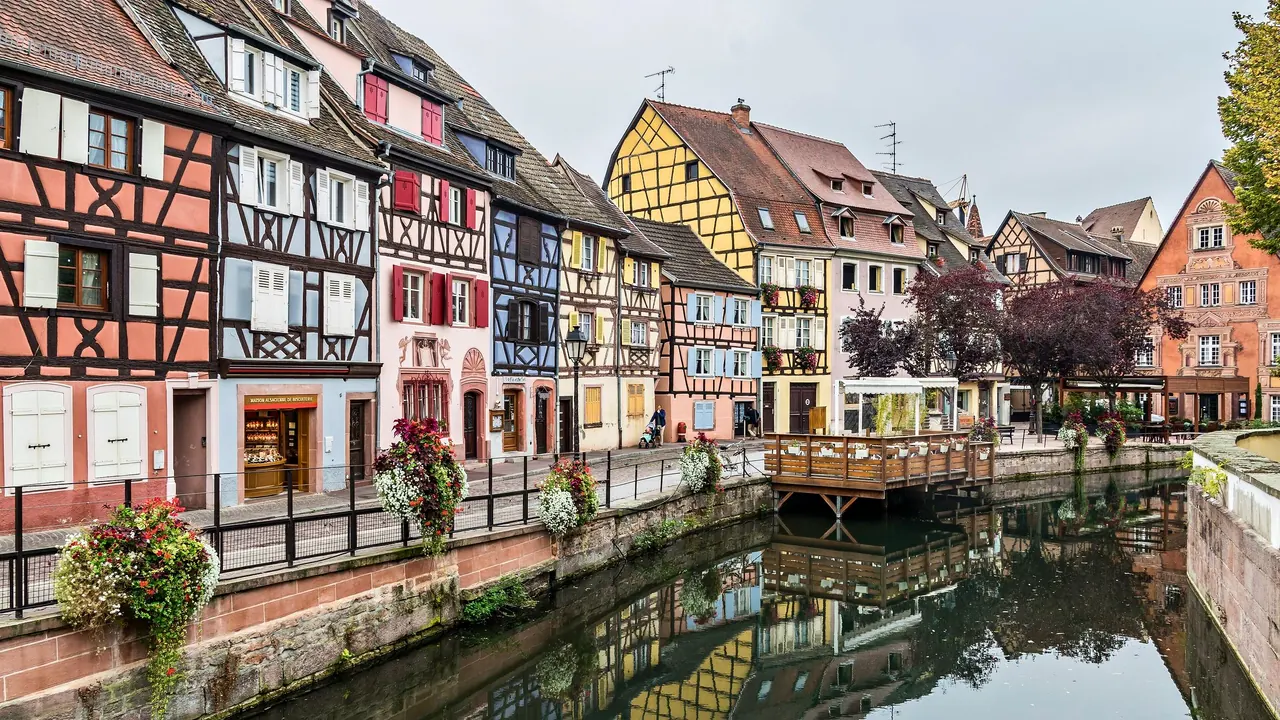
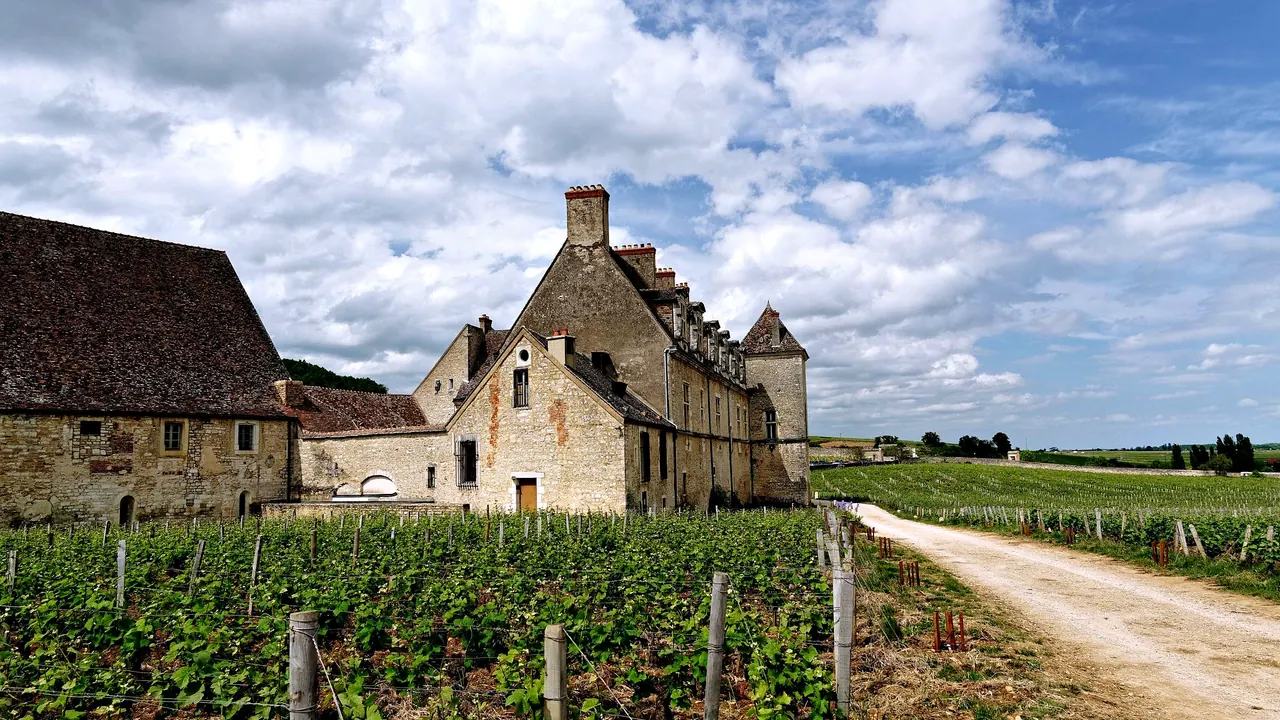
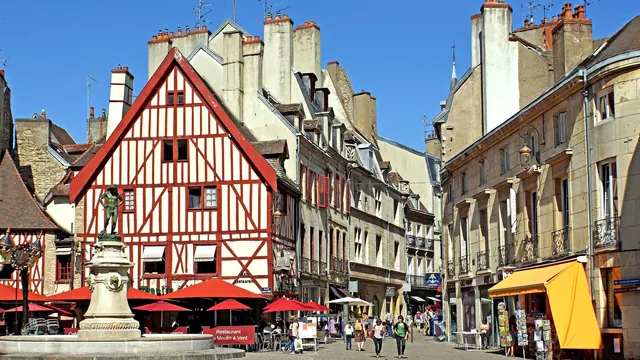
Photos: Alsace by Krzysztof Golik, CC BY-SA 4.0, cropped; Burgundy by Gu Bra, Pexels License.
Alsace or Burgundy?
Our verdict in twelve categories, each scored against the same fixed benchmark cities, and the climate month by month, so you can choose for your trip.
Choose Alsace for
- families
- getting around
- live music and the arts
Alsace is the easier and more varied choice. Strasbourg gives you a real city with trams, an opera house and student bars, Colmar and the wine villages are a short train or drive away, and the Vosges rise behind the vineyards for proper walking. It suits families above all, with Europa-Park, the monkey and eagle parks and the Mulhouse museums close at hand, and anyone who wants evenings out without having to drive.
Choose Burgundy for
- food and drink
- beaches
- prices
Burgundy is for travellers who put the table and the cellar first. The Côte de Nuits and Côte de Beaune hold wines that Alsace's Rieslings, good as they are, do not match in fame, and Beaune makes a small, wine-soaked base. Add scattered Romanesque abbeys and a slow week on the canals, and it rewards couples with a car and an unhurried pace far more than it rewards children or night owls.
Scoreboard
Twelve categories on one fixed scale from 0 to 100. The shaded stretch is the gap between the two.
Your match
Pick a travel style or drag the sliders, and both match scores follow your weighting.
Wins on families and getting around with your weighting.
Wins on food and drink and beaches with your weighting.
What matters to you?
Category by category
What the scores mean for a trip.
Beaches & swimming
Neither region has a coast, and in both summer swimming means a lake on a hot afternoon. Alsace's options are flooded gravel pits on the Rhine plain and cool reservoirs up in the Vosges. Burgundy's are a little more of an outing: the Morvan reservoirs, especially Lac des Settons, with supervised beaches and sailing, plus Lac Kir on the edge of Dijon.
Food & drink
Both regions eat seriously, but Burgundy is the one people travel to for the table. Its Côte de Nuits and Côte de Beaune produce red and white wines of world fame, and boeuf bourguignon, coq au vin, snails and Époisses are dishes known far beyond France. Beaune puts wine bars and serious restaurants in one small walled town.
Alsace's cooking is heartier and more Germanic: choucroute, baeckeoffe and flammekueche in a wood-panelled winstub, with Riesling, Gewurztraminer and crémant from the growers and plenty of local beer. It is very good eating, but it lacks Burgundy's grand-name cellars. Neither offers much street food or cooking from elsewhere.
Culture & sights
Both regions are rich in heritage, but it is arranged differently. In Alsace it is concentrated: Strasbourg's sandstone cathedral and UNESCO-listed island centre, Petite France and the Palais Rohan museums, then Colmar's Isenheim Altarpiece, all linked by train.
Burgundy's treasures are medieval and monastic, and spread out across the countryside. Dijon's Palace of the Dukes and the tiled roof of Beaune's Hospices are easy, but Vézelay, Fontenay, Cluny and Autun each need a car and most of a day. Romanesque enthusiasts will find more of it here than in Alsace.
Nightlife
Neither region is a place for big nights, but Alsace has more going on after dinner, almost all of it in Strasbourg. The Krutenau student quarter and the streets near the cathedral fill with beer and wine bars, and the quays are busy on summer evenings.
Burgundy's evenings are mostly long dinners. Dijon has a few student streets and a couple of clubs, Beaune's wine bars stay open late in summer, and the villages go quiet early.
Nature & outdoors
Alsace has the more striking landscape. The Vosges climb steeply behind the vines to the Grand Ballon at 1,424m, and the Route des Crêtes and the GR5 give long ridge walks with views to the Black Forest and sometimes the Alps, with modest skiing in winter.
Burgundy is softer country of vineyard slopes, Charolais pastures and the beech forests of the Morvan. Its strength is slow movement: cycling the canal towpaths, a self-drive boat on the Canal du Nivernais, or a balloon flight over the vines.
Day trips
Alsace has the edge, largely because its sights sit so close together. The wine villages from Obernai to Eguisheim are a few kilometres apart, Strasbourg and Colmar are half an hour by train, and the borders add Basel, Freiburg, Baden-Baden and even Heidelberg.
Burgundy's outings are just as rewarding but take more driving. From Beaune the Côte villages are minutes away, but Semur-en-Auxois, Noyers, Chablis and Cluny lie further apart, and Lyon is the main city within reach.
Good for families
This is where the two regions differ most. Alsace has plenty built for children: Europa-Park across the Rhine, macaques and falconry near Kintzheim, Mulhouse's railway and car museums and zoo, and boat trips through Petite France.
Burgundy has a few strong outings, above all Guédelon, where a castle is being built by medieval methods, plus the Alésia museum and the Morvan lake beaches. A hired canal boat is its best family vacation, but beyond that the days revolve around wine and food.
Getting around
Alsace is easier without a car. Frequent trains run the length of the plain between Strasbourg, Colmar and Mulhouse, and Strasbourg adds a good tram network and some of the best cycling in France.
In Burgundy the trains link Dijon, Beaune and the larger towns, but the abbeys and medieval villages are scattered, so a hired car is close to essential. With wine tastings on the agenda that brings a real catch, though cycling the Côte between villages works well.
Shopping & style
Alsace offers a little more, with Strasbourg's department stores and boutiques around Place Kléber, Betschdorf stoneware and Soufflenheim baking moulds. In December its centuries-old Christmas markets make shopping the main event.
Burgundy's shopping is almost entirely for the larder: wine at the cellar door, Dijon mustard, cassis and cheese, best found in Dijon's covered market hall and Beaune's Saturday market.
Affordability
Costs are similar in the two regions, and in both a hired car adds to the bill. In Alsace the pressure falls on Strasbourg and Colmar, especially during the Christmas markets and Parliament sessions, while village guesthouses are kinder. In Burgundy, Beaune and the Côte are the dear part, and the Morvan and rural Yonne are where to stay for less. The great bottles and starred tables can also push a Burgundy trip far beyond its basic costs.
Live music & performing arts
Alsace has more on stage through the year. Strasbourg has a full opera season with the Opéra national du Rhin, a philharmonic orchestra and one of France's leading drama theatres, with autumn festivals of jazz and contemporary music.
Burgundy comes alive mainly in summer: baroque opera in Beaune, street theatre in Chalon-sur-Saône, jazz at Cluny and concerts in Vézelay's basilica. Outside those months it relies on Dijon's opera house.
Wellness & relaxation
Alsace's thermal waters at Niederbronn-les-Bains and Morsbronn come with modern spa complexes built for leisure bathing. Many country hotels in the vineyards and Vosges valleys have their own spas, and Baden-Baden's great baths are an easy crossing of the Rhine. Just avoid Strasbourg in December if calm is the aim.
In Burgundy, the springs at Bourbon-Lancy and Saint-Honoré-les-Bains serve mainly medical cures. A few hotels around Beaune offer grape and wine treatments, but rest here comes mostly from the pace: long lunches and quiet villages, with no spa to plan the day around.
When should you go?
Pick your month. The climate figures are measured averages, not a forecast.
Alsace in July
Burgundy in July
Daytime high, °C
Rainfall in the month, mm
Where the figures come from
Burgundy's temperatures are measured 33 km from the centre, at Dijon.
Burgundy has no rain gauge within 25 km of the centre, so its rainfall comes from a gridded climate dataset read at the destination rather than from a gauge further away.
Temperature and rainfall are climate normals, averaged over the years shown. Alsace: 1991-2020 normals, Ihringen (20.8 km from centre). Burgundy: 1991-2020 normals, Dijon (32.7 km from centre).
The two regions follow almost the same temperature curve. Both reach about 26°C or 27°C in July and August, warm enough for an afternoon at a lake, and both drop to around 6°C from December to February, when walking in the vineyards is cold and grey. May, June and September are the most comfortable months for touring towns, villages and trails in either.
The difference is in the rain. Alsace, sheltered by the Vosges, has dry winters and gets its wettest weather in late spring and summer, with May bringing around 87mm, so its December markets are usually walked in dry cold. Burgundy is wetter through autumn and early winter, with November near 83mm, so the harvest months and late season there carry more risk of grey, damp days. It is also a little sunnier in spring and September.
Which traveller are you?
On a family trip with children, Alsace is far easier going. Outings are short hops apart, trains link the main towns, and only the parks really need a car. In Burgundy, children spend long stretches in the back seat between cellars and abbeys.
For an outdoors trip, Alsace has more to offer. The steep, forested Vosges behind the vineyards give proper hill days and snowshoeing in winter. Burgundy's Morvan forests and canal towpaths are milder, better suited to easy cycling than to serious walking.
For a wine-tasting trip, choose Burgundy. You can taste Pommard, Meursault or Gevrey-Chambertin at the domaines where they are made, then eat boeuf bourguignon in Beaune. For depth and renown, the Alsace wine route cannot quite match it.
Before you go
| Measure | Alsace | Burgundy |
|---|---|---|
| Official language | French | French |
| Currency | Euro (EUR) | Euro (EUR) |
| Sockets | CE230 V, 50 Hz | CE230 V, 50 Hz |
| Driving side | Right | Right |
| Time zone | UTC+1, UTC+2 in summer | UTC+1, UTC+2 in summer |
| Emergency number | 112 | 112 |
| Main airport | Strasbourg Airport (SXB)43 non-stop destinations | Lyon Saint-Exupéry Airport (LYS)141 non-stop destinations |
| Public holidays this year | 11 days | 11 days |
By the numbers
| Measure | Alsace | Burgundy |
|---|---|---|
| Population | - | 1,642,687 |
Where else could you go?
Every comparison below shares a destination with this one, so you can follow Alsace or Burgundy somewhere new.
- Black Forestvs Alsace
- Swiss Alpsvs Alsace
- French Alpsvs Burgundy
- Swiss Alpsvs Burgundy
- French Alpsvs Alsace
- Black Forestvs Burgundy