France
Dijon
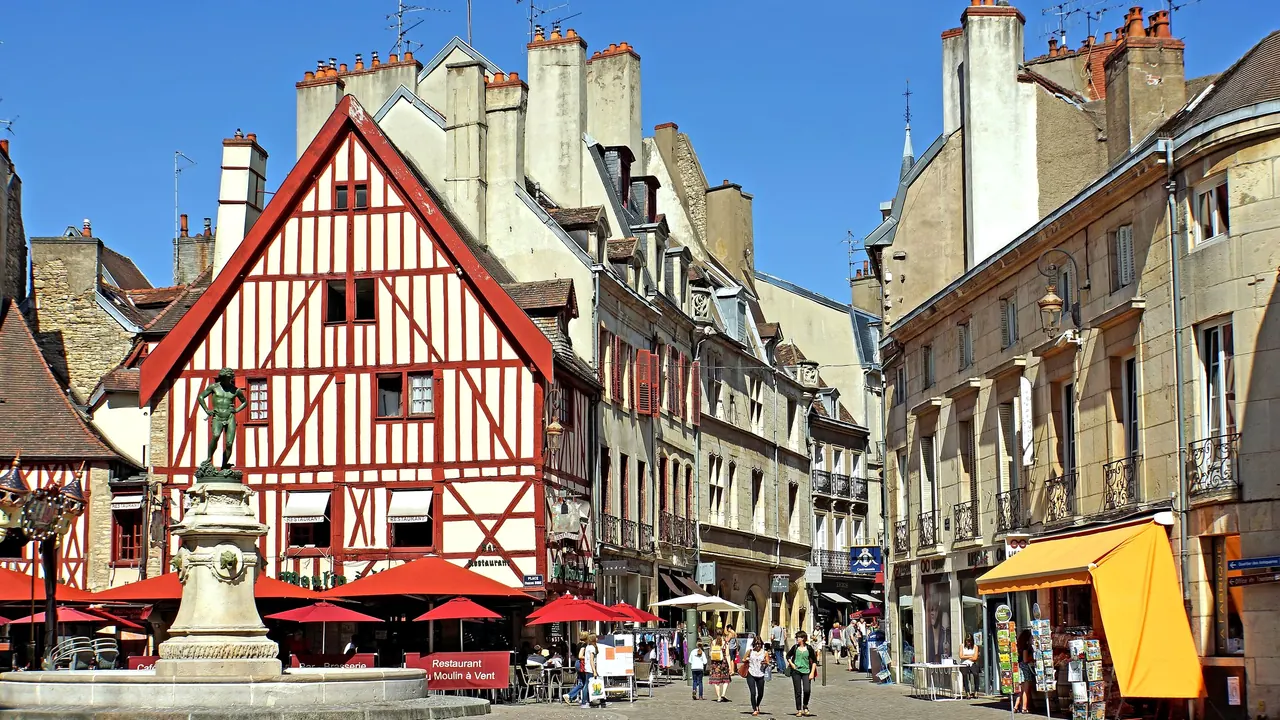
Half-timbered houses on the Rue des Forges
- Day trips78
- Getting around72
- Food & drink68
Photo: Dennis G. Jarvis, CC BY-SA 2.0, cropped
Match
48
Every category weighted equally
- Beach & sun43
- Culture & arts56
- Food & nightlife51
- Family trip49
- Outdoors52
- Relax & unwind45
- Shopping & style51
- On a budget49
Dijon in twelve categories
Our verdict on each, scored 0 to 100 against the same fixed benchmark cities, so a score means the same thing on every page.
Beaches & swimming. Scores 10 out of 100.
Food & drink. Scores 68 out of 100.
Culture & sights. Scores 64 out of 100.
Nightlife. Scores 32 out of 100.
Nature & outdoors. Scores 52 out of 100.
Day trips. Scores 78 out of 100.
Good for families. Scores 40 out of 100.
Getting around. Scores 72 out of 100.
Shopping & style. Scores 40 out of 100.
Affordability. Scores 52 out of 100.
Live music & performing arts. Scores 45 out of 100.
Wellness & relaxation. Scores 28 out of 100.
Dijon category by category
Beaches & swimming
10Dijon is deep inland, several hours from any coast, so a beach vacation is out of the question. The nearest thing is Lac Kir, a reservoir on the western edge of town with a lawn-and-sand bathing area that is supervised in summer. It suits local families on a hot afternoon. Otherwise, swimming means a municipal pool or a hotel pool.
Food & drink
68Dijon sits at the head of one of France's great food and wine regions. Burgundian cooking is the classic kind: boeuf bourguignon, coq au vin, jambon persillé, snails in garlic butter and gougères with an aperitif. The city also has its own specialities in mustard, pain d'épices and blackcurrant crème de cassis, the base of the kir. The covered market, Les Halles, is a nineteenth-century iron hall north of the old centre. On market days it is the city's kitchen, with stalls of Bresse poultry, Époisses cheese and charcuterie, and bistros all around it.
The wine country begins at the city's southern edge, so wine bars pour village Burgundies you rarely meet by the glass elsewhere. The Cité Internationale de la Gastronomie et du Vin, in the old hospital, brings together tastings, cookery and regional produce. There is a serious fine-dining tier in and around the city. The range is narrow, though: this is a place for French regional cooking and wine, not for international variety or street food.
Culture & sights
64The heart of Dijon is the Palace of the Dukes of Burgundy, a reminder that the city was once the capital of a powerful medieval state. Today the palace holds the Musée des Beaux-Arts, one of the oldest museums in France. Its great treasure is the carved tombs of the Valois dukes, ringed by sculpted mourners. You can climb the Tour Philippe le Bon for a view over the glazed, patterned roofs.
Around the palace, the old centre is a well-kept web of half-timbered houses and Renaissance hôtels particuliers. Notre-Dame stands out for its rows of gargoyles, and on its outer wall is a small carved owl that visitors touch for luck, which the city has made its emblem. Saint-Bénigne Cathedral has a Romanesque crypt, and the Chartreuse de Champmol has Claus Sluter's Well of Moses. The historic centre is part of a UNESCO listing with the Burgundy vineyards. It is a rewarding two or three days, but no single sight makes it a destination for the world.
Nightlife
32Dijon has a large university, and that keeps its evenings livelier than its size suggests. Rue Berbisey is lined with small bars and pubs, and there are more terraces around Place Émile Zola, the market quarter and Place de la République. A night out here mostly means wine bars, beer and a late dinner. There are a few clubs, but the scene is small, and outside term time and summer weekends the streets empty by around midnight.
Nature & outdoors
52The city sits where the Burgundy plain meets a limestone plateau. Just west of town, wooded valleys called combes cut into it: the Combe à la Serre and the Combe de Lavaux have walking trails, cliffs for rock climbing and views back over the city. Lac Kir is a place for paddling and lakeside walks. The towpath of the Burgundy Canal runs flat and green for long distances, which makes for easy cycling.
The best-known ride is the signed cycle route through the vineyards towards Beaune, past the slopes of the Côte de Nuits. In about an hour and a half you can reach the granite hills and lakes of the Morvan regional park, which has the wildest landscape nearby. It is gentle, pleasant country for walkers and cyclists, without mountains or dramatic scenery.
Day trips
78Day trips are one of the main reasons to base yourself in Dijon. The Route des Grands Crus heads south through Gevrey-Chambertin, Vougeot with its Cistercian château, and Nuits-Saint-Georges to Beaune. Beaune is about twenty minutes away by train and is a walled wine town, home to the Hospices with their glazed tile roof. Further south, the Côte de Beaune villages and Château de Meursault make a full day of tasting.
To the north-west, Fontenay Abbey is a UNESCO-listed Cistercian monastery in a wooded valley, about an hour away. It pairs well with hilltop Flavigny-sur-Ozerain, the medieval ramparts of Semur-en-Auxois and the Gallic battlefield at Alésia. Vézelay's basilica is within reach for a longer day. Besançon, with Vauban's citadel, is about an hour by train. Most of the wine country is easiest by car, bike or a small tour.
Good for families
40Dijon is easy and safe with children. The centre is small and largely pedestrianised, and the pace is relaxed. The Jardin de l'Arquebuse has a natural history museum and planetarium, the Parc de la Colombière has wide lawns and play areas, and Lac Kir is good for paddling on summer days. Beyond that, there is little made for children. The vineyards, tastings and museums of fine art that fill most itineraries will interest parents more than their children.
Getting around
72Dijon's historic centre is compact and mostly pedestrian, so a visitor can walk between the station, the market, the palace and the cathedral in a few minutes. Two tram lines and a bus network serve the outskirts and Lac Kir. Regional trains run along the wine route to Beaune, and the TGV reaches Paris in well under two hours. Inside the city you will not need a car. The wine villages away from the railway are another matter: for those, hire a car or a bike, or book a tour.
Shopping & style
40Shopping in Dijon is mostly about things to eat and drink. Mustard comes in dozens of flavours, along with pain d'épices, crème de cassis and plenty of wine merchants and cellars selling Burgundy. Les Halles and the market streets around it are the best place for cheese and regional produce. The main pedestrian street, Rue de la Liberté, has a department store, French chains and a few boutiques, and the lanes off it hold antiques and small independents. If fashion or luxury shopping is the aim, there is not much to work with.
Affordability
52Prices in Dijon are typical of a French regional city, well below the capital's. Hotel rooms are moderate. The set lunch menus in bistros are a fair-priced way to eat well, and wine by the glass costs less here than in most of France. The centre is small enough to walk, so getting around costs little. What drives up the bill is the reason most people come: serious restaurants, cellar tastings, guided wine tours and good bottles of Burgundy add up quickly. This is a mid-range destination rather than a budget one.
Live music & performing arts
45For a city of its size, Dijon has a solid cultural season. The Opéra de Dijon stages opera, concerts and dance in two venues: the nineteenth-century Grand Théâtre in the old centre, and the larger Auditorium, which is known for its fine acoustics. There is also a national drama centre and a municipal contemporary music venue for touring bands. Performances follow the academic year, and in summer the programme thins out to outdoor events.
Wellness & relaxation
28Dijon has no thermal baths or bathing culture of its own, and spa options are limited to a few hotels in town and in the wine villages, some offering grape-based treatments. What it does have is an unhurried provincial rhythm. Long lunches, quiet squares and slow afternoons in the vineyards make it a restful place to stay, but nobody comes here for spa treatments.
When should you go?
Pick a month to see what it is like. The climate figures are measured averages, not a forecast.
Dijon in July
Daytime high, °C
Rainfall in the month, mm
The whole year
Shaded against this city’s own year: the deepest cell is its best month for that figure and the palest its weakest.
Temperature and rainfall are climate normals, averaged over the years shown. Dijon: 1991-2020 normals, Dijon (7 km from centre).
Before you go
| Measure | Dijon |
|---|---|
| Official language | French |
| Currency | Euro (EUR) |
| Sockets | CE230 V, 50 Hz |
| Driving side | Right |
| Time zone | UTC+1, UTC+2 in summer |
| Emergency number | 112 |
| Elevation | 220 m |
| Main airport | Lyon Saint-Exupéry Airport (LYS)178 km from centre141 non-stop destinations |
| Public holidays this year | 11 days |
By the numbers
| Measure | Dijon |
|---|---|
| City population | 161,830 |
| People per km² | 3,890 |
| Museums within 10 km | 8 |
| UNESCO World Heritage sites within 50 km | 1 |
Compare Dijon with
Every comparison with a written verdict behind it.
- Annecy
- Antibes
- Antwerp
- Avignon
- Baden-Baden
- Bern
- Biarritz
- Bordeaux
- Bruges
- Brussels
- Cannes
- Cologne
- Como
- Dusseldorf
- Frankfurt
- Geneva
- Genoa
- Ghent
- Heidelberg
- Innsbruck
- Interlaken
- Lucerne
- Lyon
- Maastricht
- Marseille
- Milan
- Monaco
- Montpellier
- Munich
- Nice
- Paris
- Portofino
- Saint-Tropez
- Strasbourg
- Stuttgart
- Toulouse
- Turin
- Zurich