Germany
Baden-Baden
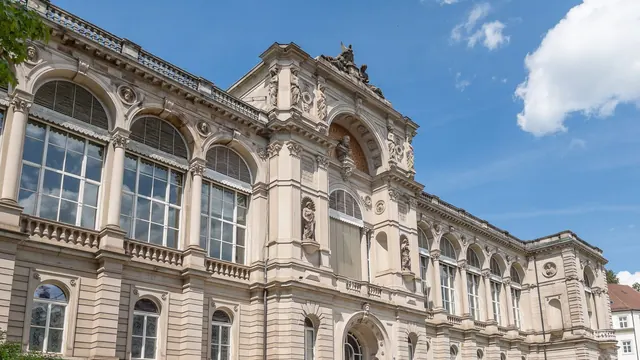
Photo: Kent Wang, CC BY-SA 2.0, cropped
Match
50
- Beach & sun47
- Culture & arts53
- Food & nightlife46
- Family trip50
- Outdoors56
- Relax & unwind55
- Shopping & style49
- On a budget48
Baden-Baden in twelve categories
Our verdict on each, scored 0 to 100 against the same fixed benchmark cities, so a score means the same thing on every page.
Beaches & swimming. Scores 8 out of 100.
8Food & drink. Scores 45 out of 100.
45Culture & sights. Scores 52 out of 100.
52Nightlife. Scores 15 out of 100.
15Nature & outdoors. Scores 70 out of 100.
70Day trips. Scores 78 out of 100.
78Good for families. Scores 50 out of 100.
50Getting around. Scores 62 out of 100.
62Shopping & style. Scores 38 out of 100.
38Affordability. Scores 30 out of 100.
30Live music & performing arts. Scores 58 out of 100.
58Wellness & relaxation. Scores 96 out of 100.
96Baden-Baden category by category
Beaches & swimming8
Baden-Baden is an inland town at the edge of the Black Forest, some way from any coast, and beaches play no part in a stay here. In summer, locals swim in the flooded gravel pits of the Rhine plain to the west and in outdoor pools, which are fine for a hot afternoon but not a reason to come. The town's water culture is about thermal bathing, not swimming outdoors.
Food & drink45
Baden sits in one of Germany's best regions for eating, and the town gets the benefit. Menus lean on regional dishes such as Flammkuchen, venison, Black Forest ham, Maultaschen and the famous cherry gateau, with French influence from just over the Rhine. Wine is the real local strength: the Rebland villages of Varnhalt, Neuweier and Steinbach grow Riesling and Pinot Noir on the slopes just outside town, and their wine taverns are a pleasant evening out.
The town itself is small, so range is limited and much of the centre is smart hotel dining and comfortable cafés serving cake and coffee. Serious food lovers drive into the northern Black Forest, home to some of the most celebrated restaurants in Germany.
Culture & sights52
The town is its own main sight: a nineteenth-century spa resort with its Belle Époque fabric largely intact, recognised as one of the Great Spa Towns of Europe. The Kurhaus with its ornate casino rooms, the colonnaded Trinkhalle, the Lichtentaler Allee park along the Oos stream and the villas on the hillsides give a strong sense of the era when European aristocracy summered here. Roman bath ruins lie beneath the old town.
For art, the Museum Frieder Burda's modern collection and the Staatliche Kunsthalle next door are of good quality, and there is a Fabergé museum and the house where Brahms spent his summers. Above the town sit the Russian church, the Stourdza Chapel and the ruined Old Castle. It is a rewarding day or two of sightseeing, not more.
Nightlife15
Evenings here are quiet and dressed-up rather than lively. The historic casino in the Kurhaus is the town's signature night out, with a smart dress code and gilded rooms, and beyond it there are hotel bars, wine bars and a few pubs in the old town. The crowd is older and the streets are calm by late evening. Anyone wanting clubs or a late scene heads to Karlsruhe or Strasbourg.
Nature & outdoors70
The northern Black Forest starts at the town's edge. The Merkur funicular climbs to a summit with long views over the Rhine plain to the Vosges, and from there and from the Battert cliffs, popular with climbers, waymarked trails run deep into fir forest. The Panoramaweg circles the town through woods and vineyards, and the Rebland wine villages make for gentle walking.
Further in, the Black Forest High Road climbs along the ridge past the dark Mummelsee and up to the moorland of the Hornisgrinde at over 1,100m, with waterfalls, mountain biking and modest skiing in winter. It is wooded upland rather than high mountains, at its best in autumn colour and in the long green summers.
Day trips78
The location is one of the town's great strengths. Strasbourg, with its cathedral and half-timbered Petite France, is about an hour away, and from there the Alsace wine route leads to villages such as Riquewihr and to Colmar. Heidelberg's castle and old town and Freiburg's minster and medieval lanes are each roughly an hour by train.
Closer in, the baroque palaces of Rastatt and Karlsruhe are a short ride, and Speyer's Romanesque cathedral and the Cistercian monastery at Maulbronn, both UNESCO sites, are around an hour by car. Pretty Black Forest towns such as Gengenbach and the Rhine plain's wine villages fill out the list. A car makes the Alsace and Black Forest outings far easier.
Good for families50
Baden-Baden is safe, clean and easy to walk, and the Lichtentaler Allee, the Merkur funicular and forest trails suit children well. But the town is made for adults taking the waters: the historic Friedrichsbad does not admit young children, and the mood is quiet and refined. The big draw for families is Europa-Park, one of Europe's largest theme parks, about an hour south, with Karlsruhe's zoo closer. Families tend to treat the town as a calm base and spend their days elsewhere.
Getting around62
The centre is small and pleasant on foot, with the baths, Kurhaus, museums and Lichtentaler Allee all within a short walk of each other, though some streets climb steeply. The railway station lies in the Oos district a few kilometres out, linked to the centre by frequent buses. Trains reach Karlsruhe, Freiburg and beyond easily, but the Black Forest High Road, the wine villages and Alsace are much simpler with a car.
Shopping & style38
For a town of its size, shopping is surprisingly polished. Sophienstraße and Lange Straße carry jewellers, watchmakers, fashion boutiques and delicatessens aimed at a well-off spa clientele, and browsing them fits the slow pace of a stay. There is little beyond that: no major department stores, no real markets and few crafts beyond Black Forest cuckoo clocks and local wine. Serious shoppers look to Strasbourg.
Affordability30
Baden-Baden is an expensive place to stay. It was built as a resort for the wealthy and still caters to them, with grand hotels setting the tone and the thermal baths charging for every visit. Simple guesthouses, wine taverns and bakeries are reasonably priced by German standards, and buses are cheap, but a stay centred on the spas adds up quickly.
Live music & performing arts58
Classical music is an unusual strength for a town this small. The Festspielhaus, built into the old railway station, is one of Germany's largest opera and concert houses and brings leading international orchestras, soloists and opera productions through its seasons. The town's own philharmonic plays in the Kurhaus, and the jewel-box nineteenth-century theatre stages drama and opera. Brahms, Berlioz and Clara Schumann all worked here, and the musical tradition is part of the town's identity. Jazz, rock and theatre beyond that are thin.
Wellness & relaxation96
Taking the waters is the reason this town exists. Hot springs that the Romans used rise beneath the old town, and two bathhouses define a stay. The Friedrichsbad is a domed nineteenth-century Roman-Irish bath where visitors follow a set sequence of warm and hot rooms, scrubs and pools, unclothed and in silence. Caracalla next door is a modern thermal complex with indoor and outdoor pools and a large sauna area.
Around the baths, the whole town is set to a slow pace: grand hotels with their own spas, unhurried walks along the Lichtentaler Allee, coffee and cake, and an early night. It suits anyone who wants to rest properly rather than sightsee.
When should you go?
Pick a month to see what it is like. The climate figures are measured averages, not a forecast.
| July | Baden-Baden |
|---|---|
| Daytime high | 25 °C |
| Night-time low | 14 °C |
| Rainfall in the month | 117 mm |
| Sunshine | 8 hours a day |
| Daylight | 16 hours a day |
The whole year
Shaded against this city’s own year: the deepest cell is its best month for that figure and the palest its weakest.
Temperature and rainfall are climate normals, averaged over the years shown. Baden-Baden: 1991-2020 normals, Baden-Baden-Geroldsau (3.9 km from centre).
Getting there
| Flying from | Baden-Baden |
|---|---|
| PalmaPMI | 2 h 0 m no fares FKB · 12 km |
| LondonLHR, LGW, STN, LTN +2 | 1 h 30 m no fares FKB · 12 km |
| GironaGRO | 1 h 40 m no fares FKB · 12 km |
| AlicanteALC | 2 h 15 m €136-156 FKB · 12 km |
| MalagaAGP | 2 h 40 m no fares FKB · 12 km |
| PortoOPO | 2 h 30 m €92-133 FKB · 12 km |
| AtlantaATL, PDK | 9 h 30 m no fares STR · 72 km |
| Sao PauloGRU, VCP, CGH, RTE | 12 h 10 m no fares FRA · 143 km |
| FezFEZ | 3 h 0 m no fares FKB · 12 km |
| SingaporeSIN, XSP | 12 h 45 m no fares FRA · 143 km |
The busiest departure cities for Baden-Baden, with a place kept for each other part of the world. Busiest means arriving passengers where an official count exists, and where none does, the number of non-stop services flown: official route statistics are published by the European reporting countries and by nobody else, so a table ranked on them alone would offer a reader in New York or Tokyo ten European cities. Flying times are estimated from the distance between airports, and every row is a city flown non-stop. Where the typical offer connects anyway, the stops are shown. Under each figure is the airport the flight lands at and how far that is from the centre, because the nearest airport is not always the one a route is flown to. Typical return fares for 2026-09 to 2026-10, cached market data up to 7 days old. The figure is the middle half of the offers found, so a single price means they agreed and a range means they did not; for a typical route that middle half spans about a quarter of the median, and for the least settled routes rather more than the median itself.
Before you go
| Measure | Baden-Baden |
|---|---|
| Official language | German |
| Currency | Euro (EUR) |
| Sockets | CF230 V, 50 Hz |
| Driving side | Right |
| Time zone | UTC+1, UTC+2 in summer |
| Emergency number | 112 |
| Elevation | 181 m |
| Main airport | Karlsruhe Baden-Baden Airport (FKB)12 km from centre43 non-stop destinations |
| Public holidays this year | 12 days |
By the numbers
| Measure | Baden-Baden |
|---|---|
| City population | 56,952 |
| People per km² | 406 |
| Museums within 10 km | 11 |
| UNESCO World Heritage sites within 50 km | 2 |
Compare Baden-Baden with
Every comparison with a written verdict behind it.