Australia
Canberra
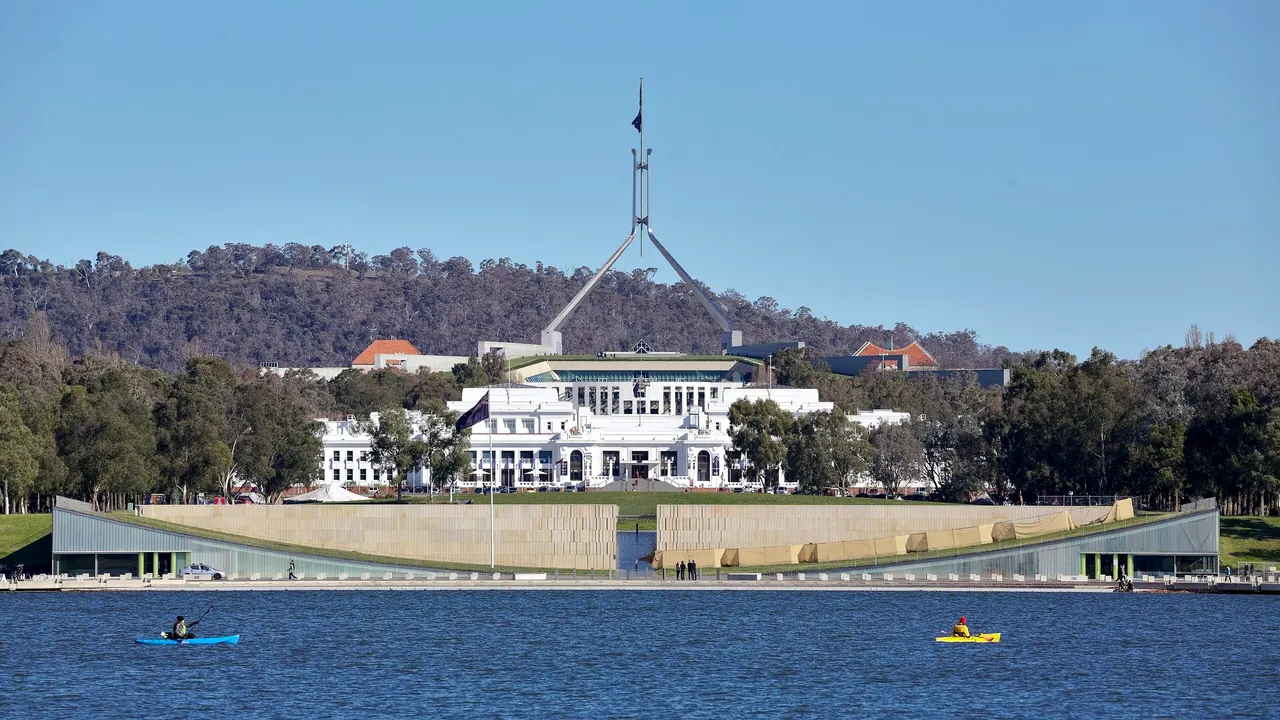
Old and new Parliament House across Lake Burley Griffin
- Families68
- Nature & outdoors66
- Culture & sights56
Photo: Thennicke, CC BY-SA 4.0, cropped
Match
40
Every category weighted equally
- Beach & sun37
- Culture & arts41
- Food & nightlife36
- Family trip44
- Outdoors44
- Relax & unwind39
- Shopping & style39
- On a budget40
Canberra in twelve categories
Our verdict on each, scored 0 to 100 against the same fixed benchmark cities, so a score means the same thing on every page.
Beaches & swimming. Scores 12 out of 100.
Food & drink. Scores 44 out of 100.
Culture & sights. Scores 56 out of 100.
Nightlife. Scores 27 out of 100.
Nature & outdoors. Scores 66 out of 100.
Day trips. Scores 42 out of 100.
Good for families. Scores 68 out of 100.
Getting around. Scores 38 out of 100.
Shopping & style. Scores 30 out of 100.
Affordability. Scores 38 out of 100.
Live music & performing arts. Scores 34 out of 100.
Wellness & relaxation. Scores 30 out of 100.
Canberra category by category
Beaches & swimming
12Canberra is an inland city, and the sea is about two hours' drive away over the Clyde Mountain at Batemans Bay. That is a weekend away, not part of a stay. Close to the city, summer swimming means the Murrumbidgee and Cotter rivers. Casuarina Sands, Kambah Pool and Pine Island have sandy or rocky banks where locals cool off on hot days, though there are no lifeguards and currents and river levels change. A few bays on Lake Burley Griffin are used for swimming, but blue-green algae often closes the lake after warm spells. Anyone who wants beach time should plan for the coast as a separate trip.
Food & drink
44Eating in Canberra is good but small in scale. The best of it is in a few inner districts. Braddon has casual modern Australian places, bakeries and brunch cafés. Kingston and Manuka have older, quieter restaurant strips, and Dickson's Woolley Street is lined with Chinese, Vietnamese and other Asian kitchens that feed the public-service lunch crowd. Coffee is taken seriously, as everywhere in Australia, and weekend brunch is the city's real food ritual.
The distinctive element is wine. The Canberra District vineyards around Murrumbateman and Lake George are known for cool-climate shiraz-viognier and riesling, and many cellar doors are under forty minutes from the centre. The Capital Region Farmers Market brings in produce from the surrounding tablelands. There is no local cuisine to speak of, and the fine-dining tier is short.
Culture & sights
56Canberra exists to hold the nation's institutions, and that is what a visitor comes to see. Around the lake, the Parliamentary Triangle groups Parliament House, with its grass-covered roof and public galleries, along with Old Parliament House, the National Gallery with its large Aboriginal and Torres Strait Islander collection, the National Portrait Gallery and the National Library. The Australian War Memorial at the end of Anzac Parade is the most moving and most visited of them, and the National Museum sits on its own peninsula.
The city is also a sight in itself. Walter Burley Griffin's geometric plan of axes and a central lake still shapes the views from Mount Ainslie, and the embassy district in Yarralumla is an odd catalogue of national architectural styles. There is almost no old streetscape, so the interest lies in the museums and the design rather than in wandering.
Nightlife
27Canberra is a public-service and university town, and going out reflects that. Braddon's Lonsdale Street and the laneways of Civic hold most of the cocktail bars, small breweries and pubs, and a few late venues near the bus interchange fill up with students on Friday and Saturday. Kingston has a quieter bar strip. Midweek the city goes to bed early, and outside term and parliamentary sitting weeks it can feel very still. It suits a relaxed drink after dinner, not a big night out.
Nature & outdoors
66Canberra calls itself the bush capital, and it earns the name. Hills of open eucalypt woodland, such as Mount Ainslie, Black Mountain and Red Hill, rise between the suburbs and are laced with walking and mountain-bike trails. Kangaroos graze on the reserves and playing fields at dusk. Lake Burley Griffin has a long flat circuit for cycling and running, plus rowing, kayaking and sailing.
Southwest of the city, about forty minutes away, the Brindabella Ranges and Namadgi National Park rise to granite summits above 1,800m. They have long hikes, Aboriginal rock-art sites and snow on the tops in winter. Tidbinbilla Nature Reserve is closer, with koalas, platypus and emus in a valley setting. Summers are hot and dry, winters frosty and clear, and spring and autumn are best for walking. There is no coast, and the ski slopes of the Snowy Mountains lie beyond a day trip.
Day trips
42The countryside around Canberra holds small towns rather than major sights. Murrumbateman and the Yass Valley make an easy wine day, with cellar doors spread along country roads. Bungendore, about half an hour away, has galleries and old shopfronts. Braidwood, a heritage-listed gold-rush town about an hour out, is the most rewarding of the small towns. Goulburn has grand Victorian buildings and cathedrals, and the Southern Highlands villages around Bowral and Berrima are reachable in about an hour and a half.
At the edge of the range, the coastal towns around Batemans Bay are about two hours away. These are pleasant outings for anyone with a car, but there is no single destination that would make a visitor plan a trip around it.
Good for families
68Canberra is an easy and relaxed city for children. Questacon, the national science centre, is the highlight, with floors of hands-on exhibits that can fill most of a day. The National Zoo and Aquarium lets children get close to big cats, and Tidbinbilla offers short walks with a good chance of seeing kangaroos, emus and koalas. The National Museum and the War Memorial both have dedicated children's galleries. The National Arboretum has one of the city's best playgrounds, with sweeping views.
Streets are quiet and safe, parks and lakeside paths are everywhere, and nothing is crowded. What it lacks is a theme park or a beach, and the distances mean a car makes days with small children much simpler.
Getting around
38Canberra was planned around the car, and it shows. The national institutions are set apart on wide landscaped avenues around the lake. Civic, Braddon and the Parliamentary Triangle are each walkable, but walking between them takes a long time in summer heat or winter wind. A light rail line runs from the northern suburbs into Civic, and buses cover the rest of the city on a single tap-on card, though services thin out in the evenings and at weekends.
Cycling is the pleasant alternative. A network of off-road paths circles the lake and links the suburbs, and the terrain is mostly gentle. Traffic is light and parking is easy, so for reaching Tidbinbilla, Namadgi or the wineries a car is effectively needed.
Shopping & style
30Shopping in Canberra is practical rather than a reason to come. The large Canberra Centre mall in Civic covers the mainstream Australian and international chains. Braddon and the arcades around it hold a few independent fashion and design shops. The most enjoyable stop is the Old Bus Depot Markets in Kingston on Sunday mornings, where local makers sell crafts, food and jewellery. The national museum and gallery shops are good for Australian design and Aboriginal art prints. There is no luxury street to speak of.
Affordability
38Canberra has Australian prices, which means eating out, drinks and taxis cost a good deal by most international standards. Two things soften this. Hotel rooms often fall in price at weekends, when the political and business travellers go home. And almost all the main sights are free, including Parliament House, the War Memorial, the National Gallery's collection, the Portrait Gallery and the National Museum. Questacon and the zoo charge entry, and hiring a car adds to the cost of a stay.
Live music & performing arts
34Canberra has a small but steady performing-arts life. The Canberra Theatre Centre in Civic hosts touring plays, dance and musicals. The Canberra Symphony Orchestra plays a concert season, some of it in Llewellyn Hall at the ANU School of Music. Smaller stages put on local and independent theatre.
The highlight of the year is the National Folk Festival at Easter, when traditional music and dance fill the city for several days. Outside that, live music happens in a handful of pubs and bars. Many major national and international tours leave the capital off their route, so a visitor here takes what is on rather than planning a trip around a particular show.
Wellness & relaxation
30Canberra has no bathing tradition, and spa options are limited to a few day spas and hotel wellness centres. Its real restorative quality is its pace. The city is quiet, uncrowded and green, mornings by the lake are calm, and evenings are early. That suits someone who wants a gentle, unhurried break, but there is nothing here to build a wellness trip around.
When should you go?
Pick a month to see what it is like. The climate figures are measured averages, not a forecast.
Canberra in July
Daytime high, °C
Rainfall in the month, mm
The whole year
Shaded against this city’s own year: the deepest cell is its best month for that figure and the palest its weakest.
Temperature and rainfall are climate normals, averaged over the years shown. Canberra: 1991-2020 normals, Canberra (6.7 km from centre).
Before you go
| Measure | Canberra |
|---|---|
| Official language | English |
| Currency | Australian Dollar (AUD) |
| Sockets | I230 V, 50 Hz |
| Driving side | Left |
| Time zone | UTC+10, UTC+11 in summer |
| Emergency number | 000 |
| Elevation | 578 m |
| Main airport | Canberra Airport (CBR)6 km from centre11 non-stop destinations |
| Public holidays this year | 13 days |
By the numbers
| Measure | Canberra |
|---|---|
| City population | 381,488 |
| People per km² | 809 |
| Museums within 10 km | 20 |
| UNESCO World Heritage sites within 50 km | 0 |
Compare Canberra with
Every comparison with a written verdict behind it.