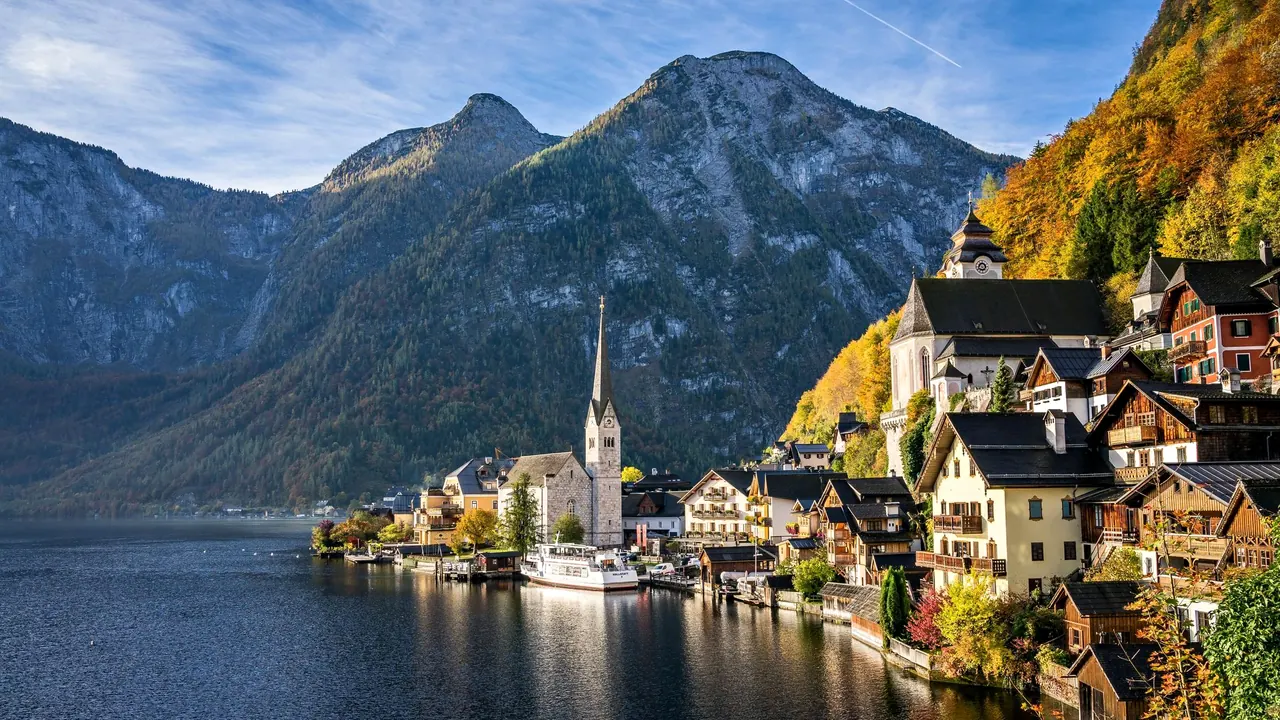
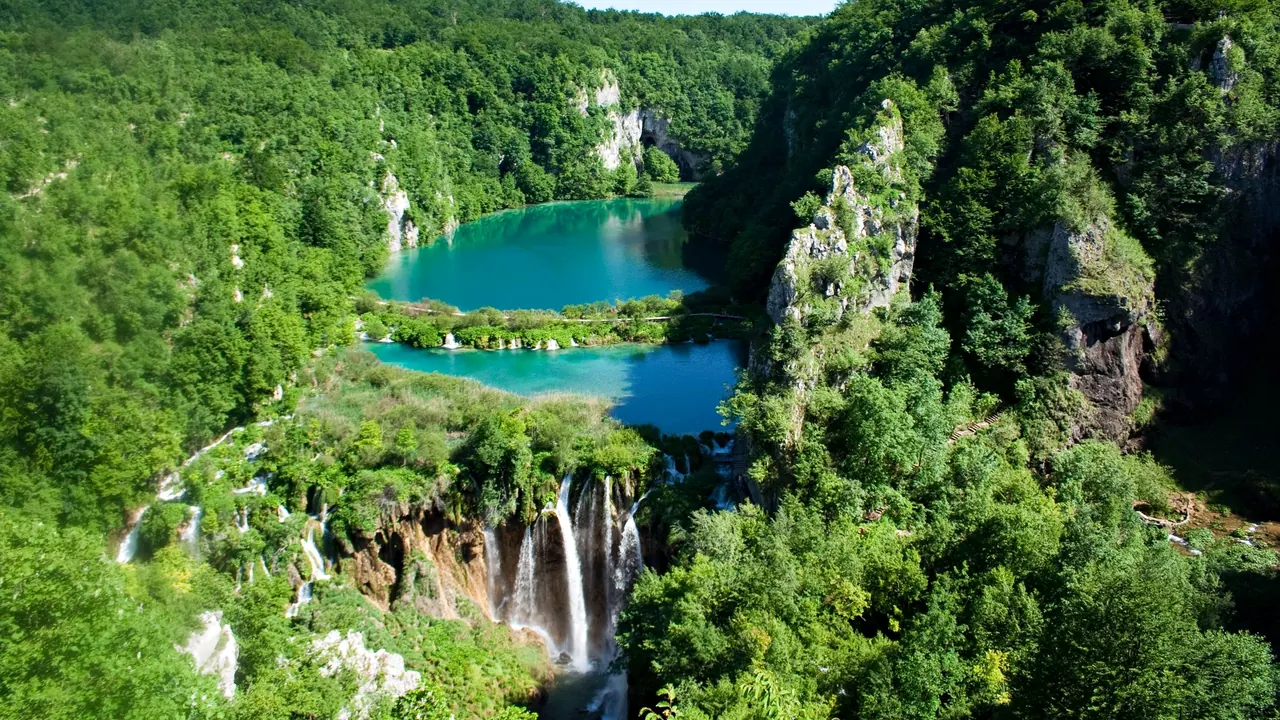
Photos: Austrian Alps by Leonhard Niederwimmer, Pexels License; Plitvice Lakes by Pablo BM from London, England, CC BY 2.0, cropped.
Austrian Alps or Plitvice Lakes?
Our verdict in twelve categories, each scored against the same fixed benchmark cities, and the climate month by month, so you can choose for your trip.
Choose Austrian Alps for
- live music and the arts
- nightlife
- culture and sights
The Austrian Alps suit a longer trip where you want several things at once: mountains to hike or ski, a lake to swim in, a baroque city to walk around, and a thermal bath or a sauna at the end of the day. Families, music lovers planning around Salzburg's summer, and skiers chasing big linked areas all get more from it. The cost is the price of a vacation in one of Europe's most developed mountain regions, and a lot of moving between valleys and towns.
Choose Plitvice Lakes for
- prices
Plitvice Lakes is one extraordinary landscape and not much else. Its terraced lakes and waterfalls are worth a detour, and a night or two in a village guesthouse costs less than the Alps and gives you the boardwalks early, before the crowds. Most people will want it as a stop between Zagreb and the Adriatic rather than the whole trip, since there is little culture, no swimming in the park and nothing to do in the evenings.
Scoreboard
Twelve categories on one fixed scale from 0 to 100. The shaded stretch is the gap between the two.
Your match
Pick a travel style or drag the sliders, and both match scores follow your weighting.
Wins on live music and the arts and nightlife with your weighting.
Wins on prices with your weighting.
What matters to you?
Category by category
What the scores mean for a trip.
Beaches & swimming
Neither place has the sea, but only the Austrian Alps let you build a vacation around swimming. Carinthia's Wörthersee and Millstätter See warm up nicely in midsummer, and towns like Velden have proper lidos with lawns, piers and diving boards.
At Plitvice the lakes are off limits for swimming. Your options are the cool, clear Korana river near Slunj or a two-hour drive to the Adriatic.
Food & drink
The Austrian Alps give you more choice: Salzburg's cafés and cakes, Innsbruck's everyday restaurants, and serious Alpine fine dining in the Arlberg and Kitzbühel, on top of hut classics like Kaiserschmarrn and Käsespätzle.
Plitvice has spit-roast lamb, river trout and dishes slow-cooked under the iron bell in roadside inns. It is good once, but there are no cafés, markets or fine dining to vary it.
Culture & sights
The Austrian Alps have far more to see. Salzburg alone could fill several days with its baroque old town, cathedral, Residenz and the Hohensalzburg fortress above it, and Innsbruck adds the Golden Roof and the bronze Habsburg figures of the Hofkirche. Beyond the two cities are Hallstatt's salt-mining heritage, the abbey library at Admont and the spa architecture of Bad Ischl, though seeing them means moving from town to town.
Plitvice is World Heritage for its nature, not its buildings. Rastoke's water mills, the ruined walls of Drežnik above the Korana canyon and the memorials to the first deaths of the 1991 war are worth seeing, but together they make one afternoon's outing.
Nightlife
In winter, the Austrian Alps have some of the loudest après-ski in Europe, in Ischgl, St Anton and Saalbach, and Innsbruck's students keep a few bars busy all year. Out of season, the resorts go quiet early.
At Plitvice, evenings end with dinner and a glass of brandy, and the villages are silent soon after dark.
Nature & outdoors
Both are outstanding, but the Austrian Alps offer more variety and enough for a much longer stay: the glaciers and peaks of the Hohe Tauern, the valleys of Tyrol, huge ski areas in winter, and staffed huts, via ferratas and lakes for paddling in summer.
Plitvice is one concentrated spectacle, with sixteen turquoise lakes falling through beech and fir forest, crossed on boardwalks. The Korana rafting, the Barać caves and the Velebit ridges add a few days, but in summer the main circuits are crowded by mid-morning.
Day trips
In the Austrian Alps the outings depend on your base. From Salzburg you can reach Hallstatt, St Wolfgang and Bad Ischl in the Salzkammergut, the Königssee over the German border, and Munich in about an hour and a half by train. From Innsbruck it is Hall in Tirol, Rattenberg and Kitzbühel close by, with Füssen's royal castles and Bolzano and Merano about two hours away over the passes.
Plitvice has a few good short trips: Rastoke half an hour north, Bihać and the Una falls in Bosnia within an hour, and Tesla's birthplace at Smiljan for half a day. Anything bigger, such as Zadar's Roman forum or Zagreb, means about two hours each way, so a long day.
Good for families
The Austrian Alps are much better set up for children, with nursery slopes, ski schools and childcare, hotels built around kids' clubs and pools, and summer toboggan runs and adventure trails at the top of the lifts.
Plitvice delights children for a day, with the boats, the little train and fish in the clear water. But the narrow, wet boardwalks without railings are hard work with toddlers, and swimming is not allowed.
Getting around
You can manage the Austrian Alps without a car if you stay in one valley. Trains run along the Inn valley, to Gastein and over the Arlberg, Postbus lines climb into the side valleys, and guest cards often cover local buses. Getting between valleys is slower, and a car helps if you want to combine lakes, towns and passes.
At Plitvice the park is easy on foot, with electric boats and panoramic trains, and intercity buses between Zagreb and the Dalmatian coast stop at the entrances. Beyond that there is little local transport, so you need a car to reach the outlying villages, Rastoke and anywhere else nearby.
Shopping & style
Neither is a shopping destination, but the Alps at least have Salzburg's Getreidegasse and Innsbruck's old town for dirndls, loden coats and felt hats, plus crystal from Wattens and Christmas markets in December.
At Plitvice, the best things to take home are the farmers' cheese, honey and brandy sold at roadside stalls.
Affordability
In the Austrian Alps the high prices come from the famous addresses: the Arlberg and Kitzbühel are among the dearest in the Alps, and Salzburg's hotels charge most during the festival. Half-board keeps meal costs predictable, and guest cards that include buses and sometimes lifts take away some of the extras.
Overall Plitvice costs less, but where you stay makes a big difference. The few hotels by the gates charge for their location, and with little competition the meals near the park are priced for passing visitors. Staying a few villages further out costs noticeably less.
Live music & performing arts
Here only one of the two has anything to offer. In summer the Austrian Alps host the Salzburg Festival and opera on Bregenz's floating stage, with Mozart Week, the Schubertiade and Erl spread across the rest of the year.
At Plitvice, the most you will hear is Lika folk music at a village festival. For concerts or theatre you would have to go to Zagreb or Zadar.
Wellness & relaxation
The Austrian Alps have a real bathing tradition, with the radon springs and healing gallery at Bad Gastein, the Aqua Dome's outdoor pools beneath the Ötztal peaks, and long-standing sauna worlds in hotels across the valleys.
Plitvice has no spa culture beyond a few hotel saunas. What you get instead is quiet, in a farmhouse among the fir forests once the coach groups have left.
When should you go?
Pick your month. The climate figures are measured averages, not a forecast.
Austrian Alps in July
Plitvice Lakes in July
Daytime high, °C
Rainfall in the month, mm
Where the figures come from
Plitvice Lakes has no weather station within reach, so its figures come from a gridded climate model rather than a measured record, and read a broad area rather than one spot.
Temperature and rainfall are climate normals, averaged over the years shown. Austrian Alps: 1991-2020 normals, Innsbruck-Flughafen (4.1 km from centre). Plitvice Lakes: 2001-2020 normals, NASA POWER reanalysis grid, no weather station within 90 km.
Both have a similar warm season, with summer highs of about 26°C in the Austrian Alps and 27°C at Plitvice, but the rain falls at opposite times of year. In the Alps, summer is both the wettest and the sunniest season, with afternoon storms building up to about 144mm in August, and July and August are when the Carinthian lakes are warm enough to swim. Winter, from December to April, belongs to skiing, and May, June and September are the most comfortable months for walking.
Plitvice is driest in high summer, at around 69mm in July, which is good weather for the boardwalks though the park is at its busiest then. Autumn is the wettest stretch, at about 140mm in September and November, but the forests turn red and gold. Spring brings the fullest waterfalls. Winters at both are cold, with highs of a few degrees, and at Plitvice that means frozen falls and quiet trails rather than ski runs.
Which traveller are you?
On a culture and arts trip, the Austrian Alps win easily. Salzburg's baroque old town, Innsbruck's Habsburg monuments, Hallstatt and the summer festivals at Salzburg and Bregenz give you weeks of sights and music, while Plitvice's built heritage fills an afternoon at most.
For a trip on a tight budget, Plitvice Lakes is the better choice. Village guesthouses and country inns are reasonably priced, especially in spring and autumn when the park fee drops, whereas lift passes and the well-known Alpine resorts quickly push up the cost of a stay.
For skiers, only the Austrian Alps will do. The Arlberg, Kitzbühel and Ski Amadé areas have some of Europe's most extensive pistes from December to April, plus loud après-ski, while Plitvice in winter offers frozen waterfalls and snowy walks but no slopes.
Before you go
| Measure | Austrian Alps | Plitvice Lakes |
|---|---|---|
| Official language | German, Austrian Sign Language | Croatian |
| Currency | Euro (EUR) | Euro (EUR) |
| Sockets | CF230 V, 50 Hz | CF230 V, 50 Hz |
| Driving side | Right | Right |
| Time zone | UTC+1, UTC+2 in summer | UTC+1, UTC+2 in summer |
| Emergency number | 112 | 112 |
| Main airport | Innsbruck Airport (INN)40 non-stop destinations | Zagreb Franjo Tuđman International Airport (ZAG)66 non-stop destinations |
| Public holidays this year | 16 days | 14 days |
Where else could you go?
Every comparison below shares a destination with this one, so you can follow Austrian Alps or Plitvice Lakes somewhere new.
- Bavariavs Austrian Alps
- Dolomitesvs Austrian Alps
- Krkavs Plitvice Lakes
- Bračvs Plitvice Lakes
- Hvarvs Plitvice Lakes
- Lake Gardavs Austrian Alps