Austria
Hallstatt
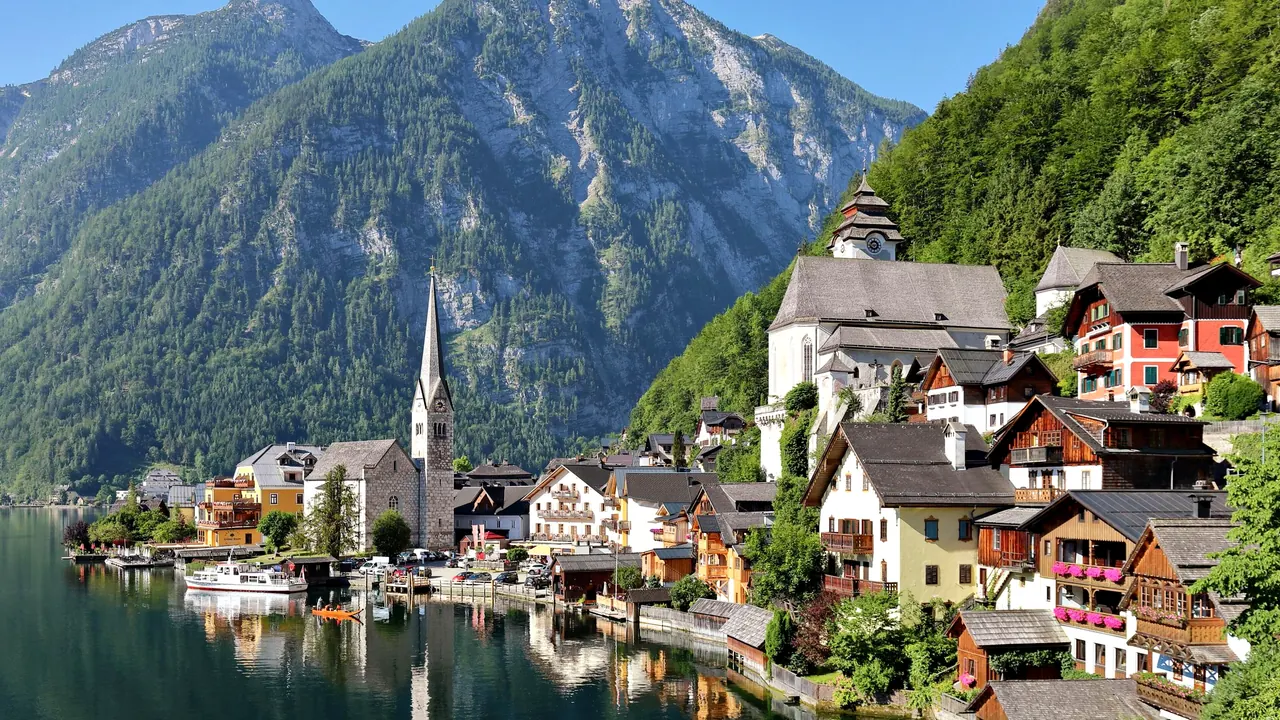
Hallstatt's church, coloured houses and the lake
- Nature & outdoors90
- Day trips63
- Getting around58
Photo: C.Stadler/Bwag, CC BY-SA 4.0, cropped
Match
36
Every category weighted equally
- Beach & sun37
- Culture & arts34
- Food & nightlife27
- Family trip43
- Outdoors48
- Relax & unwind40
- Shopping & style31
- On a budget35
Hallstatt in twelve categories
Our verdict on each, scored 0 to 100 against the same fixed benchmark cities, so a score means the same thing on every page.
Beaches & swimming. Scores 28 out of 100.
Food & drink. Scores 20 out of 100.
Culture & sights. Scores 35 out of 100.
Nightlife. Scores 3 out of 100.
Nature & outdoors. Scores 90 out of 100.
Day trips. Scores 63 out of 100.
Good for families. Scores 45 out of 100.
Getting around. Scores 58 out of 100.
Shopping & style. Scores 15 out of 100.
Affordability. Scores 25 out of 100.
Live music & performing arts. Scores 8 out of 100.
Wellness & relaxation. Scores 45 out of 100.
Hallstatt category by category
Beaches & swimming
28Swimming here means an Alpine lake. Hallstätter See is deep, clear and dark green, and fed by mountain water, so it warms slowly and reaches around 20°C at best in July and August. There is a small lawn-and-jetty bathing area at the northern end of the village and a larger lakeside lido at Obertraun on the southern shore, both good for a cold, bracing swim after a hike.
The season is short and unreliable, and steep shores leave little room to spread out. Visitors who want long days of lake bathing usually drive to the warmer, gentler Salzkammergut lakes further north, such as the Wolfgangsee. Here a swim is a pleasant extra, not the reason to stay.
Food & drink
20Hallstatt is a village, and eating here is simple. A handful of guesthouse dining rooms and lakeside terraces serve Austrian standards like schnitzel, goulash and dumplings. The one real local note is fish from the lake, char and whitefish, often smoked or pan-fried, with a view over the water that does much of the work.
There is no market, no café culture to speak of and little range beyond traditional cooking, and kitchens can close early once the day visitors leave. Eat lake fish once, have coffee and cake in the square, and look to Bad Ischl, with its historic imperial-era patisseries, if you want more.
Culture & sights
35The village itself is the main sight: painted wooden houses stacked on a narrow ledge between the lake and a cliff, two church spires and a small square, the core of the Hallstatt-Dachstein Salzkammergut UNESCO landscape. People have mined salt in the mountain above for some seven thousand years, and the Iron Age finds from the burial ground here gave their name to the Hallstatt culture of early Europe.
You can see this history in the salt mine, reached by funicular and set up for visitors, and in the small Museum Hallstatt, which tells the prehistoric story well. The Beinhaus, the charnel house beside the Catholic parish church, holds hundreds of painted skulls and is unlike anything else in the region. It is a rich half day or a full day, but not a long sightseeing stay.
Nightlife
3There is effectively no nightlife. Once the day visitors leave in the late afternoon, the village goes quiet, and an evening out means a long dinner, a glass of wine on a terrace by the water and a walk along the lake in the dark. That calm is a big part of the appeal of staying overnight, but anyone wanting bars or a late night should look elsewhere.
Nature & outdoors
90This is where Hallstatt is strongest. The lake sits in a steep glacial trough beneath the Dachstein massif, and serious mountain country starts at the edge of the village. From Obertraun a cable car climbs the Krippenstein to the Five Fingers viewing platform over a sheer drop, the high karst plateau and the entrances to the Dachstein Giant Ice Cave and the Mammoth Cave. Paths lead up the Echerntal valley past waterfalls towards the glacier, and the walk to the Gosausee, with the Dachstein reflected in it, is one of the classic views of the Alps.
In summer there is hut-to-hut hiking, via ferratas, cycling around the lake and paddling or rowing on the still water. Winter brings freeride and ski touring on the Krippenstein, with pistes at Dachstein West near Gosau. The weather is Alpine and often wet, and mist can sit on the lake for days, but on a clear morning there are few prettier places anywhere.
Day trips
63Hallstatt sits in the middle of the Salzkammergut, a region of lake towns that make easy outings. Bad Ischl, about half an hour away, was the summer residence of the Habsburgs: you can visit the Kaiservilla and its park and the old spa streets. Further on are St Wolfgang with its pilgrimage church and famous altarpiece, St Gilgen on the Wolfgangsee, Gmunden on the Traunsee with its lake castle and ceramics, and Bad Aussee and Altaussee on the Styrian side.
Salzburg, with its old town, fortress and Mozart sites, is about an hour and a half away by car, slower by public transport, and makes a full but rewarding day. Without a car, the trips are possible by bus and the lakeside railway, but they take planning.
Good for families
45Hallstatt has a few real hits with children. The salt mine tour, with its funicular, wooden miners' slides and underground lake, is made for curious kids. The cable car up the Krippenstein and the giant ice caves are memorable for older children who can manage the cold and the many steps, and boats, rowing and the lakeside lawns fill a summer afternoon.
Beyond that, little here is made for children. The village is a single narrow lane on a steep slope, often packed with tour groups in the middle of the day and awkward with a pushchair. Families tend to do better staying in Obertraun or another lakeside village, which have more space, and visiting Hallstatt for a few hours.
Getting around
58The village is so small that everything in it is a few minutes' walk, and the centre is largely closed to traffic, with parking at the edges. The walking is steep and narrow in places, with steps up to the church and the houses above.
Getting in and out is less simple. The railway station is on the opposite shore, and a small boat crosses the lake to the village. Regional buses run to Obertraun for the Dachstein cable car, to Gosau and to Bad Ischl, but services are limited, especially outside summer. Many visitors find a car worth having for the wider Salzkammergut.
Shopping & style
15Shopping is a short stroll past souvenir shops along the main lane. The one distinctive buy is salt from the local mine, sold in bags, grinders and bath mixes, alongside carved wood, dirndl accessories, schnapps and painted ornaments. It makes a pleasant half hour, and nobody comes here to shop.
Affordability
25Hallstatt is an expensive place to stay. The village has only a small number of rooms and draws visitors from all over the world, so lakeside guesthouses and hotels charge well above the Austrian average and fill early in summer. Meals are at Alpine tourist-resort level, and the main attractions, the salt mine, the funicular and the Dachstein cable car, all add up.
Visitors on a budget usually stay in Obertraun, Bad Goisern or Bad Ischl, where rooms are easier to find and cheaper, and come into Hallstatt for the day.
Live music & performing arts
8There is almost no performing arts scene. The village brass band plays at local feast days, the churches host the odd summer concert, and folk music turns up at traditional celebrations, but there is no theatre or concert hall and no regular programme to plan an evening around. For opera and classical music, Salzburg's season is the nearest real option, and Bad Ischl has a long-running operetta tradition in summer.
Wellness & relaxation
45Hallstatt has no spa culture of its own beyond a few hotel saunas, but it sits in a historic spa region. Bad Ischl, about half an hour away, has drawn people to its salt-brine baths since the nineteenth century and has a large thermal complex. Bad Aussee and Bad Goisern add their own brine and spa traditions nearby.
The village's restorative side is its stillness at the edges of the day: early mornings with mist on the lake, and evenings after the tour groups have gone, when there is nothing to do but sit by the water. Around midday the lane is crowded and anything but calm, so a slow stay depends on spending the busy hours on the lake or in the hills.
When should you go?
Pick a month to see what it is like. The climate figures are measured averages, not a forecast.
Hallstatt in July
Daytime high, °C
Rainfall in the month, mm
The whole year
Shaded against this city’s own year: the deepest cell is its best month for that figure and the palest its weakest.
Where the figures come from
Hallstatt's temperatures are measured 56 km from the centre, at Salzburg.
Hallstatt has no rain gauge within 25 km of the centre, so its rainfall comes from a gridded climate dataset read at the city rather than from a gauge further away.
Temperature and rainfall are climate normals, averaged over the years shown. Hallstatt: 1991-2020 normals, Salzburg (55.5 km from centre).
Before you go
| Measure | Hallstatt |
|---|---|
| Official language | German, Austrian Sign Language |
| Currency | Euro (EUR) |
| Sockets | CF230 V, 50 Hz |
| Driving side | Right |
| Time zone | UTC+1, UTC+2 in summer |
| Emergency number | 112 |
| Elevation | 511 m |
| Main airport | Salzburg Airport (SZG)55 km from centre64 non-stop destinations |
| Public holidays this year | 16 days |
By the numbers
| Measure | Hallstatt |
|---|---|
| City population | 741 |
| People per km² | 12 |
| Museums within 10 km | 3 |
| UNESCO World Heritage sites within 50 km | 2 |
Compare Hallstatt with
Every comparison with a written verdict behind it.
- Baden-Baden
- Basel
- Bern
- Bled
- Bologna
- Bratislava
- Budapest
- Colmar
- Como
- Cortina d'Ampezzo
- Dresden
- Florence
- Frankfurt
- Graz
- Heidelberg
- Innsbruck
- Interlaken
- La Spezia
- Leipzig
- Ljubljana
- Lucca
- Lucerne
- Milan
- Munich
- Nuremberg
- Pisa
- Portofino
- Prague
- Rovinj
- Salzburg
- Split
- Strasbourg
- Stuttgart
- Trieste
- Venice
- Verona
- Vienna
- Zadar
- Zagreb
- Zurich