Dhaka
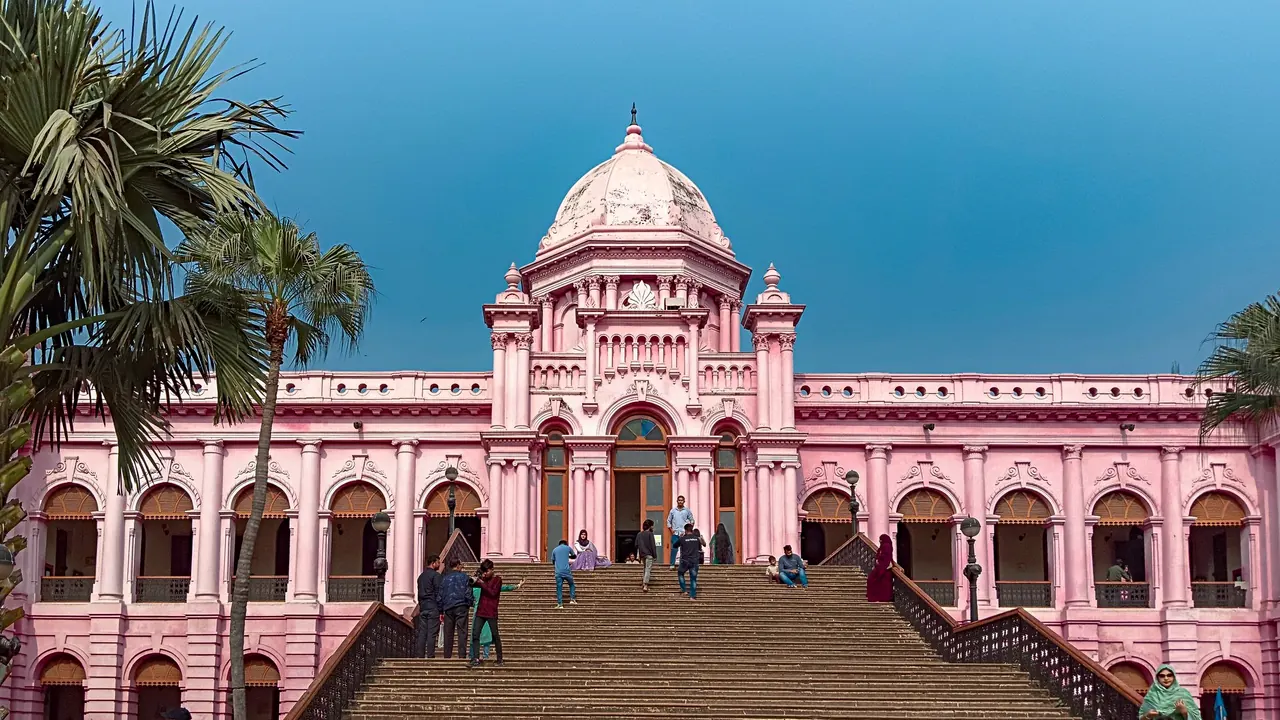
The pink Ahsan Manzil palace in Old Dhaka under a clear blue sky
- Affordability90
- Food & drink62
- Culture & sights55
Photo: Riyad Hossain Hridoy, Pexels License
Match
33
Every category weighted equally
- Beach & sun31
- Culture & arts37
- Food & nightlife36
- Family trip33
- Outdoors32
- Relax & unwind30
- Shopping & style36
- On a budget39
Dhaka in twelve categories
Our verdict on each, scored 0 to 100 against the same fixed benchmark cities, so a score means the same thing on every page.
Beaches & swimming. Scores 5 out of 100.
Food & drink. Scores 62 out of 100.
Culture & sights. Scores 55 out of 100.
Nightlife. Scores 10 out of 100.
Nature & outdoors. Scores 18 out of 100.
Day trips. Scores 30 out of 100.
Good for families. Scores 15 out of 100.
Getting around. Scores 20 out of 100.
Shopping & style. Scores 45 out of 100.
Affordability. Scores 90 out of 100.
Live music & performing arts. Scores 28 out of 100.
Wellness & relaxation. Scores 12 out of 100.
Dhaka category by category
Beaches & swimming
5Dhaka is an inland city on the rivers of the Ganges delta, and it has no beaches. The rivers around it are working waterways and you can't swim in them. The country's long sandy coast at Cox's Bazar is a separate trip, a flight or most of a day by road, so if you want sea and sand, plan it as its own leg of the journey. In the city itself, swimming means a hotel pool.
Food & drink
62Dhaka eats seriously, and the heart of it is Old Dhaka. Its Mughal-descended cooking is famous across Bengal: rich kacchi biryani slow-cooked with mutton and potatoes, tehari, bakarkhani flatbreads, and kebabs grilled on the lanes around Chawkbazar and Nazira Bazar. Bengali home cooking runs on river fish, with hilsa in mustard as the national favourite, alongside bhorta mashes, dal and rice. On the street there are fuchka and chotpoti stalls, and cha (sweet milky tea) is poured at every corner. Sweet shops sell roshogolla, mishti doi and sandesh.
During Ramadan, Chawkbazar turns into a huge iftar market with mounds of fried snacks and roasted meats. The leafy diplomatic districts of Gulshan and Banani have international restaurants and smarter dining. Alcohol is hard to find outside a few hotels and clubs, so evenings revolve around food and tea. Street food is excellent, but a cautious stomach pays off.
Culture & sights
55Dhaka's sights are rewarding, but they are spread across a dense city and take some effort to see. Old Dhaka by the Buriganga river holds most of the heritage: Lalbagh Fort, an unfinished seventeenth-century Mughal fort with gardens and a mausoleum; the pink Ahsan Manzil palace of the Nawabs; the mosaic-covered Star Mosque; and the quiet Armenian Church. The narrow lanes of Shankhari Bazar and the crowds of boats at Sadarghat show how the old river city works.
The great modern landmark is the National Parliament House, Louis Kahn's monumental composition of concrete, brick and water, which ranks among the most admired buildings of the twentieth century. The National Museum, the Liberation War Museum, the Shaheed Minar and the red-brick Curzon Hall at the university tell the story of language and independence. There is a lot of history here, but none of it is polished for visitors.
Nightlife
10Dhaka has very little nightlife in the usual sense. Alcohol is tightly controlled in this Muslim-majority country, and drinking happens in a few international hotels and private clubs in Gulshan and Banani, often for members or foreign passport holders only. There are no public bar districts or club scene. Evenings are still sociable, though: families crowd the restaurants and dessert shops, tea stalls stay busy and the markets run late, but this is a city for a long dinner rather than a late night.
Nature & outdoors
18Dhaka sits on flat, low-lying delta land, and the city is so dense that open space is hard to come by. Ramna Park and Suhrawardy Udyan give a little shade in the centre. The National Botanical Garden in Mirpur and the lake parks of Dhanmondi and Gulshan are where locals go for a walk. The most memorable outdoor experience is on the water: a country boat on the Buriganga or out to the delta villages, where green paddy fields come right to the riverbank.
The sal forest of Bhawal National Park is the nearest woodland, but traffic makes even short distances slow. The Sundarbans mangroves, the hill tracts and the tea gardens of Sylhet are all trips of several days. Heat, humidity and monsoon floods limit outdoor activity for much of the year.
Day trips
30The classic day out is Sonargaon, the old capital of medieval Bengal, a couple of hours east depending on traffic. Its main sights are Panam Nagar, a street of crumbling merchants' mansions, and the Folk Art and Crafts Museum set in a former zamindar's palace. Dhamrai, with its brass-casting workshops and wooden chariot festival, and the riverside towns of old Bikrampur make smaller outings. The Buddhist ruins of Mainamati near Comilla are at the edge of a long day. Traffic is the real constraint: allow far more time than the distance suggests, and hire a car with a driver, which most visitors do.
Good for families
15Bangladeshis are warm towards children, and families with kids will meet a lot of friendly attention, but Dhaka is a demanding place to bring them. Gridlocked traffic, crowded streets with few pavements, heavy air pollution in the dry months and humid heat the rest of the year make simple outings tiring. The National Zoo in Mirpur and amusement parks on the northern edge of the city are what exists for children, and big shopping malls have indoor play areas. Families who do come tend to base themselves in Gulshan or Banani, use a hired car and keep plans short.
Getting around
20Getting around Dhaka is the hardest part of a visit. Its traffic jams are notorious, and a few kilometres can take an hour or more at busy times. An elevated metro line runs north to south from Uttara through Farmgate to Motijheel, and it is the one fast, calm way to cross the city when it happens to go where you need. Otherwise visitors use ride-hailing cars, green CNG auto-rickshaws and the cycle rickshaws that fill every street, which are slow but fun for short hops in Old Dhaka. Pavements are broken or missing, so walking is limited to short stretches. Most visitors find it easiest to hire a car with a driver.
Shopping & style
45Textiles are why to shop in Dhaka. The city is the home of jamdani, the fine handwoven muslin descended from the legendary Dhaka muslin. Saris, cotton panjabis, nakshi kantha embroidery, block prints and jute crafts are sold in fair-trade craft stores and on the shopping streets of Dhanmondi and Gulshan, and tailors will make clothes to measure quickly.
New Market and the old covered bazaars are crowded mazes of fabric, shoes and household goods, and Shankhari Bazar in Old Dhaka still has its conch-shell carvers. The big malls, such as Bashundhara City and Jamuna Future Park, are among the largest in South Asia. There are no international luxury brands and very little independent design.
Affordability
90Dhaka is very cheap for a visitor. A plate of biryani, a cup of street tea, a rickshaw ride or a metro trip cost very little, and entry to Lalbagh Fort, the National Museum and the other sights is modest even at foreigners' rates. Mid-range hotels and local restaurants cost a fraction of Western prices. The exceptions are the international hotels and expat-oriented restaurants of Gulshan and Banani, which charge international prices, and alcohol, which is scarce and expensive where it is sold at all. Hiring a car and driver for the day is affordable and often worth it.
Live music & performing arts
28Dhaka has a living performing culture, but it doesn't make itself easy to find for a visitor. The Bangladesh Shilpakala Academy is the main stage for drama, dance and music, and the theatre groups of Bailey Road keep a strong tradition of Bengali stage drama going, almost all of it in Bangla. Rabindra Sangeet (Tagore's songs), Bengali classical music and folk forms such as baul are loved and performed widely. They are at their most visible during Pohela Boishakh, the Bengali new year, when singers greet the dawn at Ramna Park. There is no opera, Western orchestral season or club circuit, so a visitor has to seek out performances through local contacts or cultural centres.
Wellness & relaxation
12Dhaka isn't a place to unwind. The city is loud, crowded and often hazy with pollution, and there is no tradition of public baths or spa-going. Wellness means the spas and pools of the big international hotels and a few salons in Gulshan and Banani offering massage. The calmest moments are early mornings in a lakeside park or a slow boat on the river.
When should you go?
Pick a month to see what it is like. The climate figures are measured averages, not a forecast.
Dhaka in July
Daytime high, °C
Rainfall in the month, mm
The whole year
Shaded against this destination’s own year: the deepest cell is its best month for that figure and the palest its weakest.
Temperature and rainfall are climate normals, averaged over the years shown. Dhaka: 1945-2025, 18 years observed (sunshine 1991-2020, rainfall 1991-2020) normals, Dhaka (4.4 km from centre).
Before you go
| Measure | Dhaka |
|---|---|
| Official language | Bangla |
| Currency | Taka (BDT) |
| Sockets | ACGK220 V, 50 Hz |
| Driving side | Left |
| Time zone | UTC+6 |
| Emergency number | 999 |
| Elevation | 4 m |
| Main airport | Hazrat Shahjalal International Airport (DAC)13 km from centre31 non-stop destinations |
| Public holidays this year | 7 days |
By the numbers
| Measure | Dhaka |
|---|---|
| Population | 16,800,000 |
| People per km² | 45,652 |
| Museums within 10 km | 17 |
| UNESCO World Heritage sites within 50 km | 0 |
Compare Dhaka with
Every comparison with a written verdict behind it.