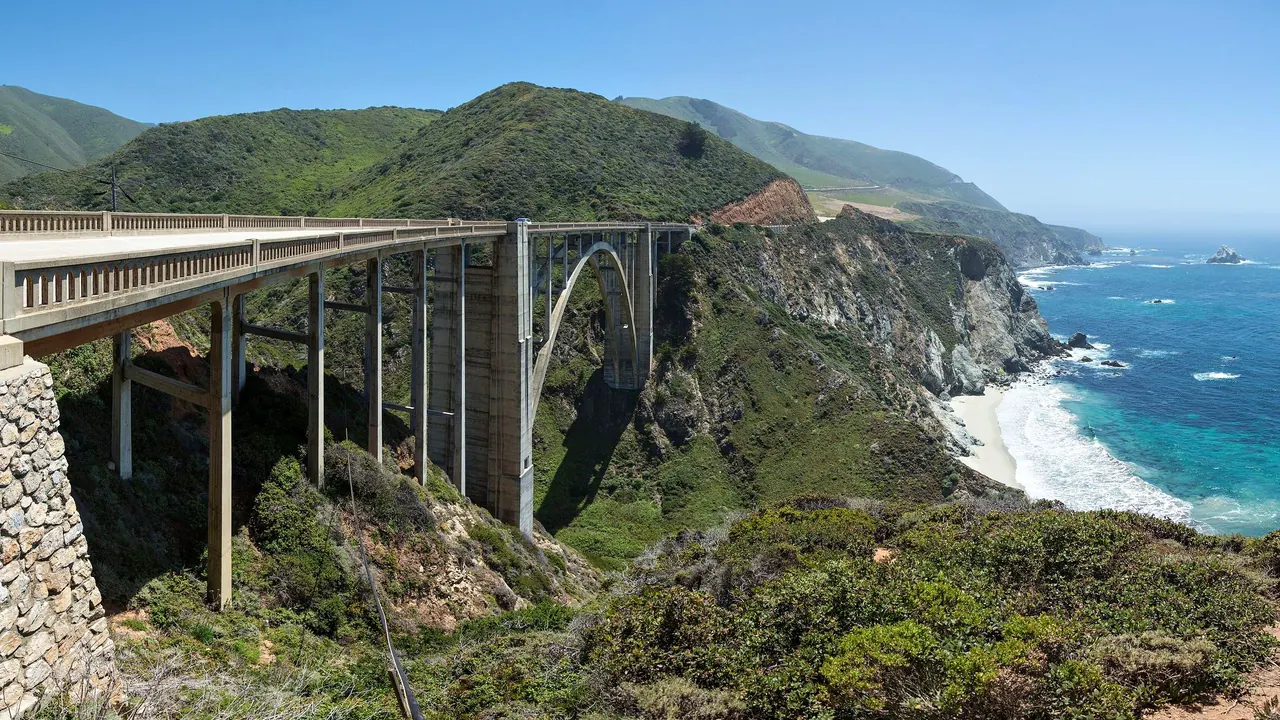
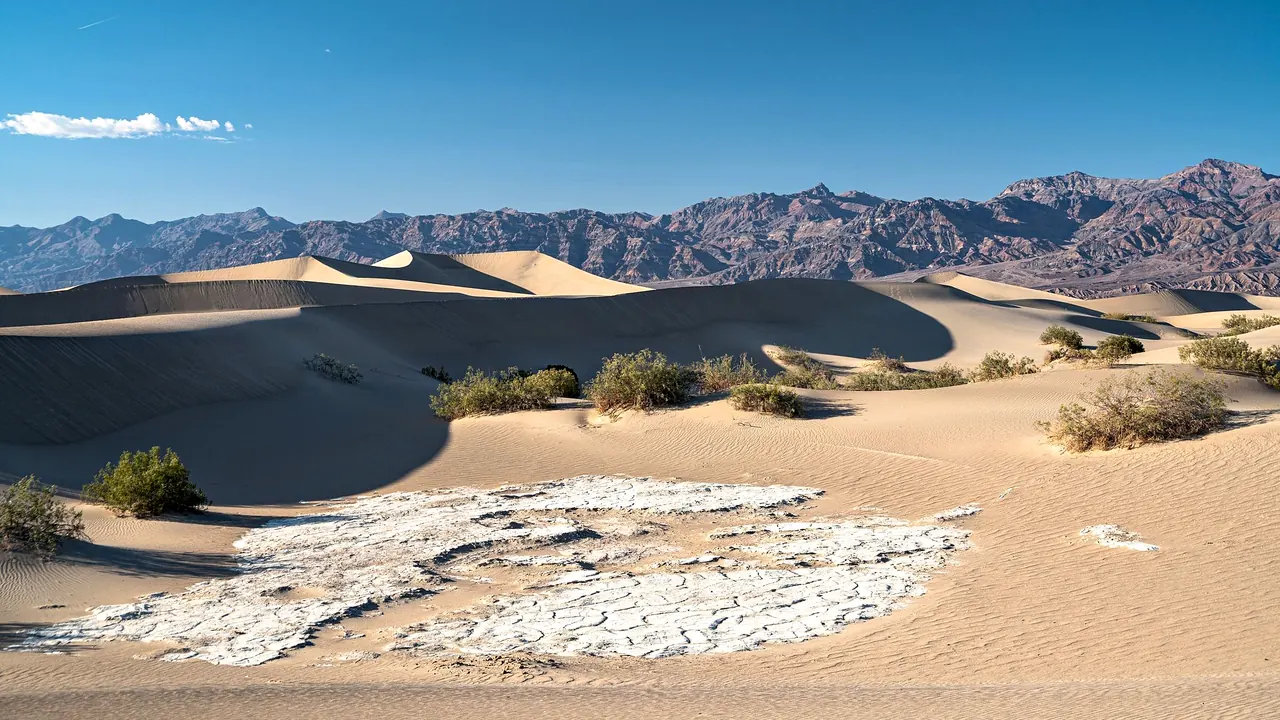
Photos: Big Sur by Diliff, CC BY-SA 3.0, cropped; Death Valley by Anthony Brown, Pexels License.
Big Sur or Death Valley?
Our verdict in twelve categories, each scored against the same fixed benchmark cities, and the climate month by month, so you can choose for your trip.
Choose Big Sur for
- wellness
- day trips
- beaches
Big Sur is the choice for a slow, scenic trip between spring and autumn. The point of it is cliffs, redwoods and the Pacific, seen from a road that rarely runs straight. It suits couples and travellers who want a cliff-top lodge, a spa or the Esalen baths, one long lunch above the ocean, and easy outings to Carmel, Monterey or Hearst Castle when they want more. Go knowing that it is expensive and that the sea is for looking at.
Choose Death Valley for
- prices
- getting around
Death Valley rewards travellers who come in the cool months for space, bare rock and silence: salt flats, dunes, badlands and canyons under a sky that goes fully dark. It costs less to see well, especially if you camp and bring your own food, and its paved roads are easier driving than Highway 1. In return there is less to do outside the park, meals are functional, and the summer heat rules it out for a large part of the year.
Scoreboard
Twelve categories on one fixed scale from 0 to 100. The shaded stretch is the gap between the two.
Your match
Pick a travel style or drag the sliders, and both match scores follow your weighting.
Wins on wellness and day trips with your weighting.
Wins on prices and getting around with your weighting.
What matters to you?
Category by category
What the scores mean for a trip.
Beaches & swimming
Neither place is for swimming, but Big Sur at least has shoreline worth the walk: Pfeiffer Beach with its rock arch and purple sand, and the coves at Garrapata and Plaskett Creek. The water is cold and the surf is dangerous, so come for a jacket and a sit on the sand.
Death Valley has no shore at all, only dry salt flats and old lakebeds. The closest thing to a swim is a spring-fed pool at Furnace Creek, and that is for resort guests.
Food & drink
Big Sur eats better, though the choice is thin. There is a respected bakery, a couple of serious dinner rooms cooking with Central Coast produce and wine, and cliff-top tables where the view does some of the work. Many visitors still save their big dinners for Carmel or Monterey.
In Death Valley, eating is a matter of logistics: lodge dining rooms and saloons at Furnace Creek, Stovepipe Wells and Panamint Springs, general stores and a cool box. Dates from the farm near Tecopa, in shakes and bread, are the one local taste.
Culture & sights
Neither has museums of note or a town to wander, and in both the history is about the people the land drew in. Big Sur's story is literary and bohemian, with the Henry Miller Memorial Library under the redwoods, Bixby Bridge and the Point Sur Lightstation on its volcanic rock. Death Valley's is industrial and harsher: the borax works of the twenty-mule teams, the beehive charcoal kilns at Wildrose, abandoned mining camps, and the Timbisha Shoshone, whose story is told at the Furnace Creek visitor centre.
Nightlife
Both go quiet soon after dinner, with a lodge bar or saloon for one drink and nothing beyond it. What differs is how the evening is spent. On Big Sur it means a campfire under the redwoods and avoiding the dark coast road. In Death Valley it means some of the darkest skies in the country, with the winter Milky Way bright enough to cast shadows.
Nature & outdoors
These are both landscapes people cross the country to see, and the difference between them is entirely in kind. Big Sur is mountains falling straight into the sea: about 140km of cliffs, redwood canyons and waterfalls, with condors overhead, otters in the kelp, grey whales offshore and elephant seals at Piedras Blancas.
Death Valley is bare rock and extremes, from the salt crust of Badwater below sea level to snow on Telescope Peak, with dunes, golden badlands, Mosaic Canyon and the Racetrack in between. Its trails are for the cool months, while Big Sur's can be walked through most of the year, as long as landslides have not closed the road.
Day trips
Big Sur has much better outings at either end. To the north are Carmel's galleries and mission, Monterey's aquarium and Cannery Row, and the Carmel Valley wineries. To the south are Hearst Castle and Cambria. The coast road is slow, so most visitors pick the end nearest their base.
Around Death Valley the choices are few and far apart: the ghost town of Rhyolite, the hamlets of Tecopa and Shoshone, and, about two hours west, Lone Pine and the Manzanar historic site. Most days are spent inside the park.
Good for families
For families the two are close, and what separates them is season and age. Big Sur is a summer trip, and it suits camping families with children of any age: a riverside pitch under the redwoods, a short waterfall walk and an afternoon watching otters or elephant seals make good days. What it lacks is a safe sea and fenced viewpoints, and families who want an aquarium or a beach day stay in Monterey.
Death Valley works only in winter, and best with older children who like a bit of adventure: dunes to run down, a salt flat below sea level and a ranger badge to earn, with a pool at Furnace Creek afterwards. The long drives between sights wear out younger children, and from spring onwards the heat rules the trip out for small ones altogether.
Getting around
Death Valley is the easier drive. Its main paved roads are quiet and straightforward and reach Badwater, Zabriskie Point and the dunes, although distances are long and the back country needs a high-clearance vehicle.
Big Sur's single road, Highway 1, is narrow, full of hairpins and slow in summer traffic. Landslides can close it for long periods and force a detour of several hours inland. You need a car in both places, and fuel stops are rare in both.
Shopping & style
There is nothing to shop for in either place. Big Sur's roadside stops at least have a couple of galleries selling local art and jewellery, and Carmel is close by for proper browsing. Death Valley offers maps, borax souvenirs and Tecopa dates, so stock up in Las Vegas or Pahrump on the way in.
Affordability
Neither is cheap, but Death Valley is easier to do on less. Its few lodges charge remote-resort rates, yet with a campground, your own food and fuel bought in Beatty or Pahrump, a modest budget is realistic.
Big Sur is among the dearest places to sleep in the United States, even in plain motels and cabins, and everything trucked in along its one road costs more. Its campgrounds are the way round this, but they book up months ahead for summer.
Live music & performing arts
Neither is a place to plan evenings around a show. Big Sur at least has a small programme in the warmer months, with outdoor concerts, films and readings at the Henry Miller Memorial Library, and the Monterey jazz and Carmel Bach festivals are within a drive.
Death Valley has one stage, the Amargosa Opera House at Death Valley Junction. It is a curiosity rather than a programme: an adobe theatre with a painted audience on its walls, and the building itself is the reason most people stop.
Wellness & relaxation
Big Sur is the stronger retreat. Esalen's stone baths fed by hot springs, cliff-top spas with yoga and soaking tubs facing the ocean, and real darkness at night are made for long, slow stays, though these stays are costly and need booking well ahead.
Death Valley's rest is simpler: warm spring-fed pools and a resort spa at Furnace Creek, and the rustic mineral pools of Tecopa, best after dark. The desert silence is real, but the long drives between sights keep most stays busier than planned.
When should you go?
Pick your month. The climate figures are measured averages, not a forecast.
Big Sur in July
Death Valley in July
Daytime high, °C
Rainfall in the month, mm
Where the figures come from
Big Sur's temperatures are measured 42 km from the centre, at Monterey / Pacific Grove Acres.
Big Sur has no rain gauge within 25 km of the centre, so its rainfall comes from a gridded climate dataset read at the destination rather than from a gauge further away.
Death Valley has no weather station within reach, so its figures come from a gridded climate model rather than a measured record, and read a broad area rather than one spot.
Temperature and rainfall are climate normals, averaged over the years shown. Big Sur: 1991-2020 normals, Monterey / Pacific Grove Acres (41.9 km from centre). Death Valley: 1991-2020 normals, TerraClimate 4 km grid at the town, no weather station within 90 km.
The two are at their best at opposite ends of the year. Big Sur's coast is mild in every month, with afternoons in the high teens to low twenties. Nearly all of its rain falls from November to March, though, peaking at around 205mm in December, and wet winters can close the road. May to October is dry, with fog often on the coast in early summer and the clearest days in autumn. The sea never gets above about 15°C, so it stays something to look at rather than swim in.
Death Valley gets almost no rain in any month, so the heat is what decides. In December and January the valley floor around Furnace Creek is only a little warmer than the coast, and it is ideal for hiking. It warms quickly from February, though, and reaches about 27°C in March while Big Sur is still in the high teens. By May it is hot, and in July it reaches about 46°C, when walking is dangerous after mid-morning. Go to the desert in winter and early spring, and to the coast in its dry season.
Which traveller are you?
For a relaxing and wellness trip, Big Sur is well ahead. It has hot-spring baths above the surf, cliff-top spas and a coast with no town and little phone signal, so slowing down comes easily. Death Valley's soaking pools are small, and the drives between them are long.
On a trip on a tight budget, Death Valley is the more realistic choice. Neither is cheap to sleep in, but Big Sur is among the costliest stays in the country. In the desert, camping, a cool box and fuel bought outside the park keep costs sensible.
For an outdoors trip, the season decides. From November to March, Death Valley's canyons, dunes and high ridges are at their best for hiking. From spring to autumn, Big Sur's redwood trails, the Ventana Wilderness and its wildlife-watching coast take over.
Before you go
| Measure | Big Sur | Death Valley |
|---|---|---|
| Currency | US Dollar (USD) | US Dollar (USD) |
| Sockets | AB120 V, 60 Hz | AB120 V, 60 Hz |
| Driving side | Right | Right |
| Time zone | UTC-8, UTC-7 in summer | UTC-8, UTC-7 in summer |
| Emergency number | 911 | 911 |
| Main airport | Monterey Regional Airport (MRY)11 non-stop destinations | Harry Reid International Airport (LAS)160 non-stop destinations |
| Public holidays this year | 13 days | 13 days |
By the numbers
| Measure | Big Sur | Death Valley |
|---|---|---|
| Swim season, months above 21 °C | None | - |
Where else could you go?
Every comparison below shares a destination with this one, so you can follow Big Sur or Death Valley somewhere new.
- Carmel-by-the-Seavs Big Sur
- Montereyvs Big Sur
- Sequoiavs Death Valley
- Kings Canyonvs Death Valley
- Napa Valleyvs Big Sur
- Yosemitevs Big Sur