Brazil
Salvador
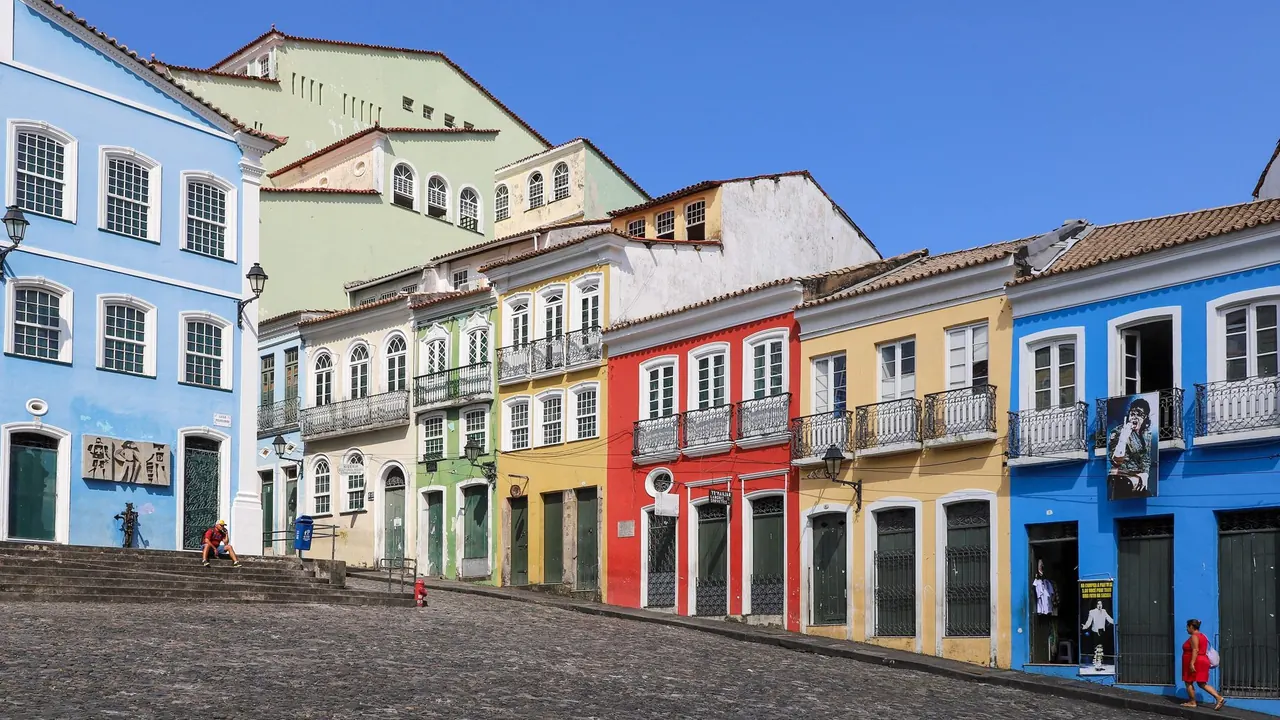
Painted colonial houses in the Pelourinho
- Beaches84
- Culture & sights74
- Nightlife70
Photo: Paul R. Burley, CC BY-SA 4.0, cropped
Match
58
Every category weighted equally
- Beach & sun60
- Culture & arts59
- Food & nightlife60
- Family trip57
- Outdoors57
- Relax & unwind56
- Shopping & style56
- On a budget59
Salvador in twelve categories
Our verdict on each, scored 0 to 100 against the same fixed benchmark cities, so a score means the same thing on every page.
Beaches & swimming. Scores 84 out of 100.
Food & drink. Scores 66 out of 100.
Culture & sights. Scores 74 out of 100.
Nightlife. Scores 70 out of 100.
Nature & outdoors. Scores 52 out of 100.
Day trips. Scores 56 out of 100.
Good for families. Scores 42 out of 100.
Getting around. Scores 42 out of 100.
Shopping & style. Scores 42 out of 100.
Affordability. Scores 70 out of 100.
Live music & performing arts. Scores 63 out of 100.
Wellness & relaxation. Scores 32 out of 100.
Salvador category by category
Beaches & swimming
84Salvador sits on a peninsula between the Bay of All Saints and the open Atlantic, so the sea is never far and it stays warm all year, around 26°C to 28°C. On the bay side, Porto da Barra is the city's living room: a small, calm, sheltered cove where families swim, vendors work the sand and the whole neighbourhood watches the sunset. Along the ocean shore, the beaches run north through Ondina, Rio Vermelho, Pituba and Itapuã to Stella Maris and Flamengo, getting wider, wilder and cleaner as they go.
Water near the busier city stretches can be murky after rain, so locals favour the northern beaches and the bay coves. For a full beach day, the reef pools and coconut-fringed sand of Praia do Forte are about an hour north, and the island beaches across the bay are a ferry ride away. Beach life is part of everyday Salvador, not an add-on.
Food & drink
66Bahian cooking is one of the most distinctive regional cuisines in Brazil, shaped by West African cooks and built on dendê palm oil, coconut milk, dried shrimp and chilli. The signature street food is acarajé, a black-eyed-pea fritter fried in dendê and split open with vatapá and shrimp, sold by baianas in white lace at stalls on the squares and beachfronts. Moqueca baiana, a seafood stew simmered in a clay pot, is the dish to sit down for.
The best eating is casual: beach shacks with grilled fish and cold beer, lunch counters serving rice, beans and stews by weight, and the fruit and spice stalls of the São Joaquim market. Fresh tropical juices are everywhere. Beyond the Bahian classics the range is modest, and international or high-end dining is limited.
Culture & sights
74Salvador was Brazil's first capital and the main port of the Portuguese Atlantic for two centuries, and the Pelourinho, its UNESCO-listed upper town, is one of the great colonial ensembles of the Americas: steep cobbled streets lined with pastel townhouses and dozens of baroque churches. The Church and Convent of São Francisco, its interior almost entirely covered in gilded carving, is the highlight, with the cathedral, the blue-tiled Rosário dos Pretos church and the Carmo district close by.
The Lacerda Elevator links the upper town to the port below, where the Mercado Modelo occupies the old customs house. The Afro-Brazilian Museum, the modern art museum at the seafront Solar do Unhão and the Barra lighthouse fort fill out the list, alongside the Bonfim church on its hill, hung with ribbons left by pilgrims. The Afro-Brazilian heritage running through all of it gives the city a character found nowhere else.
Nightlife
70Going out in Salvador centres on Rio Vermelho, the bohemian seafront district where plastic tables spill across the pavements, acarajé stalls stay busy late and bars fill up with locals well past midnight. Barra has a younger, beachfront crowd, and the Pelourinho squares come alive on weekend and Tuesday nights. The mood is open-air, unpretentious and fuelled by cold beer and caipirinhas.
Carnival is the city's defining night out: a week of street parties following music trucks along the Barra seafront and through the centre, among the largest anywhere. Outside that week the club scene is fairly small. Visitors tend to take taxis between districts after dark rather than walk.
Nature & outdoors
52The landscape around Salvador is coastal and low-lying: the wide Bay of All Saints with its islands, and an Atlantic shore of reefs, dunes and coconut palms running north. Sailing and boat trips on the bay are the classic outing, and surfers head to Stella Maris and Flamengo. The white dunes and dark lagoon of Abaeté sit inside the city, and the large City Park offers shaded walks.
From roughly July to October humpback whales pass along the coast and can be seen on boat trips, and the sea-turtle project at Praia do Forte draws nature lovers. There are no mountains or serious hiking nearby; the canyons and waterfalls of the Chapada Diamantina are a multi-day trip inland.
Day trips
56The most rewarding day out is Cachoeira, a colonial river town of baroque churches and sugar-era mansions in the Recôncavo, about two hours inland, paired with São Félix just across the bridge. Santo Amaro, birthplace of samba de roda, lies on the way. North of the city, the fishing village of Praia do Forte combines beaches with the ruins of the Garcia d'Ávila castle.
Across the bay, ferries reach Itaparica island and its old town, and boat tours call at the smaller islands. Morro de São Paulo, a car-free island village, is reached by catamaran in about two hours, though many visitors stay overnight. The list is pleasant rather than long.
Good for families
42Brazilians are openly fond of children and they are welcome in restaurants and on the beach, where the calm, shallow water of Porto da Barra suits young swimmers. The turtle centre at Praia do Forte, boat trips to the bay islands and the drumming and capoeira of the Pelourinho give older children something to remember.
Beyond that there is little made for families: no major aquarium or theme park, a modest zoo, steep cobbled streets in the old town and strong tropical sun. Parents need to keep a close eye on belongings and stick to busy areas, and most families end up basing a stay around a beach hotel or the resorts to the north.
Getting around
42Salvador is a city of two levels: the upper town with the Pelourinho and the lower town by the port, linked by the Lacerda Elevator and a funicular. The historic centre is walkable but steep and cobbled, and Barra is easy on foot along the seafront. Between districts, distances grow and the city spreads a long way north along the coast.
The metro runs two lines, useful mainly for the airport and the bus station, while the bus network is extensive but hard for a visitor to read. Most travellers use taxis and ride-hailing, which are cheap, and they are the sensible choice after dark. A car is unnecessary in the city but handy for the coast to the north.
Shopping & style
42Shopping here is about Bahian crafts. The Mercado Modelo in the lower town and the shops of the Pelourinho sell carved wood, lacework, percussion instruments, capoeira berimbaus, colourful fabrics and the Bonfim ribbons tied on visitors' wrists. The sprawling São Joaquim market is a working market of produce, pottery, herbs and candomblé offerings, more interesting to wander than to buy in.
For everyday and fashion shopping, Salvador has large air-conditioned malls in the newer districts, with Brazilian chains rather than international flagships. There are few independent boutiques or luxury streets, and much of what the old town sells is aimed at tourists.
Affordability
70Salvador is good value by international standards and cheaper than the bigger Brazilian destinations. Street food, beach-shack meals, beer, buses and ride-hailing all cost little, and simple guesthouses in Barra and the Pelourinho are easy on the budget. The main sights, from churches to museums, charge modest entry or nothing at all.
Comfortable beachfront hotels and better restaurants cost more, and the resorts at Praia do Forte sit in a higher bracket. Carnival is the exception to everything: rooms book out far ahead and prices rise steeply for that week.
Live music & performing arts
63Salvador's strength is rhythm. It is the home of samba-reggae and axé, and its bloco drum groups, with their huge percussion sections, rehearse in the Pelourinho squares and in neighbourhoods such as Liberdade. These rehearsals are open to anyone and build up through the months before Carnival, when they are at their most frequent. In the old town, the Balé Folclórico da Bahia stages Afro-Brazilian and folk dance most evenings, and capoeira rodas and street percussion turn up in the squares without notice.
The formal side is modest. The Teatro Castro Alves, with its open-air Concha Acústica, is the main stage, home to the Bahia state symphony orchestra and to touring concerts and productions. A few smaller theatres and live-music bars in Rio Vermelho fill out the week, but opera is rare and the classical and theatre programme is thin. Come for drums and dance rather than a concert season.
Wellness & relaxation
32Salvador has no bathing or spa tradition of its own, and wellness amounts to hotel spas in the city and the larger resort spas along the coast to the north. What it does have is an unhurried rhythm: long lunches, afternoons in the shade and an easygoing Bahian manner that takes the edge off a stay.
The city itself is noisy, hot and busy in its centre, so visitors looking to unwind usually pick a quiet guesthouse in Santo Antônio or a resort outside town and treat Salvador as the place for culture and music.
When should you go?
Pick a month to see what it is like. The climate figures are measured averages, not a forecast.
Salvador in July
Daytime high, °C
Rainfall in the month, mm
The whole year
Shaded against this city’s own year: the deepest cell is its best month for that figure and the palest its weakest.
Temperature and rainfall are climate normals, averaged over the years shown. Salvador: 1991-2020 normals, Salvador (4.5 km from centre).
Before you go
| Measure | Salvador |
|---|---|
| Official language | Portuguese |
| Currency | Brazilian Real (BRL) |
| Sockets | CN60 Hz |
| Driving side | Right |
| Time zone | UTC-3 |
| Emergency number | Police 190, ambulance 192, fire 193 |
| Elevation | 8 m |
| Main airport | Deputado Luiz Eduardo Magalhães International Airport (SSA)20 km from centre31 non-stop destinations |
| Public holidays this year | 14 days |
By the numbers
| Measure | Salvador |
|---|---|
| City population | 2,417,678 |
| People per km² | 3,489 |
| Museums within 10 km | 49 |
| UNESCO World Heritage sites within 50 km | 1 |
| Swim season, months above 21 °C | 12 months |
Compare Salvador with
Every comparison with a written verdict behind it.