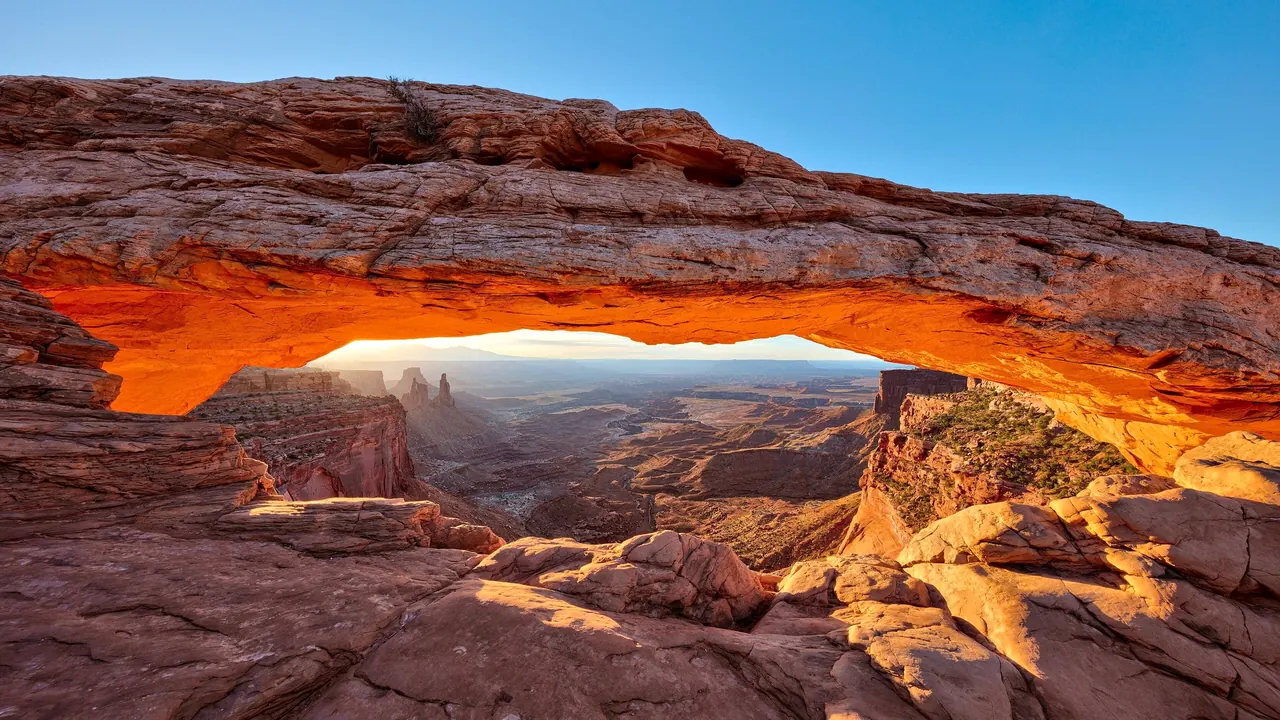
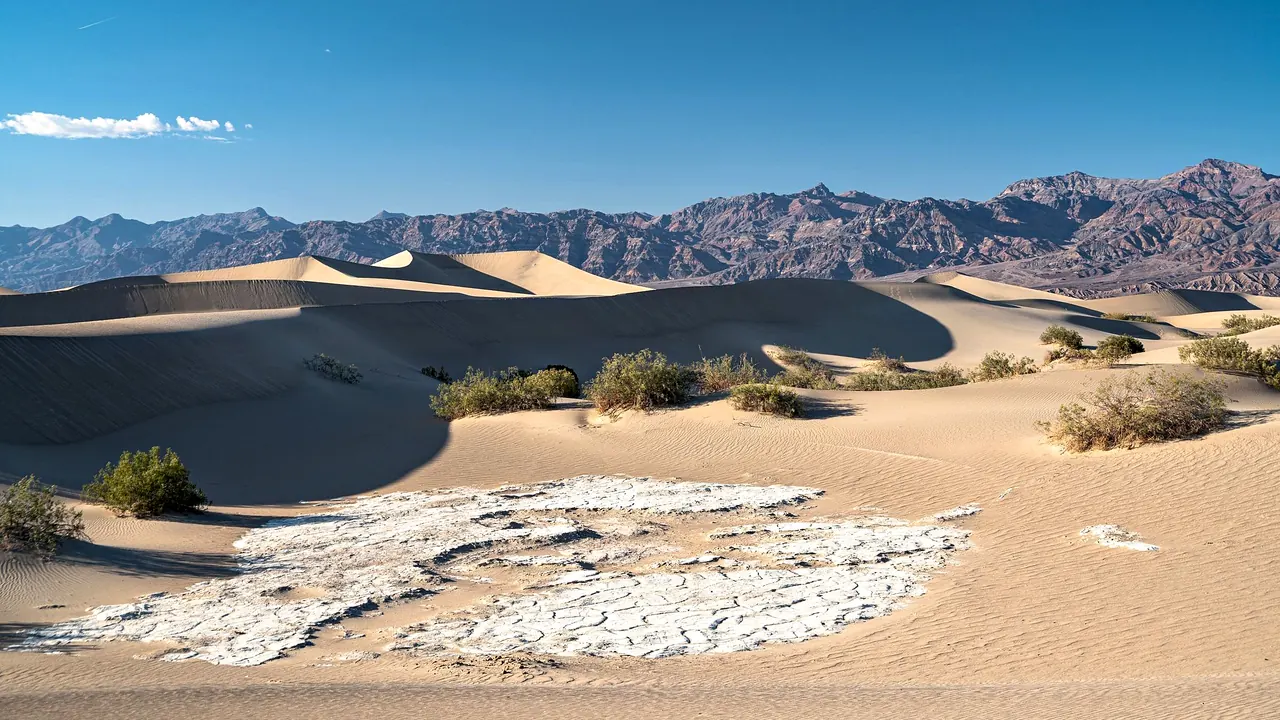
Photos: Canyonlands by Thomas Wolf, www.foto-tw.de, CC BY-SA 3.0, cropped; Death Valley by Anthony Brown, Pexels License.
Canyonlands or Death Valley?
Our verdict in twelve categories, each scored against the same fixed benchmark cities, and the climate month by month, so you can choose for your trip.
Choose Canyonlands for
- families
- food and drink
- shopping
Canyonlands is the better choice if you want to be active in the desert as well as look at it. From a base in Moab you can bike the slickrock, raft the Colorado, climb at Indian Creek and walk among the arches of Arches, then eat and sleep in a real small town. It suits a spring or autumn trip, and families and first-time desert travellers who want a base with some comforts.
Choose Death Valley for
- wellness
Death Valley is a winter destination for travellers who want space, silence and strange geology more than activity. Salt flats below sea level, dunes, badlands and snow on Telescope Peak fill the days, and the hot springs at Tecopa and the warm pools at Furnace Creek fill the evenings. It asks more of you, with longer drives, fewer services and dangerous summer heat. In return it is a slower, emptier trip.
Scoreboard
Twelve categories on one fixed scale from 0 to 100. The shaded stretch is the gap between the two.
Your match
Pick a travel style or drag the sliders, and both match scores follow your weighting.
Wins on families and food and drink with your weighting.
Wins on wellness with your weighting.
What matters to you?
Category by category
What the scores mean for a trip.
Beaches & swimming
Neither is a place to swim, and Death Valley has less water still. In Canyonlands you can at least get into water outdoors: an eddy on a calm stretch of the Colorado or a small reservoir in the hills above Moab.
In Death Valley, swimming means the spring-fed pools at the Furnace Creek resort, and only if you are staying there.
Food & drink
Moab gives Canyonlands a clear lead. It has burgers, Tex-Mex, pizza, food trucks, taprooms and early breakfast places, more choice than a town that size usually has.
In Death Valley you eat in lodge dining rooms and saloons, at general stores, or at diners in Beatty and Shoshone, so most people bring a cool box. The one local treat is a date shake from the farm near Tecopa.
Culture & sights
Canyonlands has more history to seek out, almost all of it painted or carved on rock. Fremont and Ancestral Puebloan rock art is everywhere, from Newspaper Rock to the life-size figures of the Great Gallery in Horseshoe Canyon.
Death Valley's history is industrial and more scattered: the Harmony Borax Works ruins, the Wildrose charcoal kilns, and the story of the Timbisha Shoshone told at the Furnace Creek visitor centre. Both are background to the landscape, but the rock art is the bigger reason to make a detour.
Nightlife
Both are early-to-bed places. In Moab you get a brewpub with rafting guides and bikers, which can be lively on a spring weekend. In Death Valley you get a quiet beer in a lodge saloon. In both, the best part of the evening is the dark sky, especially on a winter night in Death Valley.
Nature & outdoors
These are two of the great deserts of the American West, and Canyonlands comes out slightly ahead because of its variety. Arches, the overlooks of Island in the Sky, the gooseneck bend at Dead Horse Point, the spires of the Needles and the remote Maze are all within reach, with rivers to raft and mountains rising above them.
Death Valley is more stark than varied. You go from Badwater's salt crust below sea level to snow on Telescope Peak, with dunes, badlands, a volcanic crater and the Racetrack in between. There are no rivers to paddle, and from November to March it is a place for walking.
Day trips
In both places your days are spent mostly inside the parks, and the towns around them are small. From Canyonlands you can visit the pottery museum and ruin at Blanding, the old stone houses of Bluff, the Hovenweep towers, or the orchards of Palisade across the Colorado line.
From Death Valley you can visit the ghost town of Rhyolite, Tecopa and Shoshone, or drive about two hours to Lone Pine and the Manzanar historic site. Las Vegas is also about two hours away.
Good for families
Canyonlands is the easier choice with children. Arches has short walks to Double Arch and the Windows, there are dinosaur tracks near Moab, half-day float trips suit younger children, and a motel with a pool is never far away. Unfenced drops and summer heat are still real risks.
Death Valley works only for older children in winter. Sliding down the Stovepipe Wells dunes and walking on the salt at Badwater will stay with them. But there is nothing built for families, and shops and fuel are scarce.
Getting around
You need a car in both, but Canyonlands is more compact. Arches starts just outside Moab, Island in the Sky and Dead Horse Point are under an hour away on paved roads, and a bike path runs along the river. The catch is the queue of cars at the Arches gate in spring and autumn.
Death Valley is one huge park. An hour or more between areas is normal and fuel stations are few, so you have to keep the tank full. Both regions save their remotest corners, the White Rim and the Racetrack, for high-clearance vehicles.
Shopping & style
Canyonlands has more to buy. Moab's Main Street has bike, climbing and rock shops and some galleries, and the trading posts around Bluff and Blanding sell Navajo rugs, silver jewellery and pottery. Death Valley has general stores and lodge gift counters selling maps and borax souvenirs, and its best thing to take home is a box of Tecopa dates.
Affordability
Both are expensive if you stay in hotels and cheap if you camp. In Canyonlands the cost is Moab's motels, which fill up in spring and autumn, plus guided rafting and jeep trips. You can keep it down with free dispersed camping on the public land around the parks.
In Death Valley the cost is having only a few lodgings in the park, plus expensive fuel in the valley. The cheaper options are the park campgrounds or a motel in Beatty or Pahrump, which means a long drive in each day.
Live music & performing arts
Canyonlands has the one event worth planning a trip around, the Moab Music Festival. This chamber-music festival runs from late summer into early autumn, and some of its concerts are held in sandstone grottoes you reach by jet boat down the Colorado.
Death Valley has only the Amargosa Opera House at Death Valley Junction, a small adobe theatre with an audience painted on its walls. It puts on occasional shows, but most visitors stop just to see the building.
Wellness & relaxation
Death Valley is better for unwinding. In winter you can soak in the natural mineral pools at Tecopa under the night sky, in the warm spring-fed pools at Furnace Creek, or at the resort spa there. It is rustic, but it is real hot water.
Canyonlands has nowhere to bathe. A massage in Moab after a day's riding and the silence of a canyon rim at sunrise are the closest you get, on a trip built around physical effort.
When should you go?
Pick your month. The climate figures are measured averages, not a forecast.
Canyonlands in July
Death Valley in July
Daytime high, °C
Rainfall in the month, mm
Where the figures come from
Canyonlands has no weather station within reach, so its figures come from a gridded climate model rather than a measured record, and read a broad area rather than one spot.
Death Valley has no weather station within reach, so its figures come from a gridded climate model rather than a measured record, and read a broad area rather than one spot.
Temperature and rainfall are climate normals, averaged over the years shown. Canyonlands: 2001-2020 normals, NASA POWER reanalysis grid, no weather station within 90 km. Death Valley: 1991-2020 normals, TerraClimate 4 km grid at the town, no weather station within 90 km.
The two deserts are at their best in opposite seasons. Canyonlands is good in spring and autumn. April, May, September and October are warm enough for long hikes and river days without the heat. By July afternoons reach 36°C, so you hike at dawn. Winter highs fall to about 4°C, which is crisp but quiet. Rain is light all year, with slightly more in late summer and early autumn, when storms can bring flash floods to the canyons.
Death Valley is the place for winter. From November to March daytime highs sit around 18°C to 27°C, ideal for walking the canyons and dunes, while Moab is cold. From May on the valley becomes extreme, and July highs average 46°C, when walking is dangerous. Rain hardly ever falls. A late-autumn or winter trip suits Death Valley, and spring or autumn suits Canyonlands.
Which traveller are you?
On an outdoors trip, Canyonlands gives you more to do. Death Valley is mostly for hiking and driving. Around Moab you can mountain bike, raft for several days through Cataract Canyon, go canyoneering, climb, and walk up into the alpine meadows of the La Sal Mountains.
For a relaxing and wellness trip, Death Valley is the better pick. In the cool months you can soak in Tecopa's simple mineral hot springs under the stars or in the warm spring-fed pools at Furnace Creek. Canyonlands has quiet but few places to bathe.
On a family trip with children, Canyonlands is easier. Arches has short walks to big arches, there are dinosaur tracks and calm float trips near Moab, and the motels have pools. Death Valley suits only older, adventurous children, and only in winter.
Before you go
| Measure | Canyonlands | Death Valley |
|---|---|---|
| Currency | US Dollar (USD) | US Dollar (USD) |
| Sockets | AB120 V, 60 Hz | AB120 V, 60 Hz |
| Driving side | Right | Right |
| Time zone | UTC-7, UTC-6 in summer | UTC-8, UTC-7 in summer |
| Emergency number | 911 | 911 |
| Main airport | Canyonlands Regional Airport (CNY)2 non-stop destinations | Harry Reid International Airport (LAS)160 non-stop destinations |
| Public holidays this year | 12 days | 13 days |
Where else could you go?
Every comparison below shares a destination with this one, so you can follow Canyonlands or Death Valley somewhere new.
- Archesvs Canyonlands
- Sequoiavs Death Valley
- Kings Canyonvs Death Valley
- Bryce Canyonvs Canyonlands
- Joshua Treevs Death Valley
- Yosemitevs Death Valley