China
Beijing
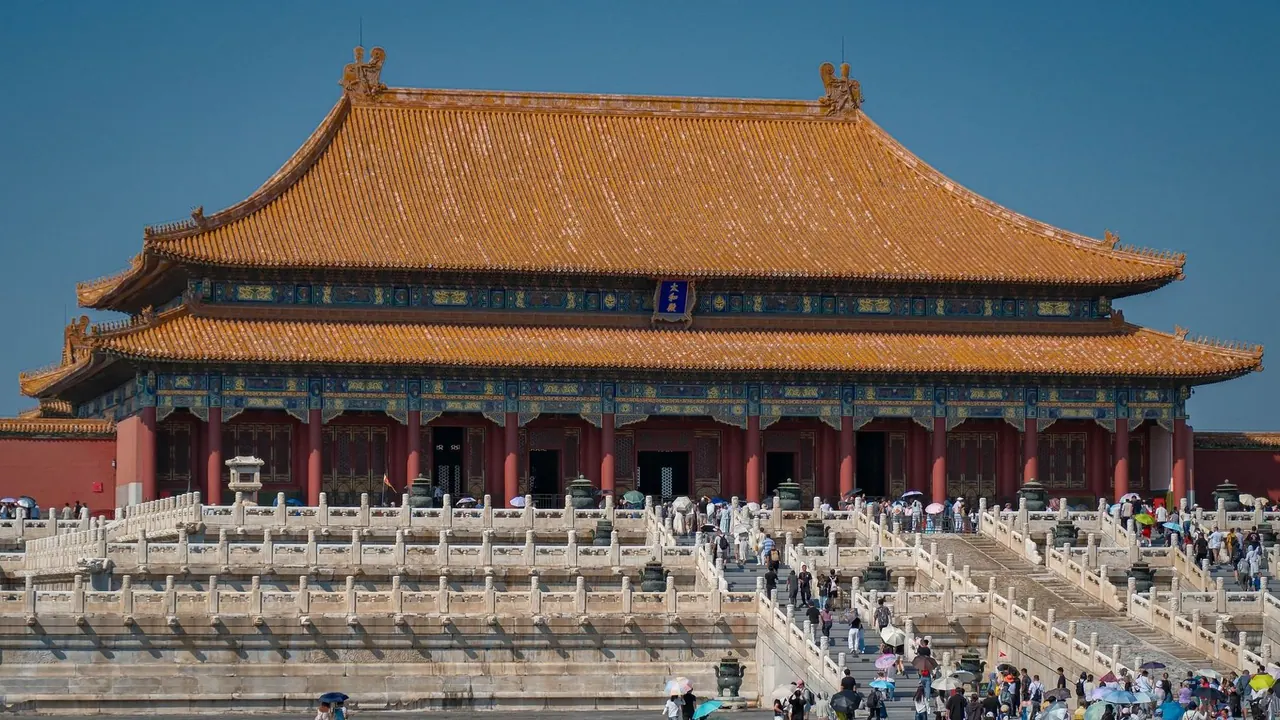
The Forbidden City
- Culture & sights93
- Day trips85
- Food & drink81
Photo: BI ravencrow, Pexels License
Match
65
Every category weighted equally
- Beach & sun57
- Culture & arts73
- Food & nightlife68
- Family trip63
- Outdoors65
- Relax & unwind60
- Shopping & style69
- On a budget65
Beijing in twelve categories
Our verdict on each, scored 0 to 100 against the same fixed benchmark cities, so a score means the same thing on every page.
Beaches & swimming. Scores 6 out of 100.
Food & drink. Scores 81 out of 100.
Culture & sights. Scores 93 out of 100.
Nightlife. Scores 58 out of 100.
Nature & outdoors. Scores 60 out of 100.
Day trips. Scores 85 out of 100.
Good for families. Scores 64 out of 100.
Getting around. Scores 69 out of 100.
Shopping & style. Scores 72 out of 100.
Affordability. Scores 68 out of 100.
Live music & performing arts. Scores 68 out of 100.
Wellness & relaxation. Scores 55 out of 100.
Beijing category by category
Beaches & swimming
6Beijing is an inland capital and beaches play no part in a stay. The nearest coast is the Bohai Sea resort of Beidaihe, about two hours away by fast train, where the water is warm in high summer but grey, shallow and crowded. In the city, swimming means a hotel pool or a public pool. Some locals take winter dips in Houhai and the other lakes, but that is a local custom to watch rather than a beach day.
Food & drink
81Roast duck is the dish everyone comes for. The ceremony is the point: the lacquered skin is carved at the table and wrapped in thin pancakes with scallion and sweet bean sauce. Around it sits a sturdy northern kitchen of wheat and lamb, with hand-pulled and zhajiang noodles, jiaozi dumplings, cumin-spiced lamb skewers and copper-pot hotpot in winter. Mornings start at street stalls selling jianbing crêpes, baozi and soy milk.
The real depth comes from the capital pulling in cooks from everywhere. Sichuan, Hunan, Yunnan, Xinjiang and Cantonese restaurants all cook to a high standard, many of them run by provincial government offices. The hutongs around Gulou and Dongcheng have small noodle shops and courtyard restaurants. The business districts have serious fine dining and good cocktail bars. Tea culture is strong, but coffee and wine are secondary. Snack streets near the big sights mostly sell novelty food to tourists.
Culture & sights
93This is the capital of six centuries of emperors, and the core of the city still follows the imperial plan. The Forbidden City, the largest surviving palace complex in the world, lies on the north-south axis that runs through Tiananmen Square. The Temple of Heaven's round blue-roofed hall stands in a park of ancient cypresses. The Summer Palace stretches along the lake shore in the northwest, and the ruined European-style pavilions of the Old Summer Palace are nearby. The Lama Temple, the Confucius Temple and the Drum and Bell Towers add more classical architecture.
The National Museum on Tiananmen Square holds one of the great collections of Chinese art and antiquities. The Capital Museum and the 798 art district carry the story forward into the modern era. The grey-brick hutong lanes around Nanluoguxiang, Shichahai and Dashilar give a feel for courtyard-house life. The scale is the drawback: sights sit far apart in a vast modern city, and each one takes most of a morning.
Nightlife
58Going out in Beijing splits into a few distinct areas. Sanlitun in Chaoyang is the busiest, with cocktail bars, craft-beer taprooms and large clubs that go on until the early hours, especially around the Workers' Stadium. The hutongs around Gulou and Andingmen are quieter and more relaxed, with small bars in converted courtyard houses and on rooftops. Houhai's lakeside bars are lively but touristy, with neon lights and karaoke. Locals also go out to KTV karaoke rooms and late-night skewer and beer stalls in summer. The scene is broad, but distances are large and it lacks the street life of the great going-out cities.
Nature & outdoors
60The mountains north and west of the city are the real outdoor draw. The Yanshan range carries the Great Wall along its ridges, and walking the wild, unrestored stretches between watchtowers is one of the best hikes near any capital. The Fragrant Hills and Western Hills are close enough for a morning walk and turn red with maple leaves in autumn. Yanqing has ski slopes in winter, and rocky gorges such as Shidu suit climbing and rafting. In the city, the parks around Beihai and the Summer Palace lakes give some green space and boating. Springs can be dusty, summers hot and humid, and smog sometimes hides the hills.
Day trips
85The Great Wall is the reason many people come. Several sections make an easy day out. Mutianyu is restored and has a cable car and a toboggan run. Badaling is the most crowded. Jinshanling and Simatai run along steep ridges about two hours northeast. The Ming Tombs lie on the way to Badaling, and the imperial Qing tombs to the east and west are grander and much quieter.
Fast trains open up more. Tianjin is about half an hour away, with a waterfront lined with old European concession buildings. Chengde, the emperors' summer retreat, is about an hour by high-speed rail, with a walled palace park and a ring of Tibetan-style temples. Closer in, the cave site of Peking Man at Zhoukoudian and the old village of Cuandixia make quieter outings.
Good for families
64Children have more to do here than the imperial sights suggest. Universal Beijing Resort is a full theme park on the eastern edge of the city. The giant pandas at Beijing Zoo are an easy win, the aquarium sits next to them, and the China Science and Technology Museum near the Olympic Park has large hands-on galleries. Pedalling a boat on the lakes at Beihai or the Summer Palace and riding the Mutianyu toboggan down from the Great Wall also go down well.
The hard part is logistics. The main sights are huge, involve a lot of walking and are packed during Chinese school vacations and national breaks, and getting between them takes time. Summers are hot, winters are bitterly cold, and air quality varies. Chinese culture is very warm towards children, and the streets are safe.
Getting around
69The metro is one of the largest in the world. It is clean, cheap and signposted in English, and lines reach the Forbidden City, the Summer Palace, the Olympic Park and both airports. The trouble is size. The city spreads across a series of ring roads, so changing lines can mean long underground walks, every station has bag screening, and getting between two sights often takes most of an hour.
Walking works well in the hutong quarters around the lakes and the Drum Tower, but avenues several lanes wide make other districts slow going on foot. Taxis and ride-hailing are cheap, and mobile payment is used for almost everything, so it is worth setting up before arrival. Great Wall trips usually mean a hired driver or a tour.
Shopping & style
72Shopping here comes in two forms. At the top end, the big malls in Guomao and Sanlitun carry every international label, and Wangfujing is the old commercial avenue with its department stores. Design boutiques are scattered through the hutongs and the 798 art district, but independent fashion is thinner than the malls suggest.
The markets are the more memorable side. Panjiayuan antiques market is best early in the morning, with porcelain, jade, calligraphy and plenty of reproductions. The silk and pearl markets expect hard bargaining. For crafts, Liulichang is an old street of brushes, paper, ink and art books, and Dashilar has traditional shops selling tea, silk and cloth shoes.
Affordability
68For a world capital, Beijing is good value day to day. Metro rides cost very little, taxis are cheap, a bowl of noodles or a plate of dumplings in a local restaurant costs a fraction of Western prices, and entry to the Forbidden City, the Temple of Heaven and the parks is modest. Spending rises with international-standard hotels, the well-known duck restaurants, cocktail bars in Sanlitun and private drivers to the Great Wall. Imported wine and Western brands are no cheaper than at home. Visitors who eat where locals eat and use the metro can stay on a tight budget.
Live music & performing arts
68Peking opera is the city's own art form. Its mix of falsetto singing, painted faces, embroidered costumes and acrobatic fighting is staged nightly in historic guild halls and theatres, often in short, subtitled programmes. Acrobatics and kung fu shows also run nightly and need no language. The National Centre for the Performing Arts, the egg-shaped dome west of Tiananmen, puts on opera, ballet and orchestral seasons, including visiting international companies, and the Forbidden City Concert Hall adds chamber music. Small live-music venues around Gulou host local rock, punk and folk bands. Most spoken theatre is in Mandarin.
Wellness & relaxation
55Beijing is not restful, but it has its own ways to recover. Foot-massage and tuina massage parlours are everywhere and open late, and traditional Chinese medicine clinics offer cupping and acupuncture. Large bathhouses, with hot pools, saunas, scrubs, buffet lounges and sleeping halls, stay open around the clock, though few visitors find them. Hot-spring resorts at Xiaotangshan, north of the city, are the nearest thing to a thermal bath. For a slower pace, watch the early-morning tai chi and ballroom dancing at the Temple of Heaven, or sit over a long pot of tea in a hutong teahouse. Traffic, crowds and air quality work against all of this.
When should you go?
Pick a month to see what it is like. The climate figures are measured averages, not a forecast.
Beijing in July
Daytime high, °C
Rainfall in the month, mm
The whole year
Shaded against this city’s own year: the deepest cell is its best month for that figure and the palest its weakest.
Temperature and rainfall are climate normals, averaged over the years shown. Beijing: 1991-2020 normals, Beijing (11.1 km from centre).
Before you go
| Measure | Beijing |
|---|---|
| Official language | Putonghua |
| Currency | Yuan Renminbi (CNY) |
| Sockets | ACI220 V, 50 Hz |
| Driving side | Right |
| Time zone | UTC+8 |
| Emergency number | Police 110, ambulance 120, fire 119 |
| Elevation | 43 m |
| Main airport | Beijing Capital International Airport (PEK)25 km from centre104 non-stop destinations |
| Public holidays this year | 6 days |
By the numbers
| Measure | Beijing |
|---|---|
| City population | 21,893,095 |
| People per km² | 1,334 |
| Museums within 10 km | 83 |
| UNESCO World Heritage sites within 50 km | 6 |
Compare Beijing with
Every comparison with a written verdict behind it.