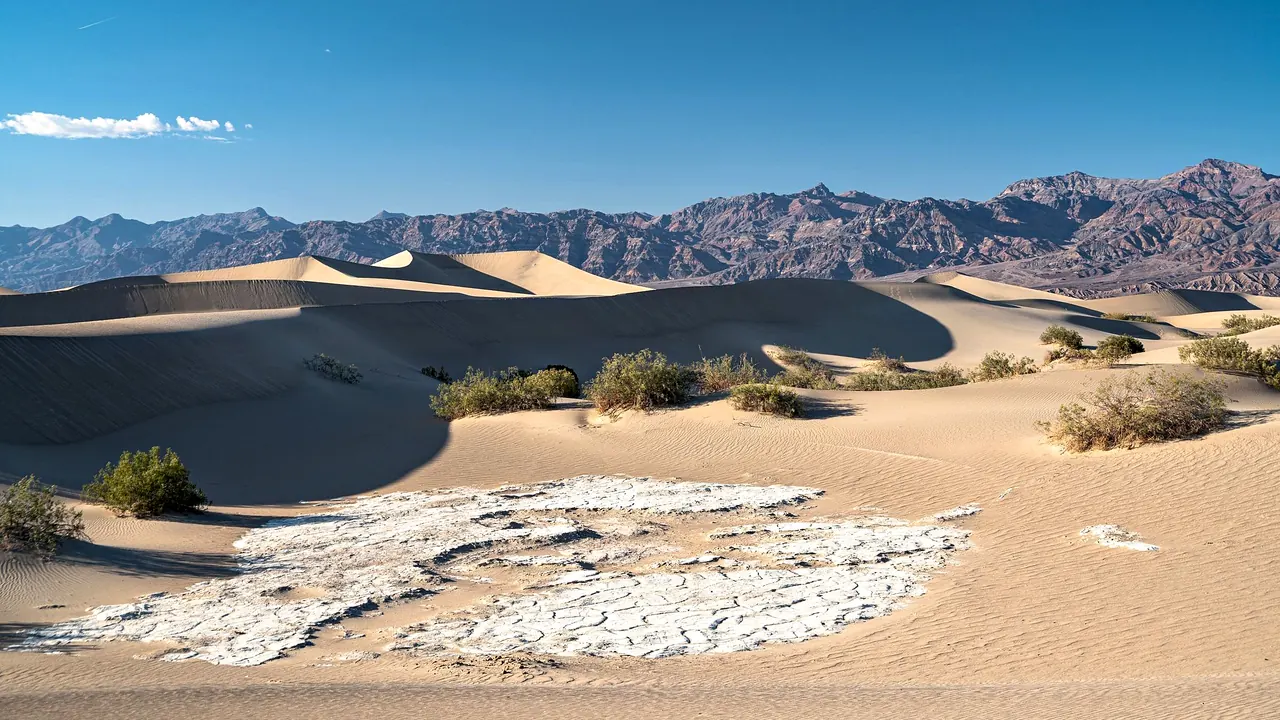
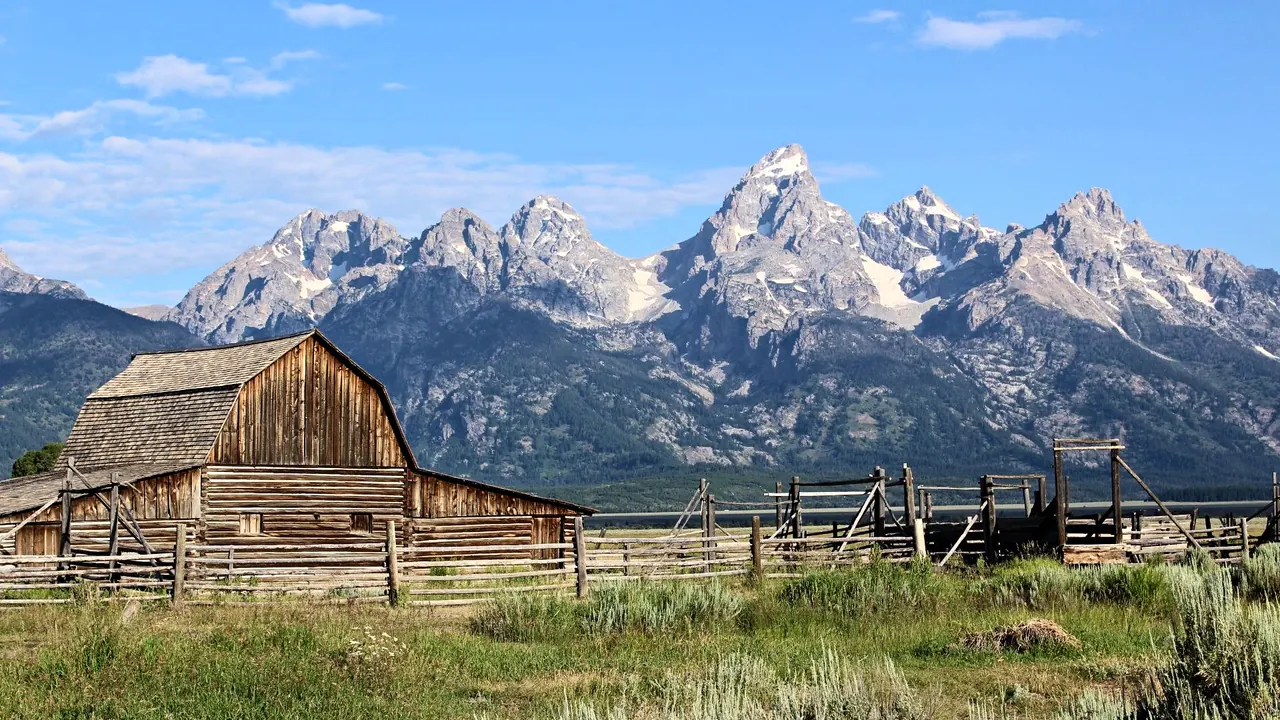
Photos: Death Valley by Anthony Brown, Pexels License; Grand Teton by Z3lvs, CC0.
Death Valley or Grand Teton?
Our verdict in twelve categories, each scored against the same fixed benchmark cities, and the climate month by month, so you can choose for your trip.
Choose Death Valley for
- prices
- day trips
- wellness
Death Valley suits a winter desert trip for travellers who are happy to spend long hours driving and are after space, silence and strange ground: salt flats below sea level, dunes, painted badlands and some of the darkest night skies in the country. It works best for photographers, stargazers and confident drivers who will plan their food and fuel, and it can be combined with Las Vegas. Camping keeps the cost a little more manageable, and the ghost towns and hot-spring hamlets nearby give you places to go beyond the park.
Choose Grand Teton for
- food and drink
- shopping
- families
Grand Teton is the stronger choice for a summer mountain vacation built around hiking, lakes and wildlife. Moose, bison and bears are part of the day, rafting and paddling add water to the trip, and Jackson gives you proper restaurants, western saloons and a music festival to come back to in the evening. Families with school-age children and anyone who wants a town base will find it easier going, as long as they accept that it is one of the more expensive places in the West to stay.
Scoreboard
Twelve categories on one fixed scale from 0 to 100. The shaded stretch is the gap between the two.
Your match
Pick a travel style or drag the sliders, and both match scores follow your weighting.
Wins on prices and day trips with your weighting.
Wins on food and drink and shopping with your weighting.
What matters to you?
Category by category
What the scores mean for a trip.
Beaches & swimming
Neither is a place to swim, but Grand Teton at least has open water. String Lake has sandy edges and warms enough for a brisk dip in high summer, and families paddle off the gravel shores of Jackson Lake at Colter Bay.
Death Valley has no natural water to swim in at all. The only swimming is in the spring-fed pools at Furnace Creek, which are for resort guests, so it is a dip at the end of a day's driving.
Food & drink
In Death Valley you organise your meals rather than look forward to them. There are lodge dining rooms and saloons at Furnace Creek, Stovepipe Wells and Panamint Springs, general stores and small-town diners outside the park. The one local treat is a date shake from the farm near Tecopa, and most visitors drive in with a full cool box.
Grand Teton eats far better because it has Jackson, where skiing and money have brought serious cooks to a small town. Elk, bison and trout, big trail breakfasts, good bakeries and craft breweries are all within a few blocks of the town square. Inside the park the choice narrows to lodge dining rooms and cafeterias, so picnics are common there too.
Culture & sights
Neither is a sightseeing destination, and in both the history is background to the landscape. Death Valley's story is borax and survival: the Harmony Borax Works ruins beside the salt flats, the beehive charcoal kilns at Wildrose and the Timbisha Shoshone story told at Furnace Creek.
Grand Teton has slightly more to show. The barns of Mormon Row and the log Chapel of the Transfiguration, with the peaks framed in its window, give you frontier scenes with mountains behind them. The National Museum of Wildlife Art in Jackson is a real museum worth a few hours, which Death Valley has nothing to match.
Nightlife
In Death Valley the night is the sky. After a beer in the saloon at Stovepipe Wells or Furnace Creek, everyone heads out under one of the darkest skies in the country.
Grand Teton gives you an actual night out, if a short one. Jackson's old western saloons have saddle bar stools and country dancing, there are brewpubs and cocktail bars around the square, and winter après-ski at Teton Village is loud in the late afternoon. Early starts for wildlife still put most people to bed early.
Nature & outdoors
Both are world-class landscapes, and they are very different. Death Valley is rock, salt and light: Badwater Basin below sea level, the badlands at Zabriskie Point, the Mesquite Flat dunes, Mosaic Canyon and the remote Racetrack. It has no lakes or rivers, many highlights need a high-clearance vehicle, and the outdoor season stops when the summer heat arrives.
Grand Teton has the edge because it offers more kinds of outdoor day. Granite summits above 4,000m rise straight from the valley over glacial lakes, and you can hike, climb, raft the Snake or paddle Jackson Lake. Moose, bison, elk and bears give it wildlife that Death Valley lacks, and in winter it turns into deep-powder ski country.
Day trips
Death Valley has more places worth leaving the park for, though they are far apart. Rhyolite's ghost-town ruins stand near Beatty and the hot springs at Tecopa lie to the south. Lone Pine and the Manzanar historic site are about two hours west, and Las Vegas is the same distance east.
From Grand Teton the one big outing is Yellowstone, just to the north, and that means more landscape rather than a change of scene. After that there are only the farming towns of Driggs and Victor over Teton Pass and the ranching country down the Hoback canyon.
Good for families
Grand Teton is much the easier place to bring children. Animals seen from the car, the shuttle boat across Jenny Lake, flat lakeside trails and calm rafting floats all suit school-age children, and Jackson adds a rodeo and the wildlife museum. Children do have to learn the bear and wildlife rules.
Death Valley can thrill older children, who can slide down the dunes and crunch across the salt at Badwater, and it has a Junior Ranger programme too. But it really only works in winter from a Furnace Creek base, with short days and plenty of water, and the heat makes it unsuitable for small children for much of the year.
Getting around
You need a car in both, but Grand Teton is simpler to manage. Its airport sits inside the park near Jackson, a full loop of the park fits into one day, Jackson's centre is walkable and a bus runs to Teton Village. The drawbacks are trailhead parking that fills early in summer and the winter closure of the Teton Park Road.
Death Valley starts two hours from Las Vegas airport and stays spread out. An hour or more between areas is normal, fuel stations are few, and the Racetrack and Titus Canyon are on rough dirt roads that need a high-clearance vehicle.
Shopping & style
Death Valley sells supplies and little else: maps, borax souvenirs and dates. Most people stock up in Las Vegas or Pahrump on the way in.
Grand Teton has a small but genuine shopping street in the blocks around Jackson's square. You will find galleries of wildlife painting and bronzes, cowboy boots, hats and leather goods, Native American jewellery and well-stocked outdoor shops for climbers, skiers and anglers.
Affordability
Neither is a cheap place to visit, but Death Valley costs less once you avoid its handful of lodges. The expense is concentrated inside the park, where a few remote resorts at Furnace Creek and Stovepipe Wells set what a bed and a meal cost, and fuel is dearest exactly where you need the most of it. If you arrive with a full tank and a full cool box, most of what you then spend is time on the road.
Grand Teton stays expensive even when you cut corners, because Jackson's resort money sets prices across the whole valley. A dinner in town or a night's room in high summer costs well beyond what the desert asks. The outings that make the trip, a float on the Snake or a guided day on the peaks, are harder to give up than anything in Death Valley, where the main sights need nothing more than the car you already have. The real saving lies over Teton Pass in Idaho, where rooms cost noticeably less than in Jackson.
Live music & performing arts
Death Valley's only stage is the Amargosa Opera House at Death Valley Junction. It is a small adobe theatre with a painted audience on its walls, and most people visit for the building, as shows are occasional.
Grand Teton has a proper summer season. The Grand Teton Music Festival, held at Teton Village since the 1960s, brings professional orchestral and chamber concerts through July and August, and Jackson adds a performing arts centre, western musicals and country bands. Outside summer and the ski season it goes quiet.
Wellness & relaxation
Both offer rest through quiet rather than a spa culture, and the difference is in the setting. In Death Valley you soak in warm water in the desert: the spring-fed pools and spa at Furnace Creek stay warm through winter, and Tecopa's rustic mineral pools are best at night under the stars, although long drives break up the calm.
Grand Teton's calm comes from mountain mornings by still lakes. For pampering, the full hotel spas in Jackson and Teton Village are busiest after ski days. Granite Hot Springs, a natural pool in the forest down the Hoback canyon, is a summer soak and a ski or snowmobile outing in winter.
When should you go?
Pick your month. The climate figures are measured averages, not a forecast.
Death Valley in July
Grand Teton in July
Daytime high, °C
Rainfall in the month, mm
Where the figures come from
Death Valley has no weather station within reach, so its figures come from a gridded climate model rather than a measured record, and read a broad area rather than one spot.
Grand Teton's temperatures are measured 33 km from the centre, at Jackson Hole / Moose.
Grand Teton has no rain gauge within 25 km of the centre, so its rainfall comes from a gridded climate dataset read at the destination rather than from a gauge further away.
Temperature and rainfall are climate normals, averaged over the years shown. Death Valley: 1991-2020 normals, TerraClimate 4 km grid at the town, no weather station within 90 km. Grand Teton: 1991-2020 normals, Jackson Hole / Moose (32.7 km from centre).
The two are at their best in opposite halves of the year. Death Valley is a winter destination. From November to March the days are mild, around 19°C in January, and that is the time to walk the canyons and dunes. By May the heat is already serious, and in July highs reach 46°C, when walking is dangerous after mid-morning. Rain hardly figures at any time of year, so almost every day is dry.
Grand Teton runs the other way. Its season is late June to September, with highs near 32°C in July and long, dry, settled days for the high trails. String Lake only gets warm enough for a brisk swim from late July into August. Winter is freezing, with highs around 0°C in January, and the wettest months fall from November to January, with about 75mm in December, much of it as snow that feeds the ski slopes. Spring and late autumn are cool and changeable in the mountains just when Death Valley is pleasant.
Which traveller are you?
For an outdoors trip, Grand Teton has the wider range. You get alpine trails from lakeshore loops to the Teton Crest, a classic climb, rafting on the Snake, kayaking on Jackson Lake and wildlife at dawn. Death Valley offers superb desert hiking, but only in the cool months.
On a family trip with children, Grand Teton is easier and more rewarding. There are moose and bison to see from the car, the boat across Jenny Lake to Hidden Falls, gentle river floats and a summer rodeo. In Death Valley the distances are long, there are few facilities and the heat is a real risk.
On a trip on a tight budget, Death Valley is a little kinder, though neither is cheap. You can camp in the park campgrounds or stay in the motel towns of Beatty and Pahrump. Jackson's resort prices, summer rooms that book up far ahead and costly guided tours stretch a small budget much faster.
Before you go
| Measure | Death Valley | Grand Teton |
|---|---|---|
| Currency | US Dollar (USD) | US Dollar (USD) |
| Sockets | AB120 V, 60 Hz | AB120 V, 60 Hz |
| Driving side | Right | Right |
| Time zone | UTC-8, UTC-7 in summer | UTC-7, UTC-6 in summer |
| Emergency number | 911 | 911 |
| Main airport | Harry Reid International Airport (LAS)160 non-stop destinations | Jackson Hole Airport (JAC)16 non-stop destinations |
| Public holidays this year | 13 days | 11 days |
Where else could you go?
Every comparison below shares a destination with this one, so you can follow Death Valley or Grand Teton somewhere new.
- Yellowstonevs Grand Teton
- Sequoiavs Death Valley
- Kings Canyonvs Death Valley
- Joshua Treevs Death Valley
- Yosemitevs Death Valley
- Zionvs Death Valley