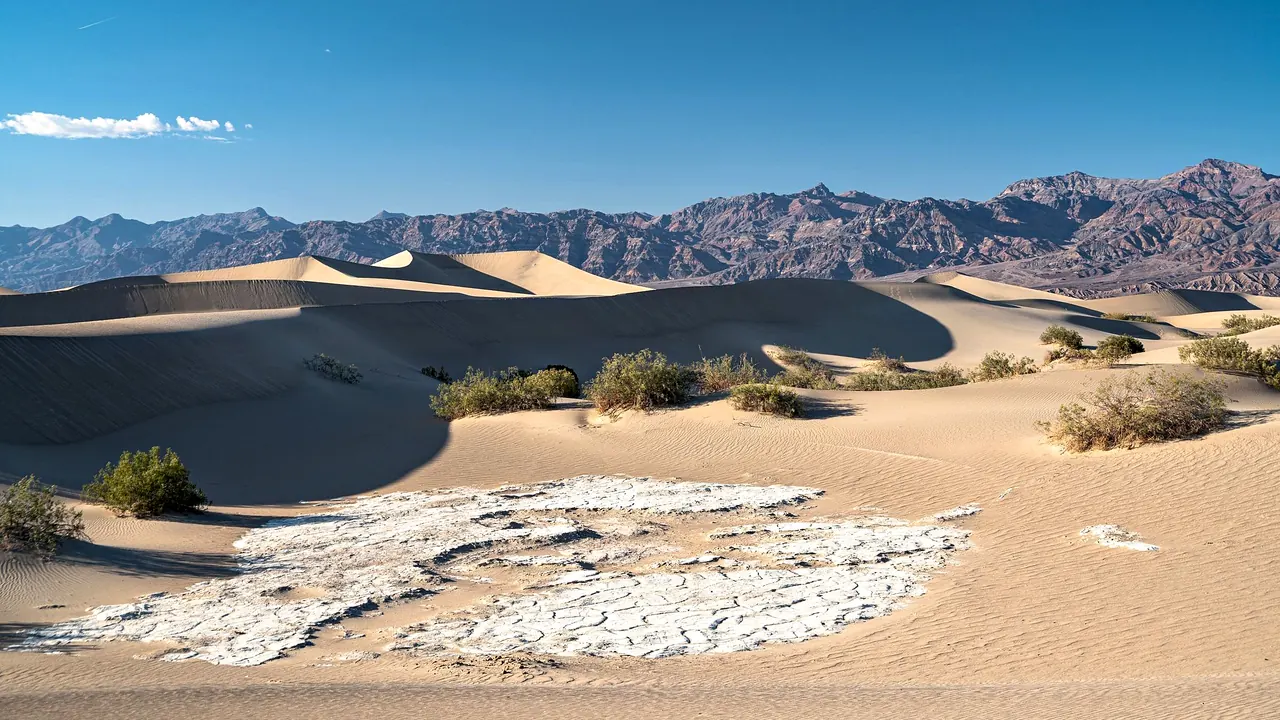
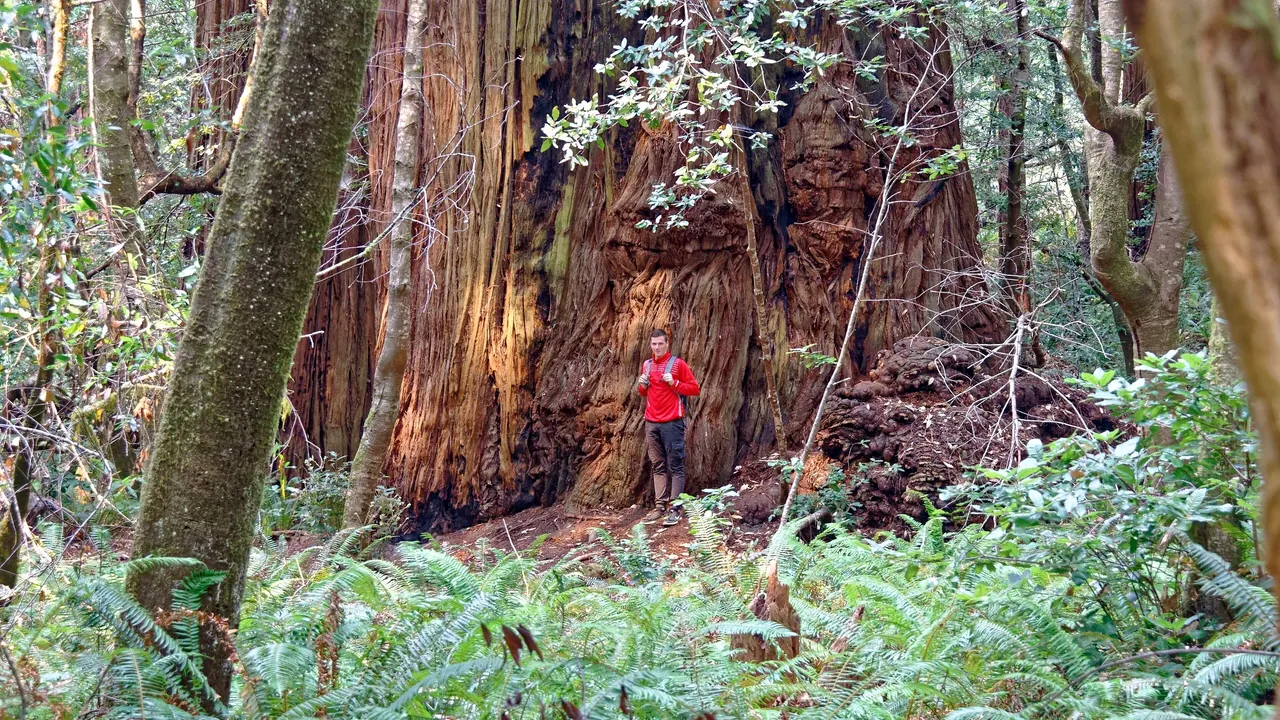
Photos: Death Valley by Anthony Brown, Pexels License; Redwood National Park by Dirtsc, CC BY-SA 3.0, cropped.
Death Valley or Redwood National Park?
Our verdict in twelve categories, each scored against the same fixed benchmark cities, and the climate month by month, so you can choose for your trip.
Choose Death Valley for
- wellness
Death Valley is for travellers drawn to raw desert on a grand scale: salt flats below sea level, golden badlands, dunes, volcanic craters and a night sky as dark as any in the country. It suits a winter trip for adults or older children who are happy to spend long hours driving between far-apart sights, and who would rather end the day in a warm spring pool than at a good restaurant.
Choose Redwood National Park for
- families
- food and drink
- prices
Redwood National Park is the gentler and more practical road trip, with forest and coast instead of rock and heat. You walk among the tallest trees on earth, watch elk in the meadows and follow a wild Pacific shore, and the groves sit a short drive apart. Arcata and Eureka to the south give you better food, a few bars and somewhere to sleep for less. In return you have to live with fog, a cold sea and a long, wet winter.
Scoreboard
Twelve categories on one fixed scale from 0 to 100. The shaded stretch is the gap between the two.
Your match
Pick a travel style or drag the sliders, and both match scores follow your weighting.
Wins on wellness with your weighting.
Wins on families and food and drink with your weighting.
What matters to you?
Category by category
What the scores mean for a trip.
Beaches & swimming
Death Valley has no beach and no open water at all. The only swimming is in the spring-fed resort pools at Furnace Creek, and those are for guests.
Redwood at least has a shoreline. Gold Bluffs, Enderts Beach and the coves around Trinidad are lovely for walking and beachcombing, but the sea is cold and sneaker waves make it dangerous to go in. For a real swim, head inland to the clear pools of the Smith River in July and August.
Food & drink
In Death Valley, food is a matter of supplies. You eat in the lodge dining rooms at Furnace Creek and Stovepipe Wells, buy from general stores, and fill a cool box before driving in. The one local treat is a date shake from the farm near Tecopa.
Redwood is plain close to the groves too, with diners and smoked-fish shacks, but Arcata and Eureka at the southern end add Humboldt Bay oysters, Dungeness crab, a Saturday farmers' market and good craft beer. Trinidad's harbour is the place for fresh fish by the water.
Culture & sights
Both parks treat history as background, but Redwood has a little more to see. Death Valley's story is borax and mining: the Harmony Borax Works ruins, the beehive charcoal kilns at Wildrose, and the visitor centre's account of the Timbisha Shoshone.
Redwood adds a rebuilt Yurok-style village of plank houses at Sue-meg State Park, lighthouses at Crescent City and Trinidad, and Eureka's restored Victorian Old Town with the ornate Carson Mansion. That is enough for a pleasant half day instead of a few roadside stops.
Nightlife
After dark Death Valley offers a beer at the Stovepipe Wells or Furnace Creek saloon and then the stars, which are the real evening event in one of the darkest places in the country. Redwood is quiet near the park too, with campfires and a few taverns. An hour's drive south, though, the university keeps a handful of bars and brewpubs busy around Arcata's plaza, and Eureka's Old Town has a few more for an evening in company.
Nature & outdoors
Both are world-class landscapes, and they could hardly be more different. Death Valley is rock, salt and light. You can go from Badwater Basin below sea level to the snow on Telescope Peak, and between them lie the Zabriskie Point badlands, the Mesquite Flat dunes, Mosaic Canyon and the Racetrack. It is open and bare, and you can only hike it in the cool months.
Redwood is green and alive, with old-growth giants in fog at Stout Grove and Tall Trees Grove, fern-walled Fern Canyon and a coastal trail above sea stacks. It has wildlife Death Valley lacks: Roosevelt elk, grey whales and sea lions. There is water to use as well, with kayaking on the Smith River and tide pools at Trinidad.
Day trips
From Death Valley every outing means a long drive across empty desert, while Redwood's are short hops along the coast. Near Death Valley you have the ghost town of Rhyolite by Beatty and the hot-spring hamlet of Tecopa. Lone Pine and the sobering Manzanar camp are about two hours west, and Las Vegas is two hours east, so most days stay inside the park.
Redwood's excursions are modest but easy: fishing-village Trinidad, the university town of Arcata, Eureka's waterfront and Victorian Ferndale down the coast, and the harbour towns of southern Oregon to the north.
Good for families
Redwood is the far better family park. Its flat loop trails suit small children, Fern Canyon is made for scrambling and wading, and spotting elk is an easy thrill. There is a gondola into the forest near Klamath and a canopy walkway at Eureka's zoo. Watch children closely on the beaches, though, because of the sneaker waves.
Death Valley can thrill older, adventurous children who like sliding down dunes and crunching across the salt at Badwater. But nothing there is built for them, distances are long, and outside winter the heat is a genuine danger to small children.
Getting around
You need a car in both, but Redwood is far less demanding. Its groves line about 70km of coast along US-101 and the Newton B. Drury Scenic Parkway, and the hops between them are short. Only a few highlights, like Howland Hill Road and the road to Fern Canyon, involve gravel or shallow creek crossings.
Death Valley is vast. Expect an hour or more between areas and few fuel stops, and the Racetrack and Titus Canyon need a high-clearance vehicle. The nearest big airport is in Las Vegas, a two-hour drive away.
Shopping & style
Death Valley sells little beyond maps, borax souvenirs and dates, and visitors are better off stocking up in Las Vegas or Pahrump on the way in. Redwood has more to browse, though it is still a sideline: redwood burl carvings and chainsaw sculptures at roadside stalls, galleries and antique shops in Eureka's Old Town, and Native basketry and jewellery in Arcata and Eureka.
Affordability
Redwood is noticeably easier on the wallet. The state park campgrounds in the redwoods are inexpensive and the motels in Crescent City cost far less than lodging near the big-name parks, though campsites and rooms fill early in summer.
Death Valley has only a few lodgings, and they charge what remote resorts do, and fuel inside the park is expensive. Camping with your own food keeps a stay affordable, and so does staying in Beatty or Pahrump, though that adds long drives every day.
Live music & performing arts
Death Valley's single stage is the Amargosa Opera House at Death Valley Junction, a small adobe theatre with a painted audience on its walls. It is worth a stop for the building even when no show is on.
Redwood has no landmark like that, just ranger campfire talks in summer near the groves. An hour south, though, there is a little more to attend: touring acts at Arcata's university, and a small symphony and community theatre in Eureka.
Wellness & relaxation
Death Valley is the better choice for rest, mainly because it has natural hot water and Redwood has none. At Furnace Creek, the springs feed pools that keep their warmth on cool desert evenings, and the resort there adds spa treatments. Tecopa, over an hour's drive south, is a scruffy, likeable hamlet whose simple mineral soaking pools are best once darkness falls. The catch is the driving. The sights lie so far apart that a stay is seldom as slow as it sounds.
Redwood offers quiet instead of water. There are no thermal springs and no proper spa, only hot tubs and saunas rented by the hour in Arcata and massage at a few lodges. Here you unwind on long, soft walks through the hush of the old-growth groves, which many visitors treat as their own kind of forest bathing.
When should you go?
Pick your month. The climate figures are measured averages, not a forecast.
Death Valley in July
Redwood National Park in July
Daytime high, °C
Rainfall in the month, mm
Where the figures come from
Death Valley has no weather station within reach, so its figures come from a gridded climate model rather than a measured record, and read a broad area rather than one spot.
Redwood National Park's temperatures are measured 35 km from the centre, at Arcata / Clam Beach.
Redwood National Park has no rain gauge within 25 km of the centre, so its rainfall comes from a gridded climate dataset read at the destination rather than from a gauge further away.
Redwood National Park's sunshine is measured 55 km from the centre, at Eureka.
Temperature and rainfall are climate normals, averaged over the years shown. Death Valley: 1991-2020 normals, TerraClimate 4 km grid at the town, no weather station within 90 km. Redwood National Park: 1991-2020 (sunshine 1981-2010) normals, Arcata / Clam Beach (34.6 km from centre).
The two parks are at their best in opposite halves of the year. Death Valley is a winter destination. From November to March days are mild, around 19°C in January, and good for hiking canyons and dunes. By May it is hot, and in July highs reach 46°C, so walking after mid-morning is dangerous. Rain hardly falls in any month, so the timing is all about heat.
Redwood National Park stays cool all year, and daytime highs never rise above about 17°C. Rain is the problem here. It is heavy from October to April and peaks at 309mm in December, while July and August are almost dry. The sunniest stretch runs from May to July, with July the brightest month, though summer often brings fog to the coast. The sea stays around 11-13°C, too cold for swimming in any month. Late summer and early autumn are the safest time to visit.
Which traveller are you?
On a family trip with young children, Redwood National Park is far easier. Flat loop trails, Fern Canyon's creek and logs, and elk in the meadows suit small legs. Death Valley's heat, long distances and lack of anything built for children make it suitable only for older ones in winter.
On a trip on a tight budget, Redwood National Park goes further. Inexpensive state park campgrounds and highway motels sit close to the groves. Death Valley's few lodges charge what remote resorts charge, and the cheaper motel towns outside it mean long daily drives.
For a relaxing and wellness trip, Death Valley has the edge. The spring-fed pools at Furnace Creek stay warm through winter, there is a resort spa, and you can soak in Tecopa's rustic hot springs after dark. Redwood has peaceful forest trails but no thermal water or spa.
Before you go
| Measure | Death Valley | Redwood National Park |
|---|---|---|
| Currency | US Dollar (USD) | US Dollar (USD) |
| Sockets | AB120 V, 60 Hz | AB120 V, 60 Hz |
| Driving side | Right | Right |
| Time zone | UTC-8, UTC-7 in summer | UTC-8, UTC-7 in summer |
| Emergency number | 911 | 911 |
| Main airport | Harry Reid International Airport (LAS)160 non-stop destinations | California Redwood Coast-Humboldt County Airport (ACV)6 non-stop destinations |
| Public holidays this year | 13 days | 13 days |
By the numbers
| Measure | Death Valley | Redwood National Park |
|---|---|---|
| Swim season, months above 21 °C | - | None |
Where else could you go?
Every comparison below shares a destination with this one, so you can follow Death Valley or Redwood National Park somewhere new.
- Sequoiavs Death Valley
- Kings Canyonvs Death Valley
- Joshua Treevs Death Valley
- Yosemitevs Death Valley
- Zionvs Death Valley
- Grand Canyonvs Death Valley