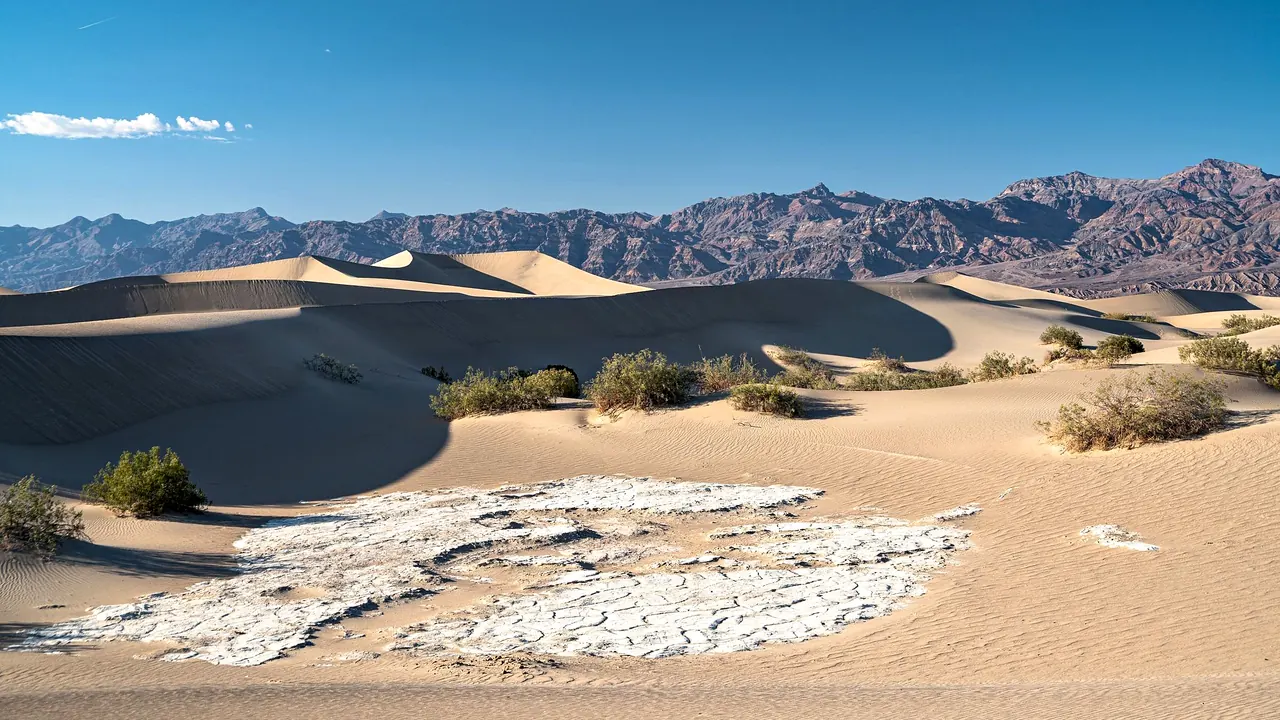
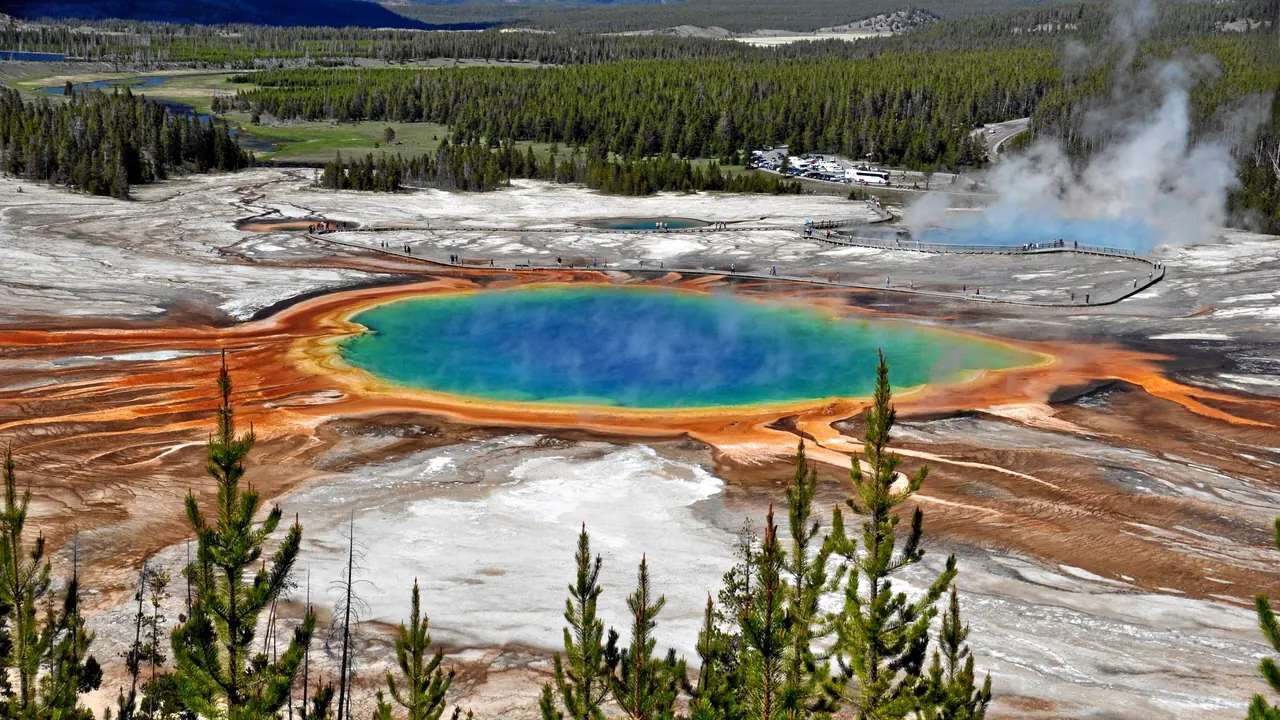
Photos: Death Valley by Anthony Brown, Pexels License; Yellowstone by James St. John from Newark, Ohio, CC BY 2.0, cropped.
Death Valley or Yellowstone?
Our verdict in twelve categories, each scored against the same fixed benchmark cities, and the climate month by month, so you can choose for your trip.
Choose Death Valley for
- wellness
- getting around
- prices
Death Valley is the choice for a winter trip into silence. From late autumn to early spring its canyons, dunes and salt flats are mild enough to walk, the paved roads are quiet, and the days end in warm spring-fed pools or the rustic soaks at Tecopa under one of the darkest skies in the country. It suits couples and adults who want rock, light and emptiness more than activity, and who are happy to eat simply.
Choose Yellowstone for
- families
- culture and sights
- food and drink
Pick Yellowstone for a summer trip with more going on. Its geysers, canyon and wildlife herds make the stronger landscape, and children are gripped from the first eruption of Old Faithful. The historic lodges, Cody's rodeo and the gateway towns also give a little more to eat, see and do around the edges. The price is crowds on the Grand Loop and long hours in traffic, and in winter the interior can only be reached by snowcoach.
Scoreboard
Twelve categories on one fixed scale from 0 to 100. The shaded stretch is the gap between the two.
Your match
Pick a travel style or drag the sliders, and both match scores follow your weighting.
Wins on wellness and getting around with your weighting.
Wins on families and culture and sights with your weighting.
What matters to you?
Category by category
What the scores mean for a trip.
Beaches & swimming
Neither is a swimming destination, and the only difference is what stands in for a beach. In Death Valley it is the warm spring-fed pools at Furnace Creek, open to resort guests at the end of a day's driving.
Yellowstone has real water, but little of it can be used. The lake stays near 10°C even in August and the thermal pools are scalding and forbidden, so swimming means a quick summer plunge in the Firehole River canyon or a commercial hot-spring pool outside the park.
Food & drink
Yellowstone eats a little better, though neither is a reason to travel. In Death Valley, meals come from a handful of lodge dining rooms and saloons and the diners of Beatty and Shoshone. Date shakes from the Tecopa farm are the only local touch, so most people arrive with a cool box.
Yellowstone has more regional character: bison burgers, elk sausage, trout and huckleberry pie, served in the historic lodges and in the steakhouses and brewpubs of West Yellowstone, Gardiner and Cody. The serious cooking is in Jackson and Bozeman, a long way from the geysers, and park kitchens close early.
Culture & sights
Both are places you visit for the land, but Yellowstone has more built heritage to give a day shape. The Old Faithful Inn is the landmark of rustic park architecture, and Fort Yellowstone and the Roosevelt Arch tell the story of the world's first national park. The Buffalo Bill Center of the West in Cody is a genuine major museum.
Death Valley's history is rougher and more scattered. There are the ruins of Harmony Borax Works beside the salt flats, the beehive charcoal kilns at Wildrose, and the Furnace Creek visitor centre on the borax era and the Timbisha Shoshone. They make good stops along the drive but are not the reason to come.
Nightlife
Neither has any nightlife, and in both places the saloon beer is over early. What differs is the reason to stay up or to sleep early. In Death Valley it is the moonless winter sky, among the darkest in the country. In Yellowstone most people go to bed soon after a ranger talk so they can be in Lamar or Hayden Valley at dawn for the wildlife.
Nature & outdoors
Both are world-class, but Yellowstone has more variety. Its volcanic plateau holds most of the world's active geysers, from Old Faithful to Grand Prismatic Spring. Add the canyon and Lower Falls of the Yellowstone River, a great mountain lake, herds of bison and elk, and wolves and grizzlies for anyone up at dawn.
Death Valley is a landscape of rock and light instead: Badwater's salt crust below sea level, snow on Telescope Peak above it, the badlands of Zabriskie Point, the Mesquite Flat dunes and the remote Racetrack. There is no wildlife spectacle and no water, and summer heat limits walking to the early morning. In winter, though, it is the better hiking ground of the two.
Day trips
Day trips are thin in both, and most days are spent inside the park. Death Valley's outings lean towards history: the ghost town of Rhyolite near Beatty, the hot-spring hamlet of Tecopa, and two hours west, Lone Pine and the wartime camp at Manzanar. Las Vegas is the one big city within reach.
Yellowstone's gateway towns are livelier places to visit: Jackson with its galleries and wildlife art museum, the Wild West streets of Cody and the university town of Bozeman. The Beartooth Highway is a day out in itself. Each is still a long day for a single stop.
Good for families
Yellowstone is far easier to sell to children. Geysers that erupt to a timetable, bubbling mud pots and bison beside the road hold their attention, the boardwalks are short and flat, and the wildlife centre in West Yellowstone shows bears and wolves up close. The catch is hours in the car and constant supervision near the thermal areas and the animals.
Death Valley works only for older, adventurous children, and only in winter. There are dunes to slide down at Stovepipe Wells, salt to crunch at Badwater and stars at night, with Furnace Creek and its pools as the base. Nothing is built for families, and outside the cool months the heat is a real danger to small children.
Getting around
You need a car in both, but Death Valley is the easier drive. Its paved roads are quiet and reach Badwater, Zabriskie Point, Dante's View and the dunes without fuss, and Las Vegas airport is about two hours away. The hard parts are the long gaps between fuel stations and the dirt tracks to the Racetrack and Titus Canyon, which need high clearance.
Yellowstone's Grand Loop is slow, with low speed limits, bison jams and full car parks at Old Faithful and Grand Prismatic in summer, so getting from one area to another takes hours. From early November to late April most roads close to cars, and the interior can only be reached on a snowcoach or snowmobile tour.
Shopping & style
Neither is a shopping trip, but Yellowstone's gateway towns give you a little more to browse. Cody and Jackson sell Western wear, cowboy boots and hats, and their galleries sell wildlife painting and bronze, alongside fly-fishing shops. In Death Valley shopping stops at general stores, maps, borax souvenirs and dates from Tecopa, so it is better to stock up in Las Vegas or Pahrump on the way in.
Affordability
Both are costly for what you get, and for the same reasons: few rooms, a captive market for meals and fuel, and a car you cannot do without. Death Valley's lodges at Furnace Creek and Stovepipe Wells charge remote-resort rates and its petrol is dear, so the savings come from camping, bringing your own food and filling up outside.
In Yellowstone the squeeze is seasonal. Summer lodges, gateway motels and above all Jackson are priced high, but spring and autumn are noticeably cheaper, and the sights cost nothing beyond the park entry.
Live music & performing arts
Yellowstone has a little more to see, mostly in summer. The evening rodeo in Cody is a real Western spectacle, West Yellowstone puts on family musicals, and the Grand Teton Music Festival brings a professional orchestra to Teton Village. Death Valley has a single stage, the Amargosa Opera House at Death Valley Junction, a painted adobe theatre that most people visit for the building rather than its occasional shows.
Wellness & relaxation
Death Valley is the more restful of the two, at least in the cool months. The spring-fed pools at Furnace Creek stay warm through the winter and the resort has a spa, the mineral soaks at Tecopa are best under the stars, and the desert silence is complete. The drives between sights do keep the days from being truly slow.
Yellowstone steams everywhere, yet nobody can bathe in its springs, so soaking means the hot-spring pools near Gardiner or in Paradise Valley. Finding stillness there depends on timing: an early morning by the lake or a trail in September, not the busy summer loop.
When should you go?
Pick your month. The climate figures are measured averages, not a forecast.
Death Valley in July
Yellowstone in July
Daytime high, °C
Rainfall in the month, mm
Where the figures come from
Death Valley has no weather station within reach, so its figures come from a gridded climate model rather than a measured record, and read a broad area rather than one spot.
Yellowstone has no weather station within reach, so its figures come from a gridded climate model rather than a measured record, and read a broad area rather than one spot.
Temperature and rainfall are climate normals, averaged over the years shown. Death Valley: 1991-2020 normals, TerraClimate 4 km grid at the town, no weather station within 90 km. Yellowstone: 2001-2020 normals, NASA POWER reanalysis grid, no weather station within 90 km.
The two run on opposite calendars. Death Valley is at its best from November to March, when highs sit around 19°C in January and the canyons and dunes are a pleasure on foot. By May the heat is building, and in July the valley floor reaches 46°C, far too hot for walking after mid-morning. Rain barely registers in any month.
Yellowstone is a summer destination. July brings highs near 25°C and the driest weeks of the year, and June and September are cooler but still good for the boardwalks and trails. From November to March daytime highs stay at or below freezing, around -6°C in midwinter, much of the precipitation falls as snow, and most roads close to cars. So a winter trip points to Death Valley and a summer one to Yellowstone, and the two barely overlap: when one is at its best, the other is either baking or snowbound.
Which traveller are you?
On a family trip with children, Yellowstone wins clearly. Old Faithful erupts to schedule, bison and elk wander past the car and the boardwalks are flat and short. Death Valley has little built for children beyond the dunes and the winter pools.
For a relaxing and wellness trip, Death Valley is the better bet. Furnace Creek has warm spring-fed pools and a spa, Tecopa's simple hot springs are best at night, and the winter desert is deeply quiet. Yellowstone's own springs are off-limits for bathing.
On an outdoors trip in summer, Yellowstone has the edge, with geyser basins, a river canyon, wolves and grizzlies at dawn and hundreds of kilometres of backcountry trails. Death Valley is the winter alternative, with canyon hikes, dunes and salt flats in mild weather.
Before you go
| Measure | Death Valley | Yellowstone |
|---|---|---|
| Currency | US Dollar (USD) | US Dollar (USD) |
| Sockets | AB120 V, 60 Hz | AB120 V, 60 Hz |
| Driving side | Right | Right |
| Time zone | UTC-8, UTC-7 in summer | UTC-7, UTC-6 in summer |
| Emergency number | 911 | 911 |
| Main airport | Harry Reid International Airport (LAS)160 non-stop destinations | Bozeman Yellowstone International Airport (BZN)27 non-stop destinations |
| Public holidays this year | 13 days | 11 days |
Where else could you go?
Every comparison below shares a destination with this one, so you can follow Death Valley or Yellowstone somewhere new.
- Grand Tetonvs Yellowstone
- Sequoiavs Death Valley
- Kings Canyonvs Death Valley
- Joshua Treevs Death Valley
- Yosemitevs Death Valley
- Zionvs Death Valley