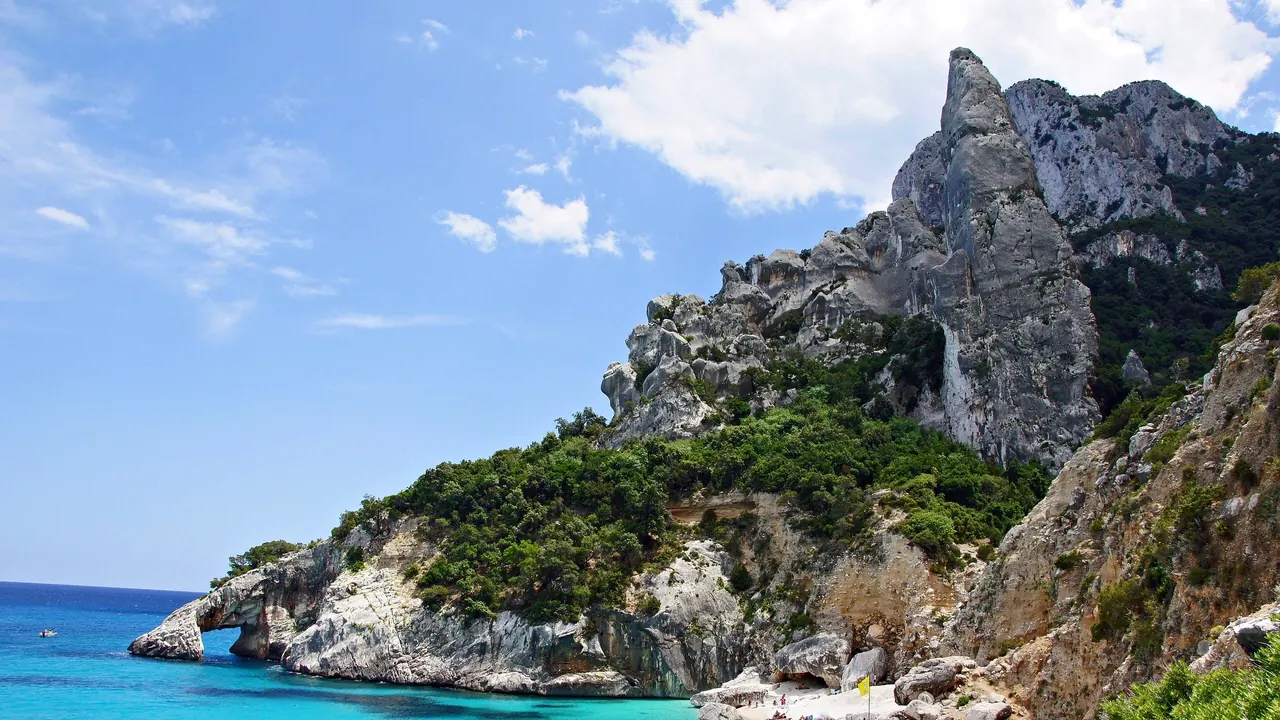
Photos: Sardinia by Yesuitus2001, CC BY-SA 2.5, cropped.
Dolomites or Sardinia?
Our verdict in twelve categories, each scored against the same fixed benchmark cities, and the climate month by month, so you can choose for your trip.
Choose Dolomites for
- nature and the outdoors
- wellness
- getting around
Pick the Dolomites if the mountains themselves are the point. Lifts lift walkers straight onto high pasture and pale rock from almost every village, the winter ski circuits link whole valleys, and the hotel spas make the evenings feel earned. It costs more and the nights are quiet, but no other region in Italy puts this much high country within easy reach, and the valley trains make outings to Merano, Verona or Innsbruck simple.
Choose Sardinia for
- beaches
- nightlife
- prices
Sardinia is the better choice for a sea vacation with some history and food thrown in. Its beaches are among the finest in the Mediterranean, its Bronze Age towers and shepherd cooking feel like nowhere else in Italy, and away from the Costa Smeralda in August it is easier on the wallet. In return you will be driving long, winding roads, and you will need to pick one corner of the island as your base.
Scoreboard
Twelve categories on one fixed scale from 0 to 100. The shaded stretch is the gap between the two.
Your match
Pick a travel style or drag the sliders, and both match scores follow your weighting.
Wins on nature and the outdoors and wellness with your weighting.
Wins on beaches and nightlife with your weighting.
What matters to you?
Category by category
What the scores mean for a trip.
Beaches & swimming
This is where the two differ most. The Dolomites' famous high lakes, such as Braies and Carezza, are for looking at rather than swimming in. Real bathing means the warm water and grassy lidos of Lake Caldaro, the outdoor pools in the valley towns, or a drive down to the northern tip of Lake Garda.
Sardinia is built around the sea. It has the turquoise granite coves of the Costa Smeralda and La Maddalena, the white pebble bays under the Orosei cliffs and the shallow fine sand at Chia and La Pelosa. When the mistral blows, there is usually a sheltered coast somewhere on the island.
Food & drink
Both eat very well, from very different kitchens. The Dolomites mix Alpine and Italian cooking: speck, canederli and strudel followed by a proper espresso, lunch on a hut terrace after a walk, Lagrein and Gewürztraminer from the slopes below Bolzano, and some surprisingly ambitious kitchens in small Alta Badia villages.
Sardinian food comes from shepherds rather than the sea. Expect myrtle-roasted suckling pig, pane carasau, culurgiones and pecorino, eaten at long farm tables in the hills with Cannonau to drink. There is bottarga and lobster on the coast. Neither region offers much range beyond its own cooking.
Culture & sights
Sardinia has the more distinctive heritage. Thousands of Bronze Age nuraghi dot the countryside, led by Su Nuraxi at Barumini, and Cagliari's archaeological museum holds the Mont'e Prama stone giants. The coast adds the Phoenician and Roman ruins of Nora and Tharros, and Alghero has its Catalan old town. You will need a car to link them up.
In the Dolomites the landscape is the heritage, and the sights sit in the valley towns. Ötzi the Iceman is in Bolzano, Trento has the frescoed Castello del Buonconsiglio and Bressanone has its cathedral and cloister, with First World War tunnels up on the passes. They make good rainy-day outings rather than a reason to come.
Nightlife
Sardinia has more going on after dark, but only in certain places and at certain times. In July and August the Costa Smeralda's beach clubs and late, dressy nightclubs draw the yacht crowd. Cagliari's Marina and Castello quarters keep wine bars open all year.
Nights in the Dolomites follow the outdoor day. There is après-ski at the foot of the slopes in Selva, Canazei and Cortina, with music and drinks until early evening, and most summer villages are asleep by eleven.
Nature & outdoors
The Dolomites are among the great mountain landscapes of the world, and they are unusually easy to get into. Lifts carry walkers up to the Alpe di Siusi or the Seceda ridge, the Alta Via 1 crosses the range hut to hut, and via ferrata cables bring non-climbers onto the high rock. In winter the Sella Ronda links whole valleys on skis.
Sardinia's wild country is harsher and partly at sea. The Gorropu gorge and the Selvaggio Blu cut through the limestone Supramonte, while the La Maddalena marine park and the kitesurfing at Porto Pollo draw people onto the water. Inland walking is best in spring and autumn, because the summer heat closes it down.
Day trips
The Dolomites have the easier and more varied outings, as long as you base yourself in the Adige valley. Merano, Bressanone and Trento are each under an hour from Bolzano, Verona is a short train ride away and Innsbruck is about two hours over the Brenner. From the high villages, every trip starts with a slow pass road.
Sardinia's best outing is the hour-long ferry from Santa Teresa Gallura to Bonifacio on Corsica. Otherwise you have small towns such as Bosa and Castelsardo and the mask villages of Barbagia, all charming, all reached by slow drives and spread out so that no single base covers them.
Good for families
Both suit children, but in different ways. Summer in the Dolomites means flat meadow paths on the Alpe di Siusi, huts with playgrounds and farm animals, toboggan runs and family hotels with children's clubs, and winter brings well-run ski schools. Steep trails and via ferrate are for older children only.
In Sardinia the days revolve around the sea: shallow sandy water at Chia, the Costa Rei and La Pelosa, plus resort pools. The midday heat in July and August needs planning around, and the cliff coves on the east coast can mean long walks or boat trips.
Getting around
The Dolomites are easier without a car, at least on the South Tyrol side. There, trains run along the Adige and Puster valleys, and buses climb to most resorts and over the main passes on one regional pass. The Belluno side is less straightforward. The railway from Venice and Padua stops at Calalzo di Cadore, and Cortina has no station, so you finish the trip by bus from Calalzo or from Dobbiaco. Once you are in a village, the lifts do much of the work, but crossing between valleys means slow hairpin pass roads, and most people who want to see several areas hire a car.
In Sardinia a hire car is all but essential. The road between Cagliari and Sassari is fast, but most of the island is reached on winding roads that take longer than the map suggests. Trains are few, buses rarely reach the beaches, and you can only get to the Orosei coves and the Maddalena islands by boat. Flying into whichever of the three airports is nearest your base saves hours.
Shopping & style
Neither region is a shopping destination, and both are best for crafts. In the Dolomites that means woodcarving from the Ortisei workshops, loden and food shops under Bolzano's arcades and some of the best-known Advent markets in the Alps, with speck and grappa to take home.
Sardinia offers red coral jewellery in Alghero, filigree gold, woven rugs and Pattada shepherd's knives, and in summer Porto Cervo's piazzetta of luxury boutiques does the job that Cortina's main street does in winter.
Affordability
Sardinia is the cheaper of the two overall, but where you stay matters a great deal. The Costa Smeralda in August is among the most expensive stretches of the Mediterranean. Around Cagliari, Alghero, Ogliastra and the inland villages, though, prices are moderate for Italy, and the agriturismo set menus are generous.
The Dolomites are expensive in both winter and summer high season, and Cortina and Alta Badia lead the way. Lift passes and guided climbs add to the bill. You can save in the Fassa and Fiemme valleys or in the valley towns, and by going in June or September.
Live music & performing arts
Neither offers much to see most of the year, and what there is differs in kind. In the Dolomites the formal scene centres on the orchestras in Bolzano and Trento, plus Bolzano's piano competition, and in summer there are concerts on alpine meadows and hut terraces, as well as Merano's autumn festival in its old spa halls.
Sardinia has opera at Cagliari's Teatro Lirico, but its more memorable sounds are traditional: canto a tenore singing and launeddas pipes at village festivals, Time in Jazz in Berchidda, and the costumed procession of Sant'Efisio.
Wellness & relaxation
The Dolomites do relaxation better, mainly through their hotels. South Tyrol's mountain hotels are designed around saunas facing the rock walls and outdoor pools heated in the snow, and the old hay bath is still offered around Völs am Schlern. Merano adds public thermal baths in the town centre.
In Sardinia, rest comes more from the pace of life than from spas. There are Roman-era springs at Fordongianus and thalassotherapy in the big beach resorts, but the real rest is a slow week at an inland agriturismo or in quiet Ogliastra.
When should you go?
Pick your month. The climate figures are measured averages, not a forecast.
Dolomites in July
Sardinia in July
Daytime high, °C
Rainfall in the month, mm
Where the figures come from
Sardinia has no rain gauge within 25 km of the centre, so its rainfall comes from a gridded climate dataset read at the destination rather than from a gauge further away.
Temperature and rainfall are climate normals, averaged over the years shown. Dolomites: 1991-2020 normals, Dobbiaco (22.3 km from centre). Sardinia: 1991-2020 normals, Olbia / Costa Smeralda (3.1 km from centre).
Summer is high season in both, but it does a different job in each. Around the Dolomites' resort valleys, June to September brings mild days that top out near 22°C, which is ideal for walking and cycling at altitude. It is also the wettest part of the year. July brings around 130mm, mostly as afternoon storms, so it pays to start walks early. June and September are a little cooler and drier than high summer. On Sardinia's coast the same months are hot and almost rainless, with highs of 32°C in July and August. That is right for the beach but too hot for walking inland in the middle of the day. The sea is warm enough to swim from June to early October and reaches about 25°C in August.
Winter is where the two part ways. From December to February the Dolomite valleys sit near freezing. That suits skiing but makes other days outdoors short and cold, and March is still wintry. Sardinia's coast stays mild, at around 14°C, but rain returns in October and the winter months are its wettest, with the sea too cool for swimming. On the island, spring and autumn are the best seasons for walking and sightseeing.
Which traveller are you?
On a beach and sun trip, Sardinia wins easily. It has granite coves in the northeast, shallow sandy bays at Chia and La Pelosa and a reliably dry, hot summer. In the Dolomites the swimming is limited to valley lakes and pools.
For an outdoors trip, choose the Dolomites. Lifts open up high walking, via ferrata and hut-to-hut routes from almost every village, and winter adds linked ski valleys. Sardinia's wild side is rougher, hotter in summer and mostly coastal: gorges, cliff treks and diving.
On a trip with a tight budget, Sardinia is the safer bet as long as you avoid the Costa Smeralda in August. Agriturismo set menus and the moderate prices around Cagliari and Alghero are hard to match in the Dolomites, where lift passes and ski-season rooms push the cost up.
Before you go
| Measure | Dolomites | Sardinia |
|---|---|---|
| Official language | Italian | Italian |
| Currency | Euro (EUR) | Euro (EUR) |
| Sockets | CFL230 V, 50 Hz | CFL230 V, 50 Hz |
| Driving side | Right | Right |
| Time zone | UTC+1, UTC+2 in summer | UTC+1, UTC+2 in summer |
| Emergency number | 112 | 112 |
| Main airport | Venice Marco Polo Airport (VCE)103 non-stop destinations | Olbia Costa Smeralda Airport (OLB)79 non-stop destinations |
| Public holidays this year | 13 days | 13 days |
By the numbers
| Measure | Dolomites | Sardinia |
|---|---|---|
| Population | - | 1,628,384 |
| Swim season, months above 21 °C | - | 3 months |
Where else could you go?
Every comparison below shares a destination with this one, so you can follow Dolomites or Sardinia somewhere new.
- Austrian Alpsvs Dolomites
- Corsicavs Sardinia
- Lake Gardavs Dolomites
- Bavariavs Dolomites
- Lake Comovs Dolomites
- Tuscanyvs Dolomites