Dolomites or Umbria?
Our verdict in twelve categories, each scored against the same fixed benchmark cities, and the climate month by month, so you can choose for your trip.
Choose Dolomites for
- nature and the outdoors
- families
- wellness
Choose the Dolomites if your vacation is meant to be spent on foot or on skis. Pale limestone peaks, lifts from almost every village and lunch on a hut terrace high above the valleys make this one of the great mountain trips in Europe. It also works well for families in summer, and for anyone who wants a good hotel spa at the end of the day. The cost is higher prices, and the sights and evenings come second to the mountains.
Choose Umbria for
- culture and sights
- prices
- day trips
Umbria is the better pick for travellers who want art, hill towns and a different outing every day. Giotto in Assisi, Orvieto's cathedral and a chain of medieval towns lie a short drive from a farmhouse base, Tuscany and Rome are close, and rooms and meals cost noticeably less. Its countryside is gentle rather than dramatic, and there is little laid on for children.
Scoreboard
Twelve categories on one fixed scale from 0 to 100. The shaded stretch is the gap between the two.
Your match
Pick a travel style or drag the sliders, and both match scores follow your weighting.
Too close to call, 2 points apart
Wins on nature and the outdoors and families with your weighting.
Wins on culture and sights and prices with your weighting.
What matters to you?
Category by category
What the scores mean for a trip.
Beaches & swimming
Neither is a place for swimming, but the water is different in each. In the Dolomites the famous high lakes are too cold for most people. The real bathing is lower down, on the lawns and lidos of Lake Caldaro on the wine route or at the northern tip of Lake Garda, so a swimmer should stay near Bolzano or Trento.
Umbria's Lake Trasimeno is shallow and warm, easy for children to paddle in, though the water is cloudy and the bottom is muddy in places. Most of the swimming happens in farmhouse pools, and the sea is a drive of two hours or more.
Food & drink
Both regions eat well and both lack range; the difference is in the kind of cooking. The Dolomites mix Alpine and Italian food: speck and canederli followed by a proper espresso, lunch on a hut terrace at 2,000m, Lagrein and Gewürztraminer from the slopes south of Bolzano, and an unexpected number of high-end kitchens in Alta Badia.
Umbria cooks country food from the hills: black truffle over handmade pasta, Norcia's pork, porchetta from market vans and Castelluccio lentils. Sagrantino and Orvieto whites are tasted at the estates. A long lunch in a village trattoria is where it is at its best.
Culture & sights
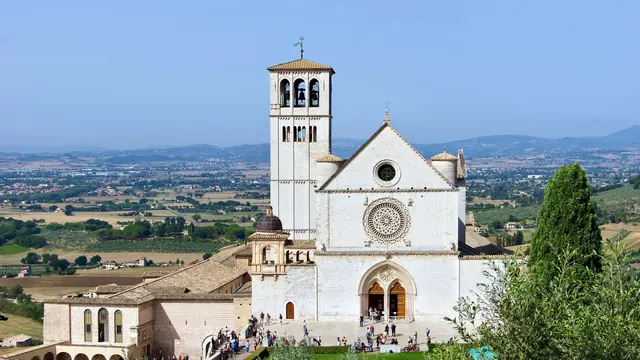
Umbria is far stronger for sights. Assisi's basilica with its Giotto and Cimabue frescoes, Orvieto's banded cathedral on its volcanic cliff and Perugia's national gallery can support a whole trip on their own. Gubbio, Spello, Todi and Montefalco then add one complete medieval town after another.
In the Dolomites, the UNESCO listing is for the mountains themselves. Ötzi in Bolzano, Trento's frescoed castle, Bressanone's cloister and the wartime tunnels on the high passes are well worth seeing, but they fill bad-weather days rather than a week.
Nightlife
Both regions are about dinner and an early night, and neither has clubs. In the Dolomites, what liveliness there is comes in winter, with après-ski at the foot of the slopes in Selva, Canazei and Cortina that is over by early evening.
In Umbria it comes from students instead. Perugia's main street and cathedral steps fill on warm evenings, and the lanes around them have wine bars and a few places that stay open late.
Nature & outdoors
This is where the Dolomites stand apart. The Tre Cime, Sassolungo and Sella massif, the gentle Alpe di Siusi and the via ferrata network give some of the best hiking, climbing and cycling in Europe from June to October. In winter a ski area links a dozen valleys, and lifts put almost all of it within reach.
Umbria's outdoors is softer: olive groves, oak woods and river valleys, with real height only in the Monti Sibillini, where the Castelluccio plain flowers in early summer. Rafting in the Valnerina, the Marmore Falls and the old Spoleto to Norcia railway path make good days out, but they do not compare with the Dolomites.
Day trips
Umbria is built for outings. From a base near Perugia or Spoleto there is a different hill town a short drive away each day. Cortona, Montepulciano and Siena are within easy range across the Tuscan border, and Rome is a little over an hour by train from Orvieto.
The Dolomites also have good trips from the Adige valley: Merano, Bressanone, the wine route, Verona by train and Innsbruck over the Brenner. From the high villages, though, every trip starts on a winding pass road, so a varied programme usually means splitting the stay between two bases.
Good for families
With children, the Dolomites are much the easier choice in summer. Lifts take the climbing out of the day, the paths across the Alpe di Siusi and the Armentara meadows are almost flat, and adventure parks and family hotels fill the gaps. In winter there are well-run ski schools on gentle slopes.
Umbria suits a slow week around a farmhouse with a pool and animals, with Trasimeno, the Marmore Falls and an amusement park near Perugia for outings. Its main sights are frescoed churches at the top of steep cobbled streets, which tire small legs and pushchairs quickly.
Getting around
A car helps in both, for different reasons. In the Dolomites, trains and buses serve the valleys and climb to most resorts, and lifts take over once you arrive. Crossing between valleys, though, means slow hairpin roads that are busy in high summer.
Umbria's roads are short, good and quiet. The difficulty is the last stretch, since hill-town centres are closed to visitors' cars and you park below the walls and ride up by escalator or funicular. A rail line links Perugia, Assisi and Spoleto, but the countryside is hard to reach without a car.
Shopping & style
In the Dolomites you buy wood and wool. Ortisei's workshops sell figures and nativity scenes carved in Val Gardena, Bolzano's medieval arcades hold loden and long-established food shops, and Cortina adds a short run of luxury boutiques. Some of the best-known Advent markets in the Alps are here, and most visitors carry home speck, mountain cheese and grappa.
In Umbria you buy clay and linen. Deruta's roadside workshops sell painted majolica, Montefalco and Bevagna weave linen by hand, and there are cashmere outlets around Perugia. Norcia's shops are hung with hams and stocked with truffles, and Sagrantino and olive oil are bought straight from the estates. There is no luxury street to match Cortina's.
Affordability
Umbria is clearly the cheaper vacation. Farmhouse stays cost less than in the hills across the Tuscan border, village set lunches and local wine are good value, and most sights are churches, so the main extra cost is a hire car.
The Dolomites are expensive in the ski season and in July and August. Cortina and Alta Badia are among the costliest resorts in Italy, and lift passes and guided climbs add up. Staying in Val di Fassa or Bolzano, or going in June or September, brings the cost down.
Live music & performing arts
Umbria has much more to see on stage, almost all of it in summer. Umbria Jazz fills Perugia's arena and streets in July, and Spoleto's Festival dei Due Mondi brings opera, theatre and dance to its Roman theatre and squares. There is also a winter jazz edition in Orvieto around the New Year.
The Dolomites offer orchestral seasons in Bolzano and Trento and some memorable settings, with musicians playing on mountain meadows and jazz in castles and wineries. These are a pleasure if your dates match, but they are rarely a reason to travel.
Wellness & relaxation
The Dolomites, and South Tyrol in particular, are the better choice for a restful stay. Many mountain hotels are built around saunas facing rock walls and heated outdoor pools. The hay bath tradition survives below the Alpe di Siusi, and Merano has public thermal baths in its town centre.
Umbria's calm comes from the pace of life instead: long lunches, views over olive groves, silence in the hermitages on Monte Subasio and a pool or massage at a country house. Its spa towns are small, and anyone who wants proper thermal bathing drives to the springs across the Tuscan border.
When should you go?
Pick your month. The climate figures are measured averages, not a forecast.
Dolomites in July
Umbria in July
Daytime high, °C
Rainfall in the month, mm
Where the figures come from
Umbria's temperatures are measured 53 km from the centre, at Frontone.
Umbria has no rain gauge within 25 km of the centre, so its rainfall comes from a gridded climate dataset read at the destination rather than from a gauge further away.
Temperature and rainfall are climate normals, averaged over the years shown. Dolomites: 1991-2020 normals, Dobbiaco (22.3 km from centre). Umbria: 1991-2020 normals, Frontone (52.9 km from centre).
The Dolomites have two seasons, summer and winter. Around the main resort valleys, July and August highs reach only about 22°C. That is ideal for hiking but too cool for swimming anywhere except the low valley lakes. Summer is also the wettest part of the year, with around 130mm in July. September is drier and still mild enough for long days on the trails. From December to February daytime temperatures stay close to freezing, which is the heart of the ski season, and March is still cool, with snow lingering on the slopes.
Umbria is at its best in spring and autumn. April, May, late September and October bring highs from the high teens to the low twenties, the right weather for climbing hill-town streets. July reaches 30°C, which is hot for sightseeing but good for Lake Trasimeno or a farmhouse pool, and it is also the driest month. The rain comes in from September and is heaviest in November, at around 97mm. Winters are cool rather than cold, so Umbria is still pleasant for walking in the months when the Dolomites are given over to skiing.
Which traveller are you?
On an outdoors trip, the Dolomites are the clear choice. Lifts carry you from almost any village up to limestone towers, high pastures and via ferrata routes, and the Alta Via offers a week of walking from hut to hut. Umbria's Sibillini and Valnerina are rewarding but gentler.
For a culture and arts trip, choose Umbria. Giotto's frescoes in Assisi, Signorelli in Orvieto and Perugino in Perugia's gallery are found in hill towns a short drive apart, and the summer festivals in Spoleto and Perugia add music. In the Dolomites, the sights fill a rainy day.
On a family trip with children, the Dolomites suit better, especially in summer. Almost flat high-pasture paths, huts with playgrounds and farm animals, toboggan runs and hotels with children's clubs keep a week full. Umbria offers a farmhouse pool and a shallow lake, but little else made for children.
Before you go
| Measure | Dolomites | Umbria |
|---|---|---|
| Official language | Italian | Italian |
| Currency | Euro (EUR) | Euro (EUR) |
| Sockets | CFL230 V, 50 Hz | CFL230 V, 50 Hz |
| Driving side | Right | Right |
| Time zone | UTC+1, UTC+2 in summer | UTC+1, UTC+2 in summer |
| Emergency number | 112 | 112 |
| Main airport | Venice Marco Polo Airport (VCE)103 non-stop destinations | Perugia San Francesco d'Assisi – Umbria International Airport (PEG)17 non-stop destinations |
| Public holidays this year | 13 days | 13 days |
By the numbers
| Measure | Dolomites | Umbria |
|---|---|---|
| Population | - | 852,085 |
| People per km² | - | 101 |
Where else could you go?
Every comparison below shares a destination with this one, so you can follow Dolomites or Umbria somewhere new.
- Austrian Alpsvs Dolomites
- Tuscanyvs Umbria
- Lake Gardavs Dolomites
- Bavariavs Dolomites
- Lake Comovs Dolomites
- Cinque Terrevs Umbria