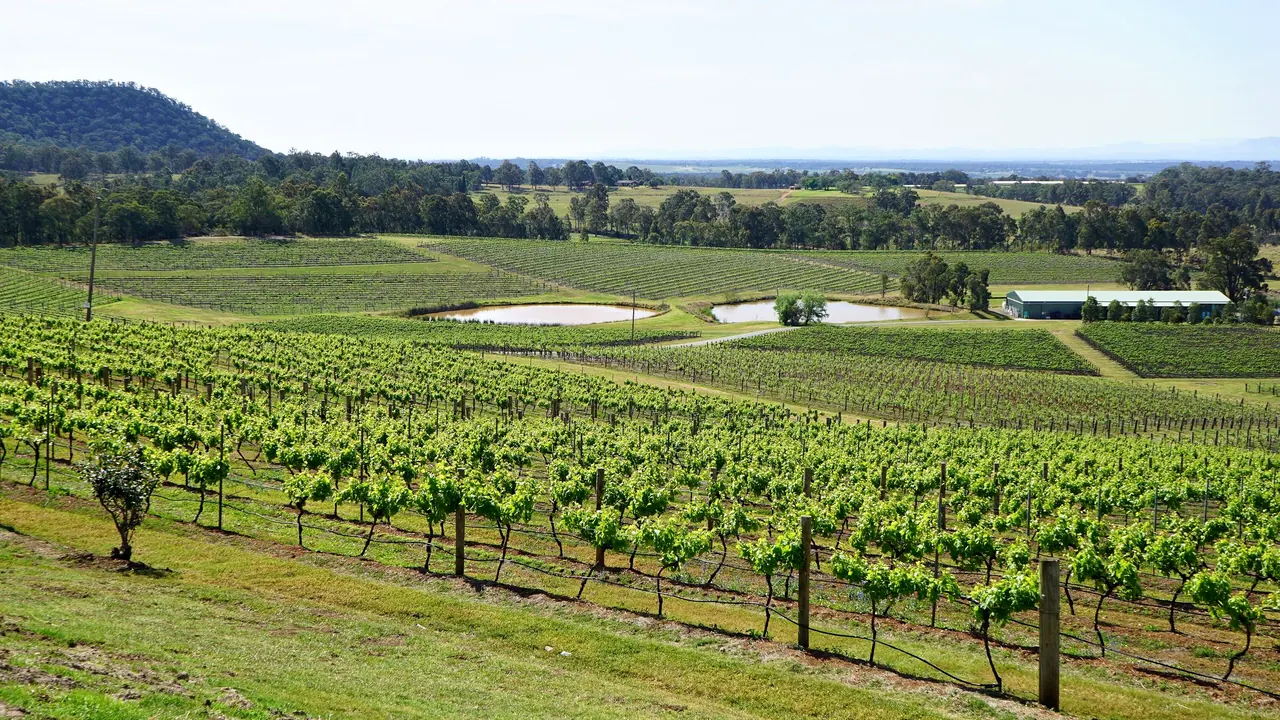
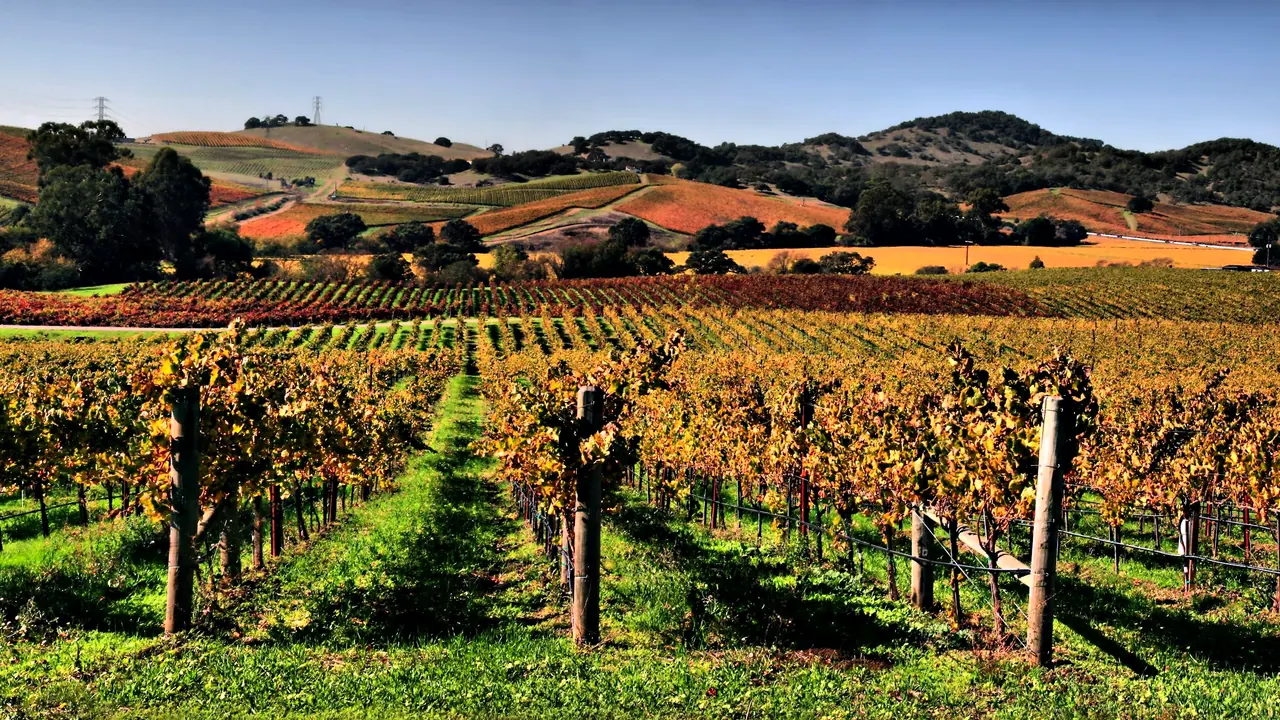
Photos: Hunter Valley by thinkrorbot, Public domain; Napa Valley by Brocken Inaglory, CC BY-SA 3.0, cropped.
Hunter Valley or Napa Valley?
Our verdict in twelve categories, each scored against the same fixed benchmark cities, and the climate month by month, so you can choose for your trip.
Choose Hunter Valley for
- beaches
- prices
- getting around
The Hunter Valley suits an easier, less costly wine weekend. You get Semillon and Shiraz at cellar doors where the winemaker often pours, short drives between them on quiet roads, and Newcastle's surf beaches and the calm bays of Port Stephens close enough for a day by the sea. It is the better choice for couples who want vineyards and a swim on the same trip, and who would rather not spend what Napa demands.
Choose Napa Valley for
- day trips
- wellness
- shopping
Pick Napa Valley when the eating and the waters are the point. Yountville's fine dining, Cabernet from grand estates and hillside cellars, and Calistoga's mud baths and mineral pools make it the stronger splurge for gourmets and anyone planning a spa retreat. San Francisco and Sonoma are near enough for good days out, but Napa costs a great deal more and has no sea you would want to swim in.
Scoreboard
Twelve categories on one fixed scale from 0 to 100. The shaded stretch is the gap between the two.
Your match
Pick a travel style or drag the sliders, and both match scores follow your weighting.
Too close to call, 2 points apart
Wins on beaches and prices with your weighting.
Wins on day trips and wellness with your weighting.
What matters to you?
Category by category
What the scores mean for a trip.
Beaches & swimming
Neither valley is on the coast, but the Hunter Valley has proper beaches within an hour. Newcastle has surf at Merewether, Bar Beach and Nobbys and its ocean baths cut into the rock, and the quieter bays around Nelson Bay suit swimmers who would rather avoid the waves. From December to April the water is warm enough for a long swim.
In Napa Valley, swimming means a summer dip at Lake Berryessa over the eastern hills, or the hotel pool. The Sonoma coast is a dramatic drive, but the cold water and strong currents rule out bathing there.
Food & drink
Both valleys exist to eat and drink, and a long lunch over the vines is the centre of any stay. The Hunter Valley's draw is Hunter Semillon, a white made in this style almost nowhere else, poured at easy-going cellar doors in Pokolbin, Broke and Lovedale. For any real range of restaurants you have to drive to Newcastle.
Napa Valley offers more choice and goes further. There is Cabernet from grand estates and from appointment-only cellars in the mountains, Yountville's rare cluster of fine dining, farm-driven bistros up-valley, and a market hall in downtown Napa for oysters and cheese. Neither valley does cheap everyday eating.
Culture & sights
Both have modest heritage that fills an afternoon, not a trip, but it differs in kind. The Hunter's is colonial townscape: Morpeth's sandstone shopfronts from its river-port days, Maitland's Victorian civic buildings and regional gallery, and Wollombi's old courthouse. Napa's is the architecture of wine itself, from nineteenth-century stone cellars and Greystone to a mock medieval castle, along with the Bale Grist Mill from the 1840s.
Nightlife
Evenings end early in both, with dinner and a last glass. What little life there is comes in a different form. In the Hunter, the old pubs of Cessnock and the country towns fill up at weekends, sometimes with hen parties. In Napa, it is wine bars, taprooms and cocktail bars along the river and First Street downtown, and they are quiet well before midnight.
Nature & outdoors
Both are gentle vineyard country, best seen from a hot-air balloon at dawn and easy to explore by bicycle on quiet roads. The Hunter's wilder side lies further out: eucalypt forest in the Watagans and Yengo, and the World Heritage rainforest of Barrington Tops for anyone who can give it a full day. Kangaroos at the vineyard edges at dusk add something Napa cannot.
Napa keeps its walking closer to hand, with the climb up Mount St. Helena and the redwoods of Bothe-Napa. Its best seasons are also different: mustard flowers between the vines in late winter, compared with the Hunter's summer harvest and autumn colour.
Day trips
From the Hunter Valley, day trips are short but modest. Newcastle has its Gothic Revival cathedral, the harbour fort and the Nobbys breakwater. There is also Maitland's old gaol, the bays of Port Stephens and the horse-stud country of the Upper Hunter. Sydney is too far for a comfortable return in a day.
Napa Valley is far better placed. San Francisco is about an hour and a half away, partly by ferry from Vallejo if you like, and Sonoma's plaza and mission, Healdsburg, Berkeley and Sausalito are all easy. Outside the city, though, many outings amount to another wine valley.
Good for families
Both are built for adults, and children will spend a fair amount of time around tasting rooms. The Hunter's extras are farm-flavoured: a small zoo where children feed kangaroos, producers to visit, the Christmas light show in the Pokolbin gardens, and Newcastle's beaches as an escape. Napa offers Calistoga's geyser and petrified forest, warm hot-spring pools and the wildlife and amusement park at Vallejo, though summer afternoons there are hot.
Getting around
Both need a car, and in both someone has to stay sober, so drivers and tours are common. The Hunter Valley is the easier of the two. Its roads are quiet, cellar doors are minutes apart, some in the Pokolbin cluster are close enough to walk between, and traffic only builds on the busiest weekends.
Napa Valley is compact, about 50km from end to end, but Highway 29 slows down at weekends and at harvest. The buses run too rarely to plan tastings around, and only the downtowns of Napa, Yountville and St. Helena are pleasant on foot. The Silverado Trail is the way round the queues.
Shopping & style
In both valleys the main purchase is wine, often by the case and shipped home. Beyond that, the Hunter Valley has cheese, olive oil and chocolate from the Pokolbin providores and the antique and craft shops of Morpeth, and anything more means a trip to Newcastle. Napa Valley offers more around the bottles: homeware, kitchen and clothing boutiques on St. Helena's Main Street, galleries in Yountville, and a food market and an outlet centre in Napa town.
Affordability
The Hunter Valley is not cheap, but its costs come in predictable places. Friday and Saturday nights carry the highest room rates, often with a minimum stay. The extras are what push a weekend up: a long lunch at a winery restaurant, a dawn balloon flight, and a driver or small-group tour for the tasting days.
Napa Valley costs a good deal more on almost every line. Room rates climb further at weekends and through the harvest season, and dinner at one of the well-known restaurants is a major outlay rather than a small treat on top. The way to soften it is where you sleep and how you lunch: a base in Napa town or further south, and picnics from the delis and markets instead of a sit-down meal.
Live music & performing arts
Both rely on summer concerts on winery lawns, with touring rock and pop acts and opera or orchestral evenings among the vines. Outside those nights the Hunter has little to offer, and anyone after theatre goes to Newcastle's Civic Theatre. Napa keeps a year-round indoor stage in downtown Napa, with its restored opera house and an Art Deco theatre, and adds a large rock festival at the Expo grounds each late spring.
Wellness & relaxation
In the Hunter Valley, relaxation means resort day spas, couples' weekends and the quiet of the vines, with no bathing tradition behind it. Napa Valley has all of that and something the Hunter lacks: Calistoga, founded as a hot-springs resort in the nineteenth century, with volcanic-ash mud baths and geothermal mineral pools in bathhouses both plain and polished.
For a trip built around the waters, stay in Calistoga. For a resort spa with serious dining nearby, choose Yountville or the Silverado Trail.
When should you go?
Pick your month. The climate figures are measured averages, not a forecast.
Hunter Valley in July
Napa Valley in July
Daytime high, °C
Rainfall in the month, mm
Where the figures come from
Hunter Valley's sunshine is measured 48 km from the centre, at Williamtown.
Napa Valley has no rain gauge within 25 km of the centre, so its rainfall comes from a gridded climate dataset read at the destination rather than from a gauge further away.
Napa Valley's sunshine is measured 76 km from the centre, at Sacramento Executive Airport.
Temperature and rainfall are climate normals, averaged over the years shown. Hunter Valley: 1991-2020 normals, Cessnock Airport (1.5 km from centre). Napa Valley: 1991-2020 (sunshine 1981-2010) normals, Napa / Middleton (21.9 km from centre).
The two valleys have their seasons the opposite way round. In the Hunter, summer runs from December to March, with highs around 31°C in January. That is hot for walking between cellar doors, but on the coast at Newcastle the sea holds at about 23°C, which is ideal for swimming. February is the wettest month at about 112mm. Spring and autumn are the most comfortable time for vineyards and walks. Winter is mild, fairly dry and sunny, which suits a quiet weekend by the fire more than a beach trip.
Napa has a dry, sunny summer. From June to September highs sit near 26°C, with almost no rain and long hours of sunshine, so it is warm without the Hunter's peak heat. Winter is cool and wet, with about 141mm of rain in January and short, grey days. May to October is the time to go, and the autumn harvest is the high point.
Which traveller are you?
On a beach and sun trip, the Hunter Valley is the only real option of the two. Newcastle's patrolled surf beaches and rock-cut ocean baths are about an hour away, and Port Stephens has calmer bays. Napa's nearest stretch of Pacific is far too cold for bathing.
For a relaxing and wellness trip, Napa Valley clearly wins. Calistoga grew up around its hot springs, with volcanic-ash mud baths and geothermal pools, and resort spas line the valley. The Hunter offers day spas and country quiet, but no bathing tradition.
On a trip on a tight budget, neither valley is cheap, but the Hunter Valley costs far less. Midweek rates drop and many cellar doors pour for little or nothing. In Napa, tasting fees mount up at every stop and the inns are priced for special occasions.
Before you go
| Measure | Hunter Valley | Napa Valley |
|---|---|---|
| Official language | English | - |
| Currency | Australian Dollar (AUD) | US Dollar (USD) |
| Sockets | I230 V, 50 Hz | AB120 V, 60 Hz |
| Driving side | Left | Right |
| Time zone | UTC+10, UTC+11 in summer | UTC-8, UTC-7 in summer |
| Emergency number | 000 | 911 |
| Main airport | Newcastle Airport (NTL)11 non-stop destinations | San Francisco International Airport (SFO)143 non-stop destinations |
| Public holidays this year | 11 days | 13 days |
By the numbers
| Measure | Hunter Valley | Napa Valley |
|---|---|---|
| Population | 620,530 | - |
| Swim season, months above 21 °C | 6 months | - |
Where else could you go?
Every comparison below shares a destination with this one, so you can follow Hunter Valley or Napa Valley somewhere new.
- Sonomavs Napa Valley
- Blue Mountainsvs Hunter Valley
- Lake Tahoevs Napa Valley
- Big Survs Napa Valley
- Yosemitevs Napa Valley
- Kings Canyonvs Napa Valley