India
Jaisalmer
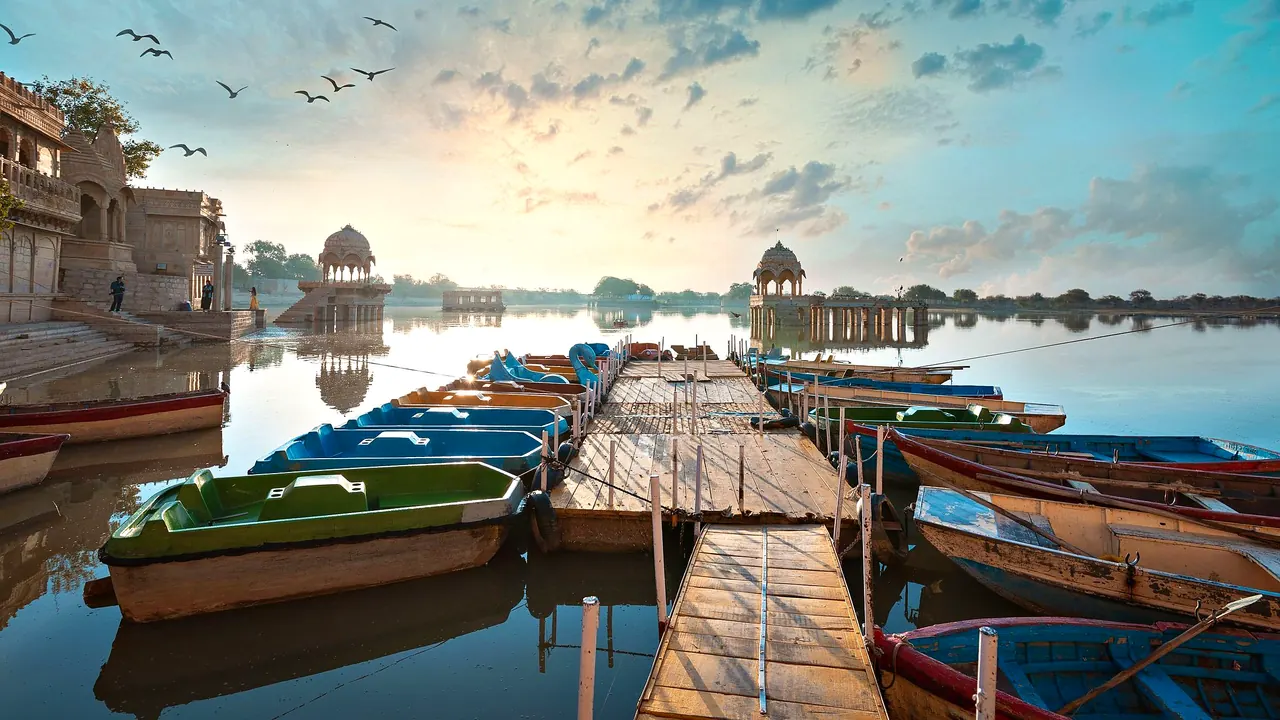
Painted boats on Gadisar Lake below the chhatris
- Affordable cities90
- Culture & sights66
- Getting around40
Photo: Prakash Yadav, Pexels License
Match
35
Every category weighted equally
- Beach & sun31
- Culture & arts39
- Food & nightlife34
- Family trip37
- Outdoors34
- Relax & unwind32
- Shopping & style36
- On a budget41
Jaisalmer in twelve categories
Our verdict on each, scored 0 to 100 against the same fixed benchmark cities, so a score means the same thing on every page.
Beaches & swimming. Scores 3 out of 100.
Food & drink. Scores 35 out of 100.
Culture & sights. Scores 66 out of 100.
Nightlife. Scores 8 out of 100.
Nature & outdoors. Scores 33 out of 100.
Day trips. Scores 20 out of 100.
Good for families. Scores 30 out of 100.
Getting around. Scores 40 out of 100.
Shopping & style. Scores 38 out of 100.
Affordability. Scores 90 out of 100.
Live music & performing arts. Scores 30 out of 100.
Wellness & relaxation. Scores 22 out of 100.
Jaisalmer category by category
Beaches & swimming
3Jaisalmer is a desert town far from any coast, and there is nowhere to swim in open water. Gadisar Lake is a place for boating and sunset views, not bathing. If swimming matters, choose a hotel with a pool. Many of the larger heritage hotels and resorts on the edge of town have one, and in the hot months it becomes the most useful thing about them.
Food & drink
35Eating here means Rajasthani desert cooking, built for a dry land: dal baati churma, ker sangri made from desert beans and berries, gatte ki sabzi, bajra roti and rich, slow curries of mutton in the meat-eating households. A vegetarian thali in a simple local eatery is the best introduction, and the town's sweet shops and morning stalls for kachori and mirchi bada are worth seeking out, with sweet lassi to cool down.
The range is narrow. Most restaurants aimed at visitors sit on rooftops facing the fort, and many mix a few Rajasthani dishes with pancakes, pasta and pizza of mixed quality. There is no fine-dining tier beyond the heritage hotels, and beer is available but drinking is not part of the local culture.
Culture & sights
66The reason to come is Jaisalmer Fort, a twelfth-century citadel of golden sandstone rising from the desert, part of a UNESCO-listed group of Rajasthan's hill forts. Unusually, it is still lived in: thousands of people inhabit its lanes, alongside the royal palace and a cluster of Jain temples with astonishingly fine carved stone interiors.
Below the walls the old town holds the merchant havelis, above all Patwon ki Haveli, Salim Singh ki Haveli and Nathmal ki Haveli, whose façades are carved like lace. Gadisar Lake with its gateway and shrines, and the royal cenotaphs at Bada Bagh just outside town, complete a set that is beautiful and coherent but small, comfortably seen in two or three days.
Nightlife
8There is very little going out in Jaisalmer. Evenings mean a rooftop dinner with the fort lit up opposite, perhaps a beer where it is served, and an early night. Those staying out at the dune camps get a campfire and a show, which ends not long after dinner. There are no clubs and no late bar scene, and the lanes empty well before midnight.
Nature & outdoors
33The Thar Desert is the one landscape here, and seeing it is the main outdoor reason to come. The Sam dunes, about 40km west, are the classic sunset spot and get crowded with jeeps and camel strings. The Khuri dunes to the south-west are quieter. The desert is at its best on an overnight camel trek, crossing scrub, small villages and patches of rolling sand, then sleeping out under a very dark, starry sky. The Desert National Park nearby protects grassland where the endangered great Indian bustard, chinkara gazelles and raptors live, and birders come in winter for the migrants.
That is the whole offer. There are no hills, rivers, forests or water sports, and little hiking or cycling. The season is short too. From October to March days are mild and sunny, with desert nights down to around 5°C. From April the heat takes over, with afternoons around 40°C in May and June, and the humid monsoon months leave only early mornings and evenings for being outdoors.
Day trips
20Jaisalmer is remote, and the other great Rajasthan cities are a long journey away rather than a day out. Within easy reach are short heritage outings: the old Jain temples of Lodurva, a former capital of the region, and the abandoned villages of Kuldhara and Khaba, whose roofless stone houses and small fort on a ridge are atmospheric and wrapped in local legend. These combine well with a dune trip.
Further out, the fort town of Pokaran and the border temple at Tanot are each around two hours by road, a long drive for a modest reward. Most visitors treat Jaisalmer as a stop on a wider Rajasthan route rather than a base.
Good for families
30Older children often love Jaisalmer: a fort that looks like a giant sandcastle, camel rides, jeep runs over the dunes and a night in a desert tent camp with music and a fire. Indian families travel here in numbers, and children are welcomed warmly.
Against that, there is nothing designed for children, no parks or museums aimed at them, and the narrow lanes are shared with motorbikes and cows. Heat is a real concern outside the cool months, hygiene needs care, and reaching the town means a long train or road journey. It works best for a family with school-age children, between October and March.
Getting around
40The town is small and its main sights sit close together, so the fort, the havelis and Gadisar Lake are easily covered on foot. The lanes are narrow and uneven, shared with motorbikes, rickshaws and wandering cattle, and walking is tiring in the heat. Auto-rickshaws cover short hops. There is no useful public transport for visitors, so the dunes, Bada Bagh and the abandoned villages are reached by hired car, jeep or an organised trip, which most hotels arrange.
Shopping & style
38Shopping here is all about crafts, and there is a lot of it. The lanes inside the fort and around the old town are lined with shops and stalls selling mirror-work and appliqué textiles, embroidered cushion covers and quilts, block-printed fabric, camel leather bags and sandals, silver jewellery, puppets and carved yellow sandstone. Sadar Bazaar and the streets near the main gate are where locals shop for spices and everyday goods.
Quality varies widely, and much of the stock repeats from shop to shop. Bargaining is expected and sellers can be insistent. There is no fashion, design or department-store shopping to speak of.
Affordability
90Jaisalmer is a very cheap place to travel. Simple guesthouses, many with rooftop views of the fort, cost little, local thalis and street snacks are inexpensive, and rickshaws and entry to the fort and havelis are modest. Camel treks and desert camps run at every level, and haggling brings prices down.
The costs that add up are at the top end: restored palace and haveli hotels and the luxury tented camps charge international rates. Foreigners also pay more than Indian visitors at monuments, and prices in shops and for tours aimed at visitors start high.
Live music & performing arts
30The Thar region is home to the Manganiyar and Langa, hereditary musician communities whose singing, kamaicha fiddles and khartal clappers are known well beyond India. A visitor hears them most evenings, at desert camps with Kalbelia dancers, on hotel rooftops and in small cultural shows near the fort, as well as puppet performances. The setting is often staged for visitors, yet the musicians themselves are the real thing.
The Desert Festival each winter brings folk music, dance and camel contests to the town and dunes. Beyond that there are no theatres, concert halls or regular venues.
Wellness & relaxation
22Jaisalmer has no bathing tradition, and wellness is limited to spas in the larger heritage hotels and simple ayurvedic massage places in the old town. The town is small but not especially restful, with touts, traffic and heat in the lanes. The calmest moments come elsewhere: an unhurried afternoon in a haveli courtyard, or a quiet night at a remote camp in the dunes, far from the noise.
When should you go?
Pick a month to see what it is like. The climate figures are measured averages, not a forecast.
Jaisalmer in July
Daytime high, °C
Rainfall in the month, mm
The whole year
Shaded against this city’s own year: the deepest cell is its best month for that figure and the palest its weakest.
Where the figures come from
Jaisalmer has no rain gauge within 25 km of the centre, so its rainfall comes from a gridded climate dataset read at the city rather than from a gauge further away.
Temperature and rainfall are climate normals, averaged over the years shown. Jaisalmer: 1993-2020 (rainfall 1991-2020) normals, Jaisalmer (1.9 km from centre).
Before you go
| Measure | Jaisalmer |
|---|---|
| Official language | Hindi, English |
| Currency | Indian Rupee (INR) |
| Sockets | CM230 V, 50 Hz |
| Driving side | Left |
| Time zone | UTC+5:30 |
| Emergency number | 108 or 112 |
| Elevation | 225 m |
| Main airport | Jaisalmer Airport (JSA)6 km from centre5 non-stop destinations |
By the numbers
| Measure | Jaisalmer |
|---|---|
| City population | 65,471 |
| People per km² | 12,837 |
| Museums within 10 km | 2 |
| UNESCO World Heritage sites within 50 km | 1 |
Compare Jaisalmer with
Every comparison with a written verdict behind it.