India
Rishikesh
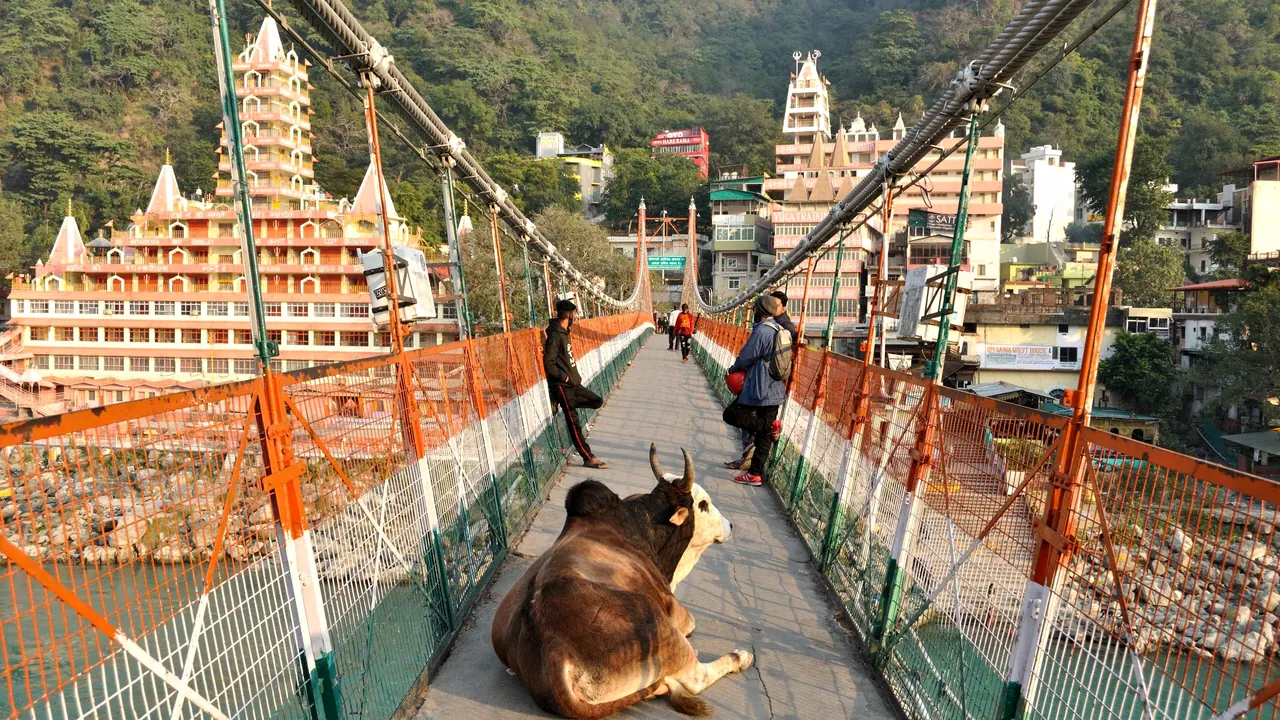
The Lakshman Jhula bridge over the Ganges
- Affordable cities93
- Wellness & relaxation88
- Nature & outdoors78
Photo: Dey.sandip, CC BY-SA 4.0, cropped
Match
43
Every category weighted equally
- Beach & sun46
- Culture & arts42
- Food & nightlife36
- Family trip47
- Outdoors53
- Relax & unwind51
- Shopping & style39
- On a budget49
Rishikesh in twelve categories
Our verdict on each, scored 0 to 100 against the same fixed benchmark cities, so a score means the same thing on every page.
Beaches & swimming. Scores 12 out of 100.
Food & drink. Scores 36 out of 100.
Culture & sights. Scores 42 out of 100.
Nightlife. Scores 4 out of 100.
Nature & outdoors. Scores 78 out of 100.
Day trips. Scores 54 out of 100.
Good for families. Scores 26 out of 100.
Getting around. Scores 38 out of 100.
Shopping & style. Scores 30 out of 100.
Affordability. Scores 93 out of 100.
Live music & performing arts. Scores 20 out of 100.
Wellness & relaxation. Scores 88 out of 100.
Rishikesh category by category
Beaches & swimming
12Rishikesh has no sea. What it has are white sand banks along the Ganges, where people sit and watch the river, and beaches upstream near Shivpuri where the rafting camps pitch their tents. The water comes down from the Himalaya cold and green. The current is strong and drownings happen, so careful visitors keep to a ritual dip at the ghats, holding the chains, rather than going for a proper swim. Come for the river as something to look at, and swim in a hotel pool if you want one.
Food & drink
36Rishikesh is a holy town, and meat and alcohol are not sold here. Eating means vegetarian food: thalis, dal and roti at simple dhabas, puri and jalebi for breakfast, and masala chai poured from stalls by the bridges and ghats. Many cafés in Tapovan and around the riverbanks have terraces over the Ganges. They cater to long-stay yoga students, with smoothie bowls, Israeli and Tibetan dishes, wood-fired pizza and Ayurvedic plates. These are pleasant places to linger, but the menus repeat from café to café and there is little cooking ambitious enough to plan a day around. People who care about food will eat well and cheaply, and find the range narrow after a week.
Culture & sights
42Here the sights are religious and atmospheric rather than monumental. Ram Jhula, the iron suspension footbridge, crosses the Ganges to Swarg Ashram, a quarter of painted ashrams, temples and shrines with statues of gods along the riverfront. Upstream, in the Lakshman Jhula area, the thirteen-storey Tera Manzil temple rises in tiers above the east bank. In the old town, Bharat Mandir is the oldest temple in Rishikesh. Triveni Ghat is the main bathing ghat, and every evening the Ganga aarti, with fire lamps, chanting and floating leaf boats, draws crowds there and to the steps of Parmarth Niketan.
The best-known single sight is the ruined Maharishi ashram where the Beatles stayed in 1968. Its meditation domes and empty halls stand in the forest, overgrown and covered in murals. Beyond that the town has no museums of note and little historic architecture, so two or three days cover it.
Nightlife
4Going out barely exists here. Alcohol is not sold in the holy town, there are no bars or clubs, and most visitors are in bed early to make a dawn yoga class. Evenings are the aarti on the ghats, a long dinner on a café terrace and perhaps a candlelit chant session. If you want a drink, you have to leave town, and that is not why people come.
Nature & outdoors
78Rishikesh sits where the Ganges leaves the mountains. Forested Shivalik ridges rise on both banks, and the outdoors starts at the edge of town. The river is the main draw. Rafting runs from upstream camps at Shivpuri and beyond, through rapids of real force, and the season stops when the monsoon swells the river in high summer. Short hikes lead to waterfalls such as Neer Garh, and before dawn people drive up to the Kunjapuri hilltop temple to watch the sun rise over snow peaks on clear winter mornings.
Rajaji National Park borders the town, with jeep safaris for elephants, deer and birds, and leopards and tigers if you are lucky. There is also bungee jumping, ziplining and kayaking. The truly high Himalaya is a multi-day trip from here.
Day trips
54The essential trip is Haridwar, under an hour down the river. It is one of Hinduism's seven holiest cities, and its evening aarti at Har Ki Pauri is far larger and more intense than Rishikesh's own. Dehradun, about an hour away, has the colonial Forest Research Institute and the Tibetan Mindrolling monastery. A little over two hours of hairpin road leads to the hill station of Mussoorie, with its Mall Road and Himalayan views.
For something more remote, Devprayag, where the Alaknanda and Bhagirathi rivers meet to form the Ganges, makes a long but rewarding day. The temple of Neelkanth Mahadev is a popular pilgrimage drive into the hills. Beyond these, the places of real interest are several days' journey into the mountains.
Good for families
26Rishikesh is not built for children. Families with teenagers can do well here, with rafting (which has minimum ages), jeep safaris in Rajaji, ziplines and the drama of the evening aarti. With small children it is harder going. The river is fast and cold, the narrow lanes are shared with motorbikes, cows and macaques that snatch food, and the hills are steep. There are no parks, museums or attractions aimed at children. Indian culture is warm towards children, and the vegetarian food is easy on young stomachs, but most of what the town offers is meant for adults seeking quiet.
Getting around
38The town strings out along both banks of the Ganges. Tapovan, Lakshman Jhula, Ram Jhula and the ghats near Triveni are linked by footbridges and riverside paths, and much of a stay is spent on foot, often uphill and dodging motorbikes on the bridges. Shared autos called vikrams run up and down the main road and are cheap once you learn the routes. Ferries cross the river near Ram Jhula. There is no metro or reliable bus system. Rafting put-ins, waterfalls and hilltop temples mean hiring a taxi or joining an organised trip, and the nearest airport and railheads are a drive away.
Shopping & style
30Shopping here follows the town's spiritual purpose. The lanes around Ram Jhula and Lakshman Jhula are lined with stalls selling cotton yoga clothes, meditation shawls, rudraksha and crystal malas, brass singing bowls, incense and Ayurvedic oils, plus bookshops full of philosophy and yoga texts. Some of it is good, but much repeats from shop to shop, and bargaining is expected. Apart from this one theme there is little, with no fashion streets, design boutiques or department stores, so few visitors come to shop.
Affordability
93Rishikesh is among the cheapest places a traveller can stay well. Simple guesthouses and ashram rooms cost very little, a thali or a café breakfast costs a fraction of Western prices, and shared autos are almost free. Drop-in yoga classes and the evening aarti are inexpensive or free. The main costs are rafting trips, multi-week teacher trainings and the upmarket riverside retreats, which are priced for an international clientele, but even these are modest by global standards.
Live music & performing arts
20Live performance here is mostly devotional. The evening aarti brings singing and drums to the ghats, and ashrams and cafés hold kirtan sessions where visitors sit and chant with harmonium and tabla. Now and then a sitar or bansuri player gives an evening recital, and music lessons are easy to find. There is no theatre, concert hall or formal performing arts season, so anyone who wants a programme to attend will find very little.
Wellness & relaxation
88People come to Rishikesh to slow down. Rishikesh calls itself the world's yoga capital and has the institutions to back the claim. Dozens of ashrams offer daily classes, silent meditation and residential courses, and both seasoned practitioners and beginners take long teacher trainings here. Ayurvedic clinics give oil massages and multi-day detox treatments, and sound healing and breathwork are on offer all over Tapovan. The International Yoga Festival held each spring adds to the calendar.
The rhythm is set by dawn practice, vegetarian food, no alcohol and early nights. A morning dip at the ghats is the local form of bathing. The calm has limits, though. The bridges and main road are crowded, horns are constant, and the peace is in the ashram gardens and the quieter stretches upriver.
When should you go?
Pick a month to see what it is like. The climate figures are measured averages, not a forecast.
Rishikesh in July
Daytime high, °C
Rainfall in the month, mm
The whole year
Shaded against this city’s own year: the deepest cell is its best month for that figure and the palest its weakest.
Where the figures come from
Rishikesh has no weather station within reach, so its figures come from a gridded climate model rather than a measured record, and read a broad area rather than the city itself.
Temperature and rainfall are climate normals, averaged over the years shown. Rishikesh: 2001-2020 normals, NASA POWER reanalysis grid, no weather station within 90 km.
Before you go
| Measure | Rishikesh |
|---|---|
| Official language | Hindi, English |
| Currency | Indian Rupee (INR) |
| Sockets | CM230 V, 50 Hz |
| Driving side | Left |
| Time zone | UTC+5:30 |
| Emergency number | 108 or 112 |
| Elevation | 372 m |
| Main airport | Dehradun Jolly Grant Airport (DED)14 km from centre13 non-stop destinations |
By the numbers
| Measure | Rishikesh |
|---|---|
| City population | 70,499 |
| People per km² | 133 |
| Museums within 10 km | 0 |
| UNESCO World Heritage sites within 50 km | 0 |
Compare Rishikesh with
Every comparison with a written verdict behind it.