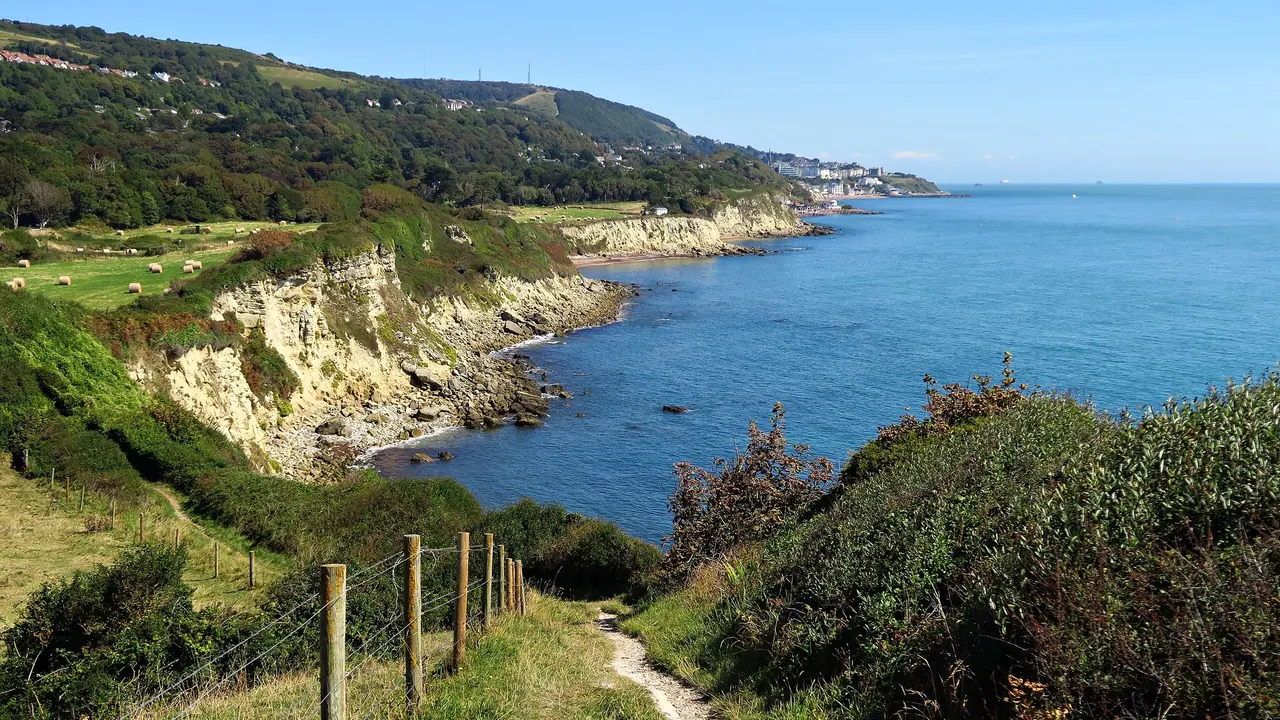
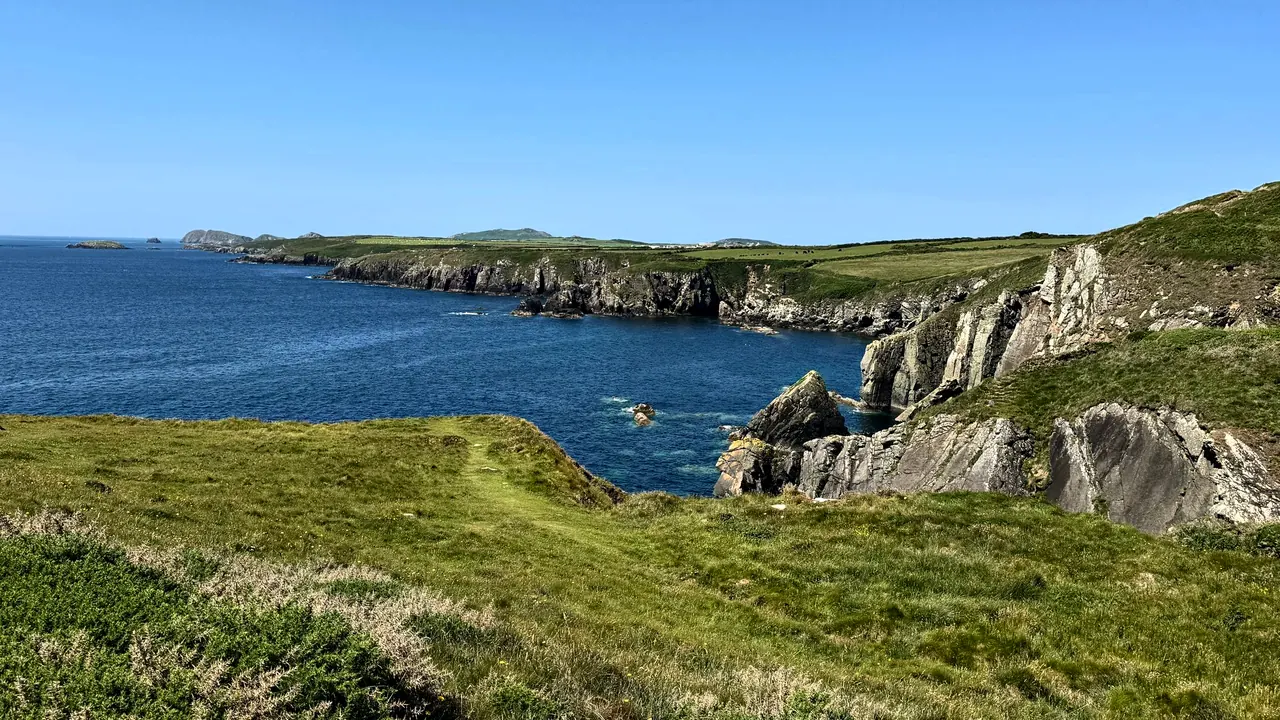
Photos: Isle of Wight by Michael Coppins, CC BY-SA 4.0, cropped; Pembrokeshire by Petra Nesti, Pexels License.
Isle of Wight or Pembrokeshire?
Our verdict in twelve categories, each scored against the same fixed benchmark cities, and the climate month by month, so you can choose for your trip.
Choose Isle of Wight for
- getting around
- day trips
- families
The Isle of Wight is the easier vacation, especially with children or without a car. It is small enough that buses and the little railway from Ryde reach the resort towns. Blackgang Chine, the zoo and the fossil beaches give children plenty to do, and summers are a touch warmer and sunnier. Portsmouth's dockyard and the New Forest are just across the Solent when you want a change.
Choose Pembrokeshire for
- nature and the outdoors
- beaches
- culture and sights
Choose Pembrokeshire when the coast itself is the point of the trip. The cliffs are bigger and wilder, there are puffins on Skomer and seals at Ramsey, and the beaches, from Barafundle to Whitesands, are finer and more varied. St Davids and the ring of Norman castles also give it more history. Expect to drive most days and to trade a little sunshine for more space.
Scoreboard
Twelve categories on one fixed scale from 0 to 100. The shaded stretch is the gap between the two.
Your match
Pick a travel style or drag the sliders, and both match scores follow your weighting.
Too close to call, 2 points apart
Wins on getting around and day trips with your weighting.
Wins on nature and the outdoors and beaches with your weighting.
What matters to you?
Category by category
What the scores mean for a trip.
Beaches & swimming
Both coasts have good sand and a cold sea, so neither suits a swimming vacation. The difference is choice. Pembrokeshire has more beaches and finer ones: Barafundle, a cove you walk in to, the surf beaches of Whitesands and Newgale, and the sheltered bays around Dale and Marloes, with lifeguards on many in summer.
The Isle of Wight's best is the long, sheltered curve of Sandown Bay and the flat sands at Ryde, which suit small children well, while Compton Bay has surf under coloured cliffs. The sea here is about a degree warmer in late summer, which barely changes how long a dip lasts.
Food & drink
The two eat in much the same way: crab and lobster from small harbours, farm shops for self-catering, pub lunches and fish and chips. The island has its garlic, tomatoes, a few vineyards and cream teas in Godshill, with its more ambitious kitchens around Cowes and Ventnor. Pembrokeshire has salt-marsh lamb, early potatoes and dairy-farm ice cream, and its few good restaurants are in St Davids, Narberth and Fishguard.
Culture & sights
Pembrokeshire has more history to seek out. St Davids, a pilgrimage place for centuries, puts its cathedral and the roofless Bishop's Palace together in one hollow. Around it are castles from Pembroke, where Henry VII was born, to Carew and Manorbier, and prehistoric sites such as Pentre Ifan in the Preseli Hills.
The Isle of Wight has one sight of national standing in Osborne House, plus Carisbrooke Castle above Newport. After those come half-day stops: the Brading mosaics, the Needles Old Battery and Tennyson's Farringford. The list is shorter, though more of it can be reached without a car.
Nightlife
Neither is a place for going out, and on most nights both are quiet by eleven. Pembrokeshire's livelier evenings are in Tenby's harbour pubs on summer weekends, when groups on weekends away fill the old town. The island has a few late bars and a small club in Newport and Ryde, and Cowes during August regatta week, when its waterfront fills with sailing crews.
Nature & outdoors
This is where the two differ most, and it is Pembrokeshire's main reason to go. Its national park coast has higher cliffs, arches and stacks, along a path nearly three times the length of the island's. The wildlife is on another scale too: puffins on Skomer, seal pups on Ramsey, gannets on Grassholm and dolphins in the bays. Coasteering, surf and sea kayaking add plenty for active visitors.
The Isle of Wight is gentler. It has chalk downs, the ridge of Tennyson Down out to the Needles, the overgrown Undercliff, red squirrels at Newtown Creek and quiet lanes for cycling. Its real strength outdoors is on the water, since the Solent off Cowes is one of the great sailing grounds.
Day trips
The Isle of Wight has the better day trips, mostly thanks to the mainland across the Solent. Portsmouth's Historic Dockyard, with HMS Victory and the Mary Rose, is a quick foot ferry from Ryde. Lymington leads on to the New Forest and Beaulieu, and Winchester can be reached through Southampton, although each crossing needs planning.
Pembrokeshire's outings are pleasant but smaller: the monks' island of Caldey by boat from Tenby, Cardigan and Aberaeron up the coast, and Dylan Thomas's boathouse at Laugharne. The Gower is the furthest worthwhile run, about two hours away.
Good for families
Both have been family seaside places for generations, but the island has more built for children. Blackgang Chine, Robin Hill, the tiger and lemur zoo, the steam railway, the fossil hunts and the Needles chairlift fill days the beach cannot, and nothing is far away.
Pembrokeshire's family days are simpler: rock pools, crabbing off harbour walls and boat trips to see seals and puffins, with a farm park and soft-play centres for rainy days. Tenby and Saundersfoot make easy bases, but most outings need the car.
Getting around
The island is far easier without a car. Buses link every town, open-top buses climb to the Needles in summer, and the railway from Ryde Pier runs down to Shanklin. The one fixed step is the ferry, and the foot-passenger crossings land right in town.
Pembrokeshire is larger and more spread out, and a car is close to essential for its narrow, hedge-lined lanes, though the beach car parks fill early. Branch lines reach Tenby, Pembroke and Fishguard, and the seasonal coastal buses help walkers doing one-way stretches of the path.
Shopping & style
Pembrokeshire has a little more worth bringing home, though shopping is a sideline on either trip. On the Isle of Wight it means the chandlers and sailing clothes along Cowes's High Street, glassblowers and potters in Ventnor and Yarmouth, and jars of coloured Alum Bay sand. Newport's high street covers everyday needs.
Pembrokeshire's best browse is Narberth, a small market town of independent shops, delis and antiques. The county's woollen mills still weave Welsh blankets and throws, the purchase here that makes a real keepsake, and galleries in St Davids sell local prints and pottery.
Affordability
Both charge British peak-summer prices in July and August and are much cheaper in spring and early autumn. Pub meals and farm-shop picnics keep daily spending down in both.
What differs is the extra cost. On the island it is the ferry, which is steep with a car, though foot passengers using the buses avoid most of it. Pembrokeshire has no crossing but does need a car, and its limited supply of good rooms fills up during the school summer break.
Live music & performing arts
The island has the bigger draw in the Isle of Wight Festival, a large rock and pop weekend outside Newport each June with roots in the late 1960s. It also has a Victorian theatre in Shanklin and Ventnor's summer fringe.
Pembrokeshire's best moment is quieter: classical concerts under the ancient roof of St Davids Cathedral in early summer. Outside those dates, both come down to folk and pub sessions.
Wellness & relaxation
Rest in both places comes from the pace rather than from treatments, and spa options are limited to a handful of hotels. The Isle of Wight has a gentle tradition of its own in Ventnor, built as a Victorian health resort for its mild, sheltered climate, and the monks of Quarr Abbey open their gardens and tea room to visitors.
Pembrokeshire's calm feels emptier. Outside August it has quiet lanes and small coastal towns, plus a few yoga and retreat stays in farmhouses and on the coast if you want a more structured break.
When should you go?
Pick your month. The climate figures are measured averages, not a forecast.
Isle of Wight in July
Pembrokeshire in July
Daytime high, °C
Rainfall in the month, mm
Where the figures come from
Isle of Wight's temperatures are measured 39 km from the centre, at Bournemouth Airport.
Isle of Wight has no rain gauge within 25 km of the centre, so its rainfall comes from a gridded climate dataset read at the destination rather than from a gauge further away.
Pembrokeshire's temperatures are measured 46 km from the centre, at Aberporth.
Pembrokeshire has no rain gauge within 25 km of the centre, so its rainfall comes from a gridded climate dataset read at the destination rather than from a gauge further away.
Temperature and rainfall are climate normals, averaged over the years shown. Isle of Wight: 1991-2020 normals, Bournemouth Airport (38.9 km from centre). Pembrokeshire: 1991-2020 normals, Aberporth (46.2 km from centre).
Both follow the same pattern. The useful season runs from May to September, beach days belong to July, August and early September, and the rain sets in heavily from October through the winter, which is cool, wet and grey in both. Around the main resorts, the Isle of Wight is the warmer and brighter of the two, with July and August highs of about 22°C against 18°C in Pembrokeshire. The island also gets more sunshine and noticeably less rain through high summer.
The sea is much the same in both. It peaks in August at about 18°C off the island and a degree cooler off Wales, so dips are brisk either way. Pembrokeshire's August is one of its wetter months, while May is its driest and sunniest, so late spring and early summer suit its coast path best. The island stays reliable for longer, from June to August.
Which traveller are you?
On a family trip with young children, the Isle of Wight is the easier choice. Blackgang Chine, Robin Hill, the zoo and the fossil hunts fill the grey days, Sandown Bay's gentle sands suit toddlers, and the short distances keep journeys painless.
For an outdoors trip, Pembrokeshire wins clearly. It has a national park coast path, puffins on Skomer and seals on Ramsey, plus coasteering, surf at Freshwater West and sea kayaking. That is far more than the island's gentle downs offer, though Cowes stays the sailors' choice.
On a beach and sun trip, Pembrokeshire has the finer and more varied sand, with enough beaches, from Barafundle to Newgale, to find a quiet one even in August. The island is slightly warmer and sunnier, but its beaches are fewer and less striking.
Before you go
| Measure | Isle of Wight | Pembrokeshire |
|---|---|---|
| Official language | English | English |
| Currency | Pound Sterling (GBP) | Pound Sterling (GBP) |
| Sockets | G230 V, 50 Hz | G230 V, 50 Hz |
| Driving side | Left | Left |
| Time zone | UTC, UTC+1 in summer | UTC, UTC+1 in summer |
| Emergency number | 112 or 999 | 112 or 999 |
| Main airport | Southampton Airport (SOU)15 non-stop destinations | Cardiff International Airport (CWL)32 non-stop destinations |
| Public holidays this year | 8 days | 8 days |
By the numbers
| Measure | Isle of Wight | Pembrokeshire |
|---|---|---|
| Population | 140,459 | 125,818 |
| People per km² | 369 | 78 |
| Swim season, months above 21 °C | None | None |
Where else could you go?
Every comparison below shares a destination with this one, so you can follow Isle of Wight or Pembrokeshire somewhere new.
- Jurassic Coastvs Isle of Wight
- Cotswoldsvs Isle of Wight
- Cornwallvs Pembrokeshire
- Devonvs Isle of Wight
- Normandyvs Isle of Wight
- Snowdoniavs Pembrokeshire