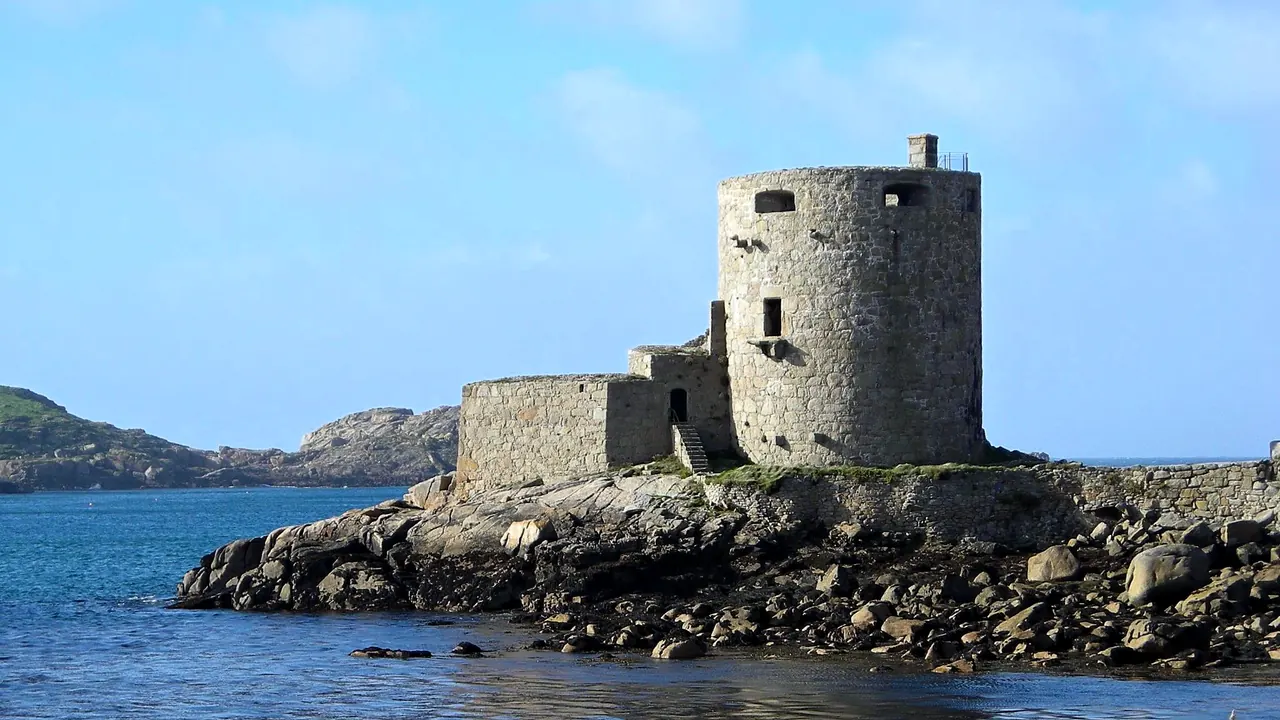
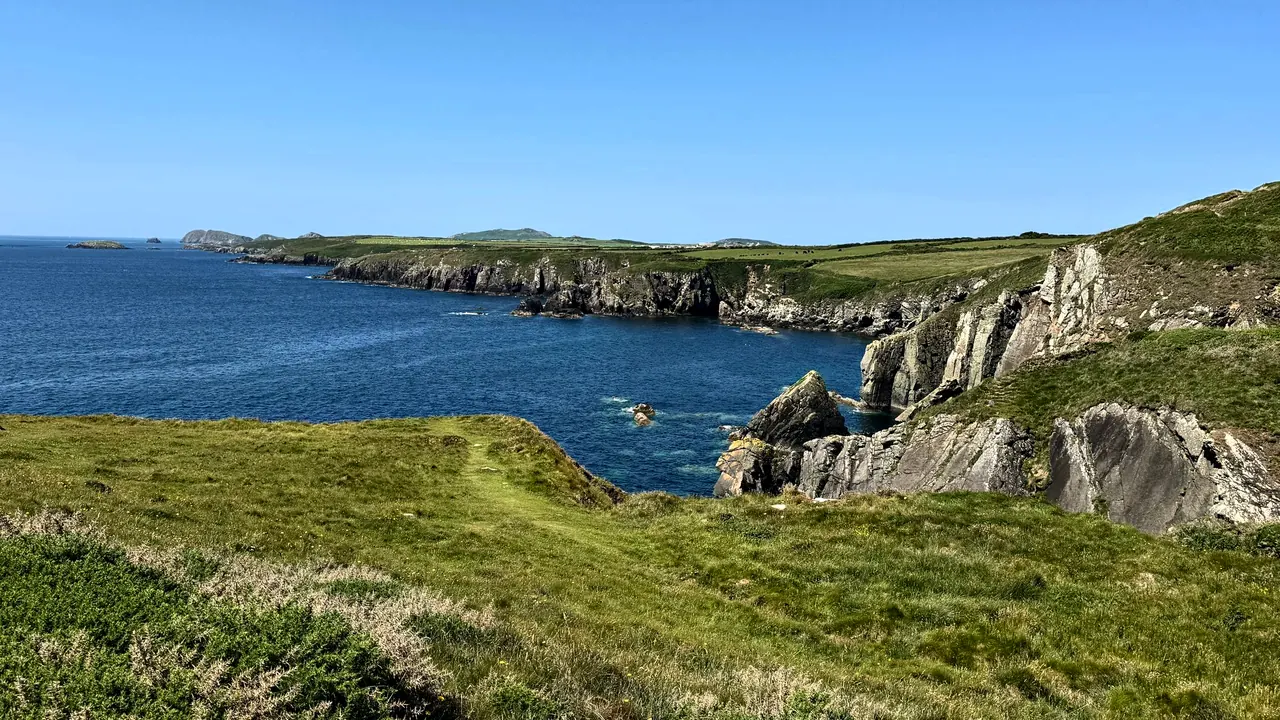
Photos: Isles of Scilly by Mark Percy, CC BY-SA 2.0, cropped; Pembrokeshire by Petra Nesti, Pexels License.
Isles of Scilly or Pembrokeshire?
Our verdict in twelve categories, each scored against the same fixed benchmark cities, and the climate month by month, so you can choose for your trip.
Choose Isles of Scilly for
- getting around
- wellness
The Isles of Scilly suit travellers who want to leave the car behind and let the tides and boat times set the day. Five small inhabited islands, each walkable in an hour or two, give you empty shell-sand bays, seals and puffins from a launch, and a quiet that is hard to find on the mainland. You give up choice and you pay a premium for it: fewer restaurants, almost nothing in the evenings and little to fall back on when the Atlantic weather closes in.
Choose Pembrokeshire for
- prices
- culture and sights
- nature and the outdoors
Pembrokeshire is the better pick for a fuller, more active and more affordable week on the coast. A long national park coastline with surf, coasteering and some of Britain's best seabird islands sits alongside St Davids Cathedral, a ring of Norman castles and more towns to eat and shop in. It suits families who need wet-day backups and walkers who want new cliffs every day, though you will spend time in a car on narrow lanes.
Scoreboard
Twelve categories on one fixed scale from 0 to 100. The shaded stretch is the gap between the two.
Your match
Pick a travel style or drag the sliders, and both match scores follow your weighting.
Wins on getting around and wellness with your weighting.
Wins on prices and culture and sights with your weighting.
What matters to you?
Category by category
What the scores mean for a trip.
Beaches & swimming
Both have the same cold Atlantic, so neither is a place to spend hours in the water. Scilly's bays are the more striking, with pale shell sand and clear turquoise water at Par Beach on St Martin's, Pentle Bay on Tresco and Rushy Bay on Bryher, and they stay nearly empty even in August.
Pembrokeshire edges ahead on range and practicality. It has town beaches in Tenby, the walk-in cove at Barafundle, big surf strands at Newgale and Whitesands, and lifeguards on many of them in summer, so it is easier to find a beach to suit the weather, the tide or the children.
Food & drink
Both draw on the same kind of larder: crab and lobster from local boats, early potatoes and farm ice cream. On Scilly nearly everything is in Hugh Town, each off-island has little more than a pub and a café, and choice drops away out of season, which is why so many visitors self-cater.
Pembrokeshire gives you more places to eat well. There are a few good restaurants in Fishguard, St Davids, Narberth and the harbour villages, and its farmers' markets and farm shops, with salt-marsh lamb and farmhouse cheeses, make self-catering easier and more varied.
Culture & sights
Scilly's heritage is compact and maritime. The Garrison walls around Star Castle, Bronze Age graves on St Mary's and the ship figureheads in Tresco Abbey Garden's Valhalla collection tell a story of shipwrecks and defence, and you can see it all in two or three days.
Pembrokeshire has more, and it carries more weight. St Davids Cathedral and the ruined Bishop's Palace, Pembroke Castle, where Henry VII was born, the castles at Carew and Manorbier, Tenby's medieval walls and Pentre Ifan in the Preseli Hills make a far richer heritage trail, though you need a car to link them.
Nightlife
Neither is for a night out, but Pembrokeshire has a bit more going on. Tenby's harbour pubs fill on summer weekends and a few bars stay open late. On Scilly the evening event is watching the pilot gigs race and having a pint on the quay, and if you are staying on an off-island, the last boat ends the night.
Nature & outdoors
Both are coast-and-wildlife destinations, but Pembrokeshire is bigger and more varied. Its national park coast path runs for about 300km over cliffs, arches and stacks. Skomer has puffins, Ramsey has seal pups and Grassholm one of the world's great gannet colonies, and there is surf, coasteering and inland moorland in the Preselis.
Scilly works on a smaller scale. It has gentle granite heath and coves, seals around the Western Rocks, puffins on Annet and snorkelling in sheltered channels. It also has a speciality of its own: in October, birdwatchers arrive in numbers for the rare migrants.
Day trips
On Scilly, a day trip means a launch to another island. Tresco is groomed, Bryher wild, St Martin's long and quiet and St Agnes remote, and they make lovely days out, but once you have done them there is nowhere else to go.
Pembrokeshire has more to drive to. You can take a boat to the monks' island of Caldey, go north up the coast to Cardigan, Aberaeron and New Quay, visit Dylan Thomas's Laugharne or reach the Gower within about two hours.
Good for families
Both are classic places for British family vacations built on rock pools, crabbing and seal trips. Scilly's great advantage is freedom: there is barely any traffic, so older children can roam. But it has nothing to fall back on when the weather turns, and toddlers need watching on the boats.
Pembrokeshire is the easier all-round choice. It has lifeguarded beaches, a farm park with an indoor funfair, a wildlife park and soft-play centres for wet days, and Tenby and Saundersfoot have beaches within walking distance in town. The trade-off is time in the car.
Getting around
Once you arrive, Scilly is the easier place to get around. No car is needed: Hugh Town is compact, St Mary's has a small bus and bikes, and launches link the islands. Getting there is the hard part, on a long ferry from Penzance or a short flight often held up by fog, and rough seas can cancel crossings between islands.
In Pembrokeshire a car is close to essential. The county is only about an hour across, but narrow hedged lanes and beach car parks that fill early in summer slow things down. Branch railway lines and the seasonal coast path buses help with walks from one place to another.
Shopping & style
Shopping is a sideline in both, but Pembrokeshire has more of it. Narberth's independent shops, delis and antiques make a good afternoon, and Welsh blankets and throws from the county's woollen mills are worth taking home. On Scilly it comes down to a few streets in Hugh Town and small island studios, and the most characteristic buy is a box of scented narcissi posted home.
Affordability
Pembrokeshire is clearly the cheaper of the two. Peak summer is expensive and the good rooms go quickly, but pub meals are moderately priced, the beaches and coast path are free, and spring and early autumn are noticeably cheaper.
Scilly costs more at every step. You pay for the flight or ferry out, hotels charge an island premium, with Tresco the dearest, food arrives by sea, and each day on another island means another boat fare. Campsites and self-catering are the main ways to soften the bill.
Live music & performing arts
Pembrokeshire has more to offer. The classical music festival under the roof of St Davids Cathedral in early summer is a genuine draw, and Fishguard and Milford Haven have small theatres for touring shows. Scilly has no venue at all, only the occasional pub folk session or church concert.
Wellness & relaxation
Neither has a spa culture, and both rely on their pace to help you unwind. Scilly does that more completely. There are no cars or crowds, the day runs to the tides and the boats, and the evenings are spent watching the light over the outer rocks. A few hotel spas on Tresco and St Mary's are the extent of the treatments.
Pembrokeshire offers a handful of country-house hotel spas and some farmhouse yoga retreats, and it is very quiet outside August. Even so, the roads and busy summer towns mean it rarely feels as cut off as the islands do.
When should you go?
Pick your month. The climate figures are measured averages, not a forecast.
Isles of Scilly in July
Pembrokeshire in July
Daytime high, °C
Rainfall in the month, mm
Where the figures come from
Isles of Scilly has no rain gauge within 25 km of the centre, so its rainfall comes from a gridded climate dataset read at the destination rather than from a gauge further away.
Isles of Scilly's sunshine is measured 78 km from the centre, at Camborne.
Pembrokeshire's temperatures are measured 46 km from the centre, at Aberporth.
Pembrokeshire has no rain gauge within 25 km of the centre, so its rainfall comes from a gridded climate dataset read at the destination rather than from a gauge further away.
Temperature and rainfall are climate normals, averaged over the years shown. Isles of Scilly: 1991-2020 normals, Scilly, Saint Mary'S (0.7 km from centre). Pembrokeshire: 1991-2020 normals, Aberporth (46.2 km from centre).
Both are at their best from late May to September, and in high summer they are almost twins: daytime highs reach about 19°C on Scilly and a degree less in Pembrokeshire, and the sea peaks around 17°C in August in both, so beach days mean brisk swims, ideally in a wetsuit. May and June bring the most sunshine to both and less rain than late summer, which makes early summer the pick for walking and wildlife. Pembrokeshire turns wetter in August, with around 89mm, while Scilly stays a little drier through July and August.
The difference shows in winter. Scilly is mild, with highs rarely below 10°C, against about 7°C in Pembrokeshire, so a winter walk there is rarely cold, though it is wet and grey from October to January in both. Spring arrives at much the same pace in each, and both are pleasant for walking from April, well before the sea is warm enough to bathe.
Which traveller are you?
For a relaxing and wellness trip, choose the Isles of Scilly, provided switching off matters more to you than treatments. With no car to drive and little to plan, a week there unwinds you faster than touring Pembrokeshire's lanes.
On an outdoors trip, Pembrokeshire suits anyone who wants a different activity each day: a long coast-path walk, a surf lesson, coasteering or a kayak trip. Scilly is better for gentle walks and watching seals than for a week of adrenaline.
On a tight budget, Pembrokeshire is the sensible choice, ideally in spring or early autumn. A campsite pitch, farm-shop food cooked yourself and free days on the beaches and coast path make money go a long way, while Scilly is a trip to save up for.
Before you go
| Measure | Isles of Scilly | Pembrokeshire |
|---|---|---|
| Official language | English | English |
| Currency | Pound Sterling (GBP) | Pound Sterling (GBP) |
| Sockets | G230 V, 50 Hz | G230 V, 50 Hz |
| Driving side | Left | Left |
| Time zone | UTC, UTC+1 in summer | UTC, UTC+1 in summer |
| Emergency number | 112 or 999 | 112 or 999 |
| Main airport | St. Mary's Airport (ISC)2 non-stop destinations | Cardiff International Airport (CWL)32 non-stop destinations |
| Public holidays this year | 8 days | 8 days |
By the numbers
| Measure | Isles of Scilly | Pembrokeshire |
|---|---|---|
| Population | 2,281 | 125,818 |
| People per km² | 140 | 78 |
| Swim season, months above 21 °C | None | None |
Where else could you go?
Every comparison below shares a destination with this one, so you can follow Isles of Scilly or Pembrokeshire somewhere new.
- Cornwallvs Isles of Scilly
- Cornwallvs Pembrokeshire
- Snowdoniavs Pembrokeshire
- Devonvs Pembrokeshire
- Jurassic Coastvs Pembrokeshire
- Devonvs Isles of Scilly