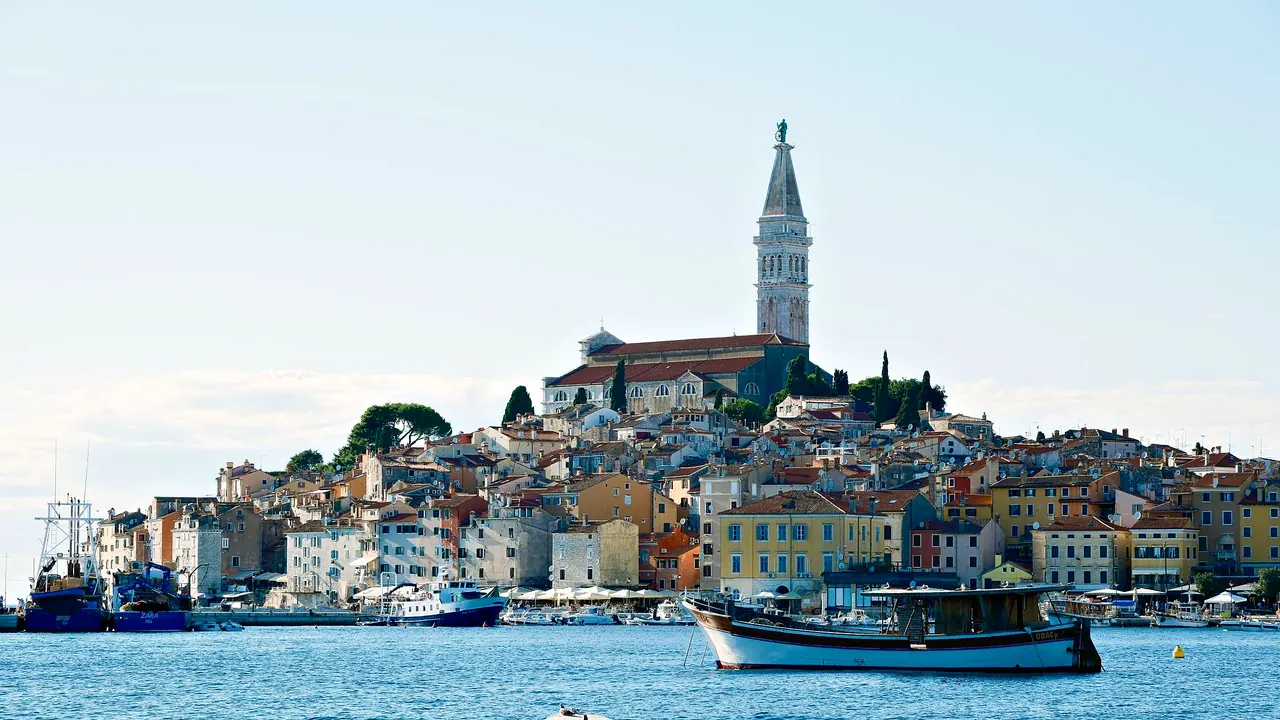
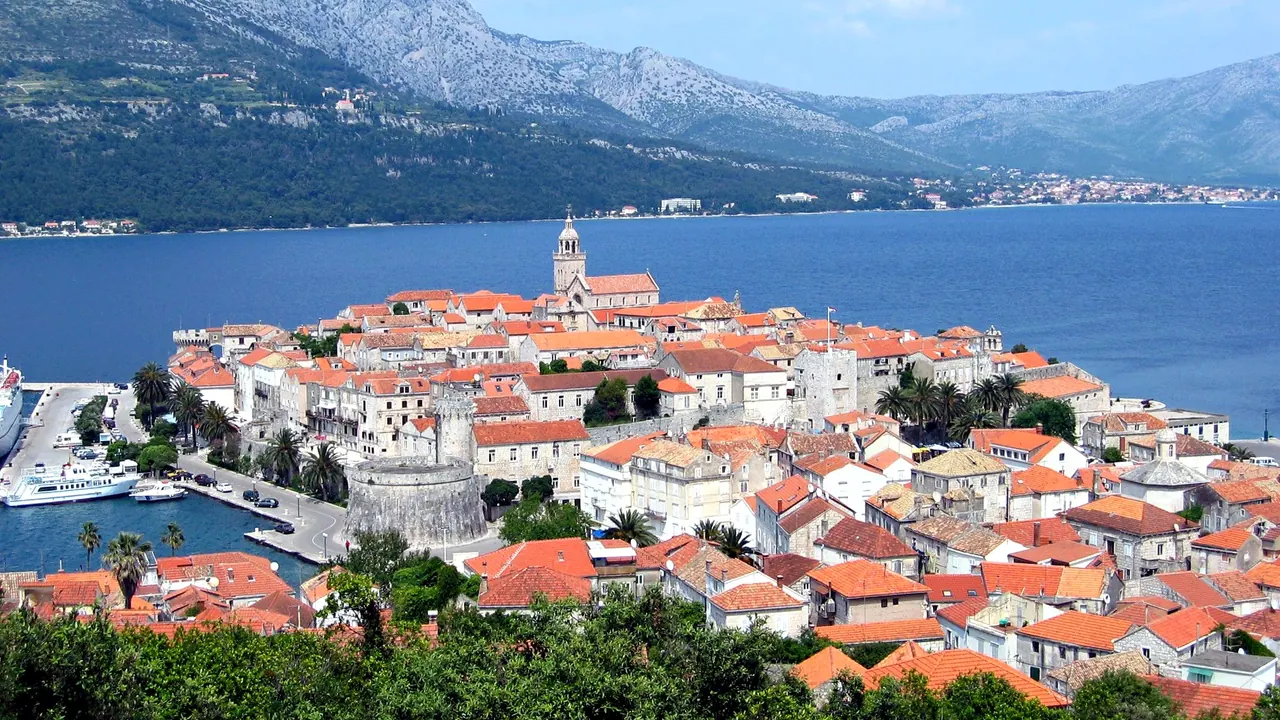
Photos: Istria by Ramon Karolan, Pexels License; Korčula by Εὐθυμένης, CC BY-SA 3.0, cropped.
Istria or Korčula?
Our verdict in twelve categories, each scored against the same fixed benchmark cities, and the climate month by month, so you can choose for your trip.
Choose Istria for
- food and drink
- day trips
- families
Istria is the better choice for a trip built around eating, drinking and touring. Truffle country, olive-oil hills and wine cellars sit inland, and Roman Pula, Poreč and Rovinj are on the coast. A good road network lets you see most of it from one base. It also does more for families, with campsites, water parks and shallow bays near Medulin, and it has more to do after dark and when the weather turns.
Choose Korčula for
- beaches
Korčula suits travellers who want a slow island summer centred on the sea. The swimming is better, from the rare sandy bays at Lumbarda to the clear water of Pupnatska Luka and the islets off Korčula Town. Summers are hotter and drier. You give up range, though: the food is simpler, the sights take a day or two, and most outings involve a boat.
Scoreboard
Twelve categories on one fixed scale from 0 to 100. The shaded stretch is the gap between the two.
Your match
Pick a travel style or drag the sliders, and both match scores follow your weighting.
Wins on food and drink and day trips with your weighting.
Wins on beaches with your weighting.
What matters to you?
Category by category
What the scores mean for a trip.
Beaches & swimming
Both coasts are mostly rock and pebble with very clear water, but Korčula's swimming is the stronger reason to go. Lumbarda's Pržina and Bilin Žal have true sand and shallow water, and Pupnatska Luka is a deep pebble bay of striking clarity. Taxi boats run from town to the islets, where you swim off flat rocks at Badija. The catch is size: the beaches are small and the well-known ones fill early.
Istria has far more coastline, and more of it is developed. Concrete platforms and easy resort beaches line the shore at Poreč and Umag. Its wildest swimming is in the coves of the Kamenjak cape, and the Medulin bays are the gentlest.
Food & drink
Istria gives you far more range at the table, and its cooking looks towards Venice more than towards Dalmatia. The inland valleys around Motovun and the Mirna are truffle country, with white truffles in autumn shaved over hand-rolled pasta. Family taverns braise local boškarin beef, and the Lim Bay sends oysters and mussels to the coast. Rovinj and Novigrad cover every level from plain fish grills to ambitious tasting menus, and the Malvazija and Teran cellars of the western hills make wine a reason to tour.
Korčula keeps to the Dalmatian repertoire and cooks it well: grilled fish, black risotto, and lamb or octopus slow-cooked under the iron bell, with Žrnovo's makaruni as a local touch. After a few nights the konoba menus start to blur, fine dining is scarce, and many kitchens close once summer ends. The island stands out in the glass instead, with Grk from Lumbarda, a white grown almost nowhere else, and Pošip from the vineyards around Čara and Smokvica.
Culture & sights
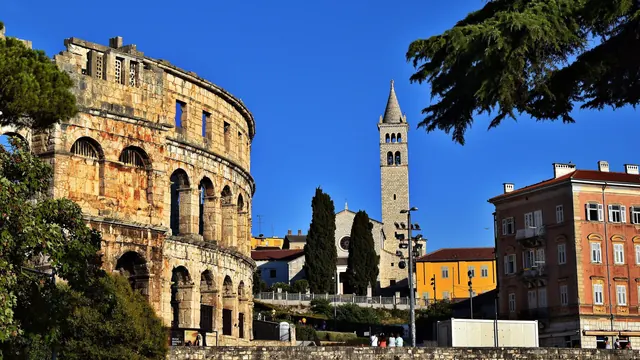
Istria has more and bigger sights. Pula's Roman Arena still stands to full height, the Euphrasian Basilica in Poreč keeps its sixth-century gold mosaics, and inland there are walled hill towns and frescoed chapels such as Beram. Its layers run from Roman to Austro-Hungarian, and you can fill several days with them.
Korčula's heritage is concentrated in one handsome walled town. Its herringbone streets lead to St Mark's Cathedral and its Tintoretto, and close by is the house said to be Marco Polo's birthplace. With the ancient cave of Vela Spila added, most visitors have seen it all within a day or two.
Nightlife
Neither is a party destination, but Istria has more going on. Pula is a port with a student population, so it keeps bars open around the Arena all year. The Poreč and Medulin coasts add beach bars and a few clubs in summer.
Korčula's evenings are a cocktail on the town walls at sunset and a few late harbour bars in July and August. The villages are asleep early, and people who want to dance take a boat to another island.
Nature & outdoors
Istria has the wider outdoor range, and cycling is its great strength. The old Parenzana railway line crosses viaducts and tunnels into the hills, and signposted routes link the hill towns. Učka rises to about 1,400m above the east coast for proper hiking, and Kamenjak and the Brijuni islands add coastal walks and parkland.
Korčula is a gentler, greener island of pine and terraced vineyards, best for easy walks along its ridge and kayaking among the islets. Its most dramatic outdoors is a short crossing away on Pelješac, with the climb of Sveti Ilija and the wind at Viganj, or a boat ride away at Mljet's saltwater lakes.
Day trips
From anywhere in Istria, a drive of an hour or less reaches hill towns, wine roads and old ports. Across the border the choice widens: Piran and Trieste are close, and the Postojna and Škocjan caves and even Ljubljana make a day out.
Korčula's outings mostly start with a boat. The Orebić ferry opens up Pelješac's Dingač wineries and the walls and oyster beds of Ston, and Mljet and Hvar are reached by sea. Dubrovnik and Split are long days, so the range is real but slower to get at.
Good for families
Istria has been built for family vacations for decades. It has large campsites and resort villages with pools around Poreč, Umag and Medulin, water parks, a dinosaur park near Funtana, an aquarium in a Pula fort and a small safari park on Brijuni. Shallow bays near Medulin and Premantura suit toddlers.
Korčula is safe and welcoming, and Lumbarda's sandy bays are excellent for small children. Beyond the beach there is nothing designed for them. The stepped lanes of Korčula Town and the ferry journeys also need patience with young children.
Getting around
In both places a car makes the stay, but Istria is easier to drive. A motorway runs down the west side, the main towns are within about an hour of each other, and coastal buses link Pula, Rovinj, Poreč and Umag. Summer traffic and parking near the old towns are the main frustrations.
Korčula has one long road with infrequent buses and steep side roads down to the coves. Taxi boats help around Korčula Town and Lumbarda. Arriving and leaving depends on ferries and catamarans, which run less often outside summer.
Shopping & style
Neither place is for fashion, and in both the best purchases are edible. Istria has more to choose from: truffle products from Motovun and Buzet, estate olive oils and cellar-door wine, plus galleries on Rovinj's Grisia and in the artists' village of Grožnjan.
Korčula's list is shorter. You can buy Grk and Pošip, fig liqueurs and cukarini biscuits, and the old town has a few jewellery and craft studios.
Affordability
Both cost about what a popular Croatian coast costs in July and August, so the real difference is in how you save. Istria has large campsites, inland farm stays among the olive groves and wine bought from the producer. On Korčula, private apartments in Lumbarda, Vela Luka or the villages and inland konobas keep costs down. Boat trips and car hire add up quickly there, and in both places June and September are the cheaper months.
Live music & performing arts
Istria has more to offer, almost all of it in summer. The Roman Arena in Pula hosts open-air concerts and the long-running Pula Film Festival, and young musicians fill Grožnjan's squares and churches with concerts.
Korčula has less but something distinctive: the Moreška sword dance, performed in Korčula Town through the summer, along with klapa singing in churches and squares. Outside the season neither has much.
Wellness & relaxation
In both, the main restorative appeal is a slow pace among vineyards and long shaded lunches. Istria adds a genuine thermal spa, Istarske Toplice, whose sulphur springs in the Mirna valley have been used since Roman times, and it has more hotel spas in Rovinj, Poreč and Umag.
Korčula has no bathing tradition, and spa treatments are limited to a few hotels near the town. In June or September, though, its quiet villages make an easy week of doing very little.
When should you go?
Pick your month. The climate figures are measured averages, not a forecast.
Istria in July
Korčula in July
Daytime high, °C
Rainfall in the month, mm
Where the figures come from
Istria's temperatures are measured 57 km from the centre, at Trieste.
Istria has no rain gauge within 25 km of the centre, so its rainfall comes from a gridded climate dataset read at the destination rather than from a gauge further away.
Korčula's temperatures are measured 69 km from the centre, at Mostar.
Korčula has no rain gauge within 25 km of the centre, so its rainfall comes from a gridded climate dataset read at the destination rather than from a gauge further away.
Temperature and rainfall are climate normals, averaged over the years shown. Istria: 1991-2020 normals, Trieste (56.5 km from centre). Korčula: 1991-2020 normals, Mostar (69.2 km from centre).
Both are swimming destinations from June to late September, but Korčula runs hotter. In July and August its daytime highs reach about 33°C, against 29°C in Istria. That makes midday walks in Korčula Town or the vineyards hard work, while Istria's hill towns are still fine to explore in the morning and evening. Korčula is also the drier and sunnier of the two in high summer, with barely any rain in July. The sea is close to 25°C in August in both places.
Autumn brings rain to both from September, and November is the wettest month in each. Istria's spring and autumn days are mild, which suits cycling and walking inland. Korčula stays a little warmer in the shoulder months, and its sea holds around 14°C even in midwinter. Even so, neither place is a winter beach destination.
Which traveller are you?
On a beach and sun trip, Korčula has the edge. It has some of the rare sandy, shallow bays on this coast at Lumbarda, the clear water at Pupnatska Luka and taxi boats out to the islets. The island is also hotter and sunnier through high summer.
For a food and nightlife trip, Istria is the clear pick. It has truffles from the Mirna valley, Lim Bay oysters, fine dining in Rovinj and wine cellars across the western hills. Pula's student bars and the seasonal clubs of Poreč and Medulin give it more to do after dinner.
On a family trip with children, Istria offers far more. You get resort villages with pools, water parks near Poreč, a dinosaur park, the aquarium in Pula and gentle bays at Medulin. On Korčula, the sand at Lumbarda is the only real asset for small children.
Before you go
| Measure | Istria | Korčula |
|---|---|---|
| Official language | Croatian | Croatian |
| Currency | Euro (EUR) | Euro (EUR) |
| Sockets | CF230 V, 50 Hz | CF230 V, 50 Hz |
| Driving side | Right | Right |
| Time zone | UTC+1, UTC+2 in summer | UTC+1, UTC+2 in summer |
| Emergency number | 112 | 112 |
| Main airport | Pula Airport (PUY)34 non-stop destinations | Dubrovnik Ruđer Bošković Airport (DBV)76 non-stop destinations |
| Public holidays this year | 14 days | 14 days |
By the numbers
| Measure | Istria | Korčula |
|---|---|---|
| Swim season, months above 21 °C | 4 months | 5 months |
Where else could you go?
Every comparison below shares a destination with this one, so you can follow Istria or Korčula somewhere new.