Croatia
Pula
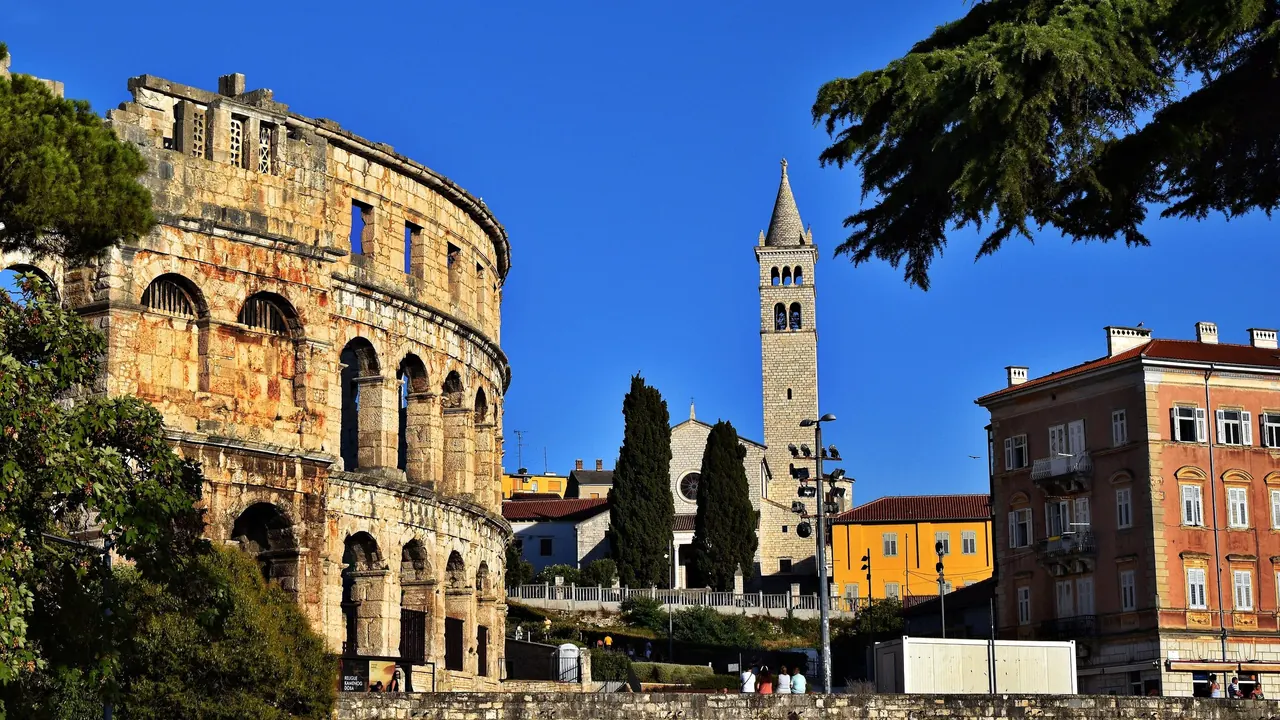
The Roman amphitheatre
- Day trips77
- Beaches75
- Nature & outdoors64
Photo: Miroslav.vajdic, CC BY-SA 4.0, cropped
Match
52
Every category weighted equally
- Beach & sun54
- Culture & arts51
- Food & nightlife48
- Family trip57
- Outdoors58
- Relax & unwind53
- Shopping & style48
- On a budget52
Pula in twelve categories
Our verdict on each, scored 0 to 100 against the same fixed benchmark cities, so a score means the same thing on every page.
Beaches & swimming. Scores 75 out of 100.
Food & drink. Scores 55 out of 100.
Culture & sights. Scores 60 out of 100.
Nightlife. Scores 38 out of 100.
Nature & outdoors. Scores 64 out of 100.
Day trips. Scores 77 out of 100.
Good for families. Scores 60 out of 100.
Getting around. Scores 50 out of 100.
Shopping & style. Scores 30 out of 100.
Affordability. Scores 50 out of 100.
Live music & performing arts. Scores 35 out of 100.
Wellness & relaxation. Scores 30 out of 100.
Pula category by category
Beaches & swimming
75Pula has no sandy town beach. Swimming happens off rocks, concrete platforms and pebble coves on the indented coast south of the centre, around the Verudela and Stoja peninsulas and the bays of Medulin. The water is very clear and reaches about 24°C in August, and the season runs comfortably from June to late September. Pine shade comes down almost to the waterline in many places.
The best swimming is at Cape Kamenjak, a protected headland about 10km south with dozens of wild coves, cliff ledges and pebble inlets. Bring water shoes, because sea urchins and sharp rock are the norm. Families looking for shallow, gently shelving water usually head for the sheltered bays around Medulin.
Food & drink
55Food here means Istrian food, one of the more distinctive regional kitchens on the Adriatic. Expect fuži and pljukanci pasta with truffle or game sauce, grilled fish and squid, scampi buzara, cured pršut, and olive oil and wine from estates a short drive inland. The white Malvazija and the red Teran are the local wines worth ordering. The covered market hall and the open-air stalls around it are the best place to see what is in season.
The city itself has a modest choice of konobas, pizzerias and seafood restaurants, and the tables around the Forum and the Arena lean towards tourist menus. The most rewarding meals are often in family taverns in the hinterland villages or by the harbours along the coast.
Culture & sights
60Pula's centrepiece is its Roman amphitheatre, the Arena. It is one of the best preserved anywhere, with its outer ring of three storeys still standing complete above the harbour. Around it the Roman town is easy to trace. The Temple of Augustus stands intact on the Forum beside the Venetian-era town hall. The Arch of the Sergii leads into the old streets, and there are remains of gates, a small theatre and floor mosaics hidden in the backstreets.
The Venetian fortress on the hill above the old town holds the city's history museum and gives views over the harbour and the shipyard cranes. The Austro-Hungarian period, when Pula was the empire's main naval base, left solid civic buildings and a ring of coastal forts. All of it can be seen in a day or two.
Nightlife
38Going out in Pula is a summer affair, and a fairly low-key one. Evenings start with drinks on terraces around the Forum and in the old town lanes below the fortress hill, then move to cocktail bars and beach bars on the Verudela peninsula and around the bays of Medulin. On warm weekends some of these play music and stay open late, and a few small clubs fill up with young Croatians and visiting groups. Many evenings simply mean a glass of Malvazija by the harbour with the Arena lit up behind you.
Outside the summer months the city goes quiet. The university keeps a few student bars and pubs busy, but most nights are over early, and nobody comes to Pula to go out.
Nature & outdoors
64The southern tip of Istria is low, stony coastline covered in macchia, pine and olive groves. Cape Kamenjak is the best of it: a car-free protected headland of cliffs, wild flowers and small islets, good for walking and cycling, with dinosaur footprints in the rock along the shore. Sea kayaking around the islets, windsurfing in Premantura bay and diving on wrecks from the naval era are all easy to arrange.
Inland, quiet roads and marked cycling routes run through red-earth farmland and oak woods towards the hill country. The Učka range, the closest real high ground, is about an hour and a half away and has good hiking. Spring and autumn are the best seasons for walking or cycling, as summer heat makes midday hard going.
Day trips
77Pula is a good base for touring Istria. Rovinj, a Venetian fishing town piled on a peninsula, is about 45 minutes north. Poreč, about an hour away, has the Euphrasian Basilica, a sixth-century church with Byzantine mosaics and a UNESCO site. The medieval hill towns of the interior, Motovun, Grožnjan and tiny Hum, are an hour or so away and combine well with truffle and wine estates.
The Brijuni islands, a short boat ride from Fažana just north of the city, combine Roman villa ruins with the summer residence and safari collection of Tito. Further afield, the Habsburg resort of Opatija, the Slovenian coastal town of Piran and the port of Trieste are each around two hours by car. Buses are limited, so a car makes most of these much easier.
Good for families
60Pula is a relaxed, safe place with children, and most family time is spent by the sea. The shallow, sheltered bays around Medulin and Premantura suit small children better than the rocky shores closer to town. The aquarium, set inside an Austro-Hungarian fort on Verudela, is a good half-day. Children also enjoy the Arena, where they can climb around the stands and explore the underground passages.
Within about an hour are a dinosaur theme park near Funtana and a large water park near Poreč, and the Brijuni boat trip includes animals in the safari park. Prams cope with the flat old-town streets, but rocky swimming spots, high summer heat and a reliance on cars make it harder work than a resort built around children.
Getting around
50The historic centre is small and flat, and the Arena, the Forum, the market and the harbour are only minutes apart on foot. City buses run out to the hotel areas on Verudela and towards Premantura, and in summer some visitors cycle the short distances to the southern coves.
Beyond the city it is a different picture. The rail line into the interior is slow and of little use to visitors, regional buses are infrequent, and Kamenjak, the hill towns and most beaches on the wider coast are far easier with a car or a scooter. Parking near the centre is tight in high season.
Shopping & style
30Shopping in Pula is modest. The best things to take home are edible: Istrian olive oil, truffle products, local wine and rakija, honey and pršut, sold at the market hall, in delicatessens and directly from producers in the countryside. The main pedestrian street through the old town has everyday fashion chains and souvenir shops. There is no luxury or design shopping to speak of.
Affordability
50Pula is mid-priced. It is noticeably cheaper than the most famous towns further down the Croatian coast, and private apartments and simple konobas keep a stay reasonable, especially in spring and autumn. In July and August, though, rooms book up and cost about as much as on the Western European coasts, and restaurant prices near the Arena and the harbour are tourist-level. City buses and the main sights are inexpensive. Car hire and boat trips add up quickly.
Live music & performing arts
35The great draw is the Arena in summer, when the Roman amphitheatre becomes an open-air venue for touring pop and rock acts, classical galas and the long-running Pula Film Festival screenings. A concert under the stone arches on a warm night is a memorable experience, even if the line-up depends on the season.
For the rest of the year there is the Istrian National Theatre, which performs drama and hosts visiting productions in Croatian, plus occasional concerts and a few bars with live bands. Visitors looking for regular opera, classical music or a theatre scene will find little here.
Wellness & relaxation
30Pula has no bathing or spa tradition of its own. Wellness means the spa areas of the large resort hotels on the Verudela peninsula and in Medulin, which offer pools, saunas and massages. What the city does offer is an unhurried pace outside high summer. Long coffees on the Forum, evening walks along the pine-shaded coastal paths and quiet days in the countryside make it easy to slow down, even without a real spa scene.
When should you go?
Pick a month to see what it is like. The climate figures are measured averages, not a forecast.
Pula in July
Daytime high, °C
Rainfall in the month, mm
The whole year
Shaded against this city’s own year: the deepest cell is its best month for that figure and the palest its weakest.
Where the figures come from
Pula's temperatures are measured 87 km from the centre, at Trieste.
Pula has no rain gauge within 25 km of the centre, so its rainfall comes from a gridded climate dataset read at the city rather than from a gauge further away.
Temperature and rainfall are climate normals, averaged over the years shown. Pula: 1991-2020 normals, Trieste (87 km from centre).
Before you go
| Measure | Pula |
|---|---|
| Official language | Croatian |
| Currency | Euro (EUR) |
| Sockets | CF230 V, 50 Hz |
| Driving side | Right |
| Time zone | UTC+1, UTC+2 in summer |
| Emergency number | 112 |
| Elevation | 5 m |
| Main airport | Pula Airport (PUY)7 km from centre34 non-stop destinations |
| Public holidays this year | 14 days |
By the numbers
| Measure | Pula |
|---|---|
| City population | 52,220 |
| People per km² | 971 |
| Museums within 10 km | 4 |
| UNESCO World Heritage sites within 50 km | 1 |
| Swim season, months above 21 °C | 4 months |
Compare Pula with
Every comparison with a written verdict behind it.
- Amalfi
- Bari
- Bergamo
- Bled
- Bologna
- Bratislava
- Budapest
- Budva
- Cesky Krumlov
- Como
- Cortina d'Ampezzo
- Dubrovnik
- Florence
- Genoa
- Graz
- Hallstatt
- Innsbruck
- Kotor
- La Spezia
- Ljubljana
- Lucca
- Lucerne
- Lugano
- Milan
- Mostar
- Munich
- Naples
- Padua
- Piran
- Pisa
- Portofino
- Positano
- Rome
- Rovinj
- Salerno
- Salzburg
- Sarajevo
- Siena
- Sorrento
- Split
- Trieste
- Turin
- Venice
- Verona
- Vienna
- Zadar
- Zagreb
- Zermatt
- Zurich