Croatia
Istria
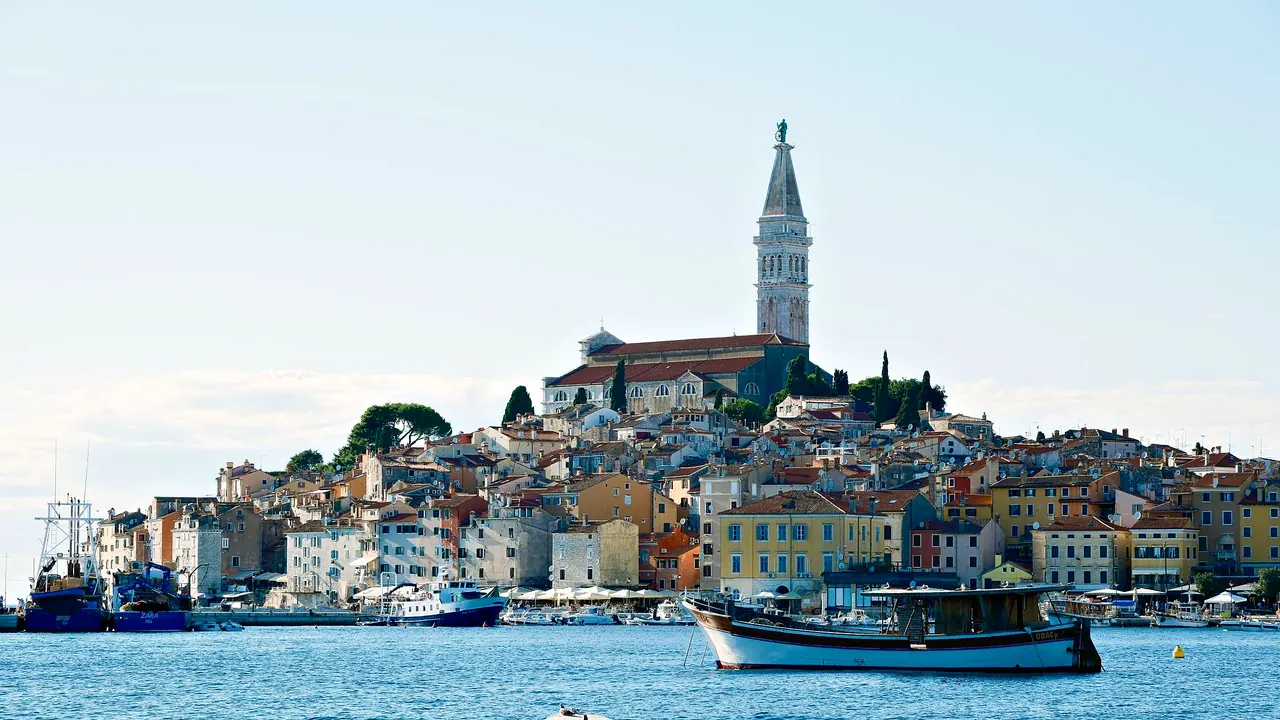
Rovinj and the church of St Euphemia from the water
- Day trips78
- Food & drink72
- Beaches70
Photo: Ramon Karolan, Pexels License
Match
56
Every category weighted equally
- Beach & sun58
- Culture & arts55
- Food & nightlife52
- Family trip60
- Outdoors61
- Relax & unwind58
- Shopping & style53
- On a budget54
Istria in twelve categories
Our verdict on each, scored 0 to 100 against the same fixed benchmark cities, so a score means the same thing on every page.
Beaches & swimming. Scores 70 out of 100.
Food & drink. Scores 72 out of 100.
Culture & sights. Scores 70 out of 100.
Nightlife. Scores 40 out of 100.
Nature & outdoors. Scores 66 out of 100.
Day trips. Scores 78 out of 100.
Good for families. Scores 66 out of 100.
Getting around. Scores 55 out of 100.
Shopping & style. Scores 32 out of 100.
Affordability. Scores 42 out of 100.
Live music & performing arts. Scores 30 out of 100.
Wellness & relaxation. Scores 46 out of 100.
Istria category by category
Beaches & swimming
70Istria's coast is a long chain of rocky coves, pine-shaded promontories and flat limestone ledges. The water is very clear and warm enough to swim from June to late September, reaching about 25°C in August. Sand is rare. Most bathing is from pebbles, smooth rocks or the concrete platforms laid out along resort shorelines, so water shoes help.
The best swimming is at the southern tip around Premantura and the Kamenjak cape, where dozens of wild coves face open water. The Medulin area has some of the few shallow, gently shelving bays. Rovinj has wooded headlands with rocky beaches close to the old town, and the Poreč and Umag coasts are lined with easy resort beaches. Rabac, on the east coast, has the best-known pebble bays.
Food & drink
72Istria is one of the Mediterranean's serious food regions, with flavours closer to the Venetian side of the Adriatic than to the rest of Croatia. Inland, around Motovun, Buzet and the Mirna valley, the forests yield black truffles and, in autumn, prized white ones. They are grated over fuži and pljukanci pasta, or over eggs. Family taverns serve slow-cooked boškarin beef, pršut and maneštra soup. The olive oils of the western hills are among the finest anywhere.
On the coast, the Lim Bay is known for oysters and mussels, and Rovinj and Novigrad have fish restaurants at every level, up to ambitious fine dining. Wine is central to a visit. Crisp white Malvazija and the dark red Teran are poured in small cellars across the hills, many of them open for tastings. Pula's covered market is good for a morning browse.
Culture & sights
70Istria's heritage comes in layers: Roman, Byzantine, Venetian and Austro-Hungarian. The two great sights are Pula's Arena, a Roman amphitheatre that still stands to its full height, and the Euphrasian Basilica in Poreč, with its sixth-century gold mosaics. Pula also has the Temple of Augustus, a triumphal arch and the Austro-Hungarian naval quarter.
Rovinj's old town rises on a near-island to the hilltop church of St Euphemia, and Poreč keeps its Roman street grid. Inland, walled hill towns such as Motovun, Grožnjan and Hum sit on hilltops above the valleys. Small churches hold medieval frescoes, the best known being the Dance of Death at Beram. Museums are small. This is a place for walking through old stone towns rather than spending days in galleries.
Nightlife
40Evenings in Istria are mostly about long dinners and a drink on a harbour front. Rovinj's waterfront and Poreč's old town fill with terraces and cocktail bars on summer nights. Pula, a port city with students, has the most year-round life, with bars in the old centre and around the Arena. The Poreč and Medulin coasts add beach bars and a few seasonal clubs from June to early September. Outside those months most towns are quiet by midnight.
Nature & outdoors
66Istria's landscape is gentle: red-earth vineyards and olive groves in the west, the oak forests and valleys of the 'grey' interior, and the bare ridge of Učka rising to about 1,400m above the east coast. Učka has the best hiking, with wide views over the Kvarner Gulf. The Lim Bay is a narrow, wooded sea inlet best seen by boat or from the cliff path.
Cycling is the region's great outdoor strength. Signposted routes run between hill towns, and the Parenzana, an old narrow-gauge railway line, crosses viaducts and tunnels from the coast into the interior. The Kamenjak cape is good for walking, kayaking and windsurfing, and the Brijuni islands are a national park of meadows and parkland. Spring and autumn are best. Midsummer heat makes inland walking hard going.
Day trips
78Istria is small enough that every part of it makes a day out from any other. Wherever you stay, the hill towns of Motovun, Grožnjan, Hum and Buzet, the coastal towns of Rovinj, Poreč and Novigrad, and the boat to the Brijuni islands are all close. The wine roads through the western hills make an easy day of tastings.
Just beyond the region, the list grows. Piran, a Venetian-Gothic town on the Slovenian coast, is under an hour from northern Istria, and Trieste is about an hour away. Opatija, the old Habsburg seaside resort, is across Učka. The Postojna and Škocjan caves and the Lipica stud farm in the Slovenian Karst are within about ninety minutes, and Ljubljana is reachable in around two hours.
Good for families
66Istria has long been a family destination, built around large seaside campsites and resort villages with pools and playgrounds, especially around Poreč, Umag and Medulin. The sea is calm and safe, though most beaches are rocky. Families with small children do best in the shallower bays near Medulin and Premantura.
There are large water parks near Poreč and in the hills behind Novigrad, a dinosaur park near Funtana and an aquarium in an old fort in Pula. On the Brijuni islands, a small safari park can be reached by boat. The Arena and the walled hill towns hold children's attention for an hour or two. Distances are short and the region feels safe, but the July and August heat and the steep, polished cobbles of the old towns call for an easy pace.
Getting around
55Istria is easiest with a car. A good motorway runs down the west side and across to the east coast, and no two main towns are much more than an hour apart. Coastal buses link Pula, Rovinj, Poreč and Umag, but the hill towns, wineries and most beaches are hard to reach without your own wheels. The old towns are compact and best explored on foot, with car parks at their edges. In July and August the coastal roads around the resorts are slow, and parking near the old towns and popular beaches fills early in the day.
Shopping & style
32Shopping in Istria means taking the region's food home: truffle products from the shops of Motovun and Buzet, single-estate olive oil, Malvazija and Teran bought straight from the cellars, and honey and pršut from farm stalls. Rovinj's steep Grisia street and the artists' village of Grožnjan have small galleries and craft studios. Beyond that, the old towns offer mostly souvenirs, and there is little for anyone looking for fashion or design.
Affordability
42Istria is not a budget destination in its summer season. Rooms in Rovinj and the best coastal spots are expensive in July and August, and seafood and truffle dishes cost about the same as in other popular Mediterranean resorts. Costs come down if you stay in a campsite, a private apartment or an inland farm stay, and in June or September. Simple tavern meals and wine bought from the producer are reasonable.
Live music & performing arts
30Live performance in Istria is mostly a summer affair, and its great stage is the Roman Arena in Pula, which holds open-air concerts on summer evenings. The long-running Pula Film Festival also screens there. Grožnjan becomes a music town in summer, with young musicians giving concerts in its squares and churches, and the old towns hold small open-air concerts and folk evenings. For the rest of the year, Pula's theatre is the main venue, and there is little to plan a trip around.
Wellness & relaxation
46Istria's restorative appeal is mainly in its pace. You can stay in a stone farmhouse among olive groves, spend long lunches in the hill towns or go for evening walks above the sea. The region has one historic thermal spa, Istarske Toplice, whose sulphur springs below a cliff in the Mirna valley have been used since Roman times. Otherwise, wellness means spas in the larger resort hotels of Rovinj, Poreč and Umag. In July and August the coast is busy, so the interior and the shoulder months are the calmer choice.
Where to stay in Istria
Rovinj is the most attractive base on the coast. Its old town rises on a near-island, and rocky beaches line the wooded headlands close by. It suits couples, food lovers and anyone who likes an evening walk before dinner by the harbour, though rooms there are among the most expensive in July and August. Further north, Poreč and Umag are the resort coast, with large campsites, resort villages with pools, easy beaches and water parks nearby. They are a natural choice for families.
In the south, Pula has the Arena, a covered market and the most life outside summer. Just beyond it, the Medulin and Premantura area has the shallow bays that suit small children and the wild coves of Kamenjak for swimming. For a quiet stay, a stone farmhouse in the interior near Motovun or Grožnjan puts you among vineyards, truffle taverns and cycling routes.
Istria is small, and no two main towns are much more than an hour apart, so one base is enough for most trips. On a first visit, the west coast between Rovinj and Poreč is closest to most of the sights. Save the interior or the southern tip for a second visit. Wherever you stay, a car makes the hill towns and beaches much easier to reach.
When should you go?
Pick a month to see what it is like. The climate figures are measured averages, not a forecast.
Istria in July
Daytime high, °C
Rainfall in the month, mm
The whole year
Shaded against this destination’s own year: the deepest cell is its best month for that figure and the palest its weakest.
Where the figures come from
Istria's temperatures are measured 57 km from the centre, at Trieste.
Istria has no rain gauge within 25 km of the centre, so its rainfall comes from a gridded climate dataset read at the destination rather than from a gauge further away.
Temperature and rainfall are climate normals, averaged over the years shown. Istria: 1991-2020 normals, Trieste (56.5 km from centre).
Before you go
| Measure | Istria |
|---|---|
| Official language | Croatian |
| Currency | Euro (EUR) |
| Sockets | CF230 V, 50 Hz |
| Driving side | Right |
| Time zone | UTC+1, UTC+2 in summer |
| Emergency number | 112 |
| Main airport | Pula Airport (PUY)34 non-stop destinations |
| Public holidays this year | 14 days |
By the numbers
| Measure | Istria |
|---|---|
| Swim season, months above 21 °C | 4 months |
Compare Istria with
Every comparison with a written verdict behind it.
- Austrian Alps
- Bavaria
- Brač
- Cinque Terre
- Dolomites
- Elba
- Hvar
- Ischia
- Korčula
- Krka
- Lake Como
- Lake Garda
- Lake Maggiore
- Plitvice Lakes
- Procida
- Swiss Alps
- Tuscany
- Umbria