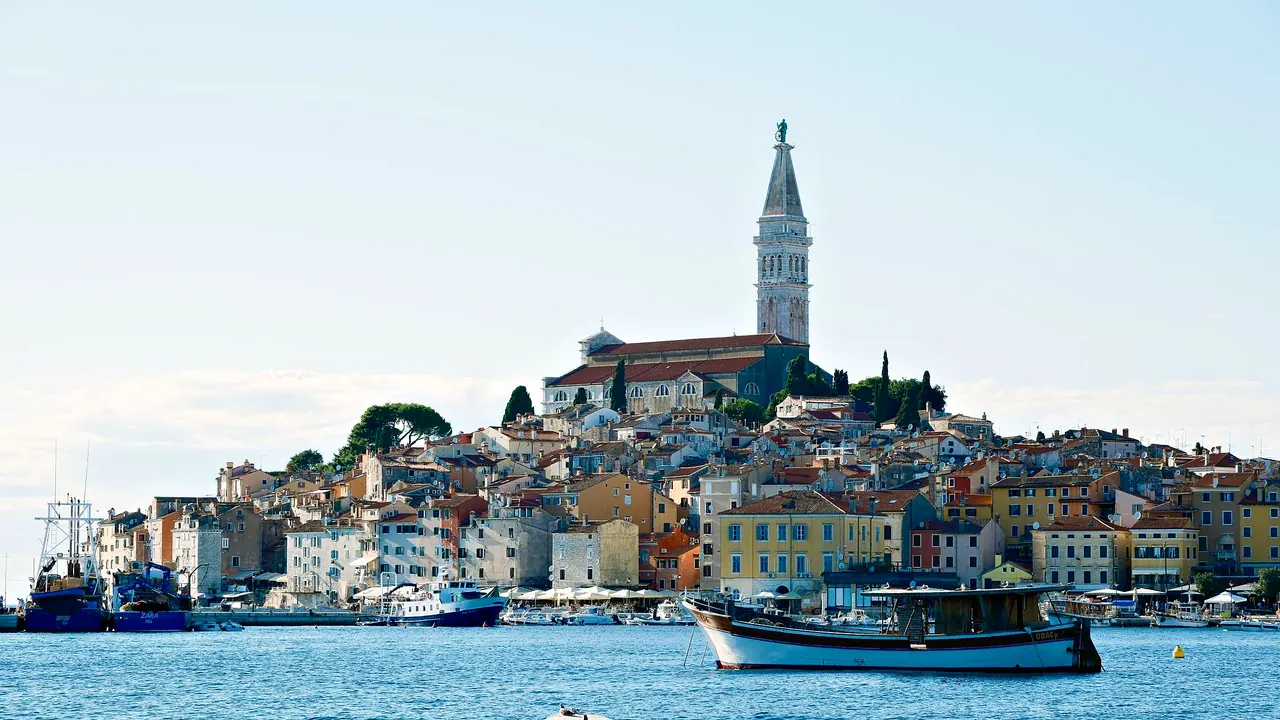
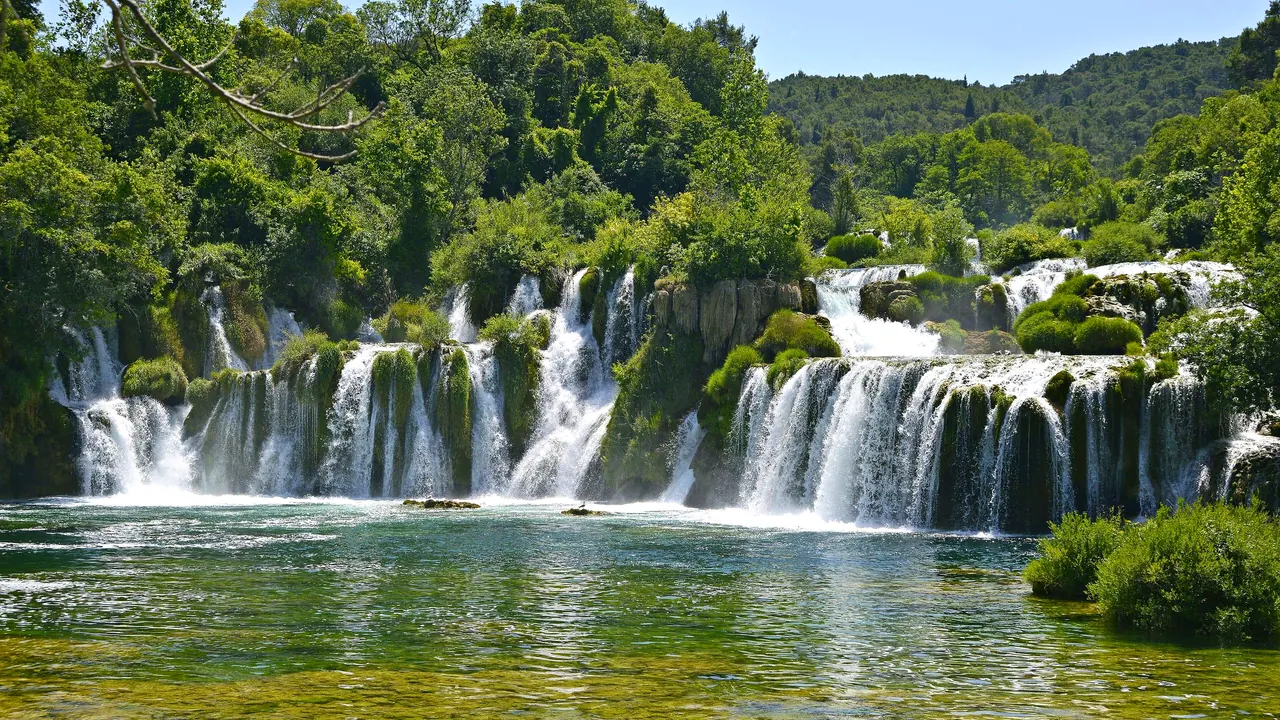
Photos: Istria by Ramon Karolan, Pexels License; Krka by Alberto-g-rovi, CC BY 4.0, cropped.
Istria or Krka?
Our verdict in twelve categories, each scored against the same fixed benchmark cities, and the climate month by month, so you can choose for your trip.
Choose Istria for
- food and drink
- nightlife
- beaches
Istria is the better choice for a full seaside vacation with plenty to do around it. It has the stronger coast, from the wild coves of Kamenjak to the resort shores of Poreč and Umag, a serious food and wine culture built on truffles, olive oil and Malvazija, and old stone towns such as Rovinj, Pula and Motovun that fill a week without repeating themselves. Families, food lovers and anyone who wants a drink on a harbour front after dinner will find more here.
Choose Krka for
- nature and the outdoors
- prices
Krka suits a shorter, narrower trip built around one landscape: the travertine falls, the canyon and the boat to the island monastery of Visovac. As a nature trip it edges ahead of Istria, and Šibenik's cathedral and fortresses add real weight on the estuary. Food, evenings, shopping and wellness are all thinner than in Istria, so it works best for walkers and sightseers happy with quiet nights in Skradin, or as a few days' stop on a longer Dalmatian route.
Scoreboard
Twelve categories on one fixed scale from 0 to 100. The shaded stretch is the gap between the two.
Your match
Pick a travel style or drag the sliders, and both match scores follow your weighting.
Wins on food and drink and nightlife with your weighting.
Wins on nature and the outdoors and prices with your weighting.
What matters to you?
Category by category
What the scores mean for a trip.
Beaches & swimming
Istria is a genuine beach destination, and Krka is not. Istria's whole coastline is for swimming, from the dozens of wild coves on the Kamenjak cape to the shallow bays around Medulin, wooded rocky headlands at Rovinj and easy resort shores near Poreč and Umag. Almost everywhere you bathe from rocks, pebbles or platforms, but you are never far from clear water.
At Krka you cannot swim at the falls, so the sea means a drive or boat down to Šibenik's pebble coves at Banj and Solaris, the bays near Primošten, or the quiet rocky shores of Zlarin and Prvić. These are pleasant places to spend an afternoon, but the beach is an extra on a Krka trip rather than the point of it.
Food & drink
Istria eats far better. Its inland towns around Motovun and Buzet are truffle country, its western hills produce outstanding olive oil, and Rovinj and Novigrad offer seafood right up to fine dining, with Malvazija and Teran poured in cellars all over the hills.
Krka's cooking is honest Dalmatian fare, such as fish from the grill, lamb under the iron bell, estuary mussels and Skradin's slow-cooked veal risotto, with Babić to drink. It is satisfying, but the choice is narrow, and most of the better tables are in Šibenik rather than along the river.
Culture & sights
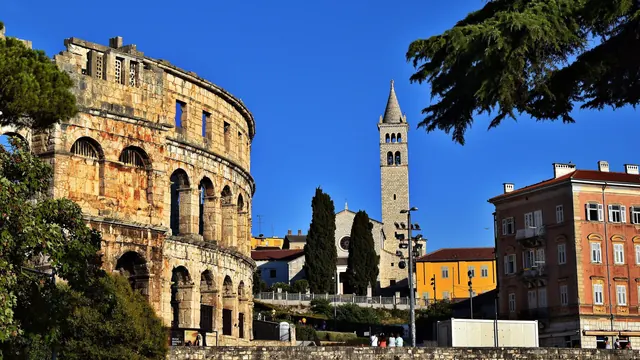
Istria has more to see, and the history goes deeper. Pula's Arena and the gold mosaics of the Euphrasian Basilica in Poreč are major Mediterranean sights, and you can add Rovinj's old town, the walled hill towns and the frescoes at Beram on top.
Krka's heritage is spread out along the river: the island monastery of Visovac, the Orthodox Krka Monastery with its catacombs, and the Roman arches of Burnum. Its two biggest sights are actually at the estuary, Šibenik's cathedral of St James and the fortress of St Nicholas. It is rewarding, but you need to travel between its sights, and it offers fewer of them than Istria.
Nightlife
Neither place is built for going out, but Istria has more life after dark. Summer terraces in Rovinj and Poreč, year-round bars in student Pula and seasonal beach clubs near Medulin give you choices. Along the Krka, a night out usually means a dinner by the water in Skradin and a few bars in Šibenik's old town, with no clubs worth the trip.
Nature & outdoors
Krka has the more striking landscape. The river drops through a limestone canyon in a series of travertine falls, with boardwalks through the spray at Skradinski Buk, the spread of cascades at Roški Slap and boats across Visovac lake. Most of it is gentle walking, though, and the paths fill up in late summer.
Istria's countryside is softer and covers more ground: vineyards, oak valleys, the Lim Bay inlet and the Učka ridge for proper hiking with sea views. Its real strength is cycling, especially along the old Parenzana railway, a kind of trip Krka's plateau roads only partly offer.
Day trips
Istria offers more for day trips, and over a longer stay the gap shows. The region itself is a ring of short outings between hill towns, coastal towns and the Brijuni islands, and over the border you can reach Piran, Trieste, the Postojna and Škocjan caves and even Ljubljana.
Krka is a good base for central Dalmatia, with Trogir and Zadar each about an hour away, Split a bit further, and ferries out to Zlarin and Prvić. The options run along a single coastline, though, rather than into a second country.
Good for families
Istria has been a family destination for decades, and it shows in the campsites and resort villages with pools around Poreč, Umag and Medulin, the water parks, the dinosaur park and Pula's aquarium in a fort. The shallow bays near Premantura suit the youngest swimmers.
Krka gives children a great day: walking over rushing water on the boardwalks and taking the boat to Visovac. Beyond that there is little aimed at them, so most families stay on the coast near Šibenik and drive in for the park.
Getting around
You need a car in both places, and the difference is in the kind of driving. In Istria you criss-cross a small region on good roads to reach hill towns, wineries and scattered beaches, and coastal buses only connect the main towns.
At Krka you drive to a single park, then switch to park buses and boats between the falls, Visovac and Roški Slap, and Skradin has its own boat to Skradinski Buk. In high summer you will queue for parking at the old towns in Istria and at the park entrances on the Krka.
Shopping & style
What you bring back from Istria is mostly edible, and there is far more of it: truffle products from Motovun and Buzet, single-estate olive oil and wine bought at the cellar door. Galleries and craft studios in Rovinj and Grožnjan add something to browse. Krka has stalls selling oil, honey and figs, a few craft shops in Šibenik, and Zlarin's coral work as its one notable craft.
Affordability
Costs are broadly similar, since both are coastal Croatia in summer and neither is cheap in July and August. Krka is slightly easier on the budget, especially if you rent an apartment inland around Lozovac. The park entrance fee is its main unavoidable cost.
In Istria, Rovinj and the best coastal spots are the expensive part. A campsite, a farm stay inland, a tavern meal or wine bought from the producer all bring the cost down. Both regions are noticeably cheaper in the shoulder months.
Live music & performing arts
Pula's Roman Arena gives Istria the more memorable stage, with open-air summer concerts and film festival screenings inside it, while Grožnjan's young musicians play in its squares and churches. Krka's summer events are mainly in Šibenik, with fortress concerts and the children's festival, plus klapa singing at village celebrations. In both places live performance is a summer extra rather than a reason to book.
Wellness & relaxation
Istria offers more for a restful trip. It has a historic thermal spa, Istarske Toplice in the Mirna valley, resort spas in Rovinj, Poreč and Umag, and olive-grove farmhouses for slow days. Krka has no bathing tradition and only a few hotel spas near Šibenik. What it does have is silence, on the river in the early morning and in Skradin's harbour at dusk.
When should you go?
Pick your month. The climate figures are measured averages, not a forecast.
Istria in July
Krka in July
Daytime high, °C
Rainfall in the month, mm
Where the figures come from
Istria's temperatures are measured 57 km from the centre, at Trieste.
Istria has no rain gauge within 25 km of the centre, so its rainfall comes from a gridded climate dataset read at the destination rather than from a gauge further away.
Krka's temperatures are measured 53 km from the centre, at Split / Marjan.
Krka has no rain gauge within 25 km of the centre, so its rainfall comes from a gridded climate dataset read at the destination rather than from a gauge further away.
Krka's sunshine is measured 53 km from the centre, at Split / Marjan.
Temperature and rainfall are climate normals, averaged over the years shown. Istria: 1991-2020 normals, Trieste (56.5 km from centre). Krka: 1991-2020 (sunshine 1971-2000) normals, Split / Marjan (52.9 km from centre).
Both are summer destinations with the same broad rhythm, but Krka runs hotter, drier and sunnier. In July and August Istria's coast reaches about 29°C, and the sea peaks around 26°C, slightly warmer than off Šibenik. Krka's summer days climb to about 31°C with very little rain, around 24mm in July. That is fine for an afternoon on the coast but hard going on the boardwalks at midday. For swimming, June to September works in both.
Spring and early autumn are the best times for walking in either place. At Krka, spring has a second advantage, because that is when the falls carry the most water. From September the rain picks up in both, and November is the wettest month in each, with about 106mm around Krka and a little less in Istria. Winters are mild and grey in Istria and a little warmer and brighter around Krka, but neither is at its best between November and March.
Which traveller are you?
For a food and nightlife trip, Istria is the clear pick. Truffle pasta in the hill towns, Lim Bay oysters and wine cellars pouring Malvazija and Teran beat Krka's handful of konobas, and Rovinj, Poreč and Pula offer far livelier summer evenings than Skradin's harbour.
On a family trip with children, Istria has much more built for them: resort villages with pools around Poreč and Medulin, shallow bays near Premantura, water parks and an aquarium in Pula. Krka gives children one memorable day on the boardwalks, and not much after that.
On an outdoors trip, Krka has the edge. Its canyon, waterfalls, rim trails and kayaking on the upper river make a landscape you travel specifically to see. Istria's gentler hills reward cyclists on the Parenzana, but they rarely match the drama of Skradinski Buk.
Before you go
| Measure | Istria | Krka |
|---|---|---|
| Official language | Croatian | Croatian |
| Currency | Euro (EUR) | Euro (EUR) |
| Sockets | CF230 V, 50 Hz | CF230 V, 50 Hz |
| Driving side | Right | Right |
| Time zone | UTC+1, UTC+2 in summer | UTC+1, UTC+2 in summer |
| Emergency number | 112 | 112 |
| Main airport | Pula Airport (PUY)34 non-stop destinations | Split Saint Jerome Airport (SPU)69 non-stop destinations |
| Public holidays this year | 14 days | 14 days |
By the numbers
| Measure | Istria | Krka |
|---|---|---|
| Swim season, months above 21 °C | 4 months | 4 months |
Where else could you go?
Every comparison below shares a destination with this one, so you can follow Istria or Krka somewhere new.