Croatia
Rovinj
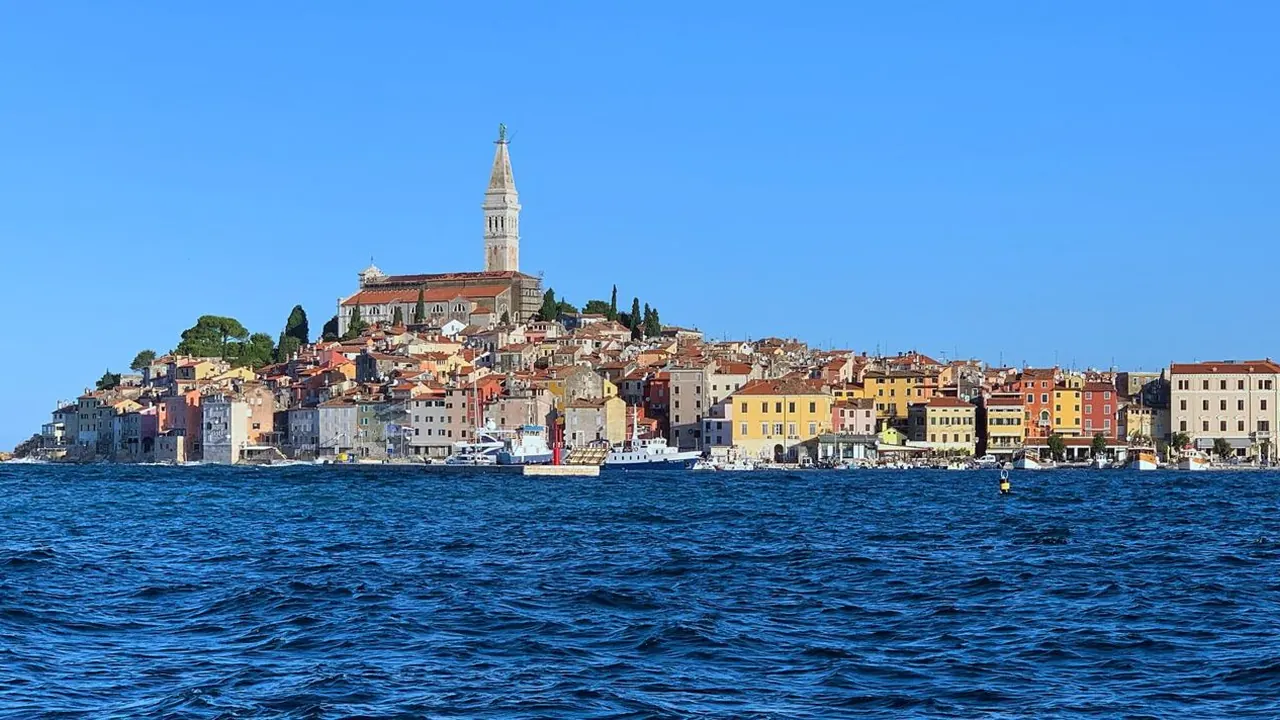
The old town from the sea
- Beaches70
- Day trips68
- Nature & outdoors60
Photo: Vyacheslav Bukharov, CC BY-SA 4.0, cropped
Match
45
Every category weighted equally
- Beach & sun49
- Culture & arts42
- Food & nightlife40
- Family trip51
- Outdoors52
- Relax & unwind49
- Shopping & style41
- On a budget44
Rovinj in twelve categories
Our verdict on each, scored 0 to 100 against the same fixed benchmark cities, so a score means the same thing on every page.
Beaches & swimming. Scores 70 out of 100.
Food & drink. Scores 50 out of 100.
Culture & sights. Scores 38 out of 100.
Nightlife. Scores 25 out of 100.
Nature & outdoors. Scores 60 out of 100.
Day trips. Scores 68 out of 100.
Good for families. Scores 52 out of 100.
Getting around. Scores 55 out of 100.
Shopping & style. Scores 28 out of 100.
Affordability. Scores 36 out of 100.
Live music & performing arts. Scores 15 out of 100.
Wellness & relaxation. Scores 42 out of 100.
Rovinj category by category
Beaches & swimming
70Swimming in Rovinj means rocks and pine shade rather than sand. The shore south of the harbour runs into the Golden Cape forest park, where flat limestone ledges, small pebble coves and concrete bathing platforms line the water for several kilometres. The Adriatic here is very clear and reaches about 24°C in August. You can swim from the rocks right below the old town walls, where people slip in off the stones at sunset.
Taxi boats cross to the islands of St Catherine and Red Island, which have quieter coves and a little more room. Bring water shoes, because sea urchins and sharp stone are part of the deal. The season runs from June to September. Families who want sand and shallow, gentle water will find little of it here.
Food & drink
50Rovinj eats like a small fishing town that also belongs to one of the Adriatic's best food regions. Expect grilled fish and shellfish, scampi buzara, Istrian pasta such as fuži and pljukanci with truffle, peppery local olive oil and the white Malvazija and red Teran wines of the hinterland. There is a handful of ambitious, refined restaurants, and family konobas in the countryside are worth the drive for slow-cooked meat and seasonal truffle dishes.
The harbourfront and the old town lanes are full of menus written for passing visitors, and there is little street food or cheap everyday eating. The small morning market by the old town sells figs, cheese, oil and fish. It is a pleasant place to eat well for a week, not a destination for its range.
Culture & sights
38Rovinj's sight is the town itself. The old town fills a former island, with tall pastel Venetian houses stacked up to the hilltop Church of St Euphemia, whose bell tower is modelled on the campanile in Venice and can be climbed for a view over the roofs and islands. Steep lanes such as Grisia, the Balbi Arch and the clock tower on the harbour square make an intact and very photogenic quarter.
Beyond that the list is short: a small town museum in a baroque palace and the Batana House, which tells the story of the local flat-bottomed fishing boats and the songs that went with them. A slow afternoon covers it all. Anyone wanting major museums or a long list of landmarks will have to look further afield.
Nightlife
25Evenings in Rovinj are about a long dinner, then a drink on the rocks below the old town as the sun drops into the sea. A few cocktail and wine bars along the waterfront and in the harbour lanes stay busy on summer nights, and there are a couple of late venues for dancing in high season.
It is a couples' and families' town, though, and most of the old town is quiet by midnight. Outside summer the night largely closes down. Anyone looking for clubs travels to the bigger party spots along the coast.
Nature & outdoors
60The Golden Cape forest park starts at the edge of town: a headland of cedar, pine and holm oak planted in the nineteenth century, crossed by flat gravel paths for walking and cycling and edged by rocky shore. Further out, the Rovinj archipelago is a scatter of low islands and islets that is good for sea kayaking, paddleboarding and diving, with clear water around the reefs and wrecks.
A short drive north, the Lim Fjord cuts a long, steep-sided green channel into the coast, where boats go to the mussel and oyster farms. Inland, quiet roads and marked trails roll through vineyards, oak woods and red earth. It is pleasant, low-key outdoor country, best in spring and autumn, without high mountains or dramatic wilderness.
Day trips
68Rovinj sits in the middle of a small region dense with places to visit. Pula, about forty minutes south, has one of the best preserved Roman amphitheatres anywhere, a temple of Augustus and a Roman gate. Porec, a similar distance north, has the Euphrasian Basilica with its sixth-century mosaics, a UNESCO site. Between them lie walled villages such as Bale and Vodnjan.
Inland, the medieval hill towns of Motovun, Groznjan and Hum perch above the vineyards and truffle forests, with wine and olive oil estates along the way, and Fazana is the jumping-off point for the Brijuni islands. Piran, in Slovenia, and Trieste, in Italy, are both about an hour and a half away across the border. Most of this needs a car.
Good for families
52Rovinj is small, safe and relaxed, and Croatian resort life is welcoming to children: late family dinners on the harbour, gelato, boat trips to the islands and plenty of shade in the Golden Cape park, where flat paths suit pushchairs and bikes. The large campsites and resorts around town are built with families in mind, with pools and playgrounds.
The drawbacks are physical. The shore is rock and concrete rather than sand, so younger children need water shoes and close watching, and the old town is a climb of steep, polished cobbles that are hard work with a pushchair. There is little made specifically for children in town, and the big waterparks of the coast mean a short drive north.
Getting around
55Within Rovinj everything is on foot. The old town is closed to cars and a waterfront promenade leads along the shore into the Golden Cape park, so a visitor staying in town can reach the harbour, the restaurants and the swimming rocks without any transport. Bikes are an easy way to cover the coast paths, and taxi boats run to the islands.
Beyond the town the picture changes. Intercity buses link Rovinj with Pula, Porec and Zagreb, but there is no railway, and the hill towns, wineries and much of the coast are effectively reached only by car. Parking near the old town is tight in summer, and the cobbled lanes are steep and slippery underfoot.
Shopping & style
28Shopping in Rovinj is small scale and mostly about things to take home from the region: truffle products, Istrian olive oil, Malvazija and Teran wine, lavender and local brandies. The steep lane of Grisia and the streets around it are lined with small galleries and artists' studios, a long-standing tradition that gives the old town some character beyond the souvenir stalls.
There are no fashion streets, department stores or design districts, and the range is thin outside summer. For anything more, people drive to the larger towns or across the border.
Affordability
36Rovinj is one of the more expensive places to stay on the Croatian coast. In July and August, rooms in and near the old town and in the upmarket resort hotels cost what a sought-after Mediterranean resort costs, and restaurants on the harbour price for the view. Eating fish, which is sold by weight, adds up quickly.
There is room to save. Private apartments and the large campsites around town are cheaper, local bakeries and markets keep lunch simple, and walking covers most needs. Late spring and September are noticeably easier on the budget than high summer.
Live music & performing arts
15Live performance in Rovinj is mostly a summer thing: occasional classical concerts in the Church of St Euphemia, open-air music on the squares and harbour, and the bitinada, a traditional local form of unaccompanied singing linked to the batana fishing boats, which is sometimes performed for visitors. Outside the season there is very little to attend, and the town has no theatre or concert life of any depth. For more, Pula's Roman arena hosts big summer concerts.
Wellness & relaxation
42Rovinj has no bathing tradition of its own, so spa life means the wellness areas of the larger resort hotels along the Golden Cape and the shore, some of them well equipped with pools, saunas and treatments open to outside guests. What the town does offer is pace. In May, June and September, long lunches, late swims off the rocks and evening walks in the pines make it an easy place to wind down.
In high summer the old town lanes and the harbour are crowded and the calm has to be found further from the centre.
When should you go?
Pick a month to see what it is like. The climate figures are measured averages, not a forecast.
Rovinj in July
Daytime high, °C
Rainfall in the month, mm
The whole year
Shaded against this city’s own year: the deepest cell is its best month for that figure and the palest its weakest.
Where the figures come from
Rovinj's temperatures are measured 64 km from the centre, at Trieste.
Rovinj has no rain gauge within 25 km of the centre, so its rainfall comes from a gridded climate dataset read at the city rather than from a gauge further away.
Temperature and rainfall are climate normals, averaged over the years shown. Rovinj: 1991-2020 normals, Trieste (63.7 km from centre).
Before you go
| Measure | Rovinj |
|---|---|
| Official language | Croatian |
| Currency | Euro (EUR) |
| Sockets | CF230 V, 50 Hz |
| Driving side | Right |
| Time zone | UTC+1, UTC+2 in summer |
| Emergency number | 112 |
| Elevation | 0 m |
| Main airport | Pula Airport (PUY)31 km from centre34 non-stop destinations |
| Public holidays this year | 14 days |
By the numbers
| Measure | Rovinj |
|---|---|
| City population | 12,968 |
| Museums within 10 km | 1 |
| UNESCO World Heritage sites within 50 km | 1 |
| Swim season, months above 21 °C | 4 months |
Compare Rovinj with
Every comparison with a written verdict behind it.