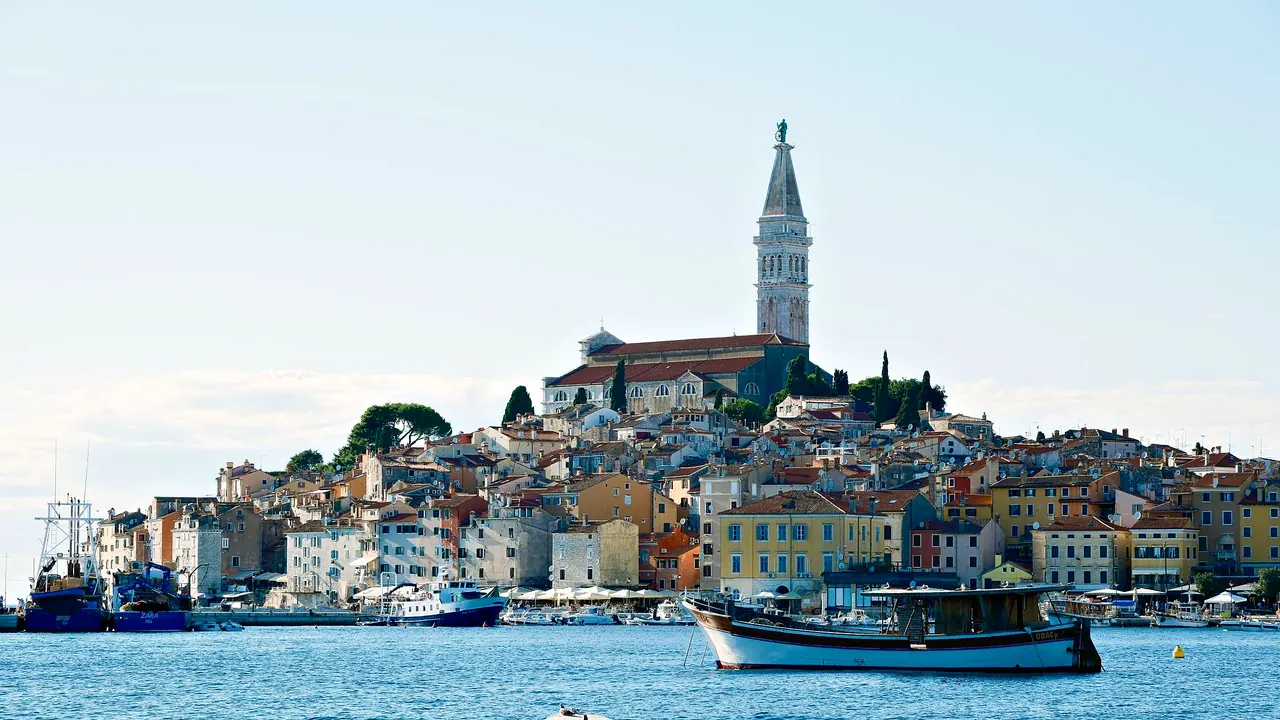
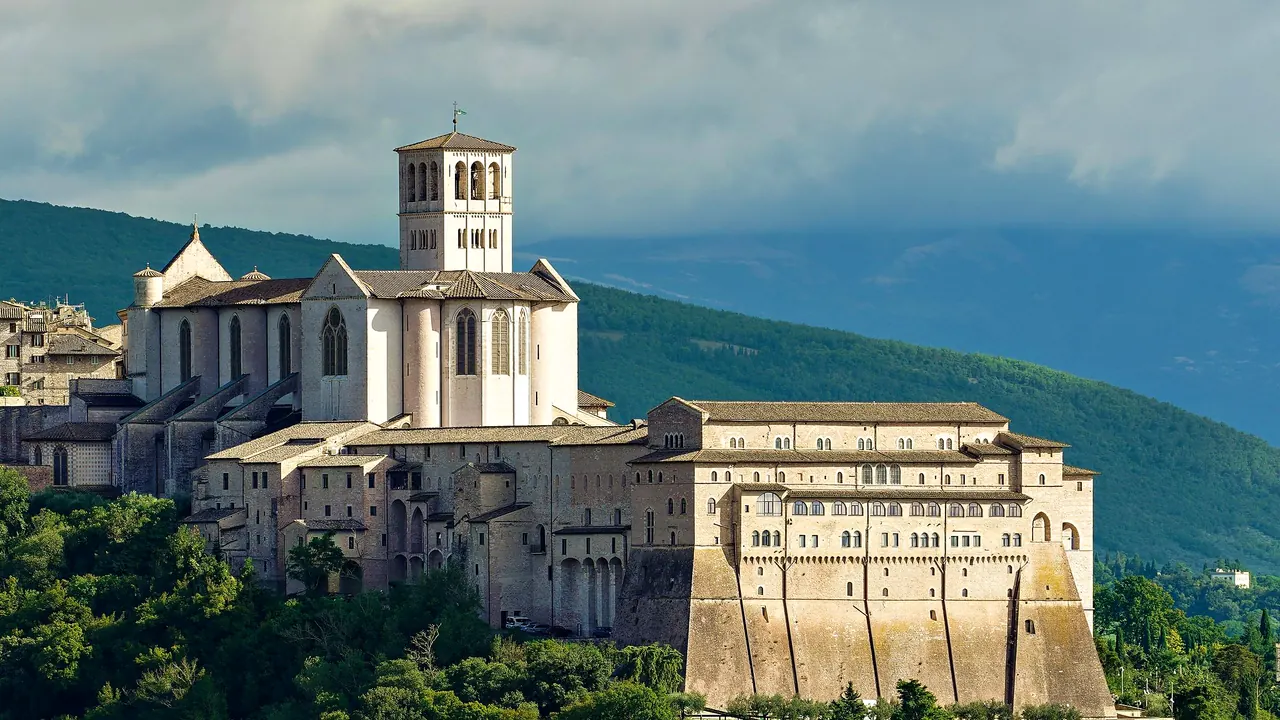
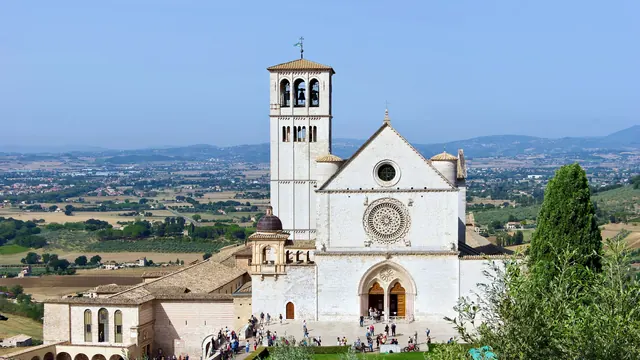
Photos: Istria by Ramon Karolan, Pexels License; Umbria by Tagooty, CC BY-SA 4.0, cropped.
Istria or Umbria?
Our verdict in twelve categories, each scored against the same fixed benchmark cities, and the climate month by month, so you can choose for your trip.
Choose Istria for
- beaches
- families
- nightlife
Istria is the one to pick for a summer by the sea with serious food close behind it. You can swim every day from the rocky coves of Kamenjak or the wooded headlands near Rovinj, the resort villages are built around children, and the truffle and wine hills are only a short drive inland. It suits travellers who want the water first and old stone towns as an evening outing.
Choose Umbria for
- live music and the arts
- culture and sights
- prices
Choose Umbria when the art and the towns are the reason for going. Giotto in Assisi, Signorelli in Orvieto and a different hill town each day, with Tuscany and Rome close enough for outings, make it a richer base for touring, and it is a little gentler on the budget. What you give up is the sea: swimming here means a lake or a farmhouse pool.
Scoreboard
Twelve categories on one fixed scale from 0 to 100. The shaded stretch is the gap between the two.
Your match
Pick a travel style or drag the sliders, and both match scores follow your weighting.
Too close to call, 1 point apart
Wins on beaches and families with your weighting.
Wins on live music and the arts and culture and sights with your weighting.
What matters to you?
Category by category
What the scores mean for a trip.
Beaches & swimming
This is the widest gap between the two. Istria has a long Adriatic shoreline with very clear water, from the wild coves of the Premantura and Kamenjak tip to the resort beaches of Poreč and Umag. The catch is that almost all of it is pebble, rock or concrete platform rather than sand.
Umbria is landlocked. Its swimming is at Lake Trasimeno's small lidos, where the water is warm and shallow but often cloudy and muddy underfoot, or in a farmhouse pool. Anyone who wants the sea faces a drive of two hours or more.
Food & drink
Both regions are serious about food, and both grate truffles over handmade pasta, so the difference is in what surrounds the truffle. Istria has the sea: oysters and mussels from the Lim Bay, fish restaurants in Rovinj and Novigrad up to fine dining, and Venetian-leaning flavours with Malvazija and Teran poured in hillside cellars.
Umbria's cooking is pure hill country: Norcia's pork butchery, porchetta from market vans, Castelluccio lentils and Trevi oil, with tannic Sagrantino as its signature wine. It is narrower in range, with little seafood, but very deep in what it does.
Culture & sights
Umbria clearly has the deeper heritage. Assisi's basilica holds frescoes by Giotto and Cimabue, Orvieto's cathedral has Signorelli's Last Judgement, and Perugia's national gallery is rich in Perugino. Behind them stands a whole chain of towns, from Gubbio to Spello, each worth a visit for its own art.
Istria's strengths are fewer but striking, chiefly Pula's Roman Arena and the gold mosaics of the Euphrasian Basilica, with Roman, Venetian and Habsburg layers in towns like Rovinj and Motovun. It rewards wandering rather than looking at great art.
Nightlife
Neither region is built for late nights, but Istria has a little more going on. In summer Rovinj's waterfront and Poreč's old town fill with terraces and cocktail bars, the Medulin and Poreč coasts add beach bars and a few seasonal clubs, and Pula keeps bars open all year.
In Umbria, Perugia is the only real exception. Its students fill the main street and cathedral steps and keep a few late bars going, while everywhere else goes quiet after dinner and there are no clubs.
Nature & outdoors
The two are close as outdoor destinations but differ in character. Istria's outdoors is gentle and often coastal: cycling between hill towns and along the old Parenzana railway, kayaking and windsurfing at Kamenjak, and the parkland of the Brijuni islands. The Učka ridge, at around 1,400m, gives the best hiking.
Umbria has the higher ground. The Monti Sibillini top 2,000m, the Castelluccio plain flowers in early summer, and the Valnerina offers rafting and canyoning, with the Marmore Falls nearby.
Day trips
Both are compact regions for touring, but Umbria has the richer list. Every hill town is a worthwhile outing, Cortona, Montepulciano and Siena lie across the Tuscan border, and Rome is a little over an hour by train from Orvieto.
Istria's own towns and wine roads are close together, and its outings beyond the region head north and east instead. Piran and Trieste are each about an hour away, the Postojna and Škocjan caves are in the Slovenian Karst, and Ljubljana is a long day out.
Good for families
Istria has long catered for families and it shows. Large campsites and resort villages around Poreč, Umag and Medulin have pools and playgrounds, and there are water parks, a dinosaur park near Funtana and an aquarium in Pula. The shallow bays near Medulin suit small swimmers.
Umbria works for a quiet farmhouse stay with a pool, Lake Trasimeno and an outing to the Marmore Falls. After that the frescoed churches and steep, cobbled towns offer children little, and pushchairs struggle.
Getting around
In both regions a car is close to essential, and journeys are short. The differences are in the details. In Istria, coastal buses link the main resort towns, but the coastal roads clog and parking fills early in July and August.
In Umbria, the roads are quiet, and a rail line threads Perugia, Assisi, Spello and Spoleto, with Orvieto on the Rome to Florence line. The hill-town centres are closed to visitors' cars, so you ride up from car parks by escalator or funicular.
Shopping & style
Umbria gives shoppers a bit more to take home. Deruta's majolica workshops, hand-loomed linen from Montefalco and Bevagna, and cashmere outlets near Perugia add crafts and clothing to the hams and Sagrantino.
In Istria, shopping is almost entirely edible: truffle products from Motovun and Buzet, olive oil and wine from the producers, plus small galleries in Grožnjan and on Rovinj's Grisia street. Neither region offers much fashion.
Affordability
Umbria is the easier region on the budget. Farmhouse stays cost less than across the border in Tuscany, village set menus are good value, and most of the great sights are churches that cost little or nothing to enter.
Istria's coast in July and August is priced like other popular Mediterranean resorts, especially in Rovinj. Campsites, inland farm stays and the months of June and September bring the cost down.
Live music & performing arts
Umbria has the stronger summer programme and a reason to plan around it. Umbria Jazz takes over Perugia's streets and squares in July, and Spoleto's Festival dei Due Mondi fills its Roman theatre and opera house with opera and dance.
Istria's highlight is a concert or a Pula Film Festival screening inside the Roman Arena, along with student musicians in Grožnjan's squares. Outside summer, Pula's theatre is the only regular venue.
Wellness & relaxation
Both rest on slow days rather than spa culture, but Umbria is the calmer retreat. Country houses offer yoga and massage, and Assisi and the Monte Subasio hermitages attract people looking for silence. Its small mineral-water spas are modest.
Istria has one historic thermal spring, Istarske Toplice in the Mirna valley, and hotel spas on the coast. A coast this busy in high summer pushes anyone seeking quiet inland or into the shoulder months.
When should you go?
Pick your month. The climate figures are measured averages, not a forecast.
Istria in July
Umbria in July
Daytime high, °C
Rainfall in the month, mm
Where the figures come from
Istria's temperatures are measured 57 km from the centre, at Trieste.
Istria has no rain gauge within 25 km of the centre, so its rainfall comes from a gridded climate dataset read at the destination rather than from a gauge further away.
Umbria's temperatures are measured 53 km from the centre, at Frontone.
Umbria has no rain gauge within 25 km of the centre, so its rainfall comes from a gridded climate dataset read at the destination rather than from a gauge further away.
Temperature and rainfall are climate normals, averaged over the years shown. Istria: 1991-2020 normals, Trieste (56.5 km from centre). Umbria: 1991-2020 normals, Frontone (52.9 km from centre).
The two regions have much the same warm season, but they are good for different things in it. On the Istrian coast the sea is warm enough to swim from June to late September and is warmest in August, at about 26°C. July is the sunniest month and the most settled, and July and August suit days built around the water. Rain picks up sharply from September and is heaviest in November, at around 102mm, so late spring and early autumn are the times for the inland hill towns and cycling routes.
Umbria gets a little hotter in high summer. Valley afternoons reach about 30°C in July, which makes climbing steep hill towns hard going in the middle of the day, even though July is also its driest month. May, June, September and early October are best for walking the towns and hills. Winters are colder than on the Istrian coast, with January highs around 7°C, and the autumn rains build to a similar peak in November.
Which traveller are you?
On a beach and sun trip, Istria is the clear choice. The sea is clear and warm enough from June to September, with wild coves at Kamenjak and easy resort beaches at Poreč. Umbria has no coast, only Lake Trasimeno's cloudy shallows and farmhouse pools.
For a culture and arts trip, Umbria goes further. Giotto's frescoes in Assisi, Orvieto's cathedral and Perugia's Galleria Nazionale outweigh Istria's Arena and Poreč mosaics. Spoleto's festival and Umbria Jazz also give it a summer stage Istria cannot match.
On a family trip with young children, Istria is better equipped. Campsites with pools, water parks near Poreč, a dinosaur park and the calm, shallow bays at Medulin fill the days. Umbria's farmhouse pools and frescoed churches run out of appeal for children much sooner.
Before you go
| Measure | Istria | Umbria |
|---|---|---|
| Official language | Croatian | Italian |
| Currency | Euro (EUR) | Euro (EUR) |
| Sockets | CF230 V, 50 Hz | CFL230 V, 50 Hz |
| Driving side | Right | Right |
| Time zone | UTC+1, UTC+2 in summer | UTC+1, UTC+2 in summer |
| Emergency number | 112 | 112 |
| Main airport | Pula Airport (PUY)34 non-stop destinations | Perugia San Francesco d'Assisi – Umbria International Airport (PEG)17 non-stop destinations |
| Public holidays this year | 14 days | 13 days |
By the numbers
| Measure | Istria | Umbria |
|---|---|---|
| Population | - | 852,085 |
| People per km² | - | 101 |
| Swim season, months above 21 °C | 4 months | - |
Where else could you go?
Every comparison below shares a destination with this one, so you can follow Istria or Umbria somewhere new.