Namibia
Windhoek
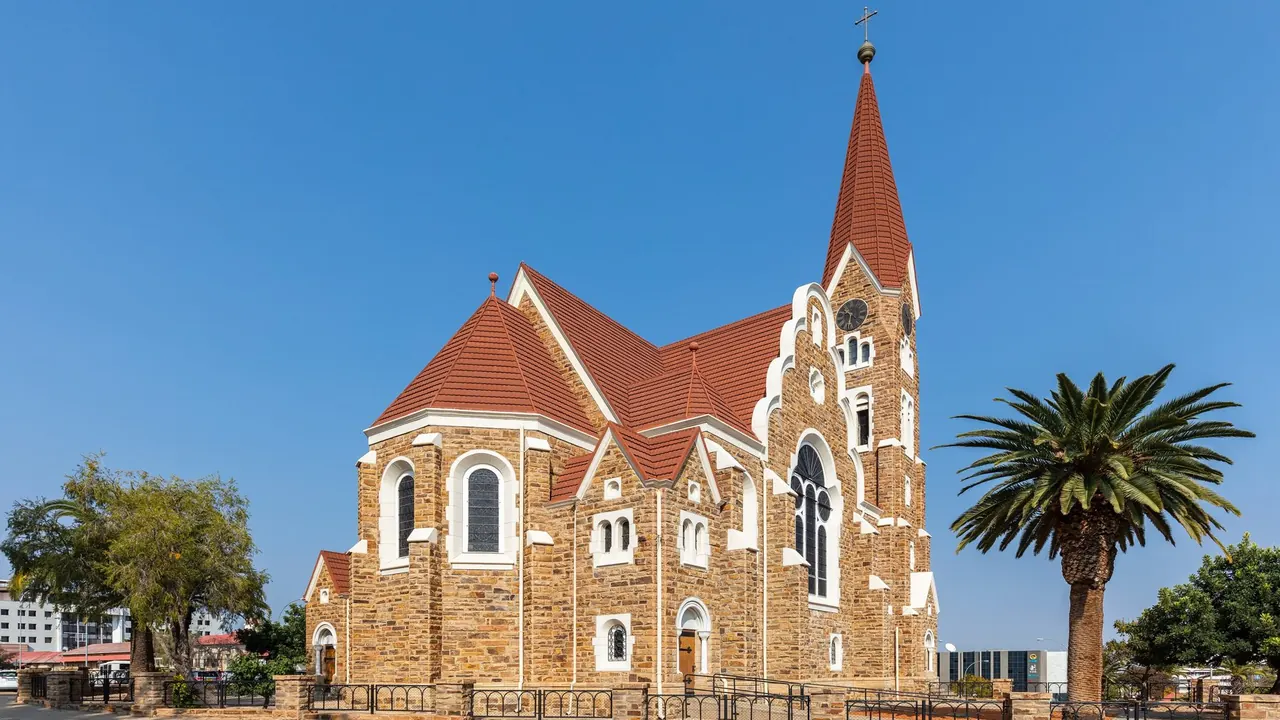
The Christuskirche among palms
- Affordable cities62
- Nature & outdoors52
- Food & drink36
Photo: Diego Delso, CC BY-SA 4.0, cropped
Match
29
Every category weighted equally
- Beach & sun29
- Culture & arts28
- Food & nightlife28
- Family trip31
- Outdoors31
- Relax & unwind30
- Shopping & style29
- On a budget33
Windhoek in twelve categories
Our verdict on each, scored 0 to 100 against the same fixed benchmark cities, so a score means the same thing on every page.
Beaches & swimming. Scores 4 out of 100.
Food & drink. Scores 36 out of 100.
Culture & sights. Scores 30 out of 100.
Nightlife. Scores 25 out of 100.
Nature & outdoors. Scores 52 out of 100.
Day trips. Scores 14 out of 100.
Good for families. Scores 30 out of 100.
Getting around. Scores 22 out of 100.
Shopping & style. Scores 30 out of 100.
Affordability. Scores 62 out of 100.
Live music & performing arts. Scores 18 out of 100.
Wellness & relaxation. Scores 30 out of 100.
Windhoek category by category
Beaches & swimming
4Windhoek is an inland capital on a high plateau, and there is no beach anywhere within reach of a day. The coast at Swakopmund is about four hours' drive west across the desert, and even there the Atlantic is chilled by the Benguela current and rarely warm enough for a comfortable swim. In the city, swimming means a hotel or guest-house pool, which in the dry heat of summer is welcome enough.
Food & drink
36Eating in Windhoek is shaped by two traditions. One is meat: game such as oryx, kudu and springbok turns up on most menus, and in Katutura the kapana stalls grill strips of beef over open fires, served with chilli salt and eaten standing. The other is the German colonial legacy, visible in bakeries selling apple strudel and Brötchen, in hearty beer-hall cooking and in the local lagers brewed to the old purity law.
Beyond that the range is modest. There are steakhouses, a few good mid-range restaurants in Klein Windhoek and the suburbs, and some Portuguese and Angolan influence, but little fine dining and not much variety for a long stay.
Culture & sights
30Windhoek's sights cluster on a short ridge above the city centre and can be seen in a day. The Christuskirche, a sandstone Lutheran church from the German colonial period, stands on its roundabout as the city's emblem, beside the Tintenpalast, the parliament building set in formal gardens. Next to them is the Alte Feste, the white-walled fort that is the oldest building in the city, best appreciated from outside as a piece of colonial architecture.
The Independence Memorial Museum, a tall gold-clad building beside the fort, is the place to understand the country. Its galleries cover colonial rule, the Herero and Nama genocide and the liberation struggle with a candour that makes it worth the time, and the top floor looks out over the city. The National Art Gallery, a scattering of German-era buildings along Independence Avenue and Heroes' Acre just south of the city complete the list. Most visitors treat Windhoek as a staging post rather than somewhere to come for its sights.
Nightlife
25Evenings in Windhoek mostly revolve around long dinners, beer gardens and a few lounge bars in the centre and Klein Windhoek. On Fridays and Saturdays a small number of clubs play Afro-house, kwaito and amapiano, and the shebeens of Katutura are where much of the city really goes out, best visited with someone local. The centre empties after dark, and walking between venues at night is not advised, so most visitors take a taxi and call it a night fairly early.
Nature & outdoors
52Windhoek sits in a basin of the Khomas Hochland, a rolling highland of thornbush, granite koppies and dry riverbeds, with the Auas Mountains on the southern skyline. Daan Viljoen Game Park, about half an hour west, has hiking trails among zebra, kudu, oryx and wildebeest, and several private game farms around the city offer guided drives, walks and birdwatching within an easy drive. Avis Dam on the eastern edge has short walking loops.
The skies are clear most of the year and the dry winter is ideal for walking. The landscapes Namibia is famous for, the red dunes of Sossusvlei and the wildlife of Etosha, are four to five hours away and need an overnight trip rather than a day out from the city.
Day trips
14There is little to visit as a day out from Windhoek. Okahandja, about an hour north, has a large woodcarvers' market and graves of Herero chiefs, and the Gross Barmen hot springs resort lies a little beyond it. Rehoboth, to the south, is a small town with a Baster history but little for visitors. Swakopmund, the coastal town with the strongest German character, and the sites of the south and north are four hours or more away, so they belong on a road trip with overnight stops.
Good for families
30Windhoek has almost nothing built for children, no zoo of note, no aquarium and no theme park. What it does offer is wildlife close by: a game drive at Daan Viljoen or one of the private farms around the city, where children can see giraffe, zebra and antelope, is the highlight for most families. Guest houses with gardens and pools in the quieter suburbs make for an easy base, and the dry climate is pleasant outside the hottest weeks. Families usually pass through on the way to Etosha or the coast, and with a hire car the city is simple enough to manage.
Getting around
22The compact centre around Independence Avenue and the ridge with the Christuskirche can be covered on foot by day. Beyond it, the city is spread across hilly suburbs with no metro, no tram and no bus service a visitor can realistically use. Locals rely on shared sedan taxis that run informal routes, which take some confidence to use; most visitors book taxis through their lodging or hire a car, which they usually need anyway for travel beyond the city. Walking after dark is best avoided.
Shopping & style
30Shopping in Windhoek is mostly about crafts. The Namibia Craft Centre, in the old brewery building, gathers baskets, Herero dolls in Victorian-style dress, embroidery, ostrich-shell jewellery and leather goods from across the country, and curio sellers set out woodcarvings along the Post Street Mall. Semi-precious stones, karakul wool and game-leather shoes are other local specialities. For everything else there are suburban malls with South African chain stores, practical for stocking up before a road trip but nothing to travel for.
Affordability
62Day-to-day costs in Windhoek are moderate. Eating out, beer and groceries are reasonable by European standards, kapana and local cafés are cheap, and comfortable guest houses in the suburbs cost much less than city hotels in Europe. What raises the bill is how Namibia is travelled: there is little public transport, so taxis or a hire car are needed, and the safaris, lodges and guided trips that bring most visitors to the country are priced for an international market. A stay in the city itself is good value; the wider trip usually is not cheap.
Live music & performing arts
18The National Theatre of Namibia is the main stage, hosting local drama, dance, choirs and the occasional touring production, and the College of the Arts puts on student concerts. Live music otherwise turns up in a few bars and at events, with local styles such as shambo and Namibian kwaito, but there is no regular circuit a visitor can count on. Anyone keen on performance should check what is on during the stay rather than expect something every night.
Wellness & relaxation
30Windhoek has no bathing tradition of its own, and spa treatments are limited to hotel and lodge spas, some of them in the game farms just outside the city. The Gross Barmen hot springs, about an hour north near Okahandja, have thermal pools in a resort setting. What the city offers instead is a quiet pace: a small capital with low-rise suburbs, garden guest houses, wide skies and clear, cool winter nights, which makes it an easy place to rest for a day before or after a long road trip.
When should you go?
Pick a month to see what it is like. The climate figures are measured averages, not a forecast.
Windhoek in July
Daytime high, °C
Rainfall in the month, mm
The whole year
Shaded against this city’s own year: the deepest cell is its best month for that figure and the palest its weakest.
Temperature and rainfall are climate normals, averaged over the years shown. Windhoek: 1991-2020 normals, Windhoek (1.7 km from centre).
Before you go
| Measure | Windhoek |
|---|---|
| Official language | English |
| Currency | Namibia Dollar (NAD) |
| Sockets | M220 V, 50 Hz |
| Driving side | Left |
| Time zone | UTC+2 |
| Emergency number | 112 |
| Elevation | 1,650 m |
| Main airport | Hosea Kutako International Airport (WDH)41 km from centre16 non-stop destinations |
| Public holidays this year | 13 days |
By the numbers
| Measure | Windhoek |
|---|---|
| City population | 486,169 |
| People per km² | 95 |
| Museums within 10 km | 5 |
| UNESCO World Heritage sites within 50 km | 0 |
Compare Windhoek with
Every comparison with a written verdict behind it.