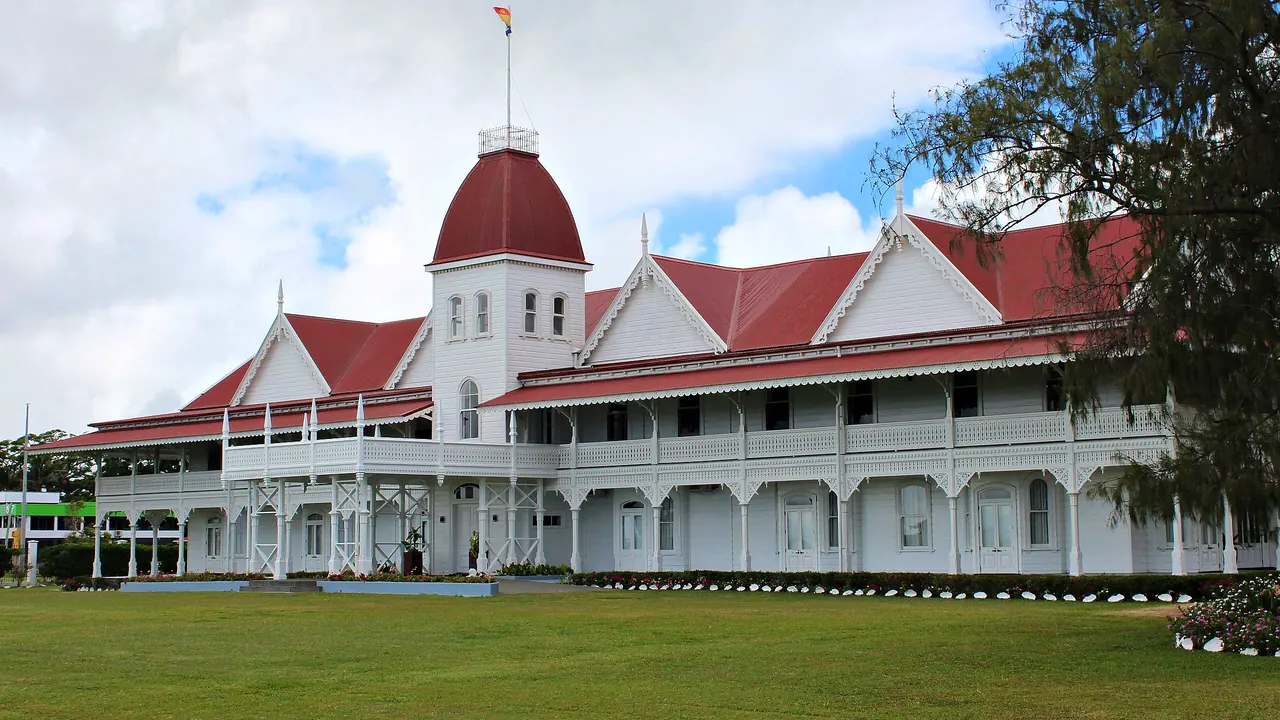
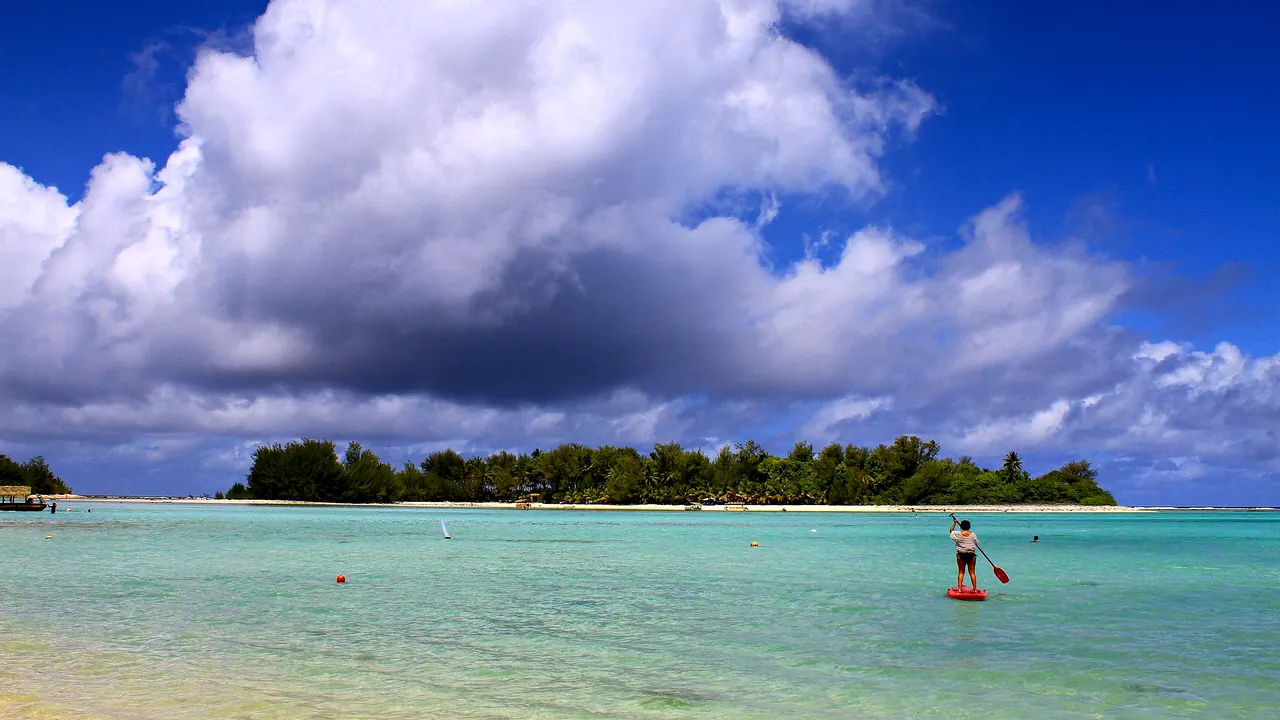
Photos: Nuku'alofa by Uhooep, CC BY-SA 4.0, cropped; Rarotonga by Christopher Johnson from Tokyo, Japan, CC BY-SA 2.0, cropped.
Nuku'alofa or Rarotonga?
Our verdict in twelve categories, each scored against the same fixed benchmark cities, and the climate month by month, so you can choose for your trip.
Choose Nuku'alofa for
- prices
- day trips
Nuku'alofa suits a traveller who wants to see the Kingdom of Tonga as it really lives: a small royal capital with its palace and churches, Sundays when the whole island stops, and the ancient stone tombs and trilithon of the old kings within an easy drive. It is the cheaper base of the two, and from July to October it lets you swim with humpback whales. The catch is that the town has no beach of its own, so lagoon days mean a boat or a drive.
Choose Rarotonga for
- getting around
- beaches
- families
Anyone whose picture of the South Pacific is a warm lagoon right outside the door should pick Rarotonga. Sheltered water and sand run almost the whole way round the island, a volcanic interior offers proper forest walks, and the bus and short coastal road make the place easy, which is why families do so well here. You pay noticeably more for it, and there is little beyond the island to explore.
Scoreboard
Twelve categories on one fixed scale from 0 to 100. The shaded stretch is the gap between the two.
Your match
Pick a travel style or drag the sliders, and both match scores follow your weighting.
Wins on prices and day trips with your weighting.
Wins on getting around and beaches with your weighting.
What matters to you?
Category by category
What the scores mean for a trip.
Beaches & swimming
This is Rarotonga's biggest advantage. A reef encircles the island, and the lagoon inside it means almost any stretch of coast is a beach you can walk out of your room onto. Muri has calm turquoise water and small islets you can reach on foot at low tide, while the south coast around Titikaveka and Aroa gives the clearest snorkelling straight from the sand.
Nuku'alofa looks out over shallow reef flats, so its waterfront is for strolling, not swimming. For beach days you take a boat to Pangaimotu or drive about half an hour to Ha'atafu on the western tip, where there is sand and good snorkelling inside the reef. Beach time here is an excursion, not something you do every day.
Food & drink
The two islands share a cuisine: raw fish in coconut cream and citrus ('ota 'ika in Tonga, ika mata in the Cooks), taro leaves cooked in coconut, and food from the earth oven. Rarotonga gives a visitor more ways to find it, at the Saturday Punanga Nui market in Avarua and the evening stalls at Muri, with beach cafés, decent coffee and a local beer as well.
In Nuku'alofa there is less to choose from, just a few waterfront places, simple Chinese restaurants and takeaways, and the stalls at Talamahu Market. Tongan cooking is at its best at a feast night or a family Sunday lunch from the 'umu, not in a restaurant.
Culture & sights
Each island takes a short morning to see, but what you see is different. Nuku'alofa's sights are those of a working monarchy: the white wooden Royal Palace, viewed from outside its grounds, the royal tombs on the lawn at Mala'ekula, and the Basilica of St Anthony of Padua with its tall thatch-like roof.
Rarotonga has the museums Nuku'alofa lacks, though both are small: a national museum and a library-museum with canoe history in Avarua. It also has the coral-lime Cook Islands Christian Church and the stone marae of Arai-te-Tonga on the ancient inland road.
Nightlife
Neither island is for a night out, but Rarotonga is a little more sociable. Sunset drinks on the west coast and beach bars fill most evenings, and on Fridays Avarua's waterfront bars and a couple of dancing spots stay open late.
Nuku'alofa also has its Friday crowd, but Tonga keeps the Sabbath by law, so Saturday ends before midnight and Sunday is almost completely shut.
Nature & outdoors
Rarotonga has more varied landscape. Its volcanic interior rises in steep, forested ridges above 600m, and the cross-island track climbs past the Needle and a waterfall down to the south coast. On the water there is kitesurfing off Muri and diving on the outer reef walls.
Tongatapu is low, flat coral with no hills, so its outdoors is mostly coastal: the long line of Mapu'a 'a Vaea blowholes, the stone arch at Hufangalupe, the flying foxes at Kolovai and Anahulu Cave. Both islands see humpbacks from July to October. In Tonga you can swim with them, while on Rarotonga they are often visible from the shore.
Day trips
Nuku'alofa gives you more to do outside town. About forty minutes east are the terraced royal tombs of Lapaha and the 13th-century Ha'amonga 'a Maui trilithon, a full day of ancient Tonga by car. 'Eua's forests and cliffs are a short flight or a ferry ride away.
Rarotonga is a lone island, so beyond driving round it the one real day trip is the flight to Aitutaki for a lagoon cruise and lunch on a sandbar. It is memorable but expensive.
Good for families
Rarotonga is the easier family choice, mainly because the shallow, reef-protected lagoon at Muri and along the south coast is right there for paddling and snorkelling. Many resorts have kids' clubs and family units, although older children may run out of things to do after a week.
Tongans are just as warm towards children, but Nuku'alofa has nothing made for them, few playgrounds and limited medical care. Families do better staying on a small island or at the western beaches, with a car for the blowholes and flying foxes.
Getting around
Rarotonga is simpler to get around. One coastal road of about 32km loops the island, the bus runs clockwise and anticlockwise and stops when you flag it down, and the flat road suits a hired scooter or a bicycle. Evenings and Sundays are the only times it becomes awkward.
In Nuku'alofa the small, flat centre is easy on foot, but buses beyond town run to informal schedules and stop early. Most visitors rely on taxis, tours or a hire car, which needs a local licence. Sunday stops nearly everything.
Shopping & style
Rarotonga has a bit more to buy. Its black pearls, sold loose or set at specialist shops in Avarua, are a real reason to shop, and the Saturday Punanga Nui market adds tivaevae quilts, pareu and pandanus hats. There is also a short street of gift shops and boutiques.
In Nuku'alofa it is crafts or nothing. Around Talamahu Market you will find ngatu bark cloth, fine pandanus mats and carvings, often sold by the women who made them.
Affordability
Nuku'alofa is the cheaper of the two, though it is not cheap. Market produce, local cooked food, taxis and modest guesthouses are reasonable, while imported goods, visitor restaurants, the island resorts and whale swims are where costs rise.
Rarotonga follows New Zealand prices or goes above them, and the beachfront resorts around Muri, meals out, diving and flights to Aitutaki add up quickly. Self-catering, the bus and a scooter help, and the lagoon and the walks cost nothing.
Live music & performing arts
Rarotonga puts on more performances a visitor can actually get to. Island nights with a dance troupe and the thunderous Cook Islands log drums run several evenings a week, and Te Maeva Nui in early August brings dance teams from every island to compete.
Nuku'alofa has no regular shows. Its dance, the graceful solo tau'olunga and the group lakalaka, appears at feast nights and at celebrations such as the Heilala Festival. On both islands the most moving music is the unaccompanied hymn singing at Sunday services.
Wellness & relaxation
For a restful trip Rarotonga is the better pick, although Nuku'alofa has a slow pace of its own. The Tongan capital is quiet on any day, but its real stillness comes once a week with the Sabbath, not evenly through the week. Treatments are limited to a few massage rooms at the island resorts, so rest here means a hammock on one of the small islands off the harbour.
Rarotonga stays unhurried every day. There are no traffic lights, and the days slip by between swims in the lagoon and the shade of a veranda. Muri and Titikaveka on the south and east coasts are the calmest places to stay. Day spas offering coconut-oil massage and some yoga on the beach also give you more to book than Tonga does.
When should you go?
Pick your month. The climate figures are measured averages, not a forecast.
Nuku'alofa in July
Rarotonga in July
Daytime high, °C
Rainfall in the month, mm
Where the figures come from
Nuku'alofa has no rain gauge within 25 km of the centre, so its rainfall comes from a gridded climate dataset read at the destination rather than from a gauge further away.
Temperature and rainfall are climate normals, averaged over the years shown. Nuku'alofa: 2009-2025 (rainfall 1991-2020) normals, Fua'Amotu (12.2 km from centre). Rarotonga: 1991-2020 normals, Rarotonga (10.8 km from centre).
Both islands are hot all year, with daytime highs near 30°C from December to April and a few degrees milder in the southern winter. The sea never drops much below 24°C, so swimming works in every month. Nuku'alofa's wet season, from January to April, is heavy, with close to 280mm of rain in March. From May to December the rain falls to about half that, and these slightly cooler months are the most comfortable for walking the town and driving out to the tombs and blowholes.
Rarotonga's wet months run from December to April and are less heavy than Tonga's. From June to October it is the drier of the two, with most months under 100mm against roughly 120mm in Nuku'alofa, and October and November are its sunniest months. For dependable lagoon days both islands are best from about June to November, and Rarotonga is the drier of the two in that window.
Which traveller are you?
For a beach and sun trip, Rarotonga is the clear choice. Its sheltered lagoon and pale sand circle almost the whole island, with Muri's wadeable islets and snorkelling straight off the sand at Aroa. In Nuku'alofa every swim starts with a boat or a drive.
On a trip on a tight budget, Nuku'alofa costs less day to day. Market food, local cooking, taxis and simple guesthouses are all fairly priced. Rarotonga runs at New Zealand prices or above, although its bus, self-catering units and free lagoon soften the bill.
For travellers who want to get into the water with humpback whales between July and October, Nuku'alofa is the place, because Tongan rules allow guided swims alongside them. On Rarotonga the whales pass close to the reef, but you watch them rather than swim with them.
Before you go
| Measure | Nuku'alofa | Rarotonga |
|---|---|---|
| Official language | English, Tongan | English, Cook Islands Maori |
| Currency | Pa’anga (TOP) | New Zealand Dollar (NZD) |
| Sockets | I240 V, 50 Hz | I240 V, 50 Hz |
| Driving side | Left | Left |
| Time zone | UTC+13 | UTC-10 |
| Emergency number | 911 | Police 999, ambulance 998, fire 996 |
| Elevation | 3 m | - |
| Main airport | Fua'amotu International Airport (TBU)13 km from centre5 non-stop destinations | Rarotonga International Airport (RAR)7 non-stop destinations |
| Public holidays this year | 11 days | 11 days |
By the numbers
| Measure | Nuku'alofa | Rarotonga |
|---|---|---|
| Population | 23,221 | 10,572 |
| People per km² | 2,037 | 158 |
| Museums within 10 km | 1 | - |
| UNESCO World Heritage sites within 50 km | 0 | - |
| Swim season, months above 21 °C | 12 months | 12 months |
Where else could you go?
Every comparison below shares a destination with this one, so you can follow Nuku'alofa or Rarotonga somewhere new.
- Aitutakivs Rarotonga
- Apiavs Nuku'alofa
- Mamanuca Islandsvs Nuku'alofa
- Mooreavs Rarotonga
- Tahitivs Rarotonga
- Apiavs Rarotonga