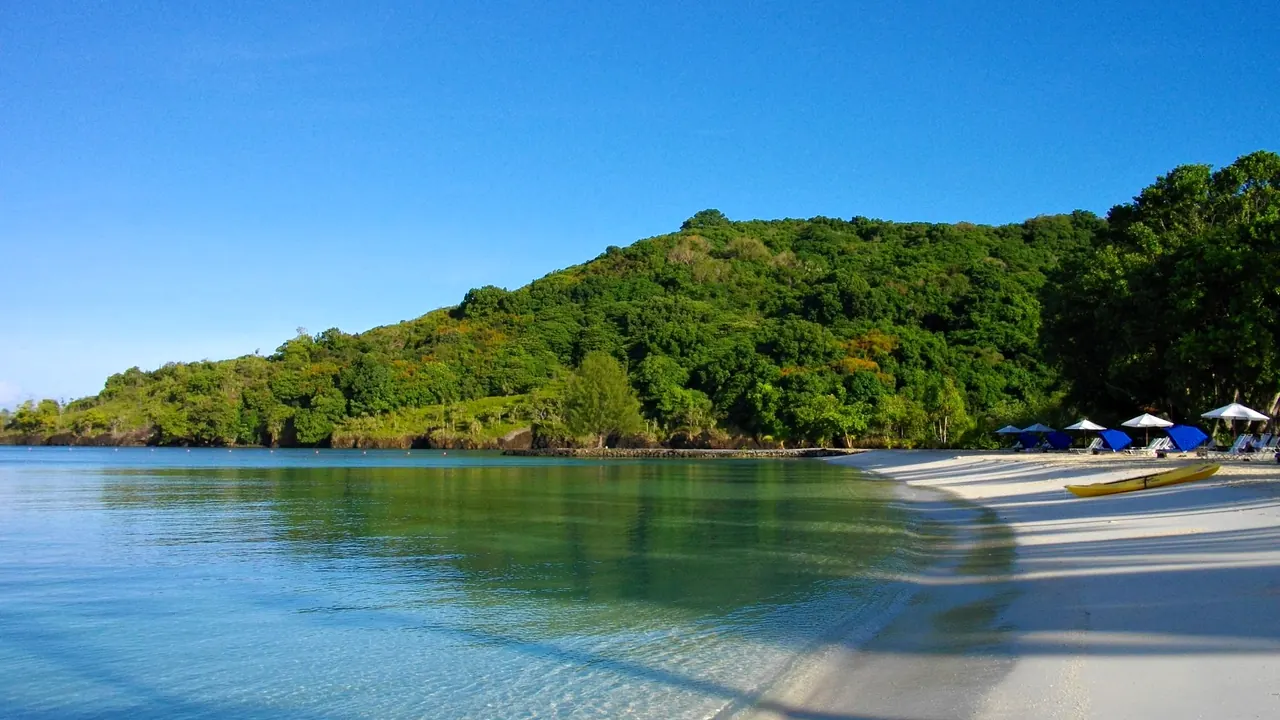
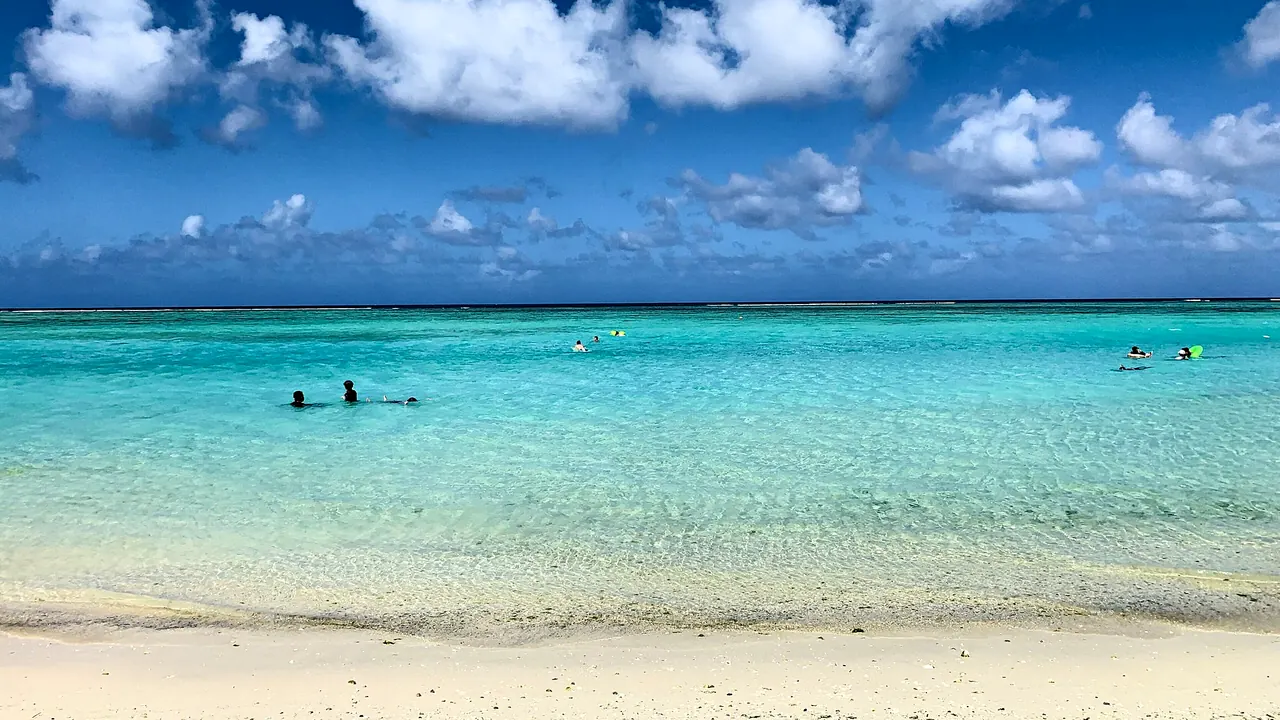
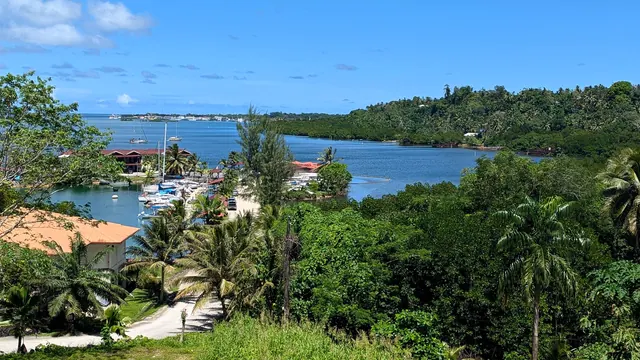
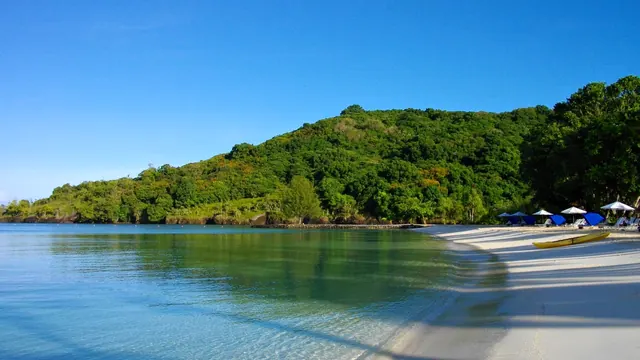
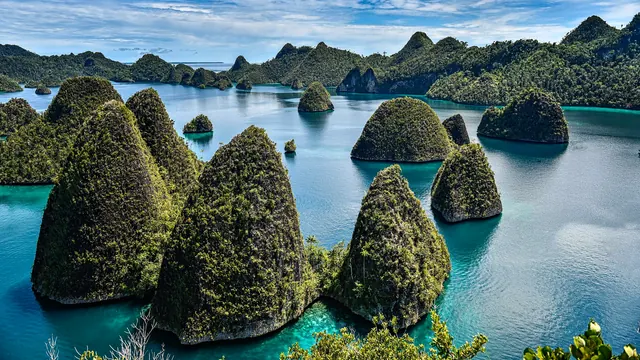
Photos: Palau by Abasaa, Public domain; Guam by Daniel Ramirez from Honolulu, USA, CC BY 2.0, cropped.
Palau or Guam?
Our verdict in twelve categories, each scored against the same fixed benchmark cities, and the climate month by month, so you can choose for your trip.
Choose Palau for
- nature and the outdoors
- day trips
- wellness
Palau is the trip for people who want to spend their days in the water. The Rock Islands lagoon, the sharks and currents at Blue Corner, the mantas of German Channel and kayaking into hidden marine lakes draw divers from all over the world. Everything else comes second. Koror is a small, quiet base with limited food and almost no evening life, boats leave early, and the daily trips and permits make it an expensive stay.
Choose Guam for
- shopping
- families
- getting around
Guam suits travellers who want an easy, self-contained resort stay, young families most of all. The calm, shallow lagoon at Tumon sits in front of the hotels, and pools, kids' clubs, duty-free shopping and restaurants are all along one road. With a car you can reach the Spanish churches of Umatac and the war park at Asan in an hour or less. The diving is good rather than legendary, but daily life is simpler, livelier and a little cheaper.
Scoreboard
Twelve categories on one fixed scale from 0 to 100. The shaded stretch is the gap between the two.
Your match
Pick a travel style or drag the sliders, and both match scores follow your weighting.
Wins on nature and the outdoors and day trips with your weighting.
Wins on shopping and families with your weighting.
What matters to you?
Category by category
What the scores mean for a trip.
Beaches & swimming
Guam is the better place for a beach stay because the sand is right outside the door. Tumon Bay's reef-sheltered lagoon is shallow, clear and calm for wading and floating. Ypao Beach has picnic lawns, Gun Beach has snorkelling below the cliffs, and the quieter coves around Agat and Cocos Island add variety.
Palau's beaches are lovelier but harder to reach. The small white crescents under the Rock Islands' limestone and the tidal sandbar near Ngemelis are stops on a boat day from Koror, which has little natural sand of its own. For long, empty beaches you need an overnight trip to Kayangel or Peleliu.
Where in Palau: Rock Islands, Kayangel, Peleliu, Koror
Food & drink
Guam gives a visitor more to eat and a cuisine worth seeking out. Chamorro red rice, lemon-cured kelaguen and smoky barbecue doused in finadene are easiest to try at the weekly night market at Chamorro Village in Hagåtña. Tumon's ramen, Korean barbecue and hotel buffets fill the gaps.
In Palau, eating means Koror's small mix of Japanese, Filipino and Chinese kitchens. The best of it is fresh reef fish, tuna sashimi and mangrove crab, with fruit bat soup as the local curiosity. It feeds a dive trip well enough but has little range.
Where in Palau: Koror
Culture & sights
Neither place is a sightseeing destination, but Guam has a little more to see because of its Spanish centuries. Hagåtña has the Plaza de España, the cathedral basilica and Latte Stone Park, Umatac has Fort Soledad above the bay, and the war park at Asan and Agat preserves the landing beaches.
Palau's sights are fewer but quite unlike Guam's. The steep-roofed bai meeting houses at Airai and Melekeok and the Badrulchau monoliths on Babeldaob are its main traditional sites. Peleliu's whole island of battlefield caves and rusting tanks is the most powerful wartime site in either place.
Where in Palau: Koror, Babeldaob, Peleliu
Nightlife
Guam is the only one of the two with any real night out. Pale San Vitores Road in Tumon has sports bars, karaoke rooms and a couple of dance clubs that stay open fairly late at weekends, though the scene is small and much the same each night. Palau's evenings end with a beer among divers in a Koror bar or resort lounge, and most people are in bed early for the morning boat.
Where in Palau: Koror
Nature & outdoors
Here Palau has its great advantage, and it is the reason people fly there. Hundreds of forested limestone islets rise from a turquoise lagoon, and the diving includes sharks riding the current at Blue Corner, mantas in German Channel, sheer walls, wartime wrecks and soft-coral channels. Kayaks slip between the islets into hidden marine lakes, and at Jellyfish Lake you can swim among stingless jellyfish when the population is healthy. Guam has no seascape like the Rock Islands, no marine lakes and no current-swept dives with sharks and mantas on that scale.
Guam's nature is pleasant rather than remarkable. Divers get the Blue Hole and the two world-war wrecks lying side by side in Apra Harbor, and snorkelling starts straight off the beach. On land it has a little more range than Palau's jungle walks on Babeldaob: the cliffs at Two Lovers Point, the forest at Ritidian and the red ridges of the south around Mount Lamlam. Its forests are oddly quiet, though, because introduced snakes wiped out most of the native birds.
Where in Palau: Rock Islands, Blue Corner and German Channel, Jellyfish Lake, Babeldaob
Day trips
Palau has the better outings, though neither has many. The boat to Peleliu makes a full and moving day among the battlefield and village. The bridge to Babeldaob opens a drive past the Capitol at Melekeok, the bai at Airai and the monoliths at Badrulchau.
On Guam, the one real excursion is the loop through the southern villages of Umatac, Merizo and Inarajan. Its neighbours Rota and Saipan need a flight and are better as overnight stays.
Where in Palau: Peleliu, Babeldaob, Angaur
Good for families
Guam is built for young families in a way Palau is not. The lagoon at Tumon is calm and shallow, and the hotels come with pools, slides and kids' clubs. The beach, shops and meals are all on one stretch, and the observatory at Piti shows children reef fish through the glass.
Palau suits older children and teenagers who swim well. They can snorkel shallow reefs and paddle kayaks between the Rock Islands, but these are long days in strong sun, diving has age limits, and there is little else made for children away from the water.
Where in Palau: Koror, Rock Islands
Getting around
Guam is easier to get around. Hotel shuttles run along Tumon and into Hagåtña, and the island is only about 50km long, with good roads and light traffic, so a rental car puts everything within an hour or so.
In Palau, nearly every outing is organised. You take taxis and hotel shuttles along Koror's hot main road, dive operators collect you from your hotel, and the Rock Islands, Peleliu and Kayangel can only be reached by boat or small plane.
Where in Palau: Koror, Babeldaob
Shopping & style
Guam is a real shopping destination, at least for brands. It has a duty-free gallery and luxury boutiques on the Tumon hotel road and American malls and outlets in Tamuning and Dededo, though few independent shops. In Palau, the one thing worth buying is a carved storyboard telling a Palauan legend, a far more personal souvenir than anything on Guam's mall shelves.
Where in Palau: Koror
Affordability
Both are costly because almost everything is imported, but Palau costs more. Daily dive and snorkel boats, entry and Rock Islands permit fees and rooms that are pricey for what they offer add up quickly, and simple meals and guesthouses in Koror help only a little.
Guam is still priced like an expensive beach resort, and you will usually need a rental car. Even so, its roadside barbecue stands, the night market and the lack of sales tax take some of the edge off.
Where in Palau: Koror
Live music & performing arts
Neither place has a stage worth planning around. In Palau, traditional dance and chant belong mainly to community celebrations and independence festivities, with only the occasional hotel dinner show, so seeing them is largely a matter of luck. If you do, what you see is genuinely Palauan.
Guam's performances are easier to find. Most visitors see Chamorro and Pacific dance at hotel dinner shows, and village fiestas for each parish's patron saint, a small symphony and a few bars with cover bands add a little more.
Wellness & relaxation
Both are restful in much the same unhurried island way, and neither has a spa tradition of its own. Palau's calm comes from early starts on the water and quiet evenings, and its one ritual is the Milky Way lagoon, where boats stop so you can coat yourself in soft white limestone mud. Guam's rest is more conventional, with resort spas in Tumon and massage shops along the main road.
Where in Palau: Koror, Rock Islands
When should you go?
Pick your month, and for a country the place in it. The climate figures are measured averages, not a forecast.
Koror (Palau) in July
Guam in July
Daytime high, °C
Rainfall in the month, mm
Temperature and rainfall are climate normals, averaged over the years shown. Koror (Palau): 1991-2020 normals, Babelthuap Island, Babelthuap/Koror Airport (6.4 km from centre). Guam: 1991-2020 normals, Agana, Guam International Airport (3.1 km from centre).
Both are hot all year, with daytime highs around 31°C and warm water for swimming in every month, so the question is rain. Koror in Palau is wet all year round. The calmer, sunnier spell runs from February to April, and the heaviest rain comes from June to August, peaking at around 411mm in July. Diving goes on through all of it, but the summer months bring more grey days on the boats.
Guam has a much clearer dry season. January to May are bright and fairly dry, with March down to about 70mm, which makes spring the easiest time for the beach and for driving round the island. From June the rain builds to about 445mm in August, and the second half of the year brings the risk of typhoons. If you can only go in spring, both work well. In late summer, Palau's diving holds up better than Guam's beach days.
Which traveller are you?
For an outdoors trip, Palau is the clear choice. Its reefs, currents and lagoon are the reason divers, snorkellers and kayakers fly halfway round the world, and nearly every day is spent on the water. Guam's diving is good, but you would be settling for less.
On a family trip with young children, Guam is far easier. Small children can swim from a calm shore right in front of the hotel, with no boat to catch. Palau rewards older children who swim confidently and can cope with long days at sea.
For a shopping trip, Guam wins outright. Its tax-free brand names draw shoppers from across Asia, and you could happily give a whole day to them. In Palau there is almost nothing to buy beyond a souvenir or two, so shopping is no reason to go.
More comparisons
Each shares a side with Palau or Guam.
Where else could you go?
Set Palau or Guam against any other country.