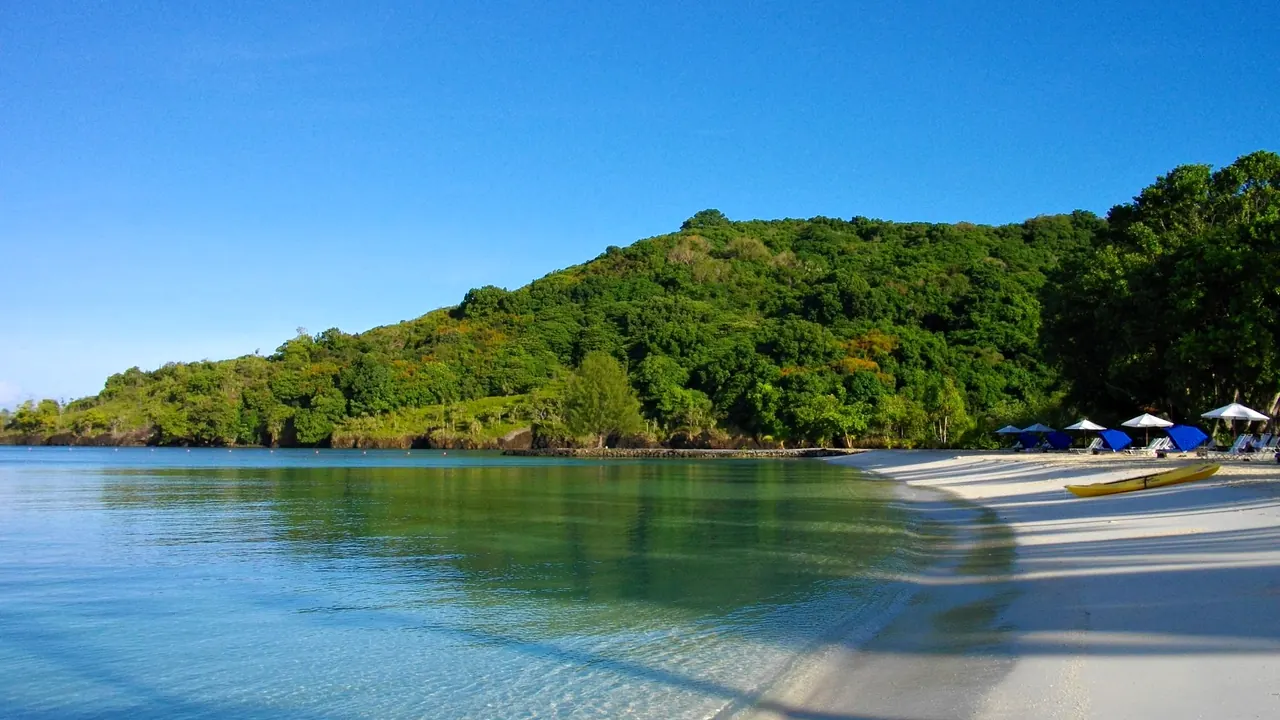
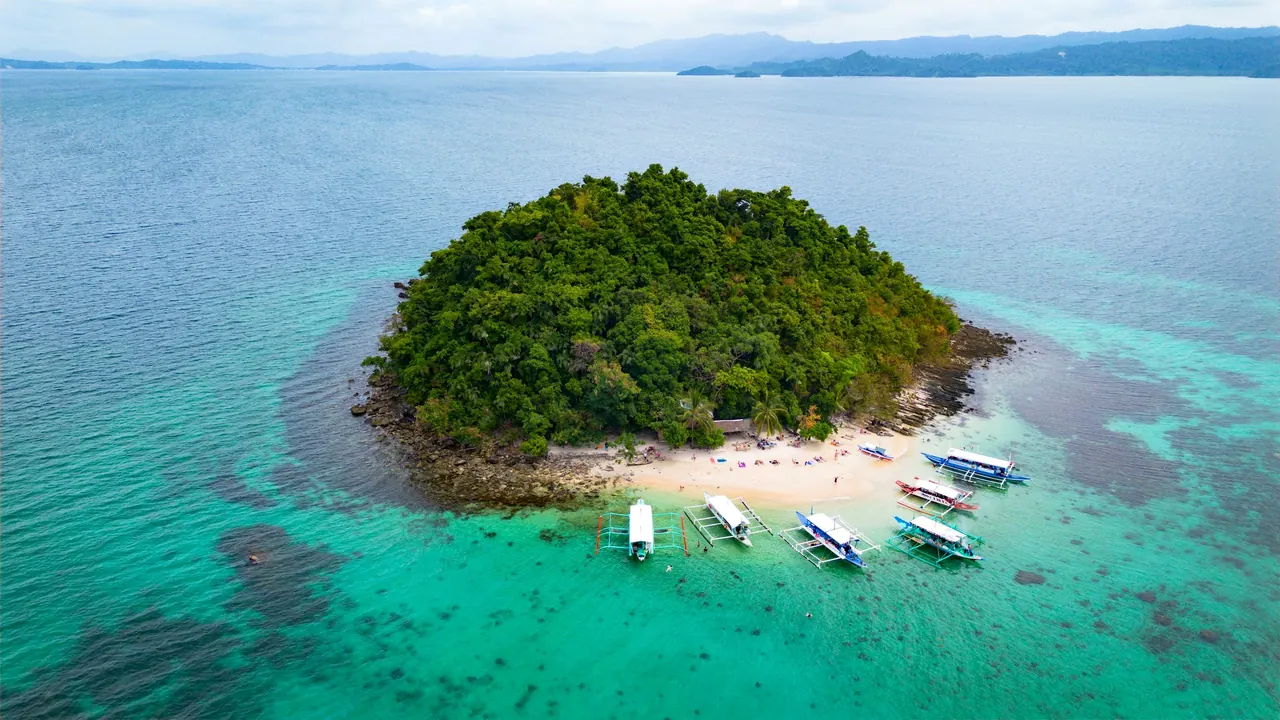
Photos: Palau by Abasaa, Public domain; Philippines by nicholas hatherly, Pexels License.
Palau or Philippines?
Our verdict in twelve categories, each scored against the same fixed benchmark cities, and the climate month by month, so you can choose for your trip.
Choose Palau for
- nature and the outdoors
Palau is for travellers who come for what lies under the water and want little else. Its reefs, the forested limestone islets of the Rock Islands and dives such as Blue Corner and German Channel are all reached by day boat from one small base in Koror, so there is no repacking and no flying between islands. It is an expensive trip, the evenings are quiet and there is not much ashore, but for divers and keen snorkellers that matches how they spend their days.
Choose Philippines for
- prices
- nightlife
- shopping
The Philippines is the better choice for almost any broader vacation. It has diving on the same level, plus better beaches, a real food culture, Spanish colonial towns, the rice terraces of the Cordillera, nights out in Manila and Boracay, and everyday costs that are far lower. You pay for this in travel time between islands, so plan fewer, longer stops.
Scoreboard
Twelve categories on one fixed scale from 0 to 100. The shaded stretch is the gap between the two.
Your match
Pick a travel style or drag the sliders, and both match scores follow your weighting.
Wins on nature and the outdoors with your weighting.
Wins on prices and nightlife with your weighting.
What matters to you?
Category by category
What the scores mean for a trip.
Beaches & swimming
The Philippines is far stronger for a beach vacation. Boracay's White Beach is a long stretch of powdery sand you can stay on. El Nido and Coron have sandbars and coves between limestone islands, and Panglao and Siquijor have snorkelling straight off the shore. There are enough beaches to build a whole trip around them in the dry months.
Palau's sand is small and hard to reach. There are white crescents tucked under the Rock Islands, and a sandbar near Ngemelis that appears at low tide, but you get to them on a boat day from Koror, which has little beach of its own. Kayangel's long empty beaches are excellent, but they need an overnight trip. Palau is for being in the water, not lying beside it.
Where in Palau: Rock Islands, Kayangel, Peleliu, Koror
Food & drink
In Palau, almost all eating happens in Koror. The menu is a small mix of Japanese, Filipino and American-style places, and the best of it is local seafood: tuna sashimi, mangrove crab and coconut crab. Fruit bat soup is the famous oddity. It makes for good meals after a dive, but nobody comes to Palau to eat.
The Philippines has a cuisine worth travelling for. Sour, vinegary adobo, sinigang and kinilaw are everywhere, Cebu is known for lechon and Pampanga for sisig. In Manila you can eat from carinderia pots one day and at the serious restaurants of Makati the next, so it pays to spend some of the trip in the cities rather than only at the resorts.
Where in Palau: Koror
Culture & sights
Palau's heritage fills a few days around the diving. Koror's Belau National Museum explains clan life and storyboard carving. On Babeldaob you can see the steep-roofed bai meeting houses at Airai and Melekeok and the Badrulchau monoliths, and Peleliu's 1944 battlefield is moving to visit.
The Philippines has much more to see, though it is spread out. Manila has Intramuros with San Agustin Church and the National Museum's pre-colonial gold. Vigan has cobbled colonial streets and the Banaue and Batad rice terraces are carved into the mountains. Each is in a different region, so seeing them shapes the route of the whole trip.
Where in Palau: Koror, Babeldaob, Peleliu
Nightlife
After dark the two could hardly be more different. In Koror, a night out is a beer with other divers in a resort lounge or a turn at karaoke, and most people are asleep early because the boats leave at dawn.
The Philippines has proper nights out. Poblacion in Makati is packed with small bars and rooftops, Bonifacio Global City has clubs open well past midnight, and Boracay's Station 2 is the place for beach parties. Karaoke is part of the night in both countries, but here it is only one part.
Where in Palau: Koror
Nature & outdoors
Both are among the best places anywhere for life under the sea, but in different ways. Palau puts it all in one place. The mushroom-shaped Rock Islands, sharks in the currents at Blue Corner, mantas in German Channel, wartime wrecks and the stingless jellyfish of Jellyfish Lake are all within a day boat of Koror, and kayaking among the islets is as good as the diving.
The Philippines gives you more variety, spread across many islands: the sardine run at Moalboal, small macro life at Anilao, wrecks at Coron and the Tubbataha liveaboards. It also has far more on land, where Palau has no mountains. You can walk through the Cordillera rice terraces, climb Mount Pulag, see the cone of Mayon, visit Bohol's Chocolate Hills and surf at Siargao.
Where in Palau: Rock Islands, Blue Corner and German Channel, Jellyfish Lake, Babeldaob
Day trips
Palau's day trips are few. You can take a boat to Peleliu's village and battlefield, or drive around Babeldaob to the Capitol at Melekeok and the old bai. Otherwise a day out means heading to the reefs.
The Philippines has a few more, depending on your base. From Manila you can reach the wartime batteries on Corregidor, the old houses of Taal and the woodcarving town of Paete. From Cebu a fast ferry goes to Bohol's stone churches at Baclayon and Loboc, and from Iloilo Guimaras is easy. Even so, long distances keep many places out of reach in a day.
Where in Palau: Peleliu, Babeldaob, Angaur
Good for families
The Philippines is the easier family destination. Resorts on Mactan, Panglao and Boracay have calm, shallow water and pools, and they are a short transfer from an airport. Manila adds an oceanarium and the Enchanted Kingdom theme park. Children are welcome everywhere, though long transfers and the heat wear small children out.
Palau works mainly for teenagers who are confident swimmers. Days snorkelling and kayaking in the Rock Islands are memorable, and the reef aquarium in Koror is a good introduction, but the sun is strong and shade is scarce. Ashore there is very little for children who are not keen on the water.
Where in Palau: Koror, Rock Islands
Getting around
Both are hard work, for different reasons. In Palau, distances are short and Babeldaob's ring road is easy to drive, but there is no public transport. Almost everything depends on taxis, hotel shuttles and an organised boat, and the dive operators collect you from your hotel.
In the Philippines the problem is distance. Most trips involve domestic flights through Manila or Cebu followed by a van and a bangka, and in rough weather boats are cancelled. Cebu with Bohol is the easiest pairing to plan around, while Manila's traffic slows any day in the city.
Where in Palau: Koror, Babeldaob
Shopping & style
Palau has very little shopping beyond Koror's dive shops and supermarkets. The one thing worth taking home is a carved storyboard telling a Palauan legend.
The Philippines offers much more. Metro Manila has huge malls that double as places to escape the heat, Greenhills sells South Sea pearls and Divisoria has bargain markets. The best buys are crafts: inabel blankets and burnay jars made in Vigan, and guitars from the workshops of Mactan.
Where in Palau: Koror
Affordability
The money gap is wide. Palau is expensive at every step: imported food, rooms that are pricey for what they offer, Rock Islands permits and, above all, the daily boat trips that are the reason for going.
In the Philippines, everyday costs are low, with cheap meals, local transport and massages. Dumaguete, Siquijor and Iloilo are where money goes furthest. Costs rise with domestic flights and the dry-season resorts of Boracay and El Nido, so a slow route through fewer islands stays cheap.
Where in Palau: Koror
Where in Philippines: Dumaguete, Siquijor, Iloilo, Bohol
Live music & performing arts
In Palau, you will only see traditional dance and chant if you happen to be there for a community celebration or a hotel dinner show. There are no theatres or regular concerts.
The Philippines has a lively live-music culture. House bands play covers and their own songs in bars across the country. Manila has the Philippine Philharmonic and theatre companies, and the great street festivals of Sinulog in Cebu, Dinagyang in Iloilo and MassKara in Bacolod fill whole cities with drums and dancing.
Wellness & relaxation
The Philippines is the better place to unwind. Hilot massage with warm oils and banana leaves is easy to find and costs little. Siquijor's healers, Camiguin's hot and cold springs and the pools of Los Baños add variety, and the smaller islands go quiet once the boats stop for the day.
Palau's calm comes from its routine: early boats, long hours on the water and quiet evenings. Its one local ritual is the Milky Way, a pale lagoon in the Rock Islands where you coat yourself in soft limestone mud and rinse off in the sea. Beyond that, spa treatments are limited to the resort hotels.
Where in Palau: Koror, Rock Islands
When should you go?
Pick your month, and for a country the place in it. The climate figures are measured averages, not a forecast.
Where in Philippines
Koror (Palau) in July
Manila (Philippines) in July
Daytime high, °C
Rainfall in the month, mm
Temperature and rainfall are climate normals, averaged over the years shown. Koror (Palau): 1991-2020 normals, Babelthuap Island, Babelthuap/Koror Airport (6.4 km from centre). Manila (Philippines): 1991-2020 normals, Science Garden (6 km from centre).
Palau barely changes through the year. Koror stays around 31°C every month, the sea is warm enough to swim year-round, and it rains heavily in every season. February to April is the drier, sunnier and calmer stretch, the best time for boat days in the Rock Islands. June to August is the wettest, with about 411mm in July. Diving carries on all year, but expect more cloud and choppier crossings in the wet months.
The Philippines has a much clearer dry season, though it differs between islands. From January to April, Manila, El Nido and Boracay are dry with calm seas, the best time for island-hopping. Boracay is already wet by May and still damp in December, so treat those as shoulder months. April and May are the hottest for walking city streets, with Manila reaching 35°C. From June to October the rains and typhoons arrive, and Manila gets about 521mm in August. Cebu has the most even weather, with its driest months in March and April. Siargao works the other way round: it is drenched from November to February and driest from June to September.
Which traveller are you?
On a trip on a tight budget, the Philippines wins easily. Cheap carinderia meals, guesthouses and jeepneys go a long way, especially in Dumaguete, Siquijor and Iloilo. In Palau, imported goods, park permits and the daily boat trips make a budget trip hard to manage.
On an outdoors trip built around snorkelling and diving, Palau is the more focused choice, with Blue Corner, German Channel and the marine lakes all a short boat ride from Koror. If you also want hikes, volcanoes and surf, go to the Philippines.
More comparisons
Each shares a side with Palau or Philippines.
 Bali vs Philippines
 Brunei vs Philippines
 Cambodia vs Philippines
 Malaysia vs Philippines
 Micronesia vs Palau
 Nauru vs Palau
 Palau vs Bora Bora
 Palau vs Fiji
 Palau vs Guam
 Palau vs Maldives
 Palau vs Palawan
 Palau vs Raja Ampat
 Philippines vs Indonesia
- Philippines vs Maldives
 Philippines vs Taiwan
 Philippines vs Thailand
 Sri Lanka vs Philippines
 Timor-Leste vs Philippines
 Vietnam vs Philippines
Where else could you go?
Set Palau or Philippines against any other country.