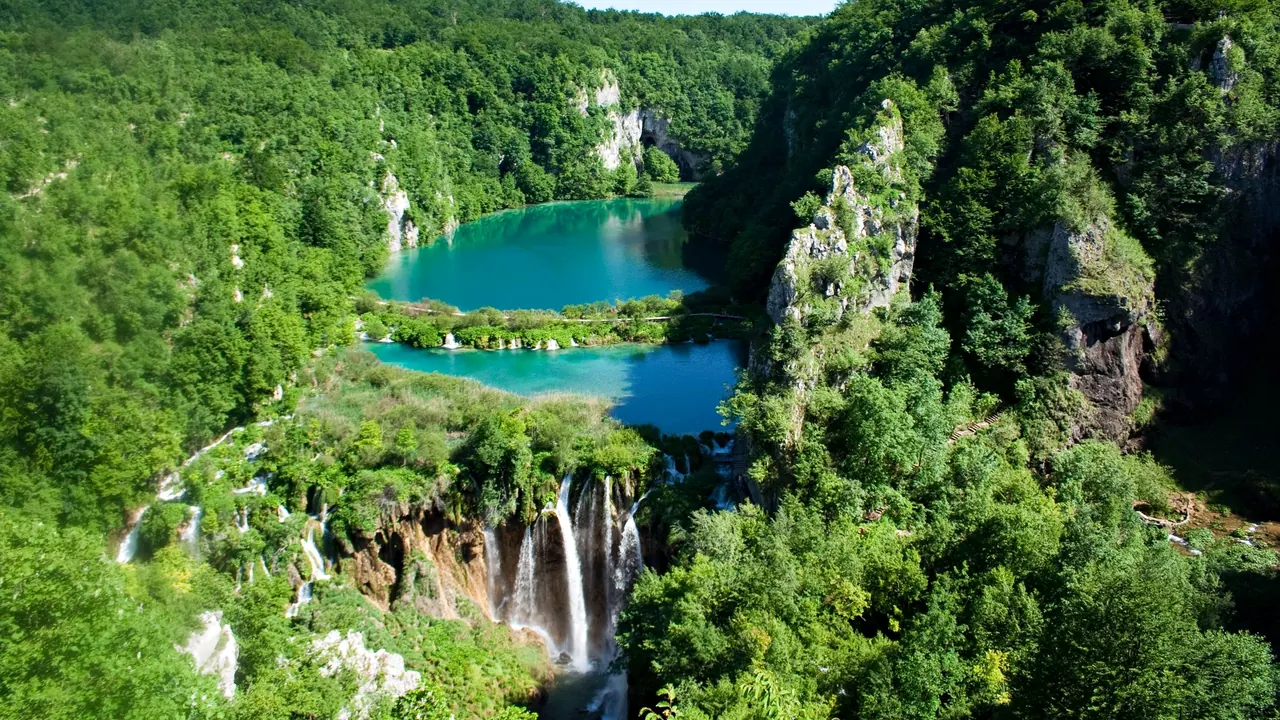
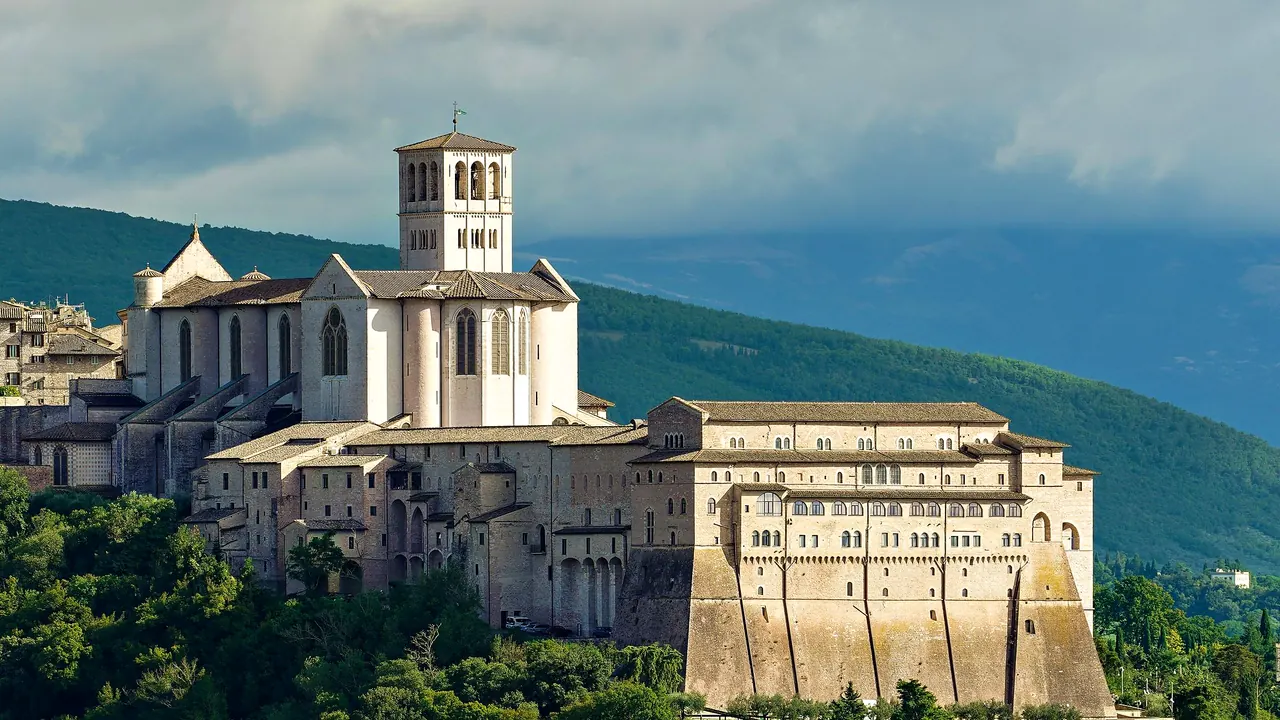
Photos: Plitvice Lakes by Pablo BM from London, England, CC BY 2.0, cropped; Umbria by Tagooty, CC BY-SA 4.0, cropped.
Plitvice Lakes or Umbria?
Our verdict in twelve categories, each scored against the same fixed benchmark cities, and the climate month by month, so you can choose for your trip.
Choose Plitvice Lakes for
- nature and the outdoors
Plitvice Lakes is for the traveller whose trip centres on one landscape: terraced lakes and waterfalls in beech and fir forest, walked on boardwalks early in the morning, with Rastoke, the Korana and the Una river within reach. It works best as a stop of a night or two between Zagreb and the Adriatic. You have to accept simple country food, silent evenings and almost nothing in the way of towns or museums.
Choose Umbria for
- culture and sights
- day trips
- food and drink
Umbria rewards a slower week or more of hill towns, frescoes and long lunches. Assisi, Orvieto, Perugia and Gubbio give it art and architecture of the first rank, and the truffles and Sagrantino wine are reasons to go in themselves. A farmhouse base puts a different town within easy reach each day, with Tuscany just over the border. Its countryside is gentle rather than dramatic, except up in the Sibillini mountains.
Scoreboard
Twelve categories on one fixed scale from 0 to 100. The shaded stretch is the gap between the two.
Your match
Pick a travel style or drag the sliders, and both match scores follow your weighting.
Wins on nature and the outdoors with your weighting.
Wins on culture and sights and day trips with your weighting.
What matters to you?
Category by category
What the scores mean for a trip.
Beaches & swimming
Neither is a beach destination, and from both the sea is a drive of two hours or more. Swimming is banned in all of Plitvice's lakes, so a dip means the cool, clear Korana river below the park, at Korana village or Slunj.
Umbria does a little better because you can swim in its lakes. Trasimeno has lidos at Castiglione del Lago and Passignano with warm, shallow water for paddling, though the water is cloudy and the bottom is soft. In practice most visitors swim in the pool at their farmhouse.
Food & drink
Food at Plitvice means filling Lika country cooking: spit-roast lamb, river trout and dishes baked under an iron bell. Most of it is served at roadside inns cooking for tour groups, and the farm cheeses and brandies are the high points. One good dinner covers it.
Umbria is a place to eat and drink with real interest. It has black truffle on handmade pasta, Norcia's cured pork, Castelluccio lentils and Trevi olive oil, and you can taste wine at estates around Montefalco and Orvieto. Both kitchens come from hill farming, but Umbria has far more depth, with markets and Perugia's choice of restaurants.
Culture & sights
Plitvice's World Heritage status is for its natural landscape, and its built sights fill an afternoon: the water mills of Rastoke, the ruined walls of Drežnik and the memorials to the first deaths of the 1990s war.
Umbria is in another league. Its chain of hill towns holds art of the first rank: Giotto and Cimabue in Assisi's basilica, Signorelli in Orvieto's cathedral and Perugino in Perugia's Galleria Nazionale, with Gubbio, Spoleto and Spello still to come. A week there barely feels long enough.
Nightlife
Plitvice has no nightlife at all. The villages go quiet soon after dinner and everyone is up early for the trails. Umbria is mostly quiet too, but Perugia's students fill the main street and the cathedral steps on warm nights, and the old centre has wine bars and a few late bars. Neither has clubs.
Nature & outdoors
Plitvice has the more striking landscape. Its terraced lakes, turquoise to emerald and linked by travertine falls you cross on boardwalks, are a sight in their own right. Caves, river rafting and bear and wolf forest lie around them.
Umbria's countryside is gentler, with olive groves and oak woods, until the Monti Sibillini in the east, where the Castelluccio plain flowers in early summer. The Marmore Falls, the Valnerina gorge and the Spoleto to Norcia cycle path give it plenty to do outdoors, but nothing that matches the lakes as a single spectacle.
Day trips
Day trips from Plitvice are worthwhile but spread out. Rastoke is half an hour away, Bihać and the Una falls are across the Bosnian border, Tesla's birthplace is at Smiljan, and Zadar or Zagreb are at the limit of a day. Most people pass through rather than stay here as a base.
Umbria is made for day trips. From Perugia or Spoleto a different hill town fills each day: Todi, Spello, Bevagna, Norcia. Cortona, Montepulciano and Siena across the Tuscan border are close, and Rome is a little over an hour from Orvieto by train.
Good for families
The two suit families about equally, but in different ways. At Plitvice children love the boardwalks, the fish in the clear water and the boat across Kozjak lake. A visit fills only a day or two, though, the walkways are narrow and mostly without railings, and swimming is forbidden.
Umbria works as a slower base, with a farmhouse with a pool and animals, shallow Lake Trasimeno for paddling and the Marmore Falls for an outing. Its steep towns and frescoed churches are hard going for young children and pushchairs.
Getting around
Inside the park Plitvice is simple, with signed circuits, electric boats and panoramic trains, and the intercity buses between Zagreb and the coast stop at the gates. Beyond the entrances you need a car to reach Rastoke or anywhere further.
Umbria is a little easier overall. A car is still the practical choice, but the roads are good and distances short. A regional railway links Perugia, Assisi, Spello and Spoleto, and Orvieto is on the Rome to Florence line. Expect to park below the hill towns and ride up by escalator or funicular.
Shopping & style
At Plitvice the only things worth buying are farm cheese, honey and fruit brandy from roadside stalls. Umbria offers far more to take home: majolica from Deruta's workshops, hand-loomed linen in Montefalco and Bevagna, cashmere from outlets near Perugia, and hams and truffles in Norcia. There is no luxury shopping in Umbria either.
Affordability
Costs are broadly similar, and in both places the best value is a family-run country guesthouse or farmhouse. At Plitvice the biggest variable is the park entrance fee, which is steep in summer and much lower in spring and autumn. Meals near the gates are priced for visitors passing through.
In Umbria, rooms and set trattoria lunches are reasonable for central Italy, and most churches cost little or nothing to enter. Against that, you will almost certainly need a hire car, Assisi and Orvieto get expensive in summer, and truffle dishes push a bill up quickly.
Live music & performing arts
Plitvice has nothing to plan a trip around, beyond the odd village festival with Lika folk music. Umbria has two summer festivals with wide appeal. Umbria Jazz takes over Perugia in July with free bands in the squares, and the Festival dei Due Mondi fills Spoleto's theatres and piazzas with opera, theatre and dance. Outside early summer, Umbria's theatres are mostly quiet.
Wellness & relaxation
Neither has much of a spa culture. Plitvice offers quiet farmhouse guesthouses among meadows and fir forest, but the park itself is crowded at midday in summer.
Umbria offers more for a restful stay: country houses with pools, massage and yoga, the hermitages on Monte Subasio, and a slow rhythm of long lunches and walks around the town walls. There are also small historic spas at San Gemini and Nocera Umbra.
When should you go?
Pick your month. The climate figures are measured averages, not a forecast.
Plitvice Lakes in July
Umbria in July
Daytime high, °C
Rainfall in the month, mm
Where the figures come from
Plitvice Lakes has no weather station within reach, so its figures come from a gridded climate model rather than a measured record, and read a broad area rather than one spot.
Umbria's temperatures are measured 53 km from the centre, at Frontone.
Umbria has no rain gauge within 25 km of the centre, so its rainfall comes from a gridded climate dataset read at the destination rather than from a gauge further away.
Temperature and rainfall are climate normals, averaged over the years shown. Plitvice Lakes: 2001-2020 normals, NASA POWER reanalysis grid, no weather station within 90 km. Umbria: 1991-2020 normals, Frontone (52.9 km from centre).
Around the park, Plitvice is cooler and wetter than Umbria all year. Summer is pleasant for walking, with highs of about 27°C in July and August. The lakes are worth seeing in every season: spring brings the fullest waterfalls, autumn turns the forest red and gold, and winter is cold enough for the falls to freeze. Rain falls steadily all year and is heaviest from September to November, at around 140mm a month, so autumn visitors need good waterproofs.
In Umbria's central valleys it is warmer and drier. Late spring and early autumn are the best times for walking the hill towns. July reaches about 30°C and the valleys can feel heavy, though that is when Lake Trasimeno is warm enough for a swim. Summer is the driest stretch, and the rain builds from September to a peak in November. Winters are mild enough for sightseeing in the towns, but often grey.
Which traveller are you?
On an outdoors trip, Plitvice Lakes is the stronger choice. The sixteen lakes and their waterfalls are a landscape few places can match, and the forest trails, the Barać caves, rafting on the Korana and the Velebit ridges fill several active days around them.
For a culture and arts trip, Umbria wins by a long way. Giotto's frescoes in Assisi, Orvieto's cathedral and Perugia's gallery are a short drive from one another, while Plitvice has little beyond the mills of Rastoke and a ruined fortress.
On a food and nightlife trip, Umbria is the only real option. Truffles, Norcia pork and Sagrantino tastings give each day a purpose, and Perugia's student evenings bring some life after dinner. At Plitvice the evening means lamb from the spit, then silence.
Before you go
| Measure | Plitvice Lakes | Umbria |
|---|---|---|
| Official language | Croatian | Italian |
| Currency | Euro (EUR) | Euro (EUR) |
| Sockets | CF230 V, 50 Hz | CFL230 V, 50 Hz |
| Driving side | Right | Right |
| Time zone | UTC+1, UTC+2 in summer | UTC+1, UTC+2 in summer |
| Emergency number | 112 | 112 |
| Main airport | Zagreb Franjo Tuđman International Airport (ZAG)66 non-stop destinations | Perugia San Francesco d'Assisi – Umbria International Airport (PEG)17 non-stop destinations |
| Public holidays this year | 14 days | 13 days |
By the numbers
| Measure | Plitvice Lakes | Umbria |
|---|---|---|
| Population | - | 852,085 |
| People per km² | - | 101 |
Where else could you go?
Every comparison below shares a destination with this one, so you can follow Plitvice Lakes or Umbria somewhere new.
- Tuscanyvs Umbria
- Krkavs Plitvice Lakes
- Elbavs Umbria
- Bračvs Plitvice Lakes
- Hvarvs Plitvice Lakes
- Korčulavs Plitvice Lakes