Saudi Arabia
AlUla
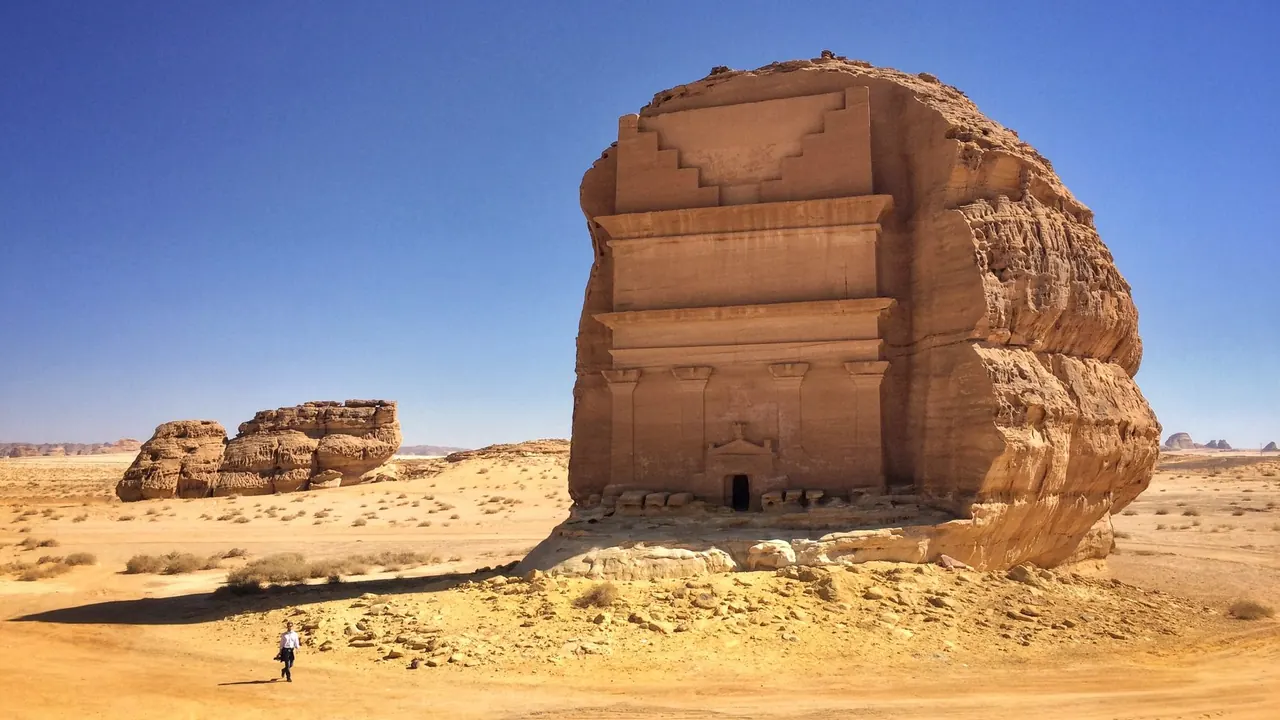
The Qasr al-Farid tomb at Hegra near AlUla
- Nature & outdoors72
- Culture & sights70
- Wellness & relaxation45
Photo: Richard.hargas, CC BY-SA 4.0, cropped
Match
30
Every category weighted equally
- Beach & sun27
- Culture & arts32
- Food & nightlife24
- Family trip31
- Outdoors34
- Relax & unwind32
- Shopping & style27
- On a budget28
AlUla in twelve categories
Our verdict on each, scored 0 to 100 against the same fixed benchmark cities, so a score means the same thing on every page.
Beaches & swimming. Scores 3 out of 100.
Food & drink. Scores 28 out of 100.
Culture & sights. Scores 70 out of 100.
Nightlife. Scores 5 out of 100.
Nature & outdoors. Scores 72 out of 100.
Day trips. Scores 20 out of 100.
Good for families. Scores 35 out of 100.
Getting around. Scores 15 out of 100.
Shopping & style. Scores 15 out of 100.
Affordability. Scores 18 out of 100.
Live music & performing arts. Scores 28 out of 100.
Wellness & relaxation. Scores 45 out of 100.
AlUla category by category
Beaches & swimming
3AlUla is a desert oasis far inland, and there is nowhere to swim in the sea or a lake within reach. The Red Sea coast is a long drive west across the mountains, too far for a day at the beach. Swimming here means a resort pool, and many of the desert camps and lodges have good ones, which matter in the warmer months.
Food & drink
28Eating in AlUla is small-scale and largely tied to where you stay. The desert resorts run polished restaurants with chef-led menus built on local produce, and the restored Old Town has a strip of terraces serving Saudi and Levantine dishes, grills and coffee, pleasant in the cool evenings. The oasis itself is the best ingredient: dates from the palm groves, citrus from the farms and Saudi coffee scented with cardamom, served with dates as a welcome almost everywhere.
Beyond that, the range is thin. There is no street-food culture to explore, few casual local places, and outside the main season some kitchens close. Most visitors eat well enough without thinking of it as a reason to come.
Culture & sights
70AlUla's heritage is ancient and on a grand scale. Hegra, Saudi Arabia's first UNESCO World Heritage Site, holds more than a hundred monumental Nabataean tombs cut into free-standing sandstone outcrops, their carved facades standing alone in open desert rather than crowded into a gorge. Closer to town, Dadan preserves the remains of the earlier Dadanite and Lihyanite kingdoms, with lion tombs cut high in the cliff, and Jabal Ikmah is a canyon whose walls are covered in inscriptions, often called an open-air library.
The Old Town is a maze of several hundred mud-brick houses on a rocky spur below a hilltop fort, inhabited until the late twentieth century. There are few museums of note, and the sites are spread across the valley and seen mostly on guided visits, so this is a place for a few deep sights rather than a dense city of them.
Nightlife
5There is no nightlife in the usual sense. AlUla has no bars or clubs, and evenings revolve around a late dinner, a walk through the lit lanes of the Old Town and coffee on a terrace. The desert night itself is the attraction, with stargazing at dark-sky sites outside town, and in the winter season events and concerts bring some life after dark.
Nature & outdoors
72The landscape is the reason most people come. AlUla sits in a long valley of palm groves walled by sandstone cliffs, and the desert around it is full of wind-carved formations, most famously Elephant Rock, standing alone on a sand plain. To the west and northwest the black lava plateau of Harrat Uwayrid rises above the valley, with views back over the sandstone. Hidden canyons and sand seas lie further out, and the Sharaan nature reserve protects a rugged landscape of red-rock canyons and mountains given over to the conservation of ibex, gazelle and the Arabian leopard.
There is plenty to do for a desert: canyon hikes, climbing and via ferrata routes, cycling through the oasis, horse and camel rides, hot-air balloon flights over the valley and some of the darkest skies in the region for stargazing. The season runs from roughly October to April. In summer daytime heat regularly passes 40°C, and time outdoors shrinks to the first and last hours of light.
Day trips
20Most of what visitors see lies within AlUla's own valley, so trips further afield are few and long. The two worthwhile outings are the ancient oasis towns of Tayma, with its great stone well and old city walls, and Khaybar, with a fortress on a basalt outcrop and abandoned stone villages among the palms. Each is roughly two hours' drive across open desert, best done as a full guided day. Beyond these there is little else of interest within easy reach.
Good for families
35AlUla works best for families with older children who enjoy the outdoors. Climbing among the rocks, camel rides, ziplines, stargazing and the scale of the tombs at Hegra can hold a child's attention, the atmosphere is calm and safe, and resort pools give a break in the afternoon. Saudi culture is warm towards children.
There is nothing built specifically for them, though: no zoo, aquarium or play attractions. Sites are spread across the valley and reached by car or tour bus, visits involve walking in the sun, and outside winter the heat makes it hard work with small children.
Getting around
15AlUla is not a town you can walk around. Hotels, the Old Town, Dadan, Elephant Rock and Hegra are spread along and beyond a long valley, often 20km or more apart, and there is no public transport in the usual sense. Visits to the main archaeological sites run on ticketed shuttle buses from visitor centres, and everything else needs a hire car, a driver or a tour. Roads are good and empty, and once you arrive the Old Town and individual sites are pleasant on foot, but planning each day around transport is part of a stay.
Shopping & style
15Shopping is limited to a small run of craft and design shops in the Old Town, selling woven goods, pottery, jewellery and local perfumes, along with work from the town's arts and crafts school. Dates from the oasis farms are the most memorable thing to take home. There is no market of note or shopping street, and nobody plans a stay here around it.
Affordability
18AlUla is an expensive place to stay. Accommodation is weighted towards luxury desert resorts and upmarket tented camps, with only a thin layer of simpler hotels, and rooms in the winter season fill and command high rates. Entry to the main archaeological sites and most activities comes through guided, ticketed tours that are costly, and getting around means hiring a car or a driver. Eating in the Old Town is more moderate and petrol is cheap, but a visit here costs well above what the rest of the region suggests.
Live music & performing arts
28Performance in AlUla is a seasonal affair. Maraya, the mirror-clad concert hall set in a desert canyon, hosts headline concerts by international singers and orchestras during the winter festival season, and the season also brings outdoor music, traditional Saudi dance and performances among the rocks. Outside those months there is little to attend, and the town has no theatre or regular live-music scene of its own, so anyone coming for this should time the trip around the events calendar.
Wellness & relaxation
45AlUla is a quiet place to slow down. The pace is unhurried, the desert is silent at night, and the main resorts and camps are built for unwinding, with spas, massage, yoga sessions at sunrise and pools set among the rocks. Evenings by a fire under a dark sky are as much a part of a stay as the sightseeing.
What it lacks is a bathing tradition. There are no public baths, hammams or springs to visit, and wellness here depends on the resort you book rather than anything in the town itself.
When should you go?
Pick a month to see what it is like. The climate figures are measured averages, not a forecast.
AlUla in July
Daytime high, °C
Rainfall in the month, mm
The whole year
Shaded against this city’s own year: the deepest cell is its best month for that figure and the palest its weakest.
Where the figures come from
AlUla has no rain gauge within 25 km of the centre, so its rainfall comes from a gridded climate dataset read at the city rather than from a gauge further away.
Temperature and rainfall are climate normals, averaged over the years shown. AlUla: 2010-2025 (rainfall 1991-2020) normals, Alula / Al ‘Ulá (23.7 km from centre).
Before you go
| Measure | AlUla |
|---|---|
| Official language | Arabic |
| Currency | Saudi Riyal (SAR) |
| Sockets | G60 Hz |
| Driving side | Right |
| Time zone | UTC+3 |
| Emergency number | 112 or 911 |
| Elevation | 692 m |
| Main airport | Al-Ula International Airport (ULH)24 km from centre8 non-stop destinations |
By the numbers
| Measure | AlUla |
|---|---|
| City population | 32,413 |
| Museums within 10 km | 2 |
| UNESCO World Heritage sites within 50 km | 1 |
Compare AlUla with
Every comparison with a written verdict behind it.