Saudi Arabia
Riyadh
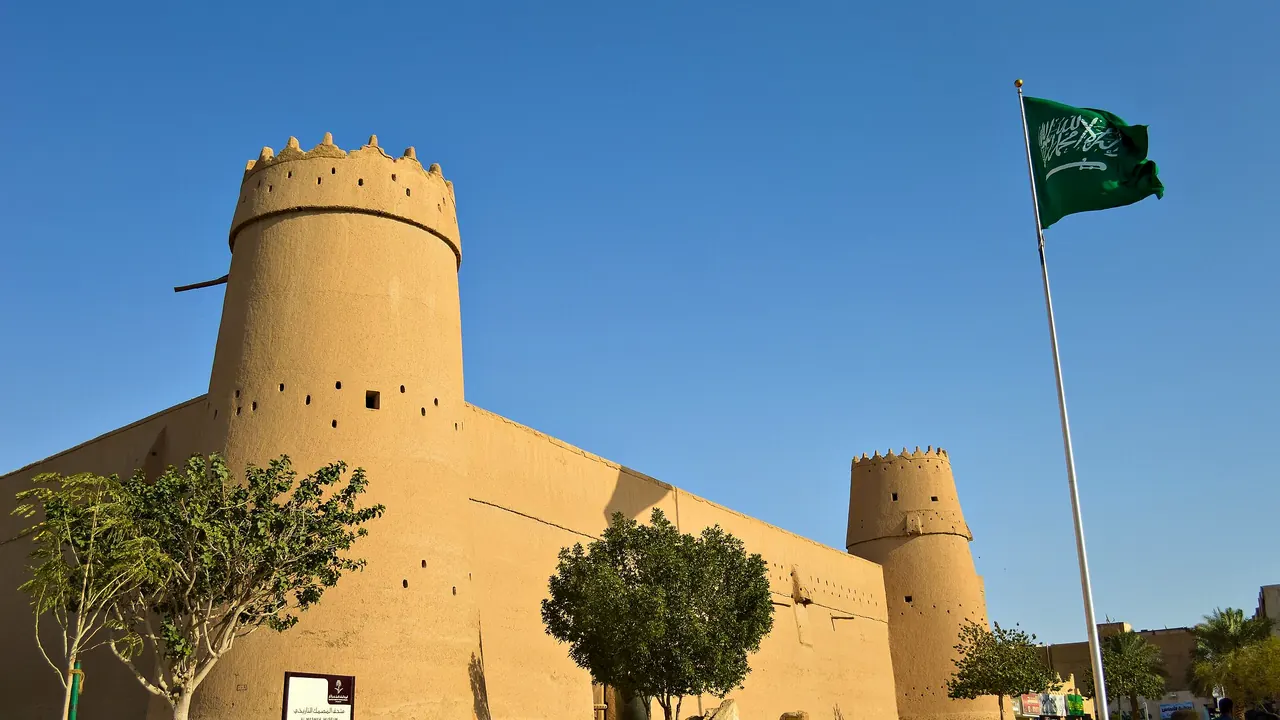
Masmak Fort in the old centre
- Shopping58
- Food & drink50
- Culture & sights48
Photo: Francisco Anzola, CC BY 2.0, cropped
Match
32
Every category weighted equally
- Beach & sun28
- Culture & arts35
- Food & nightlife33
- Family trip33
- Outdoors30
- Relax & unwind30
- Shopping & style37
- On a budget33
Riyadh in twelve categories
Our verdict on each, scored 0 to 100 against the same fixed benchmark cities, so a score means the same thing on every page.
Beaches & swimming. Scores 5 out of 100.
Food & drink. Scores 50 out of 100.
Culture & sights. Scores 48 out of 100.
Nightlife. Scores 12 out of 100.
Nature & outdoors. Scores 27 out of 100.
Day trips. Scores 22 out of 100.
Good for families. Scores 40 out of 100.
Getting around. Scores 33 out of 100.
Shopping & style. Scores 58 out of 100.
Affordability. Scores 40 out of 100.
Live music & performing arts. Scores 28 out of 100.
Wellness & relaxation. Scores 20 out of 100.
Riyadh category by category
Beaches & swimming
5Riyadh sits deep in the desert plateau of central Arabia, about 400km from the Gulf coast, so there is no sea or lake bathing within reach. Swimming means a hotel pool, a resort day pass or a water park. Visitors who want the sea fly or drive to the coast for a separate stay.
Food & drink
50Eating out is the city's main social life, and it happens late. Najdi cooking is hearty and rice-based: kabsa and mandi with lamb or chicken, jareesh made from cracked wheat, and slow-cooked dishes served on large shared platters, often in restaurants with private family sections and floor seating. Lebanese, Yemeni, Turkish, Indian and Pakistani kitchens are everywhere, reflecting the large expatriate population.
Coffee is the real specialism. Cardamom-spiced Arabic coffee poured with dates is offered almost everywhere, and specialty coffee shops line the northern districts such as Olaya and around King Fahd Road. Date markets are worth a visit. There is no alcohol at all, so wine and beer culture is absent, and street food is limited compared with older Arab cities.
Culture & sights
48The strongest sight is At-Turaif in Diriyah, on the city's north-western edge: the UNESCO-listed mud-brick citadel that was the first seat of the Saudi dynasty, restored and set above the palm groves of Wadi Hanifah. In the centre, Masmak Fort and the Murabba Palace show traditional Najdi building, and the National Museum next to them gives a good, well-presented account of Arabian history from prehistory to the founding of the kingdom.
Beyond these, Riyadh is a modern city of wide highways and towers, with the Kingdom Centre and Al Faisaliah as its landmarks and a sky bridge for the view. The old town was largely rebuilt in the twentieth century, so two or three days covers the sights.
Nightlife
12Riyadh keeps very late hours, but not in the way most travellers mean by going out. Alcohol is prohibited, so there are no bars, pubs or conventional clubs. Evenings are spent in coffee shops, dessert cafés, malls and open-air entertainment zones that fill with families and groups of friends well past midnight, especially in the cooler months. Large music festivals and occasional alcohol-free club nights exist, but anyone looking for a drink or a dance floor will find little.
Nature & outdoors
27The landscape around Riyadh is desert, and its best outing is the Edge of the World, a sheer limestone escarpment on the Tuwaiq range about two hours north-west by four-wheel drive, with views over an ancient seabed. Closer in, the red sand dunes east of the city are used for dune driving, quad biking and overnight desert camps, and Wadi Hanifah offers a long green walking and cycling corridor of palms and pools.
From roughly May to September daytime heat often passes 45°C and outdoor activity stops. Winter brings mild days and cold desert nights, the season for camping and stargazing. There are no mountains, forests or water sports.
Day trips
22Few places to visit lie within an easy day of Riyadh. The best is Ushaiger, a restored mud-brick village with palm gardens about two hours north-west, and nearby Shaqra, with its old quarter of traditional Najdi houses. Beyond these the towns are small and modern, and the other cities of the kingdom are a flight away. Most excursions are into the desert rather than to other towns.
Good for families
40Saudi social life revolves around families, and children are welcome everywhere, out late with their parents on winter evenings. Large malls hold indoor amusement parks, ice rinks and play areas, and there is a zoo, outdoor entertainment districts and parks such as those along Wadi Hanifah. Desert camps with camel rides and dune drives appeal to older children.
The difficulties are the climate and the distances. Summer heat keeps everyone indoors for months, pavements are few, and nearly everything needs a car or taxi. The cooler months, roughly November to March, are the time to come with children.
Getting around
33Riyadh is a city built for the car: wide highways, long distances and blocks that are hard to cross on foot. A driverless metro with several lines runs along the main corridors, including Olaya, King Abdullah Road and out to the airport, and buses fill some gaps, but sights are spread far apart and the last stretch often needs a taxi. Ride-hailing apps are how most visitors get around. Walking works only in compact areas such as the old centre around Masmak Fort and Diriyah, and only in the cooler months.
Shopping & style
58Shopping here means air-conditioned malls, and there are many large ones, with the luxury floors of the Kingdom Centre and Al Faisaliah and big malls across the northern districts carrying the full range of international fashion brands. Abayas, Arabian perfume and oud are the local specialities, sold in dedicated perfume houses and mall boutiques.
For something traditional, the souqs near the old centre, above all Souq Al Zal, sell carpets, antiques, daggers, incense, dates and coffee pots, with the busiest trade in the evening. Street shopping and independent boutiques are thin, and shopping is mostly done by car from one mall to the next.
Affordability
40Riyadh is a business-led city, and hotel rooms are priced for business travel, especially around Olaya and in the luxury towers. Mid-range and upscale restaurants and the entertainment zones are not cheap either. The balance comes from simple local and South Asian eateries, which are inexpensive, low-cost metro fares and fuel, and the main museums and heritage sites, which are free or modest. Overall it is a moderately expensive destination.
Live music & performing arts
28Live performance in Riyadh comes in bursts rather than as a steady programme. The cooler months bring big-name Arab and international concerts, large outdoor music festivals and touring shows in arenas and temporary venues. Traditional culture appears in the ardah, the Najdi sword dance with drums and poetry, performed at national celebrations and heritage events. There is no resident opera, no regular orchestra season and no theatre district, so outside the winter months there is little to attend.
Wellness & relaxation
20Riyadh has no bathing culture of its own, and wellness here means the spas of the large international hotels, with massages, Moroccan-style hammam treatments and pools, usually with separate facilities for men and women. The city itself is hot, sprawling and dominated by traffic, not a place that slows anyone down. The closest thing to rest is a night at a desert camp outside the city, or the quiet of the palm groves around Diriyah on a winter evening.
When should you go?
Pick a month to see what it is like. The climate figures are measured averages, not a forecast.
Riyadh in July
Daytime high, °C
Rainfall in the month, mm
The whole year
Shaded against this city’s own year: the deepest cell is its best month for that figure and the palest its weakest.
Temperature and rainfall are climate normals, averaged over the years shown. Riyadh: 1991-2020 normals, Riyadh (8.9 km from centre).
Before you go
| Measure | Riyadh |
|---|---|
| Official language | Arabic |
| Currency | Saudi Riyal (SAR) |
| Sockets | G60 Hz |
| Driving side | Right |
| Time zone | UTC+3 |
| Emergency number | 112 or 911 |
| Elevation | 612 m |
| Main airport | King Khalid International Airport (RUH)36 km from centre117 non-stop destinations |
By the numbers
| Measure | Riyadh |
|---|---|
| City population | 7,009,100 |
| People per km² | 3,898 |
| Museums within 10 km | 5 |
| UNESCO World Heritage sites within 50 km | 1 |
Compare Riyadh with
Every comparison with a written verdict behind it.