Tunisia
Tunis
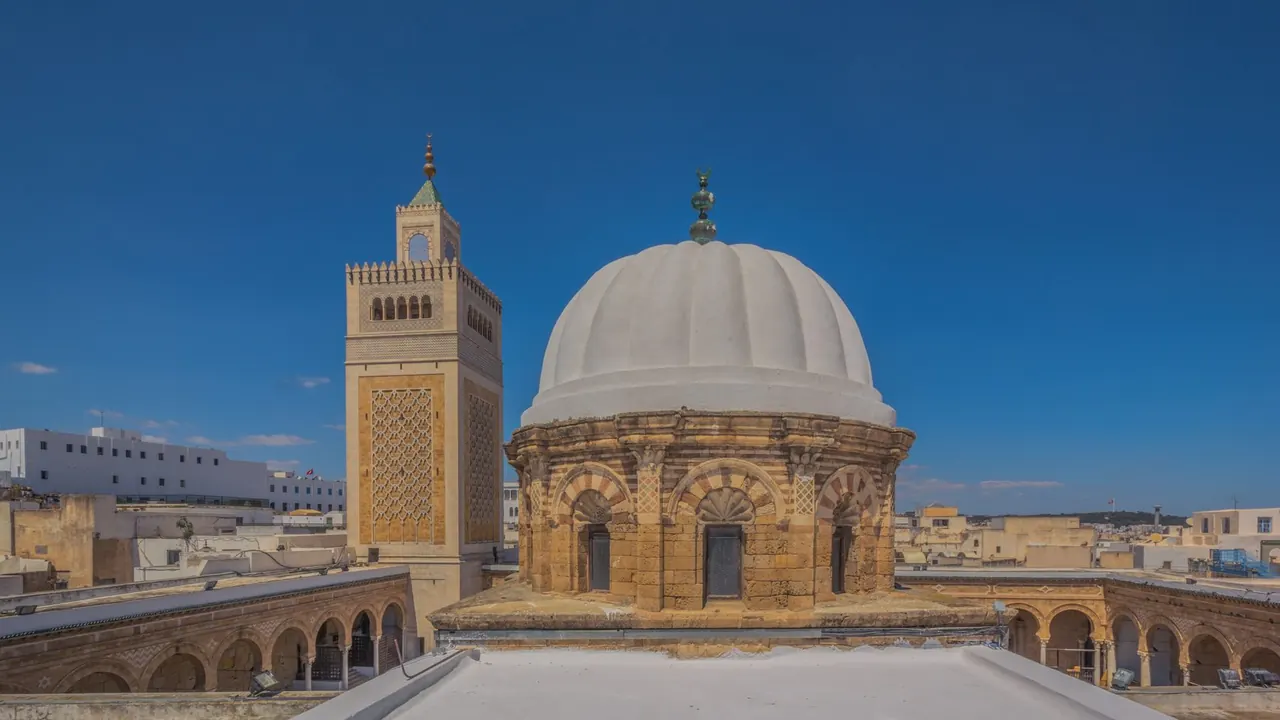
The minaret and dome of the Zitouna Mosque
- Affordable cities86
- Day trips77
- Culture & sights76
Photo: IssamBarhoumi, CC BY-SA 4.0, cropped
Match
56
Every category weighted equally
- Beach & sun58
- Culture & arts58
- Food & nightlife54
- Family trip58
- Outdoors59
- Relax & unwind58
- Shopping & style54
- On a budget59
Tunis in twelve categories
Our verdict on each, scored 0 to 100 against the same fixed benchmark cities, so a score means the same thing on every page.
Beaches & swimming. Scores 60 out of 100.
Food & drink. Scores 60 out of 100.
Culture & sights. Scores 76 out of 100.
Nightlife. Scores 33 out of 100.
Nature & outdoors. Scores 45 out of 100.
Day trips. Scores 77 out of 100.
Good for families. Scores 38 out of 100.
Getting around. Scores 48 out of 100.
Shopping & style. Scores 50 out of 100.
Affordability. Scores 86 out of 100.
Live music & performing arts. Scores 38 out of 100.
Wellness & relaxation. Scores 58 out of 100.
Tunis category by category
Beaches & swimming
60Tunis is a sea city, but its beaches are in the northern suburbs. The suburban train runs out along the bay to La Goulette, Carthage, Sidi Bou Said and La Marsa, where long sandy strands fill with local families on summer weekends. Gammarth, a little further on, has quieter sand. The water warms to about 26°C by August and stays swimmable from June into October. Near the port and the lagoon the water is less clean, so most people go north.
For a proper beach day, Hammamet and the Cap Bon coast are about an hour away by road, with wider, calmer beaches. In Tunis itself swimming is a pleasant extra rather than the reason to stay.
Food & drink
60Tunisian cooking is spicy, built on harissa and olive oil, and the most enjoyable way to meet it in Tunis is cheap and quick. Look for brik, a crisp pastry with a runny egg inside, lablabi, a chickpea soup served with torn bread for breakfast, fricassé sandwiches, ojja with merguez, and couscous with fish or lamb at Friday lunch. The covered Marché Central downtown sells piles of fish, olives and spices, and the medina has old-fashioned sweet shops selling makroudh and baklawa.
Cafés are everywhere, serving thick coffee or mint tea with pine nuts. Seafood restaurants in La Goulette and La Marsa are the best of the sit-down meals. Alcohol is sold in licensed restaurants and hotels, local wine included, but it is not central to the culture, and the international and high-end choice is limited.
Culture & sights
76The medina is the heart of it. It is a large, intact UNESCO-listed old city of covered souks, madrasas, mausoleums and carved doorways, built around the Zitouna Mosque. Around it the French-built Ville Nouvelle has wide boulevards, a cathedral and faded Art Nouveau and Art Deco facades along Avenue Habib Bourguiba. Together they show two very different chapters of the city.
The Bardo Museum, in a former beylical palace, holds one of the greatest collections of Roman mosaics anywhere. Carthage is a short suburban train ride away, with the Antonine Baths, the Punic ports, the Byrsa hill and the Roman villas. The remains are scattered and patchy, so they take some imagination. Nearby, blue-and-white Sidi Bou Said completes a rich set of sights spread over several days.
Nightlife
33Evenings in Tunis mostly happen in cafés, over coffee, mint tea and shisha, and they get much livelier during Ramadan nights and summer. Downtown has a handful of old beer bars, mostly male and fairly rough around the edges. The more relaxed and mixed scene is in the northern suburbs: lounges, hotel bars and seasonal beach clubs in La Marsa and Gammarth, where young Tunisians go out late at summer weekends. Outside those suburbs and the summer season, nights are quiet, and a visitor looking for a real bar or club scene will find little.
Nature & outdoors
45The setting is attractive more than dramatic. The city sits between salt lagoons and the Gulf of Tunis, with flamingos often feeding on the Lake of Tunis, and the twin-peaked Bou Kornine national park rising above the southern suburbs for short hikes with views of the bay. Walks along the clifftops of Sidi Bou Said and Gammarth give the best coastal scenery close to the city.
Further out, Ichkeul National Park, a lake and marsh of world importance for migrating birds, is about an hour and a half north. The rocky tip of Cap Bon and Djebel Zaghouan have quiet coastal and mountain walking. Trails and outfitters are few, and the heat of high summer makes spring and autumn the seasons for getting outdoors.
Day trips
77Day trips are one of the strongest reasons to base yourself in Tunis. Dougga, about two hours west, is among the best-preserved Roman towns in Africa, with its theatre and capitol set on a hillside among olive groves. Kairouan, roughly the same distance south, is the holy city of the Maghreb, with its Great Mosque and carpet-making medina. On the way west, Testour shows the Andalusian heritage brought by refugees from Spain.
Closer in, Hammamet's walled medina and Nabeul's pottery workshops are about an hour away. The Punic town of Kerkouane sits at the tip of Cap Bon. Bizerte has an old harbour, and Zaghouan has a Roman water temple. Sousse's walled medina is within reach by train. A driver or louage minibus makes most of these easier than the public bus.
Good for families
38Tunisians are warm towards children, and families with young ones are made welcome in cafés, restaurants and the souks. Belvedere Park, a large hilly park, has a modest zoo and space to run around. The beaches of La Marsa and Gammarth are the easiest days out in summer, and Carthage's open ruins are fun to explore. For more, the animal park and amusement areas around Hammamet are about an hour away.
In the city itself there is little built for children. Traffic is heavy and unforgiving, pavements are broken or blocked, and pushchairs are a struggle in the medina. Many families find a beach hotel on the coast with day visits into town an easier way to do it.
Getting around
48The medina and the downtown boulevards are close together and easy to walk. The key line for visitors is the TGM, a suburban railway that crosses the lagoon on a causeway and stops at La Goulette, the Carthage sites, Sidi Bou Said and La Marsa. The trains are worn and crowded at rush hour, but they are simple to use. A green light-rail network called the metro covers other districts, and yellow taxis are cheap and plentiful, though you will need to insist on the meter.
Off these routes, traffic is heavy and chaotic, pavements are uneven, and the summer heat makes long walks hard work. Day trips are easiest with a hired driver or the shared louage minibuses.
Shopping & style
50Shopping means the medina. Its covered souks are still arranged partly by trade. Souk ech Chaouachia makes felt chechia caps the traditional way, there are perfumers near the Zitouna Mosque, and you will also find brass, leather, embroidered cloth, kilims and carpets. The lanes closest to the main gate lean towards souvenirs, but going deeper rewards patience and some cheerful bargaining. Painted ceramics from Nabeul and the blue birdcages of Sidi Bou Said are classic things to bring home.
Beyond the souks there is little for a visitor. There are modern malls in the suburbs and a few design boutiques in La Marsa, but no luxury streets or fashion scene worth planning a trip around.
Affordability
86Tunis is a very cheap city for visitors from Europe or North America. Street food, café stops, set lunches, taxis and suburban train rides cost very little, and entry to the Bardo and Carthage is modest. Comfortable hotels and restored medina guesthouses cost far less than elsewhere on the Mediterranean.
The main exceptions are the smart hotels and seafood restaurants of Gammarth and La Marsa, imported alcohol and anything arranged through a tour company, which charge closer to European rates. A traveller eating where locals eat will find their money goes a long way.
Live music & performing arts
38The white Art Nouveau Municipal Theatre on Avenue Habib Bourguiba is the centre of formal performance, with theatre, concerts and dance, mostly in Arabic or French. In Sidi Bou Said, Ennejma Ezzahra, a palace built by Baron d'Erlanger, holds concerts of malouf, the Andalusian-rooted classical music of Tunisia, along with other recitals.
The calendar peaks with the long-running Carthage International Festival, whose summer concerts fill the restored Roman theatre, and the Carthage theatre and film festivals in the cooler months. Outside these seasons there is not much to choose from, and a visitor who wants live music on a random weeknight may struggle.
Wellness & relaxation
58Tunisia takes thalassotherapy seriously, and the resort hotels of Gammarth have full seawater spas with pools, wraps and massages. In the medina, traditional hammams still serve neighbourhoods, often with separate hours for men and women. They are plain, steamy and authentically local rather than polished for tourists. On Cap Bon, about an hour away, the hot springs of Korbous have flowed into the sea since Roman times.
The city itself is loud and congested, so the restorative side is found at the edges: a slow mint tea on a café terrace in Sidi Bou Said looking over the bay, or a quiet afternoon in a medina guesthouse courtyard.
When should you go?
Pick a month to see what it is like. The climate figures are measured averages, not a forecast.
Tunis in July
Daytime high, °C
Rainfall in the month, mm
The whole year
Shaded against this city’s own year: the deepest cell is its best month for that figure and the palest its weakest.
Temperature and rainfall are climate normals, averaged over the years shown. Tunis: 1991-2020 normals, Tunis-Carthage (6 km from centre).
Before you go
| Measure | Tunis |
|---|---|
| Official language | Arabic |
| Currency | Tunisian Dinar (TND) |
| Sockets | CE230 V, 50 Hz |
| Driving side | Right |
| Time zone | UTC+1 |
| Emergency number | Police 197, ambulance 190, fire 198 |
| Elevation | 4 m |
| Main airport | Tunis Carthage International Airport (TUN)7 km from centre56 non-stop destinations |
| Public holidays this year | 8 days |
By the numbers
| Measure | Tunis |
|---|---|
| City population | 602,560 |
| People per km² | 2,834 |
| Museums within 10 km | 16 |
| UNESCO World Heritage sites within 50 km | 3 |
| Swim season, months above 21 °C | 5 months |
Compare Tunis with
Every comparison with a written verdict behind it.