Türkiye
Marmaris
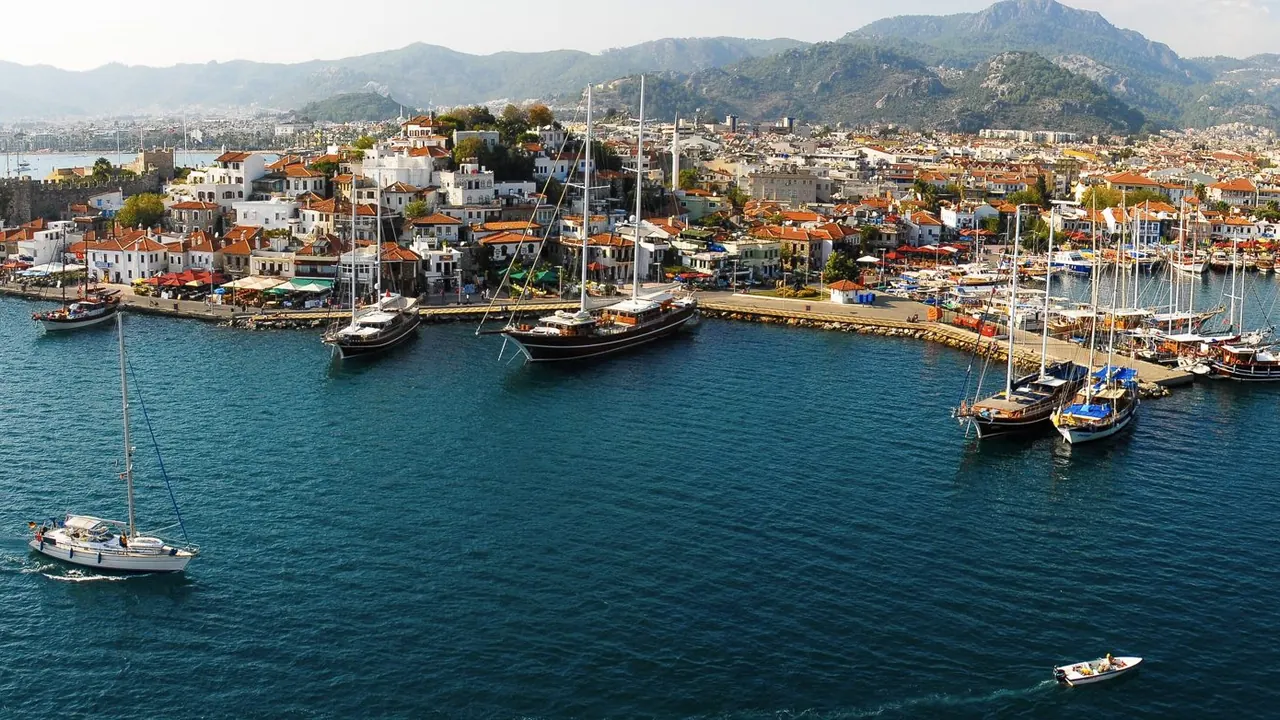
The harbour seen from above
- Beaches80
- Nature & outdoors72
- Day trips65
Photo: Mstyslav Chernov, CC BY-SA 3.0, cropped
Match
51
Every category weighted equally
- Beach & sun57
- Culture & arts43
- Food & nightlife46
- Family trip57
- Outdoors58
- Relax & unwind54
- Shopping & style46
- On a budget52
Marmaris in twelve categories
Our verdict on each, scored 0 to 100 against the same fixed benchmark cities, so a score means the same thing on every page.
Beaches & swimming. Scores 80 out of 100.
Food & drink. Scores 40 out of 100.
Culture & sights. Scores 18 out of 100.
Nightlife. Scores 60 out of 100.
Nature & outdoors. Scores 72 out of 100.
Day trips. Scores 65 out of 100.
Good for families. Scores 62 out of 100.
Getting around. Scores 55 out of 100.
Shopping & style. Scores 38 out of 100.
Affordability. Scores 62 out of 100.
Live music & performing arts. Scores 12 out of 100.
Wellness & relaxation. Scores 50 out of 100.
Marmaris category by category
Beaches & swimming
80Most visitors come to Marmaris to swim, and the bay delivers. A long strip of coarse sand and shingle runs along the promenade from the centre towards Icmeler, lined with loungers and backed by hotels, and the water in the enclosed bay stays calm and clear. By late summer the sea reaches about 26°C, and it is swimmable from late May into October.
The better swimming lies beyond the town beach. Icmeler and Turunc have quieter beaches under pine-covered slopes, and daily boat trips around the bay stop at coves where the water is far clearer than off the busy main strip. Further along the coast, the Bozburun peninsula hides small pebble bays, and Sedir Island has a famous fine-sand beach. The trade-off is crowding in high summer.
Food & drink
40Eating in Marmaris splits in two. The seafront and the streets behind it are given over to resort food: full breakfasts, steaks, pizza and long laminated menus. Good Turkish food is there if you look for it, in the lokanta serving the day's stews and vegetables in olive oil, the pide and kebab houses away from the promenade, and the fish restaurants around the harbour, where meze and grilled fish are the order of the evening.
The weekly market is the best food experience in town, piled with fruit, cheeses, olives and spices. Pine honey from the surrounding forests is a local speciality. There is no fine-dining scene to speak of.
Culture & sights
18Marmaris is a resort town rather than a sightseeing destination. Its one real monument is the small Ottoman castle on the hill above the harbour, with a modest archaeological museum and good views over the marina. Around it, the old quarter of whitewashed houses and narrow stepped lanes makes for a pleasant hour's wander. Beyond that there is a restored caravanserai housing the bazaar, and little else. Visitors with an interest in history spend their time on excursions rather than in town.
Nightlife
60Marmaris has a reputation as a party resort, and in summer it lives up to it. The heart of it is Bar Street, a lane behind the harbour lined end to end with open-fronted clubs, laser shows and foam parties, which fills after midnight and runs until near dawn. The crowd is young, largely British and there for exactly that. The marina and the seafront have calmer cocktail bars for those who want a drink with a view.
It is a single kind of night out rather than a varied scene, and it is seasonal: from November to April most of the clubs close and the town goes quiet early. Icmeler and Turunc are much more subdued.
Nature & outdoors
72The setting is the best thing about Marmaris. The bay is almost enclosed by steep hills covered in pine, and the coastline beyond, on the Bozburun and Datca peninsulas, is a wild run of headlands, inlets and islands with very little building on it. This is one of the great sailing grounds of the Turkish coast, and the marina is a base for yachts and wooden gulets heading out on day or week-long cruises.
On land, the Carian Trail threads through forest, olive groves and fishing villages, best walked in spring and autumn when the summer heat has gone. Scuba diving, sea kayaking and jeep tours into the hills are all well organised. The freshwater channels and loggerhead turtle beach near Dalyan are within reach.
Day trips
65The best day out is across the water: the ferry to Rhodes takes about an hour, landing beside a walled medieval town of knights' palaces and cobbled streets. On the Turkish side, Dalyan is about an hour and a half away, where boats run along the reed-lined river beneath Lycian rock tombs cut into the cliffs to the ruins of ancient Kaunos.
Closer to home, the villages of Selimiye and Bozburun on the peninsula are quiet harbours known for boatbuilding and fish lunches. The road west reaches Datca, an attractive small town, and the ruined Greek city of Knidos at the tip of the peninsula, a long but rewarding day. Akyaka, a pretty river village, is about an hour north.
Good for families
62Marmaris works well for a beach-and-pool family vacation. The bay water is calm and shallow at the edges, the large hotels have children's pools and clubs, and there is a big water park on the edge of town. Boat trips around the bay, with swimming stops, are a hit with older children, and Turkish staff and locals are warm and patient with young ones.
Families usually base themselves in Icmeler or Armutalan rather than central Marmaris, whose Bar Street is loud late into the night. Midsummer heat makes the middle of the day hard going, and beyond the beaches and pools there is little made specifically for children.
Getting around
55Within the bay, getting about is simple. A flat promenade runs for several kilometres along the seafront from the centre towards Icmeler, and it is pleasant to walk or cycle. Dolmus minibuses shuttle constantly between the town, Armutalan, Siteler and Icmeler, and water taxis cross the bay to Icmeler and Turunc.
Outside the bay, it gets harder. The peninsula villages, Datca and Dalyan are reached by winding mountain roads with limited bus service, so most visitors join an organised tour or hire a car for a few days. Dalaman airport is about an hour and a half away by road.
Shopping & style
38Shopping in Marmaris centres on the covered bazaar behind the harbour, a maze of lanes selling leather jackets, carpets, Turkish delight, spices, towels and a great deal of copy designer goods, all with the expected haggling. The weekly market is livelier and more local, with textiles and household goods alongside the food stalls. Worthwhile things to take home are pine honey, natural sponges, olive oil soaps and cotton peshtemal towels. There are no brand flagships or design boutiques worth seeking out.
Affordability
62Marmaris is a good-value resort by European standards. Package and all-inclusive hotels are plentiful and keenly priced, the dolmus costs little, and simple Turkish food in the lokanta and kebab houses away from the seafront is cheap. Costs rise where tourists gather: seafront restaurants, imported drinks, Bar Street, and organised trips, which are priced for visitors and worth comparing before booking. Spring and autumn bring lower room rates than July and August.
Live music & performing arts
12Performing arts barely feature in Marmaris. The performances most visitors see are hotel entertainment and Turkish nights with belly dancing and folk dance staged for tourists. In summer an open-air amphitheatre puts on the occasional concert, and some bars have live cover bands, but there is no theatre, concert hall or local music scene to plan an evening around.
Wellness & relaxation
50Turkish bath culture is the main draw for relaxation. Hammams are found all over town and in most large hotels, offering the steam, scrub and foam massage routine, though they are modern places run for visitors rather than historic bathhouses. Massage is widely offered, and the bigger resorts have full spas.
The pace depends on where you stay. Central Marmaris is loud in summer, but Icmeler is calmer, and Turunc and the peninsula villages of Selimiye and Bozburun are slow, quiet places to do very little. The mud baths and hot springs near Dalyan make a popular half-day of soaking. Spring and autumn are the most restful seasons.
When should you go?
Pick a month to see what it is like. The climate figures are measured averages, not a forecast.
Marmaris in July
Daytime high, °C
Rainfall in the month, mm
The whole year
Shaded against this city’s own year: the deepest cell is its best month for that figure and the palest its weakest.
Where the figures come from
Marmaris's temperatures are measured 49 km from the centre, at Dalaman.
Marmaris has no rain gauge within 25 km of the centre, so its rainfall comes from a gridded climate dataset read at the city rather than from a gauge further away.
Temperature and rainfall are climate normals, averaged over the years shown. Marmaris: 2000-2020 (rainfall 1991-2020) normals, Dalaman (48.8 km from centre).
Before you go
| Measure | Marmaris |
|---|---|
| Official language | Turkish |
| Currency | Turkish Lira (TRY) |
| Sockets | CF230 V, 50 Hz |
| Driving side | Right |
| Time zone | UTC+3 |
| Emergency number | 112 |
| Elevation | 7 m |
| Main airport | Dalaman International Airport (DLM)49 km from centre61 non-stop destinations |
| Public holidays this year | 14 days |
By the numbers
| Measure | Marmaris |
|---|---|
| City population | 97,818 |
| People per km² | 111 |
| Museums within 10 km | 1 |
| UNESCO World Heritage sites within 50 km | 1 |
| Swim season, months above 21 °C | 6 months |
Compare Marmaris with
Every comparison with a written verdict behind it.