United States
Moab
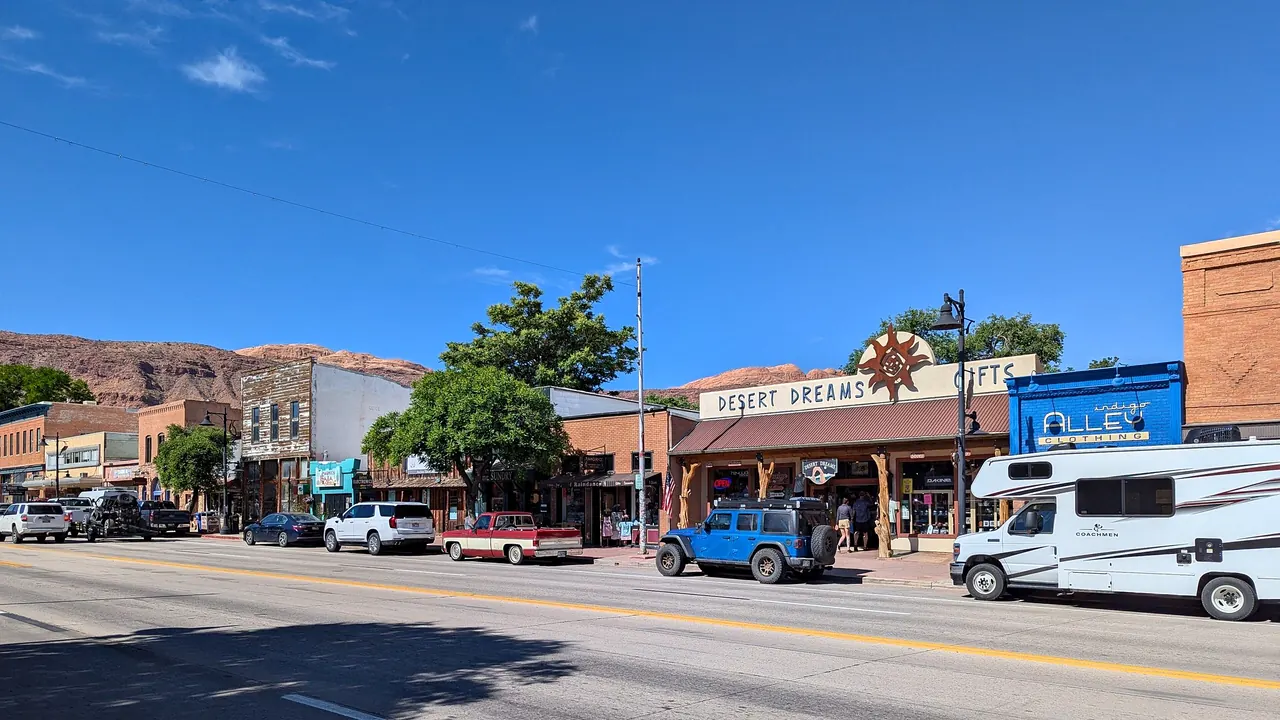
Main Street with the red cliffs behind
- Nature & outdoors94
- Families45
- Affordable cities32
Photo: G. Edward Johnson, CC BY 4.0, cropped
Match
25
Every category weighted equally
- Beach & sun26
- Culture & arts20
- Food & nightlife18
- Family trip30
- Outdoors35
- Relax & unwind28
- Shopping & style20
- On a budget26
Moab in twelve categories
Our verdict on each, scored 0 to 100 against the same fixed benchmark cities, so a score means the same thing on every page.
Beaches & swimming. Scores 7 out of 100.
Food & drink. Scores 24 out of 100.
Culture & sights. Scores 12 out of 100.
Nightlife. Scores 9 out of 100.
Nature & outdoors. Scores 94 out of 100.
Day trips. Scores 18 out of 100.
Good for families. Scores 45 out of 100.
Getting around. Scores 12 out of 100.
Shopping & style. Scores 14 out of 100.
Affordability. Scores 32 out of 100.
Live music & performing arts. Scores 14 out of 100.
Wellness & relaxation. Scores 22 out of 100.
Moab category by category
Beaches & swimming
7Moab sits in high desert hundreds of kilometres from any coast, so there is no beach vacation to be had here. In the summer heat locals cool off in Mill Creek's shallow pools, at Ken's Lake south of town or on the sandbars of the Colorado River, but the river is fast, silty and cold enough to need care, and none of these is a place to spend a day lying on sand. For most visitors, swimming means the motel pool after a long hike.
Food & drink
24Eating in Moab is about refuelling after a day outdoors. Main Street has burger and taco joints, pizza, a couple of breweries, coffee shops opening early for hikers and a handful of more ambitious dinner restaurants with Southwestern touches. Portions are big and the mood is casual, with dusty boots welcome everywhere. There is no local cuisine to seek out, choice thins in the quiet winter months, and Utah's alcohol rules make drinking with dinner more formal than travellers may expect. Expect queues on spring and autumn evenings when the town is full.
Culture & sights
12The town of Moab has little to see in itself: a short, low-rise Main Street, a few uranium-boom era buildings and the small Museum of Moab covering local geology, dinosaurs and settlement history. What gives the area cultural depth is older. Petroglyph panels left by Ancestral Puebloan and Fremont peoples line the cliffs along Potash Road and Kane Creek just outside town, and the Sego Canyon panels are a drive away. Dinosaur trackways at several nearby sites round it out. A visitor interested in museums and architecture will find a morning's worth at most.
Nightlife
9Evenings in Moab are short. A couple of brewpubs and a few bars on Main Street fill up with mountain bikers and rafters swapping stories, and on busy weekends one or two places stay lively until late, but there are no clubs and the town is largely asleep by eleven. Most visitors are up before dawn for a hike or a sunrise at the arches, and the real night-time activity here is looking at an exceptionally dark, star-filled sky.
Nature & outdoors
94This is one of the great outdoor bases on earth. Arches National Park starts a few minutes from town, with more than two thousand stone arches, fins and balanced rocks, and the Island in the Sky district of Canyonlands and Dead Horse Point overlook a vast maze of canyons cut by the Colorado and Green rivers less than an hour away. Hikes range from short walks to Delicate Arch to full days in the Fiery Furnace or the Needles.
Moab is also a world centre for mountain biking, with the Slickrock Trail and the long Whole Enchilada descent from the La Sal Mountains, which rise to over 3,800m and hold snow into early summer. Add rafting and paddling on the Colorado, canyoneering, climbing at Wall Street and jeep trails. Spring and autumn are ideal; summer days pass 38°C, and winter brings quiet, cold trails.
Day trips
18Almost everything worth a day out from Moab is landscape rather than another place to visit. The towns within reach are small: Green River on the old highway, Monticello at the foot of the Abajo Mountains, and Bluff, about two hours south, a pioneer settlement with old stone houses near the San Juan River. The more rewarding cultural outing is to the Ancestral Puebloan country to the south, with the museum and ruins at Edge of the Cedars in Blanding and the stone towers of Hovenweep at the far edge of a day. Grand Junction, across the Colorado border, has wineries but takes most of two hours.
Good for families
45Children who like climbing on rocks tend to love Moab. The short walks to Sand Dune Arch or the Windows in Arches, dinosaur tracks and a dinosaur trail park, calm stretches of the Colorado for family raft floats and jeep tours over slickrock all work well for school-age kids, and the national parks run Junior Ranger programmes. The town is small, safe and informal.
The difficulties are real, though. Summer heat makes midday hiking risky for small children, many viewpoints have long unfenced drops, and every outing means time in the car. There are no theme parks or museums built for children, so it suits active families far better than those with toddlers.
Getting around
12Moab's centre is compact and easy to walk, with motels, restaurants and outfitters strung along Main Street, and a paved path lets cyclists ride north to the Arches entrance. Beyond that, a car is essential. There is no useful public transport, the parks are spread out over long desert roads, and trailheads are often reached by dirt track. Visitors without their own vehicle depend on shuttles and guided tours run by local outfitters. A high-clearance vehicle opens up far more of the backcountry.
Shopping & style
14Shopping in Moab means outdoor equipment and souvenirs. Main Street has well-stocked bike, climbing and camping shops, rock shops selling geodes, fossils and minerals, T-shirt stores and a few galleries with Southwestern art and Navajo jewellery and weavings. It is useful when you need a spare tyre or a hat for the sun, but there is no fashion, design or department store shopping here.
Affordability
32Moab is not a cheap place to stay. It is a small town with limited rooms and enormous demand in spring and autumn, so motels and hotels charge resort prices for fairly simple rooms, and eating out costs typical American tourist-town rates. Car hire, fuel and guided activities such as rafting, jeep tours or canyoneering add up quickly. The savings come from the landscape itself: national park entry covers a week, the many public campgrounds and free dispersed camping on surrounding land are inexpensive, and most of the best hikes cost nothing. Winter is much cheaper.
Live music & performing arts
14Live performance in Moab is mostly a once-a-year affair. The Moab Music Festival, a long-established chamber music series at the end of summer, stages concerts in town and in remote canyon grottoes reached by boat, which makes for an unusual and memorable evening. The rest of the year offers little beyond a band in a brewpub on a weekend or a small community event. There is no theatre, opera or regular concert venue.
Wellness & relaxation
22Moab has no bathing tradition, no hot springs worth the trip and only a handful of small day spas and massage studios, mostly booked by people with sore legs after a day on the bike. A visit here is energetic rather than restful, with early starts and long days in the heat. What it does offer is stillness: quiet desert evenings, very dark skies and the slow pleasure of watching the cliffs turn red at sunset. Those who want true rest tend to book a remote ranch or a cabin in the La Sal Mountains rather than stay in town.
When should you go?
Pick a month to see what it is like. The climate figures are measured averages, not a forecast.
Moab in July
Daytime high, °C
Rainfall in the month, mm
The whole year
Shaded against this city’s own year: the deepest cell is its best month for that figure and the palest its weakest.
Where the figures come from
Moab's temperatures are measured 27 km from the centre, at Moab / Crescent Junction.
Moab's station stands 162 m above the city centre, so the centre is likely a little warmer than the figures say.
Moab has no rain gauge within 25 km of the centre, so its rainfall comes from a gridded climate dataset read at the city rather than from a gauge further away.
Temperature and rainfall are climate normals, averaged over the years shown. Moab: 2006-2020 (rainfall 1991-2020) normals, Moab / Crescent Junction (27 km from centre).
Before you go
| Measure | Moab |
|---|---|
| Currency | US Dollar (USD) |
| Sockets | AB120 V, 60 Hz |
| Driving side | Right |
| Time zone | UTC-7, UTC-6 in summer |
| Emergency number | 911 |
| Elevation | 1,227 m |
| Main airport | Canyonlands Regional Airport (CNY)27 km from centre2 non-stop destinations |
| Public holidays this year | 12 days |
By the numbers
| Measure | Moab |
|---|---|
| City population | 5,366 |
| People per km² | 501 |
| Museums within 10 km | 1 |
| UNESCO World Heritage sites within 50 km | 0 |
Compare Moab with
Every comparison with a written verdict behind it.
- Alta, Utah
- Aspen
- Beaver Creek
- Boulder
- Breckenridge
- Colorado Springs
- Copper Mountain
- Deer Valley
- Denver
- Flagstaff
- Huntington Beach
- Jackson Hole
- Keystone
- Laguna Beach
- Las Vegas
- Los Angeles
- Monterey
- Napa
- Newport Beach
- Palm Desert
- Palm Springs
- Park City
- Phoenix
- Salt Lake City
- San Diego
- San Francisco
- San Jose
- Santa Barbara
- Santa Fe
- Santa Monica
- Scottsdale
- Sedona
- Snowbird
- Steamboat Springs
- Taos
- Telluride
- Tucson
- Vail
- Winter Park, Colorado