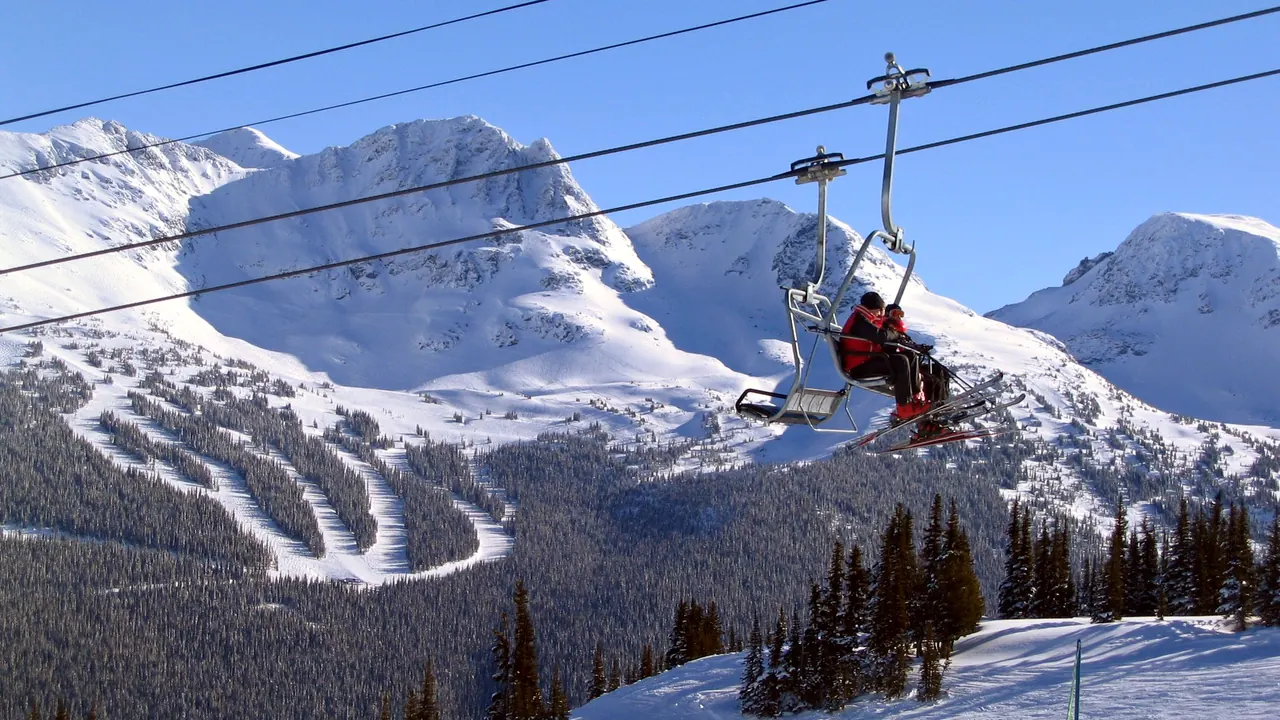
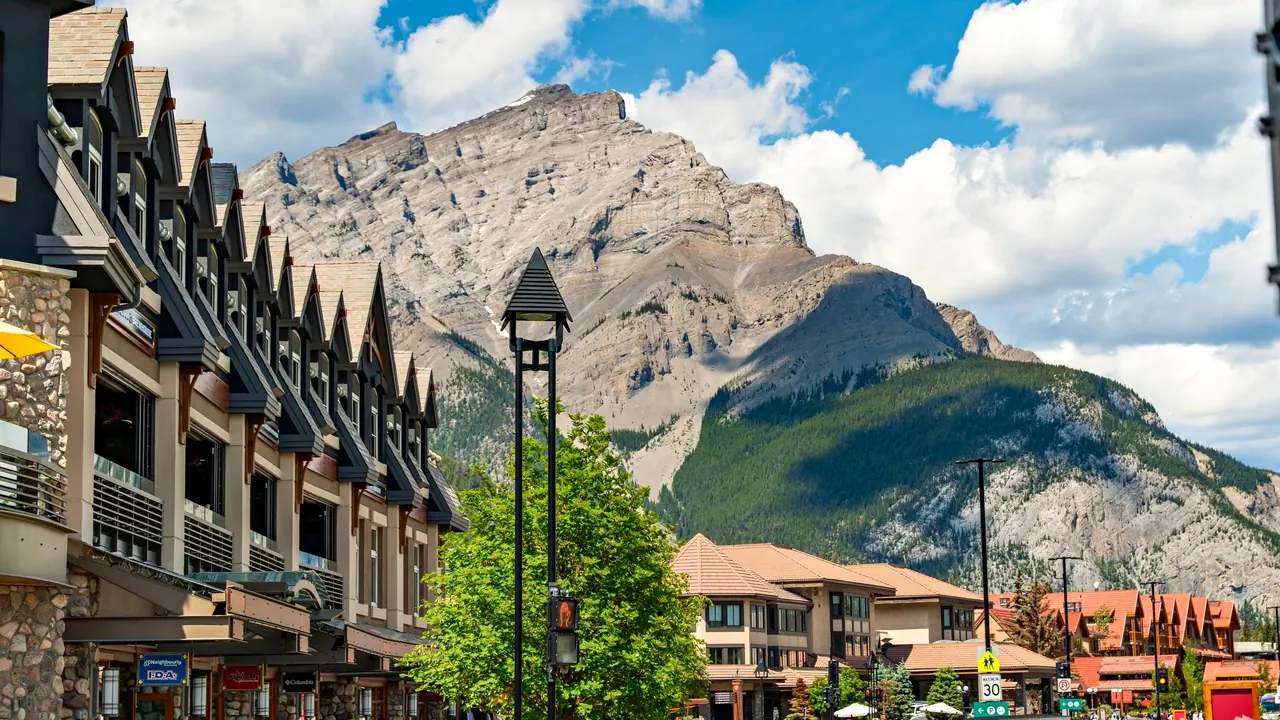
Photos: Whistler by Ruth Hartnup, CC BY 2.0, cropped; Banff by bryan pascual, Pexels License.
Whistler or Banff?
Our verdict in twelve categories, each scored against the same fixed benchmark cities, and the climate month by month, so you can choose for your trip.
Choose Whistler for
- beaches
- getting around
- nightlife
Pick Whistler for a resort week where everything works on foot. The car-free village has gondolas at its edge, large ski schools, lake beaches in summer and a famous bike park. It also eats and goes out a little better, and its forest spa makes a better end to the day. Expect to pay more than in Banff, though both are expensive, and expect much more rain in late autumn and winter.
Choose Banff for
- live music and the arts
- prices
- culture and sights
Banff suits travellers who want the national park as much as the skiing: elk and bighorn sheep beside the road, Lake Louise and Moraine Lake, the glaciers of the Icefields Parkway, and a town with a real past in its hot springs, railway castle and small museums. It is also the better choice if you like an evening at a concert or a film, thanks to the Banff Centre. Its drier climate brings crisp, very cold winters and clear summer hiking weather.
Scoreboard
Twelve categories on one fixed scale from 0 to 100. The shaded stretch is the gap between the two.
Your match
Pick a travel style or drag the sliders, and both match scores follow your weighting.
Wins on beaches and getting around with your weighting.
Wins on live music and the arts and prices with your weighting.
What matters to you?
Category by category
What the scores mean for a trip.
Beaches & swimming
Neither town is near the sea, but Whistler has lakes you would actually choose to swim in. Lost Lake has a sandy shore within walking distance of the village, and Alta Lake and Alpha Lake have rafts and jetties. In a warm spell the shallower lakes reach about 20°C.
Banff's lakes are mostly fed by glaciers and stay cold all summer. Johnson Lake on an August afternoon is about the only real swim, and Lake Minnewanka is for paddling. In Banff, warm water comes from the hot springs.
Food & drink
Whistler is the better place to eat, though neither is a food destination. Its village restaurants cook Pacific Northwest produce such as salmon and spot prawns, with deep British Columbia wine lists, and there are ramen and sushi counters next to the après-ski nachos.
Banff sticks closer to the steakhouse: Alberta beef, bison, elk and fondue, with the more ambitious cooking mostly in the grand hotels. Neither town has markets or street food, so in both a week of meals means the same few streets.
Culture & sights
In both mountain towns, sightseeing fills a day at most, but they tell different stories. Banff's sights are about how the park was founded: the Cave and Basin, where Canada's national parks began, the Banff Springs Hotel, and small museums about mountaineering, wildlife and the Plains peoples.
Whistler was purpose-built and has no old town, so it offers art and Indigenous culture instead. The Audain Art Museum has Emily Carr paintings and Northwest Coast masks, the Squamish Lil'wat Cultural Centre tells the story of the two nations whose land this is, and the 2010 Winter Games left their venues behind.
Nightlife
Whistler goes out harder. Après-ski on the packed patios runs straight into clubs and late bars in the pedestrian village, which stay loud into the early hours on winter weekends, and the big summer bike festivals keep things going outside the ski season.
Banff's version is smaller: a few pubs and a couple of dance bars around Banff Avenue, plus calmer hotel lounges. In both towns the crowd is mostly young seasonal workers, and both go quiet early in spring and autumn.
Nature & outdoors
These are two of North America's great mountain bases, equal in scale but different in character. Banff is a national park first, with elk on the lawns, bighorn sheep along the roads, Lake Louise and Moraine Lake, Johnston Canyon and the Icefields Parkway. Its skiing is spread across three separate areas.
Whistler is built around one huge pair of mountains, Whistler and Blackcomb, joined by the Peak 2 Peak Gondola. It gets deep coastal snow, has a famous downhill bike park and offers hikes to the lakes of Garibaldi Provincial Park. Choose Banff for wildlife and scenery spread over a whole park, and Whistler for big terrain reached by lift from your door.
Day trips
Neither is a good base for visiting towns, and each has one big-city day out. From Banff it is Calgary, about an hour and a half away, with its museums and Heritage Park. Canmore is close by, and Field and Golden are across the Continental Divide.
From Whistler it is Vancouver, about two hours down the Sea to Sky Highway. That makes a long day, and many visitors stay overnight instead. Squamish, Pemberton and the old Britannia mine museum are shorter stops.
Good for families
Whistler is the easier family base. The car-free village, large ski schools and gentle runs from the gondolas cut down the planning. Lodgings with kitchens are common, and in summer there are lake beaches, mini-golf and an adventure park at the foot of Blackcomb.
Banff is safe, and children love the elk, the gondola, the Johnston Canyon boardwalk and the hot springs. Its best sights are spread out, though, and mean long drives. Neither town has a zoo or aquarium, and for Banff the nearest are in Calgary.
Getting around
Whistler is easier without a car. Gondolas to both mountains leave from the edge of the pedestrian village, free shuttles run along the valley, and the paved Valley Trail links the lakes for walking and cycling.
Banff's centre is compact and walkable, and Roam Transit buses and summer park shuttles reach the gondola, Lake Minnewanka, Canmore and Lake Louise. The Icefields Parkway, Yoho and the quieter trailheads really need a car or a tour, though. Neither town has a passenger railway, so you reach Banff by road from Calgary's airport and Whistler by road from Vancouver.
Shopping & style
Shopping is a sideline in both towns, but the focus differs. Whistler's village is mostly specialist ski, snowboard and bike shops offering tuning and rentals, plus a summer farmers' market. Banff Avenue mixes general outdoor outfitters with fudge shops and moose-and-maple souvenirs. For something to take home, both have galleries selling Indigenous art, and Banff adds Rocky Mountain landscape painting.
Affordability
Both towns are expensive, but Whistler costs more, mainly because of its lift passes and its slopeside lodging in winter. In Banff the costs come from the limited number of rooms inside the park, restaurants with resort prices and the park pass. Once you have the pass, though, its trails, lakes and viewpoints are free.
The ways to save are similar. Visitors to Banff stay in Canmore or at campgrounds, while visitors to Whistler cook in their condos and stay further down the valley. Both towns are noticeably cheaper in spring and autumn.
Live music & performing arts
Banff has the stronger cultural calendar because of the Banff Centre for Arts and Creativity. Its theatres stage concerts, dance and performances by visiting artists, mostly in summer, and each autumn it hosts the Banff Mountain Film and Book Festival.
Whistler has free summer concerts in Olympic Plaza, buskers, a small community arts centre and cover bands in the pubs. For a play or an orchestra, you have to go down to Vancouver.
Wellness & relaxation
Whistler has the edge for a long soak. Its Nordic-style spa in the forest, with hot pools, saunas, steam rooms and cold plunges, and with guests asked to keep silent, can fill a whole evening. Hotel spas and massage studios for sore legs add to it.
Banff offers history and a view instead. The 1930s Upper Hot Springs bathhouse on Sulphur Mountain has a single mineral pool that gets crowded on busy days, and the grand hotels have their own spas. Both towns are calmest in spring and autumn.
When should you go?
Pick your month. The climate figures are measured averages, not a forecast.
Whistler in July
Banff in July
Daytime high, °C
Rainfall in the month, mm
Where the figures come from
Whistler has no rain gauge within 25 km of the centre, so its rainfall comes from a gridded climate dataset read at the destination rather than from a gauge further away.
Temperature and rainfall are climate normals, averaged over the years shown. Whistler: 1991-2020 normals, Whistler - Nesters (1.1 km from centre). Banff: 1991-2020 normals, Banff (2 km from centre).
Both towns have a short, pleasant summer. In Banff, June to September is the time for hiking, with July highs around 23°C. June is its wettest month, but even then it is not very wet. Winters are dry and bitterly cold, down to about -4°C in December, so walking around town from November to March means proper layers, though the cold suits skiing.
Whistler is a little warmer in summer, around 25°C in July and August, which are also its driest months and the only time the lakes are warm enough to swim. Its winters are milder than Banff's but far wetter. From October to January it gets heavy rain and snow, with about 196mm in November, which is what builds the deep snow on the mountains. For a dry autumn walk, Banff is more reliable.
Which traveller are you?
For a culture and arts trip, Banff is the better pick. The Banff Centre stages concerts and dance, and the autumn mountain film festival draws filmmakers from abroad. The Cave and Basin and the Whyte Museum also give the town a depth of park history.
On a family trip with young children, Whistler makes life easier. The car-free village, big ski schools, condos with kitchens and summer lake beaches keep everything close at hand, while Banff's best sights are often at the end of a long drive.
For a food and nightlife trip, Whistler has more going on. Its restaurants pair Pacific Northwest seafood with serious British Columbia wine lists, and après-ski leads on to clubs that stay loud into the early hours. Banff offers steakhouses and a few lively pubs.
Before you go
| Measure | Whistler | Banff |
|---|---|---|
| Official language | French, English | French, English |
| Currency | Canadian Dollar (CAD) | Canadian Dollar (CAD) |
| Sockets | AB120 V, 60 Hz | AB120 V, 60 Hz |
| Driving side | Right | Right |
| Time zone | UTC-8, UTC-7 in summer | UTC-7, UTC-6 in summer |
| Emergency number | 911 | 911 |
| Elevation | 670 m | 1,400 m |
| Main airport | Vancouver International Airport (YVR)104 km from centre109 non-stop destinations | Calgary International Airport (YYC)109 km from centre102 non-stop destinations |
| Public holidays this year | 11 days | 13 days |
By the numbers
| Measure | Whistler | Banff |
|---|---|---|
| Population | 13,982 | 8,305 |
| People per km² | 58 | 1,730 |
| Museums within 10 km | 1 | 4 |
| UNESCO World Heritage sites within 50 km | 0 | 1 |
Where else could you go?
Every comparison below shares a destination with this one, so you can follow Whistler or Banff somewhere new.
- Canmorevs Banff
- Lake Louisevs Banff
- Vancouvervs Whistler
- Calgaryvs Banff
- Victoriavs Whistler
- Tofinovs Whistler