Black Forest or Dolomites?
Our verdict in twelve categories, each scored against the same fixed benchmark cities, and the climate month by month, so you can choose for your trip.
Choose Black Forest for
- wellness
- live music and the arts
- prices
The Black Forest suits a slower, more varied trip, where walks in the woods share the days with thermal baths, wine villages and town visits. Its rounded hills are gentler than the Dolomites, but it has Baden-Baden's bathing tradition, Europa-Park for children, concerts at the Festspielhaus, and Strasbourg, Basel and Alsace all within easy reach. It also costs less to stay well. Choose it for a mix of rest, food and outings rather than one big landscape.
Choose Dolomites for
- nature and the outdoors
- shopping
- beaches
For mountains, the Dolomites are the clear choice. The pale limestone towers, the lifts from almost every village, the hut-to-hut routes and the linked ski circuits give a walking or skiing trip that the Black Forest cannot match. The price is higher, evenings are quieter and there is less to do in the valleys when the weather turns, so it works best for travellers who will spend most days outdoors.
Scoreboard
Twelve categories on one fixed scale from 0 to 100. The shaded stretch is the gap between the two.
Your match
Pick a travel style or drag the sliders, and both match scores follow your weighting.
Wins on wellness and live music and the arts with your weighting.
Wins on nature and the outdoors and shopping with your weighting.
What matters to you?
Category by category
What the scores mean for a trip.
Beaches & swimming
Neither is a place for swimming, and both offer lakes instead of sea. In the Black Forest the bathing is up in the hills at Titisee and Schluchsee, with small beaches and boat hire, but the water stays cool.
The Dolomites work the other way round. Their famous high lakes are too cold for most people, and the warm water is down at Lake Caldaro, with grassy lidos, or at the northern tip of Lake Garda.
Food & drink
Both regions eat and drink very well, and both have fine dining in surprisingly small villages: Baiersbronn in the Black Forest, Alta Badia in the Dolomites. The Black Forest leans towards France, with smoked ham, Flammkuchen, Kirsch cake and fruit brandies, and Pinot from the Kaiserstuhl and Markgräflerland.
The Dolomites mix Alpine and Italian cooking: speck, canederli and strudel, followed by a proper espresso. The meal people remember is lunch on a hut terrace high above the valley, with Lagrein or Gewürztraminer from the slopes below Bolzano.
Culture & sights
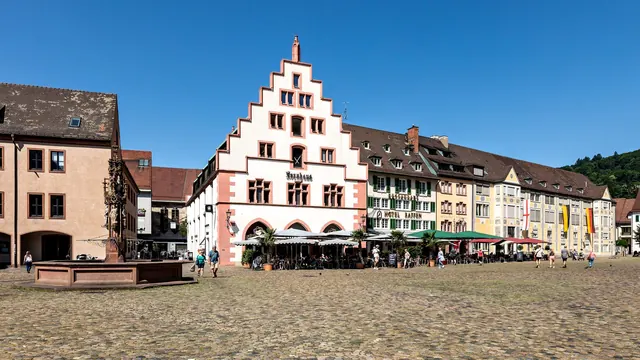
The Black Forest has slightly more to build a day around. Freiburg's red sandstone Minster and car-free old town, Baden-Baden's spa quarter and the Maulbronn monastery are its high points, with half-timbered towns such as Gengenbach and Schiltach in between.
In the Dolomites the landscape is what UNESCO listed, and the built heritage sits in the valley towns. The highlights are Ötzi in Bolzano, the frescoed Castello del Buonconsiglio in Trento and Bressanone's cathedral. First World War tunnels on the high passes add something the Black Forest has no equivalent for.
Nightlife
Both are early-to-bed regions, but the nights out they do have happen at different times and places. The Black Forest's comes from Freiburg's student pubs and summer beer gardens in term time. The Dolomites' is winter après-ski at the foot of the slopes in Selva, Canazei and Cortina, which mostly winds down by early evening.
Nature & outdoors
This is where the Dolomites pull far ahead. Sheer limestone peaks such as the Tre Cime, the Sassolungo and Seceda rise out of green meadows, lifts take walkers high from almost every village, and the via ferrata network lets non-climbers onto real rock. In winter the Dolomiti Superski area links a dozen valleys.
The Black Forest is fine walking country, but in a different register: dark fir forest, rounded summits, gorges such as the Wutach and the Triberg waterfalls. The Feldberg rises to 1,493m, and on clear days you can see the Alps from the top. Skiing there is mostly cross-country plus a few small downhill areas.
Day trips
The Black Forest has the better outings because it sits on the border with France and Switzerland. Strasbourg is under an hour from Baden-Baden, Basel is a short train ride from Freiburg, and the Alsace wine villages, Heidelberg and Lake Constance are all easy days out.
The Dolomites have good trips too, such as Merano, Verona by train and the northern end of Lake Garda. But nearly every trip from the high valleys starts with a winding pass road, so it works best to base yourself in Bolzano or Trento for this kind of travel.
Good for families
The Black Forest has the edge for children, mainly because of Europa-Park and its indoor water park at Rust. Summer toboggan runs, treetop walks, wildlife parks and cable cars up the Feldberg fill the gaps between visits.
The Dolomites are very good in summer: the Alpe di Siusi and Armentara meadows are nearly flat, lifts do the climbing, and many hotels are set up for families. On a wet day, though, the options shrink to pools and the museums in Bolzano and Trento.
Getting around
Getting around is about equally easy in both, and both reward a car. In the Black Forest the Rhine valley line and the scenic Schwarzwaldbahn and Höllentalbahn railways do much of the work, often free with a guest card. The car is mainly useful for linking waterfalls, lakes and small towns.
In the Dolomites, trains and buses serve the valleys well and lifts take over once you are in a village. The hard part is crossing from one valley to the next on slow hairpin passes. If you stay in one valley you can manage without a car.
Shopping & style
Neither is a shopping destination. In both, the souvenirs are woodwork and things to eat or drink. The Black Forest has cuckoo clocks from the Triberg workshops and Kirschwasser, plus Freiburg's department stores and a small luxury quarter in Baden-Baden. The Dolomites have the carved figures of Ortisei, loden and food shops under Bolzano's arcades, Cortina's boutiques, and some of the best-known Advent markets in the Alps.
Affordability
The Black Forest is noticeably easier on the budget. Valley guesthouses and farm stays are fairly priced, inn meals are filling, and many hosts give free local transport cards. Baden-Baden and the top restaurants are the expensive exceptions.
The Dolomites cost a lot in peak winter and in July and August. Cortina and Alta Badia are among Italy's dearest resorts, and lift passes and hut stays add up. Staying in Fassa, Fiemme or Bolzano, or going in June or September, lowers the cost.
Live music & performing arts
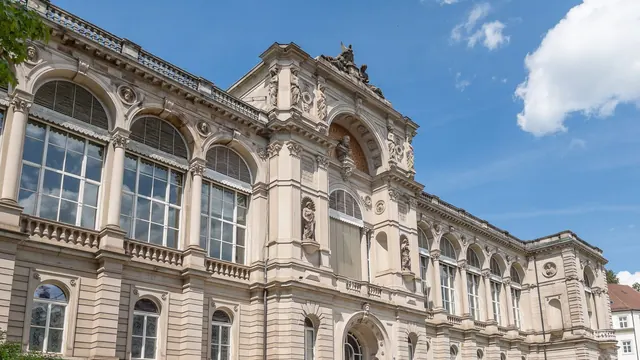
The Black Forest has much more to see and hear. Baden-Baden's Festspielhaus, one of Germany's largest opera and concert halls, brings in international orchestras and ballet, with its Easter festival as the high point. Freiburg adds opera, drama and a well-known baroque ensemble.
The Dolomites offer fewer performances but more unusual settings. Bolzano and Trento have orchestral seasons, and in summer musicians play on alpine meadows, hut terraces and castle courtyards.
Wellness & relaxation
The Black Forest has one of Europe's great bathing traditions. Baden-Baden's domed Friedrichsbad and the Caracalla baths sit in a town built for slow days, with Badenweiler, Bad Wildbad and other spa towns close by.
In the Dolomites, wellness mostly means the hotel spa: saunas facing rock walls, outdoor pools in the snow and hay baths below the Schlern. Merano's thermal baths are the main public alternative, so it pays to choose your hotel with this in mind.
When should you go?
Pick your month. The climate figures are measured averages, not a forecast.
Black Forest in July
Dolomites in July
Daytime high, °C
Rainfall in the month, mm
Temperature and rainfall are climate normals, averaged over the years shown. Black Forest: 1991-2020 normals, Freiburg (0.6 km from centre). Dolomites: 1991-2020 normals, Dobbiaco (22.3 km from centre).
In the lower towns on the Rhine side, such as Freiburg and Baden-Baden, the Black Forest has a long mild season, with highs near 27°C in July and the sunniest weather from June to August. The hills around Titisee, Schluchsee and the Feldberg are noticeably cooler, and their lakes are only really worth a swim in July and August. Rain falls steadily all year and is heaviest from May to August. Walking is comfortable from May to October. November to February are cold and grey, with short days and little sun.
Around the Dolomite valleys where most visitors stay, summer is milder and peaks near 22°C. That is good hiking weather, though July is also the wettest month, with about 130mm of rain. June to September are the months for walking. Winter is cold and much drier, with January highs around 0°C, and that is the skiing season. The Black Forest's lower towns give a longer, gentler spring and autumn, while the Dolomites divide more sharply into a summer for walking and a winter for skiing.
Which traveller are you?
On an outdoors trip, the Dolomites win. Lifts carry you straight onto high pasture, and there are routes like the Alta Via 1 and the via ferrata cables. The Black Forest offers fine forest walking on the Westweg, but on a much gentler scale.
For a relaxing and wellness trip, the Black Forest is the better choice. Baden-Baden's Friedrichsbad and Caracalla baths are surrounded by a ring of smaller spa towns. In the Dolomites, relaxation mostly happens inside a well-chosen hotel spa, with Merano's thermal baths the main public exception.
On a family trip with children, the Black Forest has more to offer. Europa-Park alone can fill several days, and treetop walks, wildlife parks and lake pedal boats cover the rest. The Dolomites have lovely flat meadow paths but no theme parks, so rainy days are harder.
Before you go
| Measure | Black Forest | Dolomites |
|---|---|---|
| Official language | German | Italian |
| Currency | Euro (EUR) | Euro (EUR) |
| Sockets | CF230 V, 50 Hz | CFL230 V, 50 Hz |
| Driving side | Right | Right |
| Time zone | UTC+1, UTC+2 in summer | UTC+1, UTC+2 in summer |
| Emergency number | 112 | 112 |
| Main airport | EuroAirport Basel–Mulhouse–Freiburg (BSL)112 non-stop destinations | Venice Marco Polo Airport (VCE)103 non-stop destinations |
| Public holidays this year | 12 days | 13 days |
Where else could you go?
Every comparison below shares a destination with this one, so you can follow Black Forest or Dolomites somewhere new.
- Austrian Alpsvs Dolomites
- Swiss Alpsvs Black Forest
- Lake Gardavs Dolomites
- Bavariavs Dolomites
- Lake Comovs Dolomites
- French Alpsvs Black Forest