Photos: Brittany by Pline, CC BY-SA 3.0, cropped; Burgundy by Gu Bra, Pexels License.
Brittany or Burgundy?
Our verdict in twelve categories, each scored against the same fixed benchmark cities, and the climate month by month, so you can choose for your trip.
Choose Brittany for
- beaches
- families
- nature and the outdoors
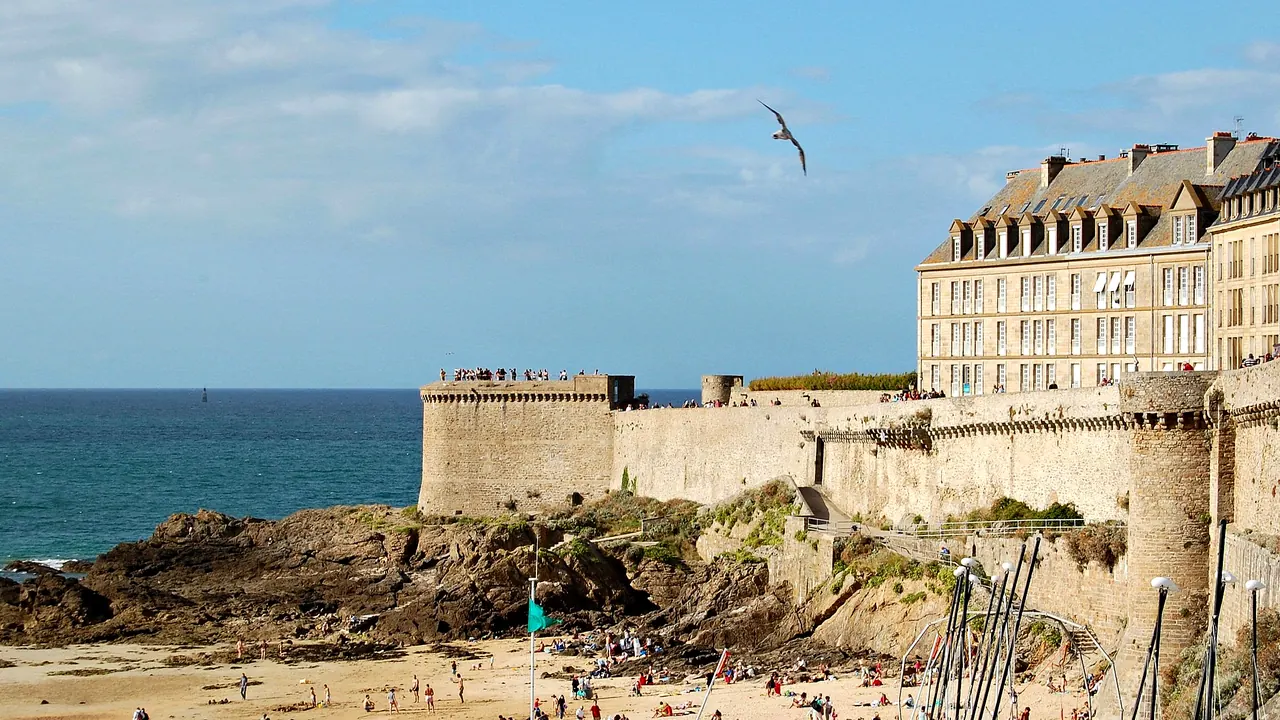
Brittany suits travellers who want the sea at the centre of the trip. It has sandy bays and granite coves, a coastal path along cliffs and headlands, sailing schools for the children and a seawater spa for the adults. It is the better choice for families and for an active outdoor vacation with a base by the shore, as long as you're happy with brisk Atlantic water and changeable skies.
Choose Burgundy for
- food and drink
- culture and sights
- shopping
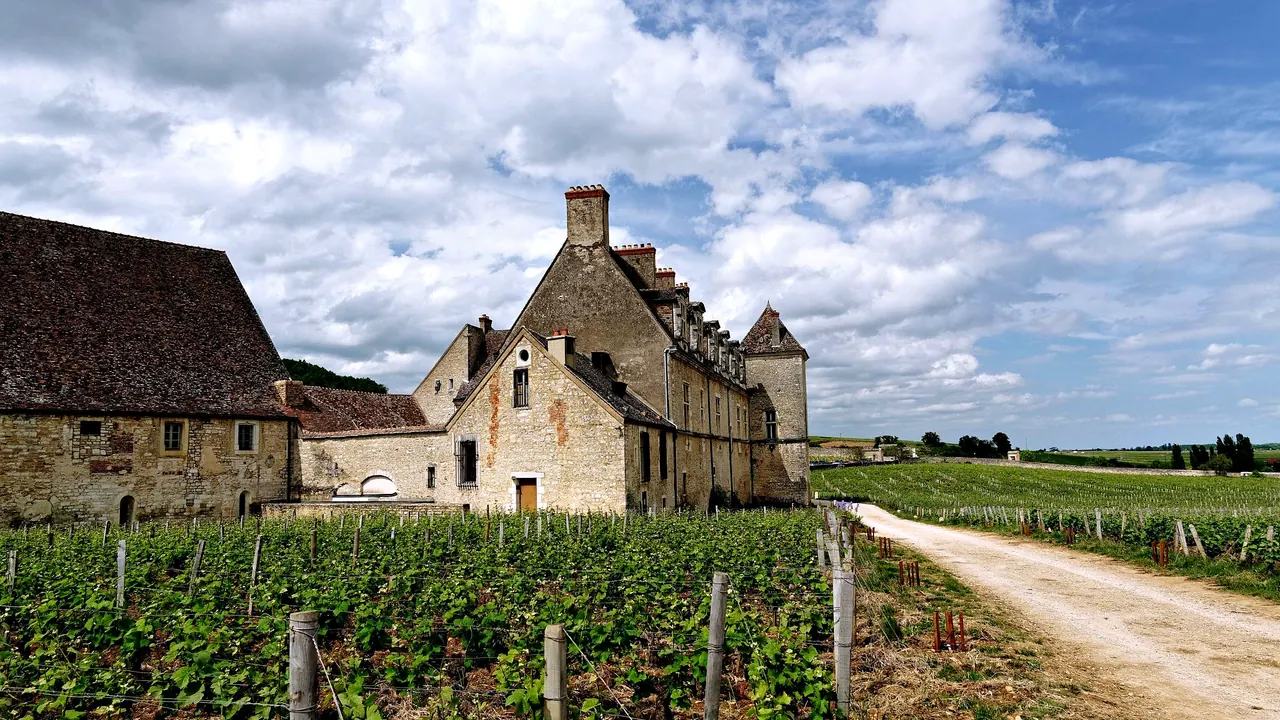
If you plan your days around the table and the cellar, Burgundy is the stronger pick. The wine villages of the Côte, the rich country cooking, the ducal palace in Dijon and the Romanesque abbeys give it more depth for a slow adult trip by car. In exchange you give up the coast, much of what children enjoy and any real life in the evenings.
Scoreboard
Twelve categories on one fixed scale from 0 to 100. The shaded stretch is the gap between the two.
Your match
Pick a travel style or drag the sliders, and both match scores follow your weighting.
Wins on beaches and families with your weighting.
Wins on food and drink and culture and sights with your weighting.
What matters to you?
Category by category
What the scores mean for a trip.
Beaches & swimming
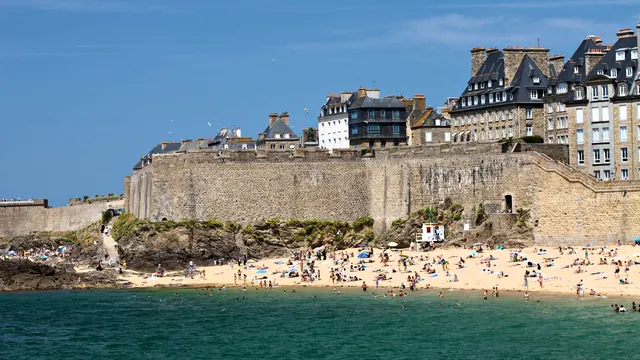
This is the widest gap between the two. Brittany's coastline is long and varied: the sandy south-coast bays around Carnac and Bénodet, the pink granite coves of Ploumanac'h, the long beaches of Crozon and the tidal flats off Saint-Malo. The water stays cool even in August, but the region is built for a seaside vacation.
Burgundy is landlocked, so swimming means lakes, mainly Lac des Settons in the Morvan and Lac Kir on the edge of Dijon. They are good for an afternoon on a hot day but are not a reason to come.
Food & drink
Both regions eat well, but in Burgundy the food and wine are the trip itself. The villages of the Côte between Dijon and Santenay make some of the most famous wine in the world. The rich cooking, from boeuf bourguignon and snails to Époisses cheese and mustard, is served at starred country inns in places like Saulieu and Chagny.
Brittany's food is lighter and comes mostly from the sea: Cancale oysters, Saint-Brieuc scallops, shellfish platters in the harbour towns, and galettes with cider. It does these things very well, but the range is narrower and there are no wine cellars to visit.
Culture & sights
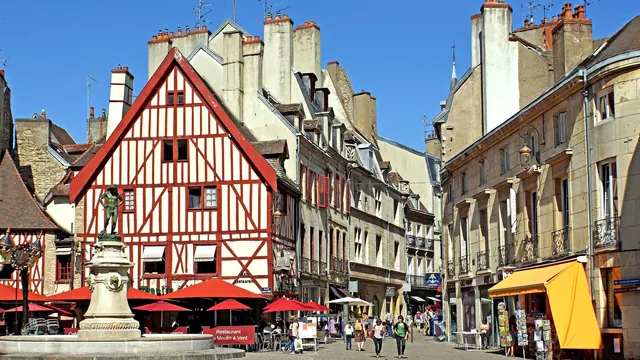
Burgundy's heritage carries more weight. Dijon has the Palace of the Dukes and its fine art museum, and Beaune has the Hospices under their tiled roof. Then there are the Romanesque and Cistercian landmarks of Vézelay, Fontenay, Cluny and Autun, though each tends to need a car and most of a day.
Brittany's heritage is older and more local: the Carnac alignments and the Morbihan dolmens, walled Saint-Malo and Concarneau, half-timbered Dinan and Vitré, and the parish closes of Finistère. Its appeal lies in a string of well-kept towns rather than in great museums or famous buildings.
Nightlife
Neither region is a place for going out, but Brittany has more of it. Rennes is a large student city where the bars around Rue Saint-Michel fill from Thursday, Brest and Lorient have harbour bars, and Saint-Malo and Quiberon stay lively on summer evenings. A village fest-noz is a night out Burgundy has nothing to match.
In Burgundy the evening is mostly a long dinner. Dijon's student streets and Beaune's wine bars are about all there is.
Nature & outdoors
Brittany's outdoors is more dramatic and more varied. The GR34 path follows almost the whole coast, past Cap Fréhel and Pointe du Raz. Islands such as Belle-Île and Ouessant add more walking, and the Gulf of Morbihan and the beaches of Finistère are good for sailing, kayaking and surfing.
Burgundy is softer country of vines, limestone and pasture, and the Morvan forests are its wildest part. It suits cycling on vineyard paths and canal towpaths, the short climb up the Roche de Solutré or a balloon flight over the vines, not anything rugged.
Day trips
Both regions have plenty of outings from a single base. The difference is in what you go out to see. In Brittany many trips are by boat, to Île de Bréhat, Belle-Île, Ouessant or the islands of the Gulf of Morbihan, and Mont-Saint-Michel is about an hour from Saint-Malo.
Burgundy's outings are by road, through wine villages and medieval towns such as Semur-en-Auxois, Noyers and Flavigny, and Lyon is within reach of Beaune. Brittany's island trips depend on ferry times, while Burgundy's villages are only minutes apart.
Good for families
Brittany is the easier region with children, mostly because so little of the day goes on driving. Beaches, small resorts and sights sit close together, and the towns are relaxed and safe. The sea needs some care: the water stays cool, the tides are strong and the shoreline can move a long way between morning and afternoon, so young swimmers need watching. Grey skies can arrive even in August, so keep an indoor plan or two ready.
Burgundy is just as calm and safe, but it is built around what adults enjoy. Its sights lie further apart, so children can spend long stretches in the back of the car. The best breaks for them come in summer at the Morvan lakes, which have supervised beaches, pedalos and canoes, and at the Alésia museum, where the Roman siege is brought to life.
Getting around
Brittany is somewhat easier to reach and get around by train. Fast trains run from Paris to Rennes in about an hour and a half, and lines continue to Saint-Malo, Vannes, Quimper and Brest. The coast and the megalith sites still need a car, and coastal roads get crowded in high summer.
Burgundy has trains between Dijon, Beaune and the larger towns, and a tram in Dijon, but buses to the villages are rare, so a car is almost essential. Along the Côte, a bicycle solves the problem that tasting and driving do not mix.
Shopping & style
Neither region is a fashion destination, and in both the best things to buy are edible. Burgundy has the edge because its main purchase, wine from the cellar door, fills a car boot easily. Add Dijon mustard, cassis, Époisses cheese and the antique dealers scattered through the countryside.
Brittany's shops sell crafts and local food: Quimper faience, striped sailor tops, salted butter caramels and Guérande salt. Rennes' Saturday market at Place des Lices is the highlight.
Affordability
Costs are broadly similar, middle of the range for France, and in both regions they rise and fall in the same way. In Brittany, the bills go up with summer rooms in Saint-Malo, Dinard and the Morbihan resorts and with seafood platters. Campsites, gîtes and dates in June or September bring them down.
In Burgundy, Beaune and the Côte villages are the expensive part, especially in summer and at harvest time, and great wines and starred meals can push the cost up quickly. The Morvan and the rural Yonne are cheaper, though you will almost certainly need to hire a car.
Live music & performing arts
Brittany has the stronger live music, rooted in Celtic tradition. There are bagad pipe bands and fest-noz dance nights, big summer festivals such as the Festival Interceltique in Lorient and Les Vieilles Charrues at Carhaix, and an opera house and national theatre in Rennes.
Burgundy offers less, and more of it is classical: Dijon's opera, a festival of baroque opera in Beaune in July, street theatre in Chalon-sur-Saône and concerts in the basilica at Vézelay. Both go quiet outside summer, Burgundy more so.
Wellness & relaxation
Brittany is the place to build a stay around spa treatments. Thalassotherapy began in Roscoff, and seawater spas line the seafronts at Quiberon, Carnac, Dinard and Perros-Guirec. They are at their best in the quiet of spring and autumn.
Burgundy relaxes you with its slow pace rather than its spas, through long lunches and slow days drifting on a canal barge. Its thermal towns, Bourbon-Lancy and Saint-Honoré-les-Bains, mostly serve medical cures, and wine-based treatments are offered by a few country hotels around Beaune.
When should you go?
Pick your month. The climate figures are measured averages, not a forecast.
Brittany in July
Burgundy in July
Daytime high, °C
Rainfall in the month, mm
Where the figures come from
Brittany has no rain gauge within 25 km of the centre, so its rainfall comes from a gridded climate dataset read at the destination rather than from a gauge further away.
Brittany's sunshine is measured 89 km from the centre, at Rennes.
Burgundy's temperatures are measured 33 km from the centre, at Dijon.
Burgundy has no rain gauge within 25 km of the centre, so its rainfall comes from a gridded climate dataset read at the destination rather than from a gauge further away.
Temperature and rainfall are climate normals, averaged over the years shown. Brittany: 2004-2020 (sunshine 1991-2020, rainfall 1991-2020) normals, Vannes-Meucon (8.1 km from centre). Burgundy: 1991-2020 normals, Dijon (32.7 km from centre).
Brittany's summer is mild, reaching about 24°C in July. The sea only reaches about 18°C in July and August, so beach days are bracing and the swimming season is short. June to September are the driest months. From October the rain comes back hard and peaks at around 121mm in November. Spring and early autumn are the best times for walking the coast path, when it is neither wet nor crowded with summer heat.
Burgundy is hotter and sunnier in summer, at around 27°C in July. That suits cycling in the vineyards and long evenings outdoors, but it can be warm for walking around towns in the middle of the day. Its winters are colder than Brittany's, with highs near 6°C, and its wettest spells come in late spring and autumn rather than in winter. May, June and September are the most comfortable months for driving between villages and abbeys.
Which traveller are you?
On a beach and sun trip, Brittany is the clear choice. It has wide sandy bays at Carnac and Quiberon, resort beaches at Dinard and Saint-Malo and a proper summer seaside season. Burgundy's only swimming is in the Morvan reservoirs and at Lac Kir near Dijon.
On a family trip with children, Brittany works much better. It has rock pools at low tide, sailing schools, campsites and gîtes, and aquariums in Brest and Saint-Malo for wet days. Burgundy has Guédelon and canal boats, but a typical day there is spent among cellars and abbeys.
For a wine-tasting trip, Burgundy has no rival here. Beaune is a walkable base for the cellars of the Côte de Nuits and Côte de Beaune, and Chablis and the Mâconnais are within reach. Brittany's drink is dry cider, and it has no vineyards to tour.
Before you go
| Measure | Brittany | Burgundy |
|---|---|---|
| Official language | French | French |
| Currency | Euro (EUR) | Euro (EUR) |
| Sockets | CE230 V, 50 Hz | CE230 V, 50 Hz |
| Driving side | Right | Right |
| Time zone | UTC+1, UTC+2 in summer | UTC+1, UTC+2 in summer |
| Emergency number | 112 | 112 |
| Main airport | Nantes Atlantique Airport (NTE)97 non-stop destinations | Lyon Saint-Exupéry Airport (LYS)141 non-stop destinations |
| Public holidays this year | 11 days | 11 days |
By the numbers
| Measure | Brittany | Burgundy |
|---|---|---|
| Population | 4,687,381 | 1,642,687 |
| Swim season, months above 21 °C | None | - |
Where else could you go?
Every comparison below shares a destination with this one, so you can follow Brittany or Burgundy somewhere new.
- French Alpsvs Burgundy
- Swiss Alpsvs Burgundy
- Normandyvs Brittany
- Black Forestvs Burgundy
- Loire Valleyvs Brittany
- Loire Valleyvs Burgundy