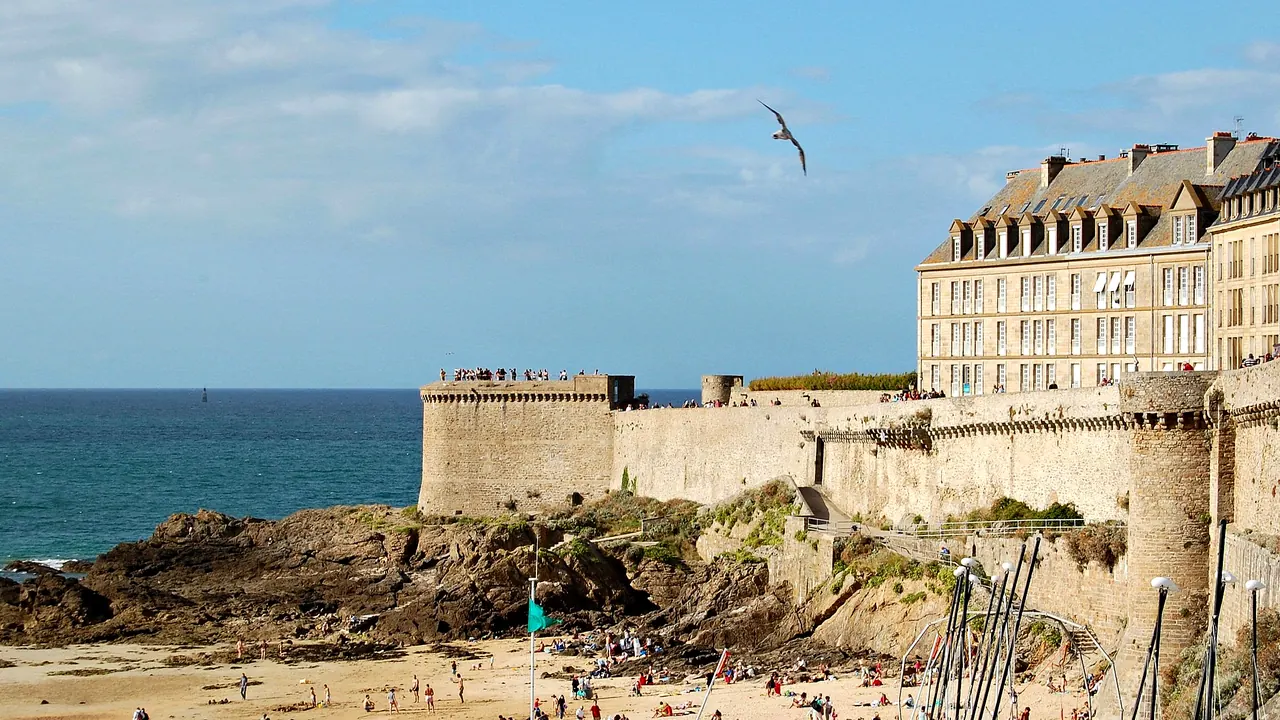
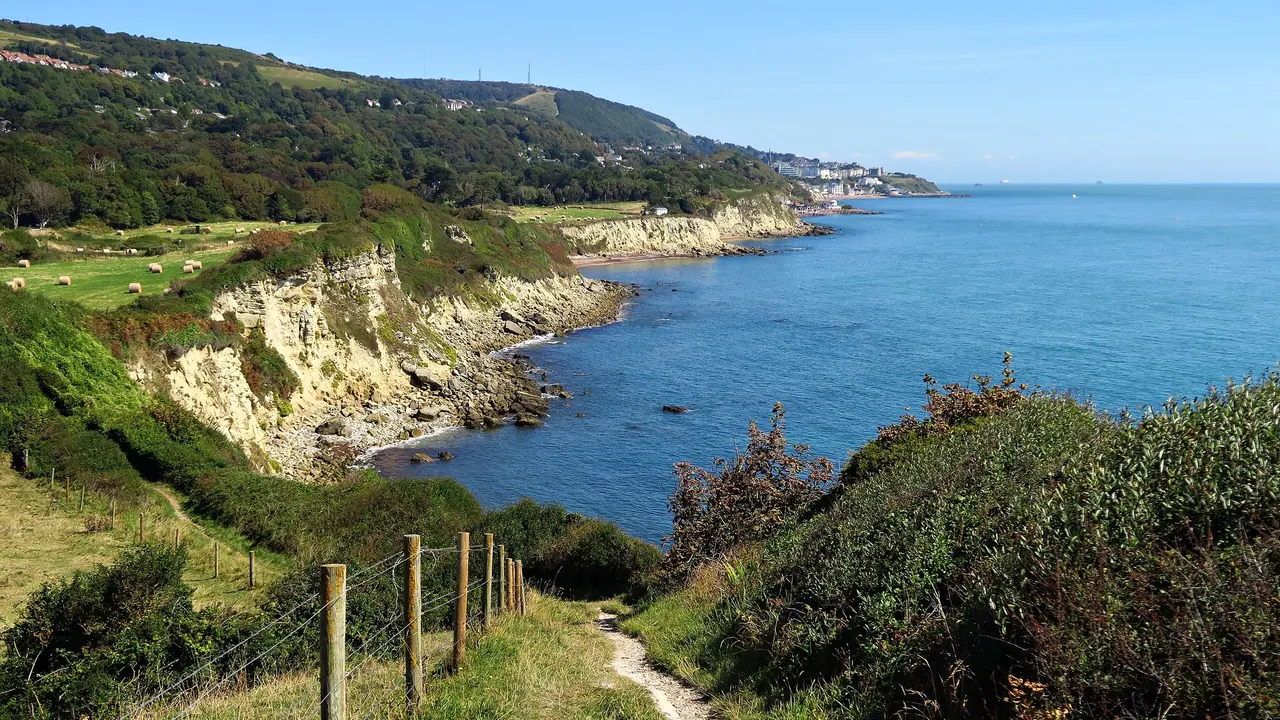
Photos: Brittany by Pline, CC BY-SA 3.0, cropped; Isle of Wight by Michael Coppins, CC BY-SA 4.0, cropped.
Brittany or Isle of Wight?
Our verdict in twelve categories, each scored against the same fixed benchmark cities, and the climate month by month, so you can choose for your trip.
Choose Brittany for
- wellness
- food and drink
- live music and the arts
Brittany suits a longer trip with a car, where each day can bring something different: sandy bays and the menhirs of Carnac, walled towns such as Saint-Malo and Dinan, and plates of oysters and galettes in the evening. It is the better choice for travellers who want variety and don't mind moving around a large region. It also has the seawater spas and the Celtic festivals that the island cannot match.
Choose Isle of Wight for
Isle of Wight does not lead in any category we score.
For a smaller, simpler week by the sea, the Isle of Wight makes more sense, especially for families from Britain or anyone who wants to travel without a car. Everything is a short bus ride away, Sandown Bay and Blackgang Chine are made for children, and sailors have the Solent at Cowes. Expect a quieter, more modest place, with much less to eat, see and do once the beach day is over.
Scoreboard
Twelve categories on one fixed scale from 0 to 100. The shaded stretch is the gap between the two.
Your match
Pick a travel style or drag the sliders, and both match scores follow your weighting.
Wins on wellness and food and drink with your weighting.
Has no clear advantage with the weighting you have chosen.
What matters to you?
Category by category
What the scores mean for a trip.
Beaches & swimming
Brittany simply has more beach, and more kinds of it. There are the wide sandy bays of Carnac and Quiberon in the south, the pink granite coves of Ploumanac'h in the north and the long strands of the Crozon peninsula. At Saint-Malo and Dinard the tide draws far out, so the beach changes through the day.
The island's beaches are fewer and gentler. Sandown Bay's slowly shelving sand is made for paddling, and Compton Bay has surf under chalk cliffs. The water is equally cool in both, so the difference is how much choice you have, not how warm it is.
Food & drink
Food is one of the main reasons to choose Brittany. Oysters from Cancale and the Gulf of Morbihan, scallops, shellfish platters, buckwheat galettes and salted-butter baking make up a real regional cuisine. Rennes and the seafood ports have restaurants worth going out of your way for.
The Isle of Wight eats well but plainly: crab and lobster in harbour pubs, fish and chips on the seafront, cream teas in Godshill and picnics from the farm shops. It is good food for a day outdoors, not a reason to cross the Solent.
Culture & sights
Brittany's heritage is broader and much older. It runs from the stone rows of Carnac to the walls of Saint-Malo, the half-timbered streets of Dinan and Vitré, and the parish closes of Finistère, spread across enough towns to fill a fortnight. The museums are modest, and the monuments do the work.
The island has one sight of national standing in Osborne House, along with Carisbrooke Castle and a handful of half-day visits such as Brading Roman Villa and the Needles Old Battery. That is a few days of sightseeing, not the core of a trip.
Nightlife
Brittany is quiet at night too, but it has Rennes, where student bars around Rue Saint-Michel fill from Thursday and a few clubs stay open late. Add summer evenings in Saint-Malo and Quiberon and the village fest-noz. On the Isle of Wight evenings end in the pub, and Cowes during regatta week is the one lively exception.
Nature & outdoors
Both are coastal walking country, but Brittany's coast is longer and wilder. The GR34 runs past the Côte de Granit Rose, the cliffs of Cap Fréhel and the headlands of Pointe du Raz. Offshore there are islands such as Ouessant and Belle-Île and puffins at Sept-Îles, and Finistère has reliable surf.
The island fits a gentler version into a small space: Tennyson Down out to the Needles, the landslipped woods of the Undercliff, and red squirrels at Newtown Creek. The whole coastal path is about 110km. Its great asset is the water, since the Solent is one of the world's classic sailing grounds.
Day trips
From almost any base in Brittany there is a full run of outings. You can reach Mont-Saint-Michel from Saint-Malo, take boats into the Gulf of Morbihan, drive the circuit of Quimper, Locronan and Concarneau, or cross to car-free Bréhat or remote Ouessant.
The island's own towns, Cowes, Yarmouth and Ventnor, are quickly covered. Portsmouth's Historic Dockyard, with HMS Victory, is less than half an hour away by foot ferry. Beyond that, every day on the mainland starts with a crossing, so the New Forest or Winchester take more effort.
Good for families
These are both traditional family seaside destinations, so the choice comes down to style. Brittany offers campsites, gîtes, sailing schools and rock pools along a long sandy coast, with Océanopolis in Brest for wet days. It is spread out, though, so expect time in the car.
The island is set up for children on a smaller scale. Blackgang Chine, Robin Hill, the zoo at Sandown, a steam railway and fossil hunts on the beaches are all close together. Brittany's strong tides need watching with young swimmers, and on the island it is the grey days.
Getting around
The two are equally easy to manage, in opposite ways. Brittany is large. Fast trains reach Rennes from Paris and run on to Saint-Malo, Vannes and Quimper, but the coast, villages and megaliths really need a car, which the toll-free dual carriageways make easy.
The Isle of Wight is only about 37km across. Good buses, open-top routes to the Needles and the railway down the east coast make a car-free stay workable. The catch is that every arrival depends on a ferry, and the lanes are narrow and busy in August.
Shopping & style
Brittany gives you more to take home, though neither place is a shopping trip. There is Quimper faience, striped sailor tops, salted caramels, cider and Guérande salt, plus the big Saturday market at Place des Lices and the high street in Rennes. The island has Newport's everyday high street, nautical clothing in Cowes, small craft studios and jars of coloured Alum Bay sand.
Affordability
Brittany is somewhat easier on the budget. Its coastal resorts get expensive in July and August too, but campsites, gîtes, crêperies and toll-free roads keep costs reasonable, and seafood platters are the main splurge.
On the island, full English high-season prices come on top of the ferry, which costs much more if you bring a car. Crossing on foot, using the buses and buying from farm shops helps. Both are noticeably cheaper in late spring and early autumn.
Live music & performing arts
Music is part of everyday life in Brittany: bagad pipe bands and fest-noz dances in the villages, and big summer festivals, from the Festival Interceltique in Lorient to Les Vieilles Charrues and the Festival de Cornouaille. Rennes adds an opera house, a national theatre and the Transmusicales in December.
On the island, music mostly means the Isle of Wight Festival each June, a famous name since the late 1960s. Outside that weekend there is a theatre at Shanklin, an arts centre in Newport and bands in the pubs.
Wellness & relaxation
Brittany has a real spa tradition. Thalassotherapy began at Roscoff, and seawater centres line the seafronts at Quiberon, Carnac, Dinard and Perros-Guirec, so you can build a whole stay around treatments, best in spring or autumn.
The Isle of Wight has no such tradition and only a few hotel spas. Rest there comes from the pace alone: Ventnor's calm as an old health resort, benches on the clifftops and the gardens of Quarr Abbey.
When should you go?
Pick your month. The climate figures are measured averages, not a forecast.
Brittany in July
Isle of Wight in July
Daytime high, °C
Rainfall in the month, mm
Where the figures come from
Brittany has no rain gauge within 25 km of the centre, so its rainfall comes from a gridded climate dataset read at the destination rather than from a gauge further away.
Brittany's sunshine is measured 89 km from the centre, at Rennes.
Isle of Wight's temperatures are measured 39 km from the centre, at Bournemouth Airport.
Isle of Wight has no rain gauge within 25 km of the centre, so its rainfall comes from a gridded climate dataset read at the destination rather than from a gauge further away.
Temperature and rainfall are climate normals, averaged over the years shown. Brittany: 2004-2020 (sunshine 1991-2020, rainfall 1991-2020) normals, Vannes-Meucon (8.1 km from centre). Isle of Wight: 1991-2020 normals, Bournemouth Airport (38.9 km from centre).
In both places summer is the beach season, and it is short. Where most visitors stay in Brittany, July afternoons reach about 24°C, against 22°C on the Isle of Wight. Both seas only reach about 18°C in August, so swimming on either side of the Channel is brisk and belongs to July and early September. Neither place ever gets too hot for walking. The winters are cool, grey and damp.
Late spring and early summer bring the driest weather in both, and that is good walking time. Brittany keeps its sunshine noticeably better into September, so it is the stronger choice for a late-season trip, while on the island the sun drops away sooner. From October the rain climbs past 100mm a month in both, and the coast becomes something to watch from a window rather than to lie on.
Which traveller are you?
For a food and nightlife trip, Brittany is the clear pick. Oysters from Cancale, shellfish platters in the harbour towns and galettes with cider beat the island's crab sandwiches. The student bars in Rennes and the village fest-noz outlast evenings that end in the pub by eleven.
On a relaxing and wellness trip, Brittany has what the island lacks: a long thalassotherapy tradition, with seawater spas at Quiberon, Carnac and Dinard. The Isle of Wight offers quiet villages and sea air, but treatments are limited to a few hotel spas.
On a family trip with young children, the Isle of Wight is the easier week. Nothing is far away, Sandown Bay shelves gently, and Blackgang Chine, the zoo and the fossil hunts fill the days. Brittany has more beaches, but you need a car to reach them.
Before you go
| Measure | Brittany | Isle of Wight |
|---|---|---|
| Official language | French | English |
| Currency | Euro (EUR) | Pound Sterling (GBP) |
| Sockets | CE230 V, 50 Hz | G230 V, 50 Hz |
| Driving side | Right | Left |
| Time zone | UTC+1, UTC+2 in summer | UTC, UTC+1 in summer |
| Emergency number | 112 | 112 or 999 |
| Main airport | Nantes Atlantique Airport (NTE)97 non-stop destinations | Southampton Airport (SOU)15 non-stop destinations |
| Public holidays this year | 11 days | 8 days |
By the numbers
| Measure | Brittany | Isle of Wight |
|---|---|---|
| Population | 4,687,381 | 140,459 |
| People per km² | - | 369 |
| Swim season, months above 21 °C | None | None |
Where else could you go?
Every comparison below shares a destination with this one, so you can follow Brittany or Isle of Wight somewhere new.
- Cotswoldsvs Isle of Wight
- Devonvs Isle of Wight
- Normandyvs Isle of Wight
- Normandyvs Brittany
- Cornwallvs Isle of Wight
- Peak Districtvs Isle of Wight