Chile
Santiago
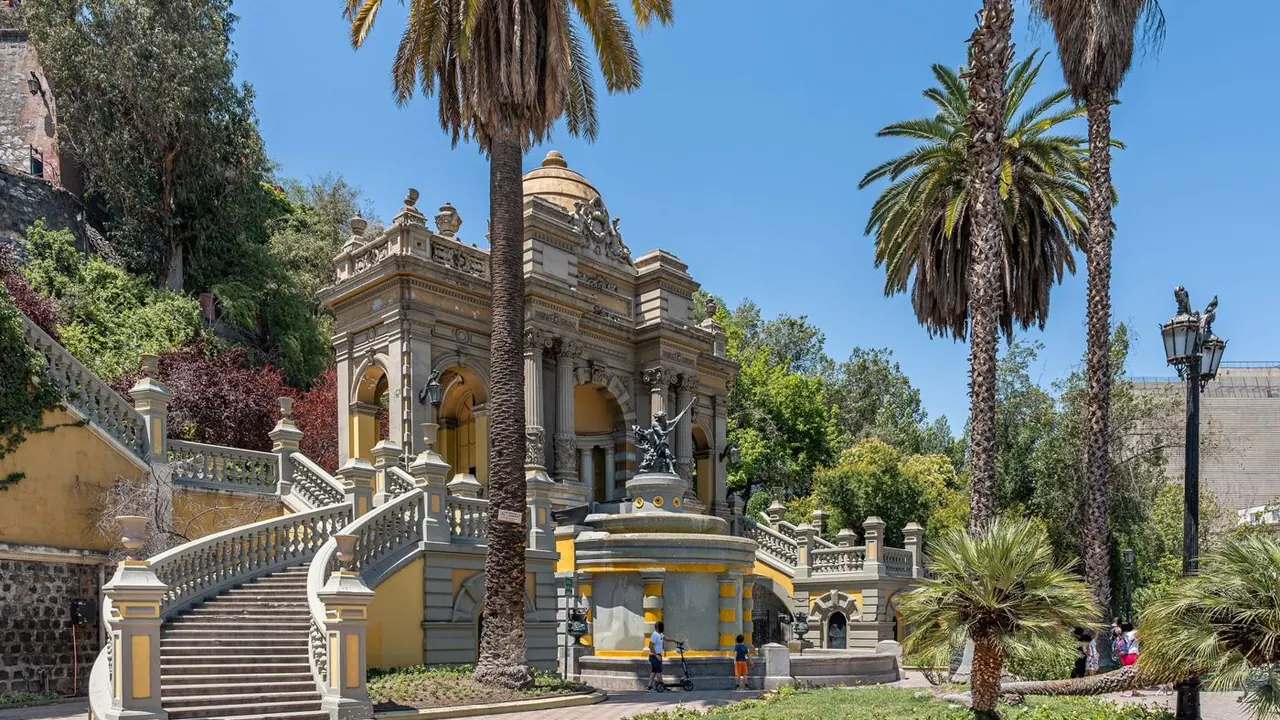
The terrace on Cerro Santa Lucía
- Nature & outdoors83
- Day trips70
- Getting around68
Photo: Rjcastillo, CC BY-SA 4.0, cropped
Match
55
Every category weighted equally
- Beach & sun50
- Culture & arts58
- Food & nightlife56
- Family trip55
- Outdoors59
- Relax & unwind52
- Shopping & style56
- On a budget56
Santiago in twelve categories
Our verdict on each, scored 0 to 100 against the same fixed benchmark cities, so a score means the same thing on every page.
Beaches & swimming. Scores 12 out of 100.
Food & drink. Scores 60 out of 100.
Culture & sights. Scores 52 out of 100.
Nightlife. Scores 60 out of 100.
Nature & outdoors. Scores 83 out of 100.
Day trips. Scores 70 out of 100.
Good for families. Scores 57 out of 100.
Getting around. Scores 68 out of 100.
Shopping & style. Scores 52 out of 100.
Affordability. Scores 58 out of 100.
Live music & performing arts. Scores 55 out of 100.
Wellness & relaxation. Scores 37 out of 100.
Santiago category by category
Beaches & swimming
12Santiago is an inland city in a basin between the Andes and the coastal range, and the sea is roughly 120km to the west. The nearest resorts, Viña del Mar and the small towns along the central coast, take about one and a half to two hours by bus or car. That makes them a day out, not part of a city stay. The cold Humboldt Current keeps the water at around 15-17°C even in midsummer, so many Chileans paddle rather than swim. In the city, swimming means a hotel pool or the large public pools in the Parque Metropolitano, which fill up on hot January afternoons.
Food & drink
60Chilean cooking is hearty, home-style food built on corn, beef and the long Pacific coast. Baked empanadas de pino, pastel de choclo, cazuela stews and the huge hot-dog sandwiches called completos are everyday staples. The seafood is the high point: conger eel soup, sea urchins, machas clams and ceviche are served in the Mercado Central and the cheap counters around La Vega, the city's big produce market. Weekday lunch menus in the Centro and Providencia are an easy way to eat like a local.
Wine is the real draw. Carmenère, Cabernet and coastal whites from the nearby valleys fill every list, and pisco sours and the summer drink terremoto are everywhere. Lastarria, Barrio Italia and Bellavista have the most interesting modern restaurants, and a small fine-dining tier cooks with native Andean and Patagonian ingredients. Away from those streets the choice narrows quickly, and the international range is modest.
Culture & sights
52Most of the city's sights sit around the Plaza de Armas and the government district: the Metropolitan Cathedral, the Central Post Office, the colonial Casa Colorada and the neoclassical La Moneda palace, where the 1973 coup is remembered. The Museo Chileno de Arte Precolombino is the outstanding museum, with a beautifully shown collection from across the Americas. The Museum of Memory and Human Rights deals seriously with the dictatorship years, and the Museo Nacional de Bellas Artes sits in a fine Beaux-Arts building in Parque Forestal.
After that the list gets shorter. Earthquakes have destroyed much of the colonial city, so walks rely on character rather than monuments: the terraces of Cerro Santa Lucía, the old houses of Lastarria, and Neruda's house La Chascona in Bellavista. Most visitors cover the essentials in two or three days.
Nightlife
60Santiago keeps South American hours. People have dinner late, bars fill after eleven, and clubs stay busy until the early morning at weekends. Bellavista, at the foot of Cerro San Cristóbal, is the loudest district, with student bars, terraces, the main LGBTQ+ clubs and crowds on the pavements. Lastarria and Barrio Italia are calmer, with wine bars and cocktail bars, and Providencia and the streets around Avenida Suecia have bigger bars for an after-work crowd.
The pisco and wine culture makes a long night easy to fall into. Electronic and reggaeton clubs are spread around the city, but the scene is mostly local, and weeknights are quieter than the weekend rush suggests.
Nature & outdoors
83On a clear day the Andes form a wall of peaks over 5,000m at the end of the city's avenues, and they are close enough to use. Cerro San Cristóbal and Cerro Manquehue give real hikes inside the city. The Cajón del Maipo valley, about an hour and a half away, has rafting, horse riding and trails up to the hanging glacier of El Morado. In winter, roughly June to September, the ski areas of Farellones, La Parva and Valle Nevado sit about an hour and a half up a winding road, so a day on the slopes from the city is possible.
The drawbacks are the sprawl you cross to get out, the winter smog that can hide the mountains for days, and the lack of public transport to most trailheads. Spring and autumn give the best hiking weather.
Day trips
70The classic day out is Valparaíso, about an hour and a half by bus. It is a UNESCO-listed port of steep hills, old funiculars, painted houses and street art, and Neruda's house La Sebastiana sits on one of the hills. Viña del Mar, its tidier neighbour with gardens and a seafront, is easy to add the same day. Neruda's third house, at Isla Negra, is further down the coast.
Wine is the other draw. The Maipo Valley's historic estates are on the edge of the city, and the cool Casablanca Valley, known for whites, is on the way to the coast. The pottery village of Pomaire makes a short half-day. Colchagua and the southern wine country are better with an overnight stay.
Good for families
57Chilean culture is warm towards children, and families are welcome in restaurants late into the evening. The Parque Metropolitano is the easiest outing: a funicular and cable car on Cerro San Cristóbal, the city zoo on its slopes and big public pools in summer. The Museo Interactivo Mirador is a large hands-on science museum. There is a traditional amusement park in Parque O'Higgins, Buin Zoo lies on the southern edge of the city, and Parque Bicentenario in Vitacura has lawns, lagoons and playgrounds.
The metro is easy with a pushchair on most lines, but the city is spread out, summer afternoons are hot and winter smog can be unpleasant. The wealthier eastern districts are the easiest base with children.
Getting around
68The metro is the backbone of a visit. It is modern, clean and easy to read, with one rechargeable card for trains and buses, and Line 1 runs straight along the main axis from the Centro through Providencia to Las Condes. The Centro, Lastarria, Bellavista and Providencia are all pleasant to walk, and leafy avenues link them.
The city is large, though. Rush-hour trains are packed, the bus network takes some learning, and buses get stuck in traffic. Ride-hailing fills the gaps cheaply. A car only helps for the mountains and the wine valleys.
Shopping & style
52Shopping in Santiago is mostly about big malls in the eastern districts. The tower complex at Costanera, Parque Arauco and Alto Las Condes carry international chains, and Alonso de Córdova and the streets of Vitacura hold the luxury labels and galleries. Barrio Italia is more interesting, with independent design, furniture and vintage shops set around old courtyards.
For things to take home, Pueblito Los Dominicos is a craft village of workshops selling copper, lapis lazuli, Mapuche silver and woollens. The Patronato district sells cheap clothing, and La Vega is a market for produce rather than souvenirs.
Affordability
58Santiago costs roughly as much as a mid-range southern European city. Set lunch menus, market food, empanadas and local wine are good value, and the metro and ride-hailing are cheap. Museums are inexpensive or free. Hotels and restaurants in Providencia, Lastarria and Las Condes, where most visitors stay, cost noticeably more, and imported goods and skiing are expensive. Day tours to the mountains or wineries add up quickly unless you share transport.
Live music & performing arts
55The Teatro Municipal, the country's 19th-century opera house, is the centre of formal performance, with an opera season, its own ballet company and a philharmonic orchestra. The Gabriela Mistral cultural centre (GAM) and the university theatres add contemporary dance, theatre and chamber music. In January the Santiago a Mil festival fills theatres, parks and streets with international and Chilean companies, and it is the best time for a visitor interested in theatre.
Outside that, most theatre is in Spanish. Live music is easier to find, from folk and nueva canción to rock and Latin bands in the Bellavista and Centro venues. Cueca, the national dance, comes out in force during the Fiestas Patrias celebrations in September.
Wellness & relaxation
37The city itself is not restful. It is a busy, car-heavy capital, smog builds up in winter, and the spa offer is mainly in hotels in Las Condes and Vitacura. The calm comes from outside the city. Up the Cajón del Maipo there are simple hot springs, from the basic pools at Baños Morales to open-air pools at Valle de Colina. Termas de Colina, on the northern edge of the city, has terraced thermal pools at the foot of the hills. In the city, the shaded paths of Parque Forestal and the gardens on Cerro San Cristóbal are the best places to slow down.
When should you go?
Pick a month to see what it is like. The climate figures are measured averages, not a forecast.
Santiago in July
Daytime high, °C
Rainfall in the month, mm
The whole year
Shaded against this city’s own year: the deepest cell is its best month for that figure and the palest its weakest.
Temperature and rainfall are climate normals, averaged over the years shown. Santiago: 1991-2020 normals, Santiago Q. Normal (3.1 km from centre).
Before you go
| Measure | Santiago |
|---|---|
| Official language | Spanish |
| Currency | Chilean Peso (CLP) |
| Sockets | CL220 V, 50 Hz |
| Driving side | Right |
| Time zone | UTC-4, UTC-3 in summer |
| Emergency number | Police 133/134, ambulance 131, fire 132 |
| Elevation | 575 m |
| Main airport | Comodoro Arturo Merino Benítez International Airport (SCL)14 km from centre67 non-stop destinations |
| Public holidays this year | 16 days |
By the numbers
| Measure | Santiago |
|---|---|
| City population | 6,257,516 |
| People per km² | 7,468 |
| Museums within 10 km | 54 |
| UNESCO World Heritage sites within 50 km | 0 |
Compare Santiago with
Every comparison with a written verdict behind it.