China
Chongqing
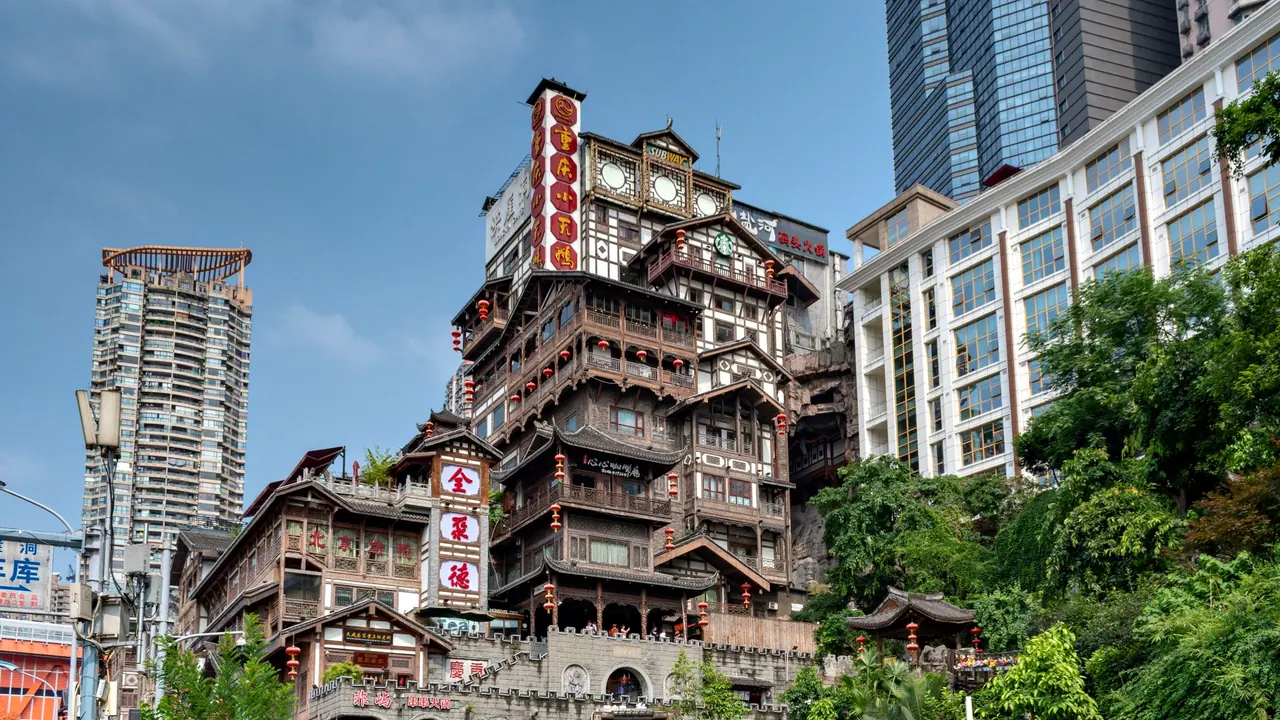
The stacked wooden buildings of Hongyadong
- Food & drink81
- Affordable cities80
- Day trips70
Photo: xiquinhosilva, CC BY 2.0, cropped
Match
58
Every category weighted equally
- Beach & sun55
- Culture & arts60
- Food & nightlife60
- Family trip57
- Outdoors60
- Relax & unwind56
- Shopping & style60
- On a budget60
Chongqing in twelve categories
Our verdict on each, scored 0 to 100 against the same fixed benchmark cities, so a score means the same thing on every page.
Beaches & swimming. Scores 5 out of 100.
Food & drink. Scores 81 out of 100.
Culture & sights. Scores 52 out of 100.
Nightlife. Scores 62 out of 100.
Nature & outdoors. Scores 66 out of 100.
Day trips. Scores 70 out of 100.
Good for families. Scores 55 out of 100.
Getting around. Scores 64 out of 100.
Shopping & style. Scores 57 out of 100.
Affordability. Scores 80 out of 100.
Live music & performing arts. Scores 38 out of 100.
Wellness & relaxation. Scores 60 out of 100.
Chongqing category by category
Beaches & swimming
5Chongqing is far inland, in the hills of south-west China, and the sea is more than 1,000km away. The Yangtze and Jialing rivers meet in the city centre, but they are fast, muddy working rivers, not places to swim. In the long, very hot summer, locals cool off in hotel pools, hot-spring resorts and the occasional river-shore wading spot. Anyone who wants a beach should plan a separate trip.
Food & drink
81Many people come to Chongqing just to eat. This is the home of hotpot: a bubbling pot of beef-tallow broth packed with chillies and numbing Sichuan pepper, cooked at the table in places from pavement stalls to huge halls with hundreds of tables. Breakfast is xiaomian, a fiery bowl of noodles eaten standing or on low stools. The rest of the day brings spicy chicken buried in dried chillies, grilled fish, chuanchuan skewers and cold noodles. Riverside and hillside neighbourhoods are packed with small kitchens, and many keep cooking long after midnight.
The heat is the point, so diners who cannot take spice will find the choice narrows fast. Most places can make a milder broth or a split pot, though. The city has far less international food and high-end dining than China's coastal cities. Drinks are simple, mostly cold local beer and sweet iced drinks to take the edge off the chillies.
Culture & sights
52For most visitors, the main sight is the city itself. Towers are stacked on steep ridges where two rivers meet, monorail trains run through hillsides and sometimes through buildings, and at night the whole peninsula is lit up. Hongyadong is a stilt-house complex rebuilt on the cliff above the Jialing. It is the city's postcard view, and it gets very crowded.
The Three Gorges Museum covers the history of the region and the Yangtze. The Huguang Guild Hall and the Luohan Temple keep a few traditional buildings in the centre. A cluster of sites recalls the city's role as China's wartime capital in the Second World War, including the Stilwell Museum. Ciqikou is an old riverside town that has been swallowed by the city. It has some charm under the souvenir stalls. Beyond these, most historic fabric has been replaced, so the sights take two or three days rather than a week.
Nightlife
62Chongqing is a late city. Its evenings start with the night views from the riverbanks and the cable car, then run on into hotpot and skewers that go past 2am. The Jiefangbei centre and the riverside promenades stay full well into the night. The Jiujie bar street in Jiangbei is the main clubbing district, with loud, glossy clubs in the Chinese style built around table service and DJs. Smaller craft-beer and cocktail bars are scattered around the centre. Hardly any of it is aimed at foreign visitors, so expect to be among locals, and expect late meals to be as much a part of the night as the bars.
Nature & outdoors
66The city is built on mountains and rivers. Nanshan rises straight across the Yangtze from the centre, with forest paths and lookouts over the skyline. Gele Mountain and the wooded Jinyun Mountain to the north-west are easy half-day escapes. The bigger landscapes lie further out. Wulong's karst country of giant natural bridges, deep sinkholes and gorges can be done in a long day, and Three Gorges cruises down the Yangtze start in the city.
The weather sets the limits. Summers are among the hottest in China, often above 38°C, with heavy humidity. Winters are grey, and haze and fog cover the valleys for much of the year. Spring and autumn are the best seasons for walking.
Day trips
70Chengdu is the obvious day trip, about an hour away by high-speed train. It has teahouses, temples, the panda base and a gentler pace. Closer to home are the Dazu Rock Carvings, thousands of Buddhist figures carved into cliffs between the 9th and 13th centuries. They are among the finest of their kind in China, and the trip takes about two hours by road. The Diaoyu Fortress in Hechuan is where a 13th-century Song garrison held off the Mongols for decades.
The outlying districts also hold old riverside and hill towns such as Zhongshan, Songji and Laitan. They have timber stilt houses, stone steps and village food, and are quieter than Ciqikou in the city. These make easy outings, but beyond them most longer excursions are about landscape rather than towns.
Good for families
55Children are welcomed warmly, and there is a fair amount to keep them busy. Chongqing Zoo has giant pandas, and there is a large science and technology museum on the riverfront in Jiangbei. Big theme parks sit on the edge of the city. The cable car over the Yangtze and the monorail threading through buildings tend to delight younger travellers.
The city's shape works against families, though. It is built in layers, with stairs, steep lanes and few flat walks, so a pushchair is often more trouble than it is worth. Summer heat is punishing, and much of the local food is too spicy for children unless you ask for mild versions. Spring and autumn visits are far easier.
Getting around
64Chongqing has a very large rail network. Metro and monorail lines, including the famous elevated Line 2 along the Jialing, reach almost everywhere a visitor goes. Signs and announcements are in English, and fares are low. Cable cars over the rivers and long escalators and lifts help with the slopes.
The hard part is the terrain. The city sits on ridges, so a short distance on the map can mean dozens of flights of stairs or a lift down twenty floors. Street level, building level and bridge level often do not match, and map apps struggle to place you. Taxis and ride-hailing are cheap, and they are useful between hillside districts. A car is never needed.
Shopping & style
57Shopping is large-scale and modern. Around the Jiefangbei monument, pedestrian streets are lined with department stores and malls carrying international and luxury brands. Guanyinqiao in Jiangbei is a second big mall district. Prices and choice are good, but most of it is the same as in any large Chinese city. Local finds are smaller in scale: packs of hotpot base and Sichuan pepper, spicy snacks, and souvenirs in Ciqikou and the old towns. Independent boutiques and craft shops are few.
Affordability
80Chongqing is one of the cheapest big cities in China for a visitor. Noodle breakfasts, street skewers and most hotpot meals cost little, metro rides are very cheap, and taxis are affordable across long distances. Comfortable mid-range and even upscale hotels cost well below what they would in the big coastal cities. The costs that add up are Yangtze cruises, cable cars, some paid viewpoints and international hotel chains, but a full day of eating and sightseeing stays modest.
Live music & performing arts
38The traditional performance a visitor is most likely to see is Sichuan opera, especially the face-changing and fire-spitting routines. These are staged in teahouse-style theatres and as shorter shows for visitors. The Chongqing Grand Theatre, a striking glass building on the Jiangbei waterfront, hosts touring productions, ballet and concerts, and the city has its own symphony orchestra. Beyond that, the live scene is small and almost entirely in Chinese, with a few live-music bars. Few visitors plan a trip around it.
Wellness & relaxation
60Chongqing has a genuine hot-spring tradition. Its thermal springs have been used for centuries, and resorts at Beiwenquan near Jinyun Mountain, Nanwenquan in the south and Dongquan further out offer outdoor pools in wooded valleys. They are a favourite local escape in the damp winters. In the city, foot-massage and reflexology parlours stay open late and are cheap, and many people end a hotpot evening in one.
The city itself is not calm. It is dense, noisy, steep and humid, and the springs mean a trip out to the edges. Restful time here is something you plan for rather than something the city gives you.
When should you go?
Pick a month to see what it is like. The climate figures are measured averages, not a forecast.
Chongqing in July
Daytime high, °C
Rainfall in the month, mm
The whole year
Shaded against this city’s own year: the deepest cell is its best month for that figure and the palest its weakest.
Temperature and rainfall are climate normals, averaged over the years shown. Chongqing: 1991-2020 normals, Chongqing (10.2 km from centre).
Before you go
| Measure | Chongqing |
|---|---|
| Official language | Putonghua |
| Currency | Yuan Renminbi (CNY) |
| Sockets | ACI220 V, 50 Hz |
| Driving side | Right |
| Time zone | UTC+8 |
| Emergency number | Police 110, ambulance 120, fire 119 |
| Elevation | 237 m |
| Main airport | Chongqing Jiangbei International Airport (CKG)19 km from centre167 non-stop destinations |
| Public holidays this year | 6 days |
By the numbers
| Measure | Chongqing |
|---|---|
| City population | 32,054,159 |
| Museums within 10 km | 7 |
| UNESCO World Heritage sites within 50 km | 0 |
Compare Chongqing with
Every comparison with a written verdict behind it.