Dolomites or Swiss Alps?
Our verdict in twelve categories, each scored against the same fixed benchmark cities, and the climate month by month, so you can choose for your trip.
Choose Dolomites for
- prices
- food and drink
- culture and sights
The Dolomites suit travellers who want great mountain scenery with better food and a gentler bill. South Tyrolean and Ladin cooking, hut lunches and the wine slopes south of Bolzano give every evening a point. Valley towns such as Bolzano and Trento add arcaded centres, castles and the Iceman. In return you will probably need a car to move between valleys, and the nights are quiet.
Choose Swiss Alps for
- getting around
- wellness
- nightlife
Pick the Swiss Alps if you would rather leave the car at home and let trains, postbuses and cable cars do the work, or if the trip is as much about rest as climbing. Thermal villages such as Leukerbad and Vals, car-free resorts and the winter après-ski of Verbier and Zermatt are what it does best. Expect a bill well above anything in the Italian valleys.
Scoreboard
Twelve categories on one fixed scale from 0 to 100. The shaded stretch is the gap between the two.
Your match
Pick a travel style or drag the sliders, and both match scores follow your weighting.
Too close to call, 2 points apart
Wins on prices and food and drink with your weighting.
Wins on getting around and wellness with your weighting.
What matters to you?
Category by category
What the scores mean for a trip.
Beaches & swimming
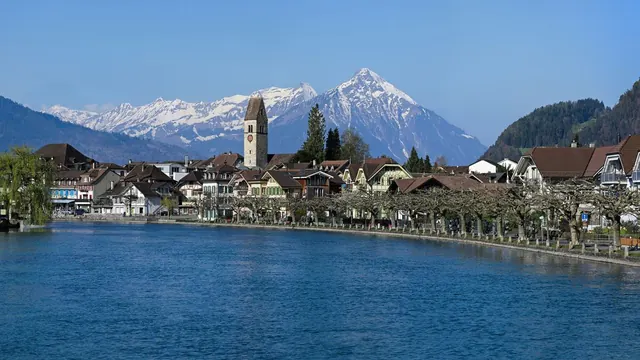
Neither is a swimming destination, but the Swiss Alps give you a little more water to work with. Most lakeside towns have a lido with jetties and diving boards, from Lake Thun and Lake Brienz below the Jungfrau to the Caumasee near Flims. To the south, Ticino's Lake Lugano and Lake Maggiore warm to about 23°C.
In the Dolomites, the famous high lakes such as Braies and Carezza are for rowing and photographs rather than bathing. The real swim is Lake Caldaro on the wine route, which gets about as warm as the Ticino lakes, or a drive from Trento to the top of Lake Garda.
Food & drink
The Dolomites eat better and with more variety, because two traditions meet at the table. You get South Tyrolean speck, canederli and strudel, Ladin dishes in Gardena and Badia, and Trentino polenta and trout, followed by a properly Italian espresso. Autumn Törggelen evenings of new wine and chestnuts, and the cluster of high-end kitchens in Alta Badia, give food lovers a reason to plan the days around meals.
Swiss mountain food is cheese first: fondue, raclette in Valais, rösti and Graubünden air-dried beef, best eaten on a hut terrace. Valais wines such as Petite Arvine are a real find. Outside Zermatt, St Moritz and Gstaad, though, most villages offer only a handful of hotel dining rooms.
Culture & sights
The Dolomites have the stronger valley towns. Bolzano's arcaded centre and the museum that holds Ötzi, Trento's cathedral and the frescoed Castello del Buonconsiglio, and Bressanone's baroque cathedral give a rainy day real substance. First World War tunnels on the high passes add to them.
Swiss heritage is spread through the landscape instead: sgraffito houses in Guarda and Zuoz, the Albula and Bernina railway lines, and the castles of Sion and Bellinzona. Müstair's Carolingian frescoes stand out, but there is less here to fill a whole day of sightseeing.
Nightlife
Both regions go to bed early, but the Swiss Alps have more going on at night once the snow arrives. In high season Verbier keeps a few clubs open past midnight, and Zermatt has a cluster of bars at the foot of the pistes. St Moritz and Gstaad offer a dressier evening in hotel bars.
Dolomite après-ski in Selva, Ortisei, Canazei and Cortina usually winds down by early evening, and Bolzano and Trento have wine bars rather than late venues. In summer, villages on both sides are quiet by eleven.
Nature & outdoors
Here the two are equals, so the choice is between two kinds of mountain. The Dolomites have pale limestone towers rising out of meadows, such as the Tre Cime, the Sassolungo and Seceda. There is easy walking on the Alpe di Siusi, long hut-to-hut routes such as the Alta Via 1, and via ferrate whose first cables date from the First World War. In winter, the Sella Ronda circles a single massif.
The Swiss Alps are bigger and icier. You get the Eiger, Mönch and Jungfrau, the Matterhorn and the Aletsch glacier, with guided glacier tours and paragliding, and ibex and chamois in the Swiss National Park.
Day trips
Days out are just as good on both sides, but they lead to different places. From Bolzano you can easily reach Merano, Bressanone and Trento. Verona and the top of Lake Garda are about an hour and a half away, Innsbruck about two hours, and Venice is possible at a stretch. That is a stronger list of famous destinations than the Swiss one.
The Swiss Alps offer more and smaller places, and the train reaches each of them: Bern and Thun from the Bernese Oberland, Lucerne over the Brünig Pass, Gruyères, Lavaux and Chillon to the west, and Lugano and Bellinzona to the south. Dolomite outings from the high valleys, by contrast, begin with a hairpin pass road.
Good for families
Both suit families about equally well, and neither has a zoo or a theme park. The Dolomites have the gentler high walking, with nearly flat paths across the Alpe di Siusi and the Armentara meadows, huts with farm animals, and hotels built around children's clubs.
In Switzerland the transport is the attraction: cable cars, cogwheel trains and lake steamers, plus the farm animals at Ballenberg. Car-free villages such as Wengen and Zermatt let children roam, though very small ones need more care with the altitude.
Getting around
This is one of the clearest gaps between the two. In the Swiss Alps, trains, postbuses, steamers and lifts run on connected timetables, and almost every village can be reached without a car. Zermatt, Wengen, Mürren and Saas-Fee ban private cars outright. Only the long hops between regions are slow.
The Dolomites work well within a single valley, with South Tyrol's trains and buses covered by one pass. Crossing between valleys, though, means slow and crowded pass roads, and Cortina has no station at all. Most visitors who want to see several areas end up hiring a car.
Shopping & style
Neither suits a shopping trip, but the Dolomites have a little more worth browsing. Ortisei's woodcarving workshops, the old shops under Bolzano's arcades on the Laubengasse, and the Advent markets of Bolzano, Merano, Bressanone and Brunico all give real reasons to stop.
Swiss resort shopping is mostly luxury boutiques in St Moritz and Gstaad, and watch and mountain-gear shops in Zermatt and Interlaken. On both sides the best things to take home are edible: speck and grappa in Italy, and dairy cheese, Valais wine and air-dried meat in Switzerland.
Affordability
Neither is cheap, but the gap between them is wide. Cortina and Alta Badia are costly at peak times, but Fassa, Fiemme, Bolzano and Trento cost noticeably less, hut meals are fair, and June or September brings room rates down.
The same day in the mountains costs far more on the Swiss side. A room in Zermatt or St Moritz, a hut lunch and a lift ticket each cost well above their equivalents in Val Gardena, or even Cortina. A few cable-car and mountain-railway excursions can add up to more than the hotel. Self-catering, supermarket picnics and multi-day travel passes help, and Goms, Val Müstair and Ticino are a little gentler, but Switzerland has nothing like a cheaper Trentino valley.
Live music & performing arts
The Swiss Alps have the bigger music festivals. The Verbier Festival brings top soloists for several weeks every July, and the Menuhin Festival fills the churches of the Saanenland around Gstaad, with smaller festivals in Davos and the Engadine. Outside summer, though, there is no resident opera or theatre.
The Dolomites work on a smaller scale. Bolzano and Trento keep orchestras and theatres going all year, and summer brings concerts on Trentino's alpine meadows, with Merano's festival in the autumn. Beyond those towns, little is on.
Wellness & relaxation
The Swiss Alps have a public bathing culture that the Dolomites largely lack. At Leukerbad's hot-spring pools below the cliffs, the stone bath at Vals, Bad Ragaz and Scuol, anyone can soak without choosing a hotel for it. The grand resort spas add more on top.
In the Dolomites, the spa usually belongs to your hotel: saunas facing rock walls, heated outdoor pools and the hay bath around Völs am Schlern. Merano's thermal baths and Levico Terme are the public exceptions, so choose your hotel with care.
When should you go?
Pick your month. The climate figures are measured averages, not a forecast.
Dolomites in July
Swiss Alps in July
Daytime high, °C
Rainfall in the month, mm
Where the figures come from
Swiss Alps has no rain gauge within 25 km of the centre, so its rainfall comes from a gridded climate dataset read at the destination rather than from a gauge further away.
Swiss Alps's sunshine is measured 66 km from the centre, at Sion.
Temperature and rainfall are climate normals, averaged over the years shown. Dolomites: 1991-2020 normals, Dobbiaco (22.3 km from centre). Swiss Alps: 2005-2020 (sunshine 1961-1990, rainfall 1991-2020) normals, Meiringen / Unterbach (19.5 km from centre).
Both regions have a summer season and a winter season, with a quiet stretch in between. In the Dolomite valleys where most visitors stay, July and August highs reach about 22°C. That is warm enough for Lake Caldaro and the valley pools, but it is also the wettest part of the year, with around 130mm in July. Winter is cold and noticeably dry. June and September bring mild walking weather and less rain than midsummer.
The Swiss Alps run a degree or two warmer all year and peak around 24°C in July. Rain falls much more evenly through the year, and the winter months are clearly wetter than on the Italian side. Summer is also the sunniest time, with about 270 hours of sunshine in July and only a small share of that in December. Late June to September is when the lakes, the high trails and the passes all open together.
Which traveller are you?
On a trip on a tight budget, the Dolomites are the more realistic choice. Neither is cheap, but a base in Val di Fassa, Val di Fiemme, Bressanone or Trento, with half board and a June or September stay, keeps the bill manageable. Swiss lifts and meals stay steep everywhere.
For a relaxing and wellness trip, the Swiss Alps make the easier retreat. You can settle into one car-free village, let trains and lifts set the pace, and end each day soaking in mineral water. The Dolomites are just as calm in June or September, but seeing a second valley usually means driving the pass roads.
On a food and nightlife trip, the Dolomites win at the table, with speck, canederli, hut terraces, Lagrein from the Bolzano slopes and Alta Badia's ambitious kitchens. If late nights matter more than dinner, though, a winter week in Verbier or Zermatt keeps going longer.
Before you go
| Measure | Dolomites | Swiss Alps |
|---|---|---|
| Official language | Italian | French, German, Italian, Romansh |
| Currency | Euro (EUR) | Swiss Franc (CHF) |
| Sockets | CFL230 V, 50 Hz | CJ230 V, 50 Hz |
| Driving side | Right | Right |
| Time zone | UTC+1, UTC+2 in summer | UTC+1, UTC+2 in summer |
| Emergency number | 112 | 112 |
| Main airport | Venice Marco Polo Airport (VCE)103 non-stop destinations | Zürich Airport (ZRH)226 non-stop destinations |
| Public holidays this year | 13 days | 10 days |
Where else could you go?
Every comparison below shares a destination with this one, so you can follow Dolomites or Swiss Alps somewhere new.
- Austrian Alpsvs Dolomites
- French Alpsvs Swiss Alps
- Lake Comovs Swiss Alps
- Black Forestvs Swiss Alps
- Lake Gardavs Dolomites
- Bavariavs Dolomites