
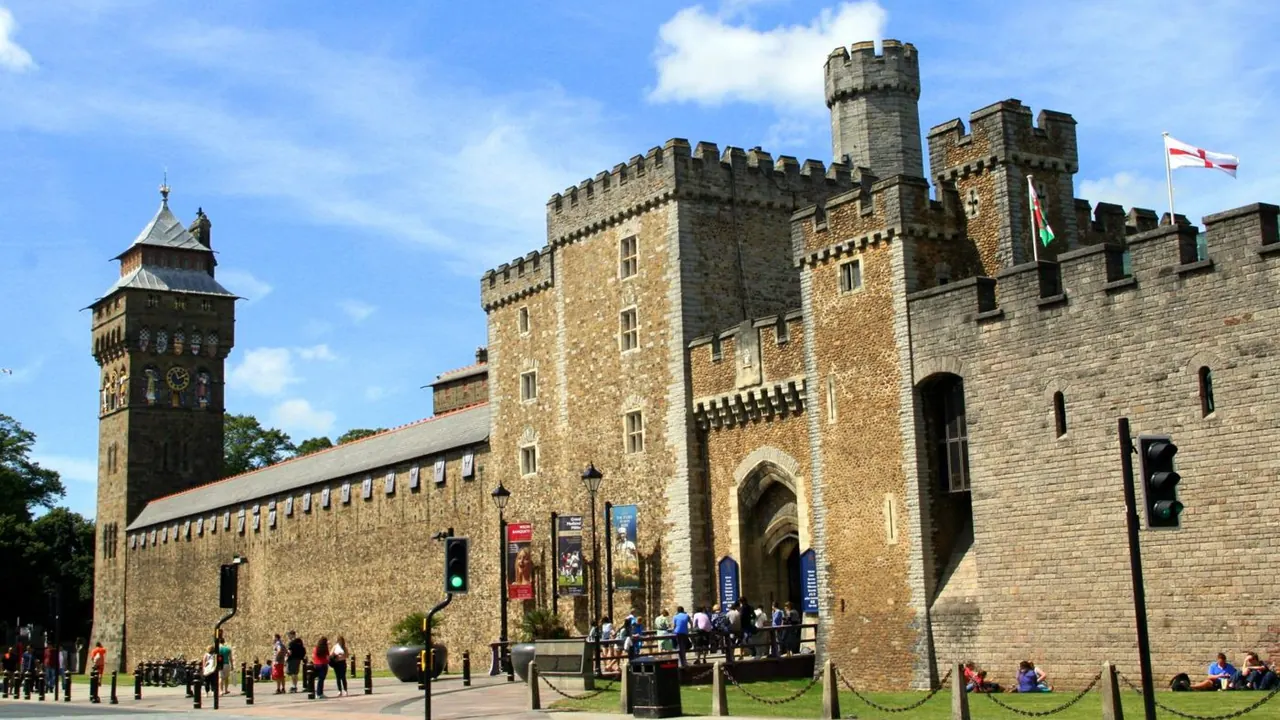
Photos: Edinburgh by Carlos Delgado, CC BY-SA 3.0, cropped; Cardiff by Tevfik Teker, CC BY 3.0, cropped.
Edinburgh or Cardiff?
Our verdict in twelve categories, each scored against the same fixed benchmark cities, and the climate month by month, so you can choose for your trip.
Choose Edinburgh for
- culture and sights
- live music and the arts
- food and drink
Pick Edinburgh if the place itself is the attraction. The medieval Old Town on its ridge and the Georgian New Town across the gardens make a far richer townscape. The arts calendar runs deeper, and Arthur's Seat puts a wild hill a short walk from the Royal Mile. Expect to pay more for rooms, especially in August, and to climb a lot of steps.
Choose Cardiff for
- prices
- beaches
Cardiff suits a relaxed, lower-cost few days where the city is a comfortable base rather than the whole point. The centre is flat and compact and the national museums are free. Short train rides reach Caerphilly, Bath and Barry Island's sands. It also suits anyone coming for a rugby international or a stadium concert, as long as they book rooms early.
Scoreboard
Twelve categories on one fixed scale from 0 to 100. The shaded stretch is the gap between the two.
Your match
Pick a travel style or drag the sliders, and both match scores follow your weighting.
Wins on culture and sights and live music and the arts with your weighting.
Wins on prices and beaches with your weighting.
What matters to you?
Category by category
What the scores mean for a trip.
Beaches & swimming
Neither city is a place for swimming, but Cardiff gets you closer to a proper seaside day. Barry Island's sandy bay and funfair are a short train ride away, and the Bristol Channel warms a few degrees more than the North Sea by late summer. Porthcawl's surf and the Gower's sands are within a drive.
Edinburgh has sand nearer the centre, at Portobello, and the East Lothian beaches are wide and handsome. The water stays colder, though, and only wetsuited regulars at Portobello and Wardie Bay go in. Walking the sand is the realistic plan there.
Food & drink
Edinburgh eats somewhat better. Its strength is Scottish seafood, beef and game cooked in the modern dining rooms of Leith, the New Town and Stockbridge, and its whisky bars are worth a visit for their own sake.
Cardiff's table is homelier. You get Welsh cakes off the griddle in the Victorian market, cawl and laverbread, and neighbourhood bistros in Pontcanna and Canton. It does have one thing Edinburgh largely lacks: a long run of cheap Middle Eastern and South Asian cooking on City Road.
Culture & sights
Edinburgh is the stronger sightseeing city because the townscape itself is the attraction. The medieval closes of the Royal Mile run from the castle down to Holyroodhouse, and the Georgian crescents of the New Town lie across the valley. Together they form one World Heritage Site, and the national galleries and museum add old masters and Scottish history on top.
Cardiff's sights are fewer and younger. The castle's Victorian Gothic rooms, the Impressionists at the National Museum and the rebuilt Welsh buildings at St Fagans fill two or three good days. Most of the city dates from the Victorian era, though, so there is less pleasure in simply wandering the streets.
Nightlife
The two cities offer about as much as each other after dark, in different styles. Cardiff is louder at weekends, with big groups on St Mary Street and the whole centre in red on rugby days. Womanby Street's small bars and late venues are the place for something less mainstream.
Edinburgh is a pub city first, with panelled Victorian bars, Grassmarket drinking dens and Leith harbour pubs, and the Cowgate for late nights. It goes to bed fairly early most of the year, then stays out into the small hours through the August festivals.
Nature & outdoors
Both have good walking within reach, and the difference is distance. Edinburgh's wild ground is inside the city: the crags of Arthur's Seat are a short walk from the Royal Mile, and the Pentland ridges are half an hour out.
Cardiff's big landscape is the Bannau Brycheiniog, about an hour's drive away, where Pen y Fan gives a higher, wilder moorland hike. In town, Bute Park, the Taff Trail and the barrage loop are gentler.
Day trips
Both are excellent bases, and castles are the common thread. From Cardiff you can visit Caerphilly and Castell Coch, Tintern Abbey in the Wye Valley, and the mining heritage of Blaenavon and Big Pit. Bath and Bristol are just across the Severn.
From Edinburgh, Glasgow and Stirling are each under an hour away. Linlithgow, St Andrews and the Borders abbeys are a little further. Waverley station sits right in the centre, so these trips are especially easy without a car.
Good for families
Both cities work well for a few days with children. Cardiff is flatter and easier with a buggy, with Techniquest, the farm animals at St Fagans, rowing boats on Roath Park lake and Barry Island's funfair in summer.
Edinburgh has more for a rainy day, with the National Museum and Dynamic Earth, and it has a zoo, which Cardiff lacks. On the other hand, its Old Town is all steps and cobbles, and the August crowds make everything harder going.
Getting around
Edinburgh is the easier city to get around. Its main sights sit within about 2km of each other, the bus network is dense, a tram runs from the airport through Princes Street to Leith, and Waverley station is in the middle of it all. The cost is hills, stairways and cobbles.
Cardiff's centre is flatter and smaller, with the castle, market and station a few minutes apart. Cardiff Bay is half an hour's walk away or a short shuttle train ride, though. There is no tram, so local trains and buses cover everything else.
Shopping & style
Neither is a shopping destination, and each can be covered in about an afternoon. Cardiff's distinctive feature is its glass-roofed Victorian arcades, full of record shops, books and vintage clothing, and the local things to take home are lovespoons and woollen blankets.
Edinburgh has a little more upmarket choice around George Street and on the curving Victoria Street. The souvenirs there are Scottish: cashmere, tweed, tartan from proper kiltmakers and single malt whisky.
Affordability
Cardiff is the cheaper stay, mainly because its hotels are moderate on ordinary dates. A rugby international or a stadium concert pushes room prices up sharply, though. Short, inexpensive train rides to castles and the coast keep extra days cheap.
Edinburgh's rooms are expensive all year and extreme during the August festivals and at Hogmanay, so many visitors stay in Leith or further out. Both cities have free national museums, and Edinburgh's best views from Arthur's Seat cost nothing, but its ticketed sights add up quickly.
Live music & performing arts
Edinburgh is the stronger arts city, and in August nowhere in Britain compares. The Fringe fills hundreds of venues with comedy and theatre, the International Festival brings leading orchestras and opera, and the Tattoo is staged on the castle esplanade. Outside August there are still two national orchestras, Scottish Opera and Ballet, and strong drama at the Lyceum and the Traverse.
Cardiff's arts life centres on the Wales Millennium Centre, home to Welsh National Opera, and the BBC National Orchestra of Wales and the music college add concerts. Its real strength is the grassroots gigs around Womanby Street most nights, along with choral singing as a living tradition.
Wellness & relaxation
Neither city suits a spa break, but Edinburgh has a little more to offer. There are the Victorian Turkish baths at Portobello, the Royal Commonwealth Pool and shoreline saunas used by the cold-water swimmers. Outside August, the Botanic Garden and the Water of Leith make for quiet mornings.
Cardiff relies on hotel and day spas and the pools at the Bay's waterfront hotels. Mostly, unwinding there means its easy pace: slow café mornings in Pontcanna and walks along the Taff through Bute Park.
When should you go?
Pick your month. The climate figures are measured averages, not a forecast.
Edinburgh in July
Cardiff in July
Daytime high, °C
Rainfall in the month, mm
Temperature and rainfall are climate normals, averaged over the years shown. Edinburgh: 1991-2020 (sunshine 1981-2010, rainfall 1981-2010) normals, Edinburgh Airport (10 km from centre). Cardiff: 1991-2020 (sunshine 1981-2010, rainfall 1981-2010) normals, Cardiff-Wales Airport (14.9 km from centre).
Cardiff is at its best from late May to early September. Highs reach about 20°C, which is comfortable for walking all day and never too hot, and May and July are the sunniest months. The sea warms to about 18°C by August, so it is still more of a paddle than a swim. Rain falls all year, but it is heaviest from October to January, peaking at about 114mm in October. Those months are also the greyest, with the least daylight.
Edinburgh runs a degree or so cooler and follows a different pattern. Its sunniest month is May and spring is its driest stretch, while July and August are among its wetter months, with August at around 55mm. Late April to June is often a better bet than high summer for long walks over Arthur's Seat. The North Sea there tops out at only 14°C. Winters in both cities are cold and dim, so a visit then works best when it is built around museums, pubs and indoor shows.
Which traveller are you?
For a trip on a tight budget, Cardiff is the easier city to keep cheap. Check the stadium calendar and come midweek, eat Welsh cakes and cawl at the market or curries on City Road, picnic in Bute Park, and spend a whole day at St Fagans.
On a beach and sun trip, Cardiff is the better of two weak options. Pick a July week and keep the bright days for the coast: Penarth's Victorian pier and pebble shore, the cliff path through the Vale of Glamorgan, then a bucket-and-spade afternoon at Barry. Edinburgh's chilly North Sea makes even paddling a test.
On a culture and arts trip, Edinburgh is the clear choice. The Old Town and the Georgian New Town make the streets a sight in themselves, and the national galleries are free. In August the Fringe and the International Festival turn the whole city into one stage.
Before you go
| Measure | Edinburgh | Cardiff |
|---|---|---|
| Official language | English | English |
| Currency | Pound Sterling (GBP) | Pound Sterling (GBP) |
| Sockets | G230 V, 50 Hz | G230 V, 50 Hz |
| Driving side | Left | Left |
| Time zone | UTC, UTC+1 in summer | UTC, UTC+1 in summer |
| Emergency number | 112 or 999 | 112 or 999 |
| Elevation | 47 m | 41 m |
| Main airport | Edinburgh Airport (EDI)11 km from centre163 non-stop destinations | Cardiff International Airport (CWL)15 km from centre30 non-stop destinations |
| Public holidays this year | 10 days | 8 days |
By the numbers
| Measure | Edinburgh | Cardiff |
|---|---|---|
| City population | 488,050 | 383,536 |
| People per km² | 1,884 | 2,734 |
| Museums within 10 km | 32 | 9 |
| UNESCO World Heritage sites within 50 km | 3 | 1 |
| Swim season, months above 21 °C | None | None |
Where else could you go?
Every comparison below shares a destination with this one, so you can follow Edinburgh or Cardiff somewhere new.
- Bristolvs Cardiff
- St Andrewsvs Edinburgh
- Bathvs Cardiff
- Glasgowvs Edinburgh
- Oxfordvs Cardiff
- Aberdeenvs Edinburgh