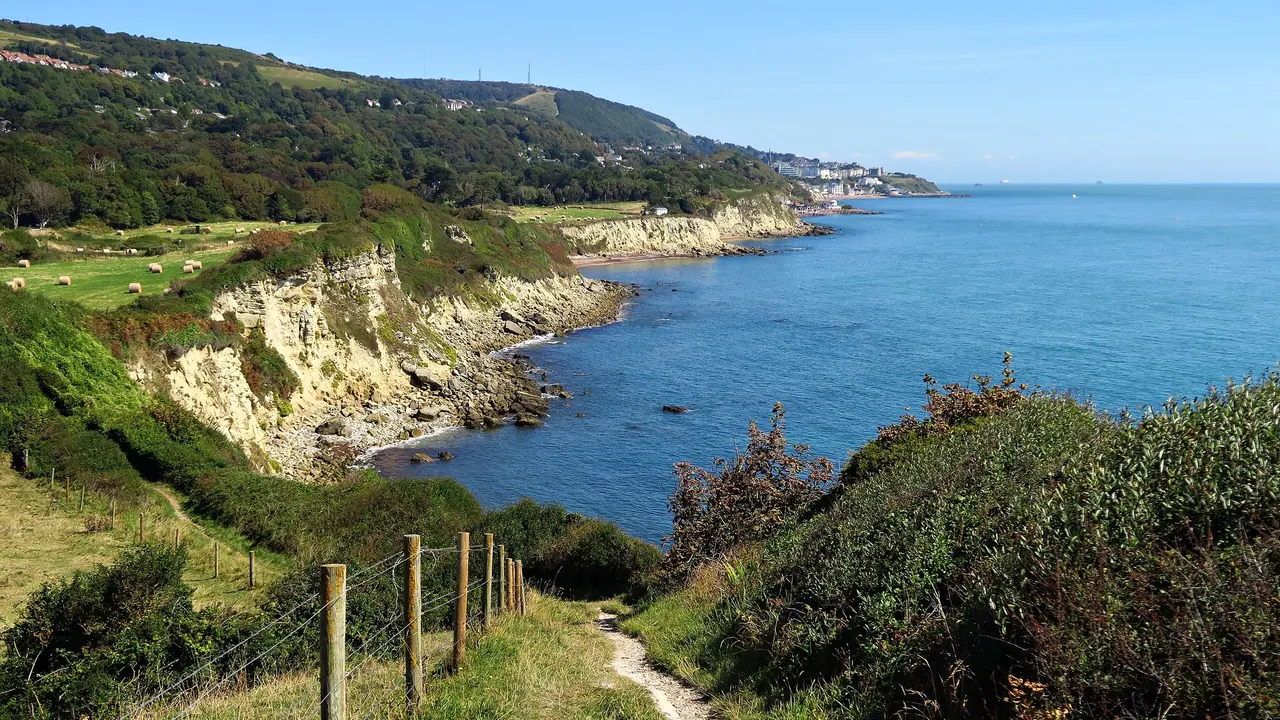
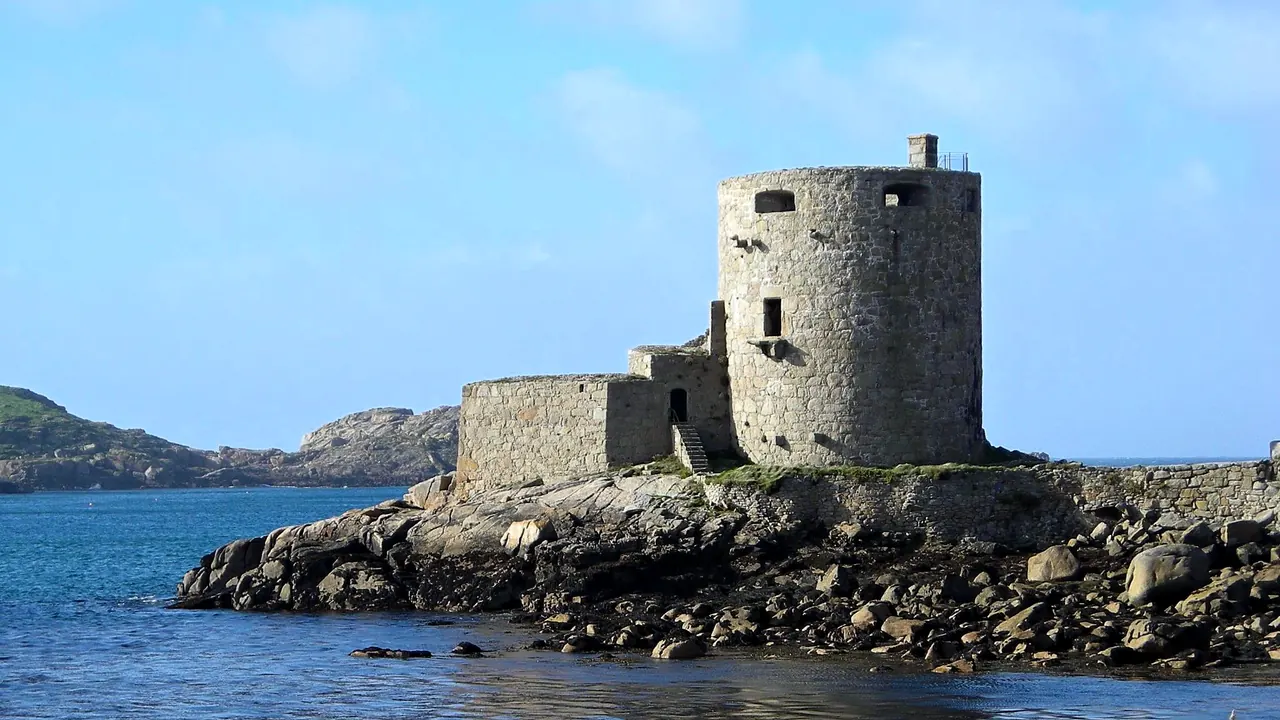
Photos: Isle of Wight by Michael Coppins, CC BY-SA 4.0, cropped; Isles of Scilly by Mark Percy, CC BY-SA 2.0, cropped.
Isle of Wight or Isles of Scilly?
Our verdict in twelve categories, each scored against the same fixed benchmark cities, and the climate month by month, so you can choose for your trip.
Choose Isle of Wight for
- day trips
- live music and the arts
- prices
The Isle of Wight is the easier and more varied choice for a classic seaside week. It has attractions built for children, a railway and buses that make the resort towns simple without a car, and Osborne House and Carisbrooke Castle for grey days. Portsmouth and the New Forest are a short crossing away. It also costs noticeably less, especially if you arrive as foot passengers.
Choose Isles of Scilly for
- wellness
- beaches
Pick the Isles of Scilly for a quieter and more remote trip. There are no cars, the shell-sand bays stay nearly empty even in August, small boats take you out to seals and puffins, and the tides set the shape of each day. It suits couples, walkers and families happy with rock pools rather than rides, as long as the budget can stretch to the journey and the island prices.
Scoreboard
Twelve categories on one fixed scale from 0 to 100. The shaded stretch is the gap between the two.
Your match
Pick a travel style or drag the sliders, and both match scores follow your weighting.
Wins on day trips and live music and the arts with your weighting.
Wins on wellness and beaches with your weighting.
What matters to you?
Category by category
What the scores mean for a trip.
Beaches & swimming
On beaches the two are close, but they feel quite different. The Isle of Wight has proper resort sands: the long curve of Sandown Bay and the wide flats at Ryde, with towns and promenades right behind them. In the west, Compton Bay is wilder, with surf under the cliffs.
Scilly's bays are smaller and emptier. They have pale shell sand and water clear enough to see the seabed, at Par Beach on St Martin's or Rushy Bay on Bryher, and you often have one almost to yourself. The sea is cool off both, but Scilly's Atlantic water is the brisker of the two, and a wetsuit is more likely to be needed there.
Food & drink
Both islands eat simply, with crab and lobster at the centre, so the real difference is how much choice you get and where. The Isle of Wight has more to offer: harbour pubs at Bembridge, Yarmouth and Ventnor, cream teas in Godshill, island garlic, vineyards and ales, and a few ambitious kitchens in Cowes and Ventnor. On Scilly, most of the eating is in Hugh Town, with a pub and a café or two on each off-island, honesty stalls by the road and a lot of self-catering, and the choice shrinks sharply out of season.
Culture & sights
The Isle of Wight has the bigger sights. Osborne House, Queen Victoria's seaside home, is a sight of national standing, and Carisbrooke Castle is where Charles I was held prisoner. Brading's Roman mosaics, the Needles Old Battery and Tennyson's Farringford add several more good half days.
Scilly's heritage is smaller and quieter. It includes the Garrison walls and Star Castle on St Mary's, Bronze Age entrance graves, and Tresco Abbey Garden with its figureheads from wrecked ships. It is atmospheric and closely tied to the sea, but two or three days are enough to see all of it.
Nightlife
Neither is a place to choose for going out. Still, the Isle of Wight has a few late bars and a small club or two in Newport and Ryde, and in regatta week in August the Cowes waterfront fills with crews and parties. On Scilly an evening means a pub, perhaps after watching the gig crews race in the harbour, and if you are staying on an off-island the last boat decides when the night ends.
Nature & outdoors
Both are protected landscapes on a gentle scale, but you enjoy the outdoors in different ways. The Isle of Wight is for walking and cycling. Tennyson Down runs out to the Needles, the Undercliff is a landslipped wood, a 110km coastal path goes all the way round, and quiet lanes link the villages. The Solent sailing out of Cowes is world-class.
Scilly is about wildlife close to the water. Boats go out to grey seals at the Western Rocks and puffins on Annet in early summer, birdwatchers come for rare migrants in autumn, and you can snorkel or kayak in the sheltered channels between granite islets. Its walks are short loops round each island rather than long days along a ridge.
Day trips
The Isle of Wight gives you far more range. Its small towns, from Yarmouth's harbour to Ventnor's terraces, make easy outings. A short foot ferry puts Portsmouth's Historic Dockyard and HMS Victory within reach, and other crossings lead to the New Forest, Beaulieu and Winchester.
On Scilly, a day out means the boat to another island: Tresco, Bryher, St Martin's or St Agnes. Each has its own character, but the days follow the same rhythm of a walk, a beach, lunch and the boat back. The mainland is too far away for a day return.
Good for families
The Isle of Wight is the more organised choice for families. It has been a British seaside vacation for generations, so the caravan parks and cottages are set up for children, and outings such as the woodland adventure play at Robin Hill or the chairlift down to Alum Bay's coloured cliffs are never more than a short drive away. The attractions are old-fashioned and small, charming more than thrilling, and the cool sea still keeps swims short.
Scilly offers a different kind of week, with outdoor freedom and nothing built for children at all. There is barely any traffic and the villages are tiny, so older children can roam on their own. The days fill up with building dams in the sand, crabbing off the quays and a picnic on a different island each day. It works best for families who are happy outdoors, because there is little to do indoors when the Atlantic weather closes in.
Getting around
You can manage most of a stay on either without a car. On the Isle of Wight, buses reach every town and a short railway runs from Ryde to Shanklin, though a car helps for the south-west. On Scilly, visitors don't bring cars at all: you walk, cycle or take the launch.
The bigger difference is the journey there and between islands. The Isle of Wight is a quick foot-ferry crossing that lands right in Ryde or Cowes. Scilly means a long sea crossing from Penzance or a short flight that fog can delay, and once there, the boats between islands depend on the tide and the weather.
Shopping & style
Shopping is not a reason to visit either, but the Isle of Wight has a little more of it. There is Newport's everyday high street, chandlers and sailing clothes in Cowes, glassblowers and potters, and garlic and chutney from the farm shops. Scilly has a few short streets in Hugh Town and small galleries on the off-islands, and its most typical buy is a box of scented narcissi posted home.
Affordability
The Isle of Wight is the cheaper trip by a clear margin. It charges normal English high-season rates in summer, and the car ferry is the big extra. Crossing as a foot passenger, using the buses, staying in a caravan park or going in spring or early autumn all bring the cost down.
Scilly costs more at every step: the flight or long ferry out, few beds, premium island hotels, food shipped in, and a boat fare for each day you spend on another island. Camping or a self-catering cottage is the main way to keep it in check.
Live music & performing arts
The Isle of Wight has one big event, its June rock and pop festival in the fields outside Newport, along with a Victorian theatre in Shanklin, an arts centre in Newport and Ventnor's small summer fringe. Scilly has no venue of any kind, only the odd folk session in a pub or a concert in a church, so evenings there are spent on sunsets rather than shows.
Wellness & relaxation
Neither has thermal baths or a spa tradition, so on both islands the rest comes from the slow pace. Scilly does this more completely: no traffic, no crowds and days set by tides and boats, plus a few hotel spas on Tresco and St Mary's.
The Isle of Wight offers a softer version of the same thing. There is Ventnor's sheltered Victorian calm, clifftop benches looking out to sea, and the gardens of Quarr Abbey, but its roads and resort towns are busier in summer.
When should you go?
Pick your month. The climate figures are measured averages, not a forecast.
Isle of Wight in July
Isles of Scilly in July
Daytime high, °C
Rainfall in the month, mm
Where the figures come from
Isle of Wight's temperatures are measured 39 km from the centre, at Bournemouth Airport.
Isle of Wight has no rain gauge within 25 km of the centre, so its rainfall comes from a gridded climate dataset read at the destination rather than from a gauge further away.
Isles of Scilly has no rain gauge within 25 km of the centre, so its rainfall comes from a gridded climate dataset read at the destination rather than from a gauge further away.
Isles of Scilly's sunshine is measured 78 km from the centre, at Camborne.
Temperature and rainfall are climate normals, averaged over the years shown. Isle of Wight: 1991-2020 normals, Bournemouth Airport (38.9 km from centre). Isles of Scilly: 1991-2020 normals, Scilly, Saint Mary'S (0.7 km from centre).
Both are warmest in July and August. The Isle of Wight's main resort area runs a few degrees warmer then, at around 22°C against about 19°C on Scilly, and it gets more sunshine in high summer. The sea is cool off both and warmest in August, a degree or so less brisk off the Isle of Wight, so on each the bathing window runs roughly from July to early September. On the Isle of Wight the drier stretch lasts from April to September. On Scilly, May and June are the driest and among the brightest months for walking between the bays.
Winter turns things round a little. Scilly sits out in the Atlantic and stays milder by day, rarely much below 10°C, while the Isle of Wight is colder. Scilly is also the wetter of the two for most of the year. On the Isle of Wight the rain sets in during October and peaks in November, at around 116mm. On Scilly the wet season lasts longer, with November and December the wettest months at about 119mm each and January not far behind. An autumn or winter trip to either means packing waterproofs.
Which traveller are you?
On a family trip with young children, the Isle of Wight is the safer bet. Blackgang Chine, the Sandown zoo, the steam railway and fossil hunts give every day a plan, Sandown Bay shelves gently, and rainy days have fallbacks.
For a relaxing and wellness trip, the Isles of Scilly do it better. With no cars, few people and days set by tides and boat times, switching off comes easily, and evenings watching the light fade over the outer rocks are the point.
On a tight budget, the Isle of Wight is much the easier choice. A foot-passenger ferry, the island buses, a caravan park and farm-shop picnics keep costs down. On Scilly, the journey, the scarce beds and the shipped-in food make every day dearer.
Before you go
| Measure | Isle of Wight | Isles of Scilly |
|---|---|---|
| Official language | English | English |
| Currency | Pound Sterling (GBP) | Pound Sterling (GBP) |
| Sockets | G230 V, 50 Hz | G230 V, 50 Hz |
| Driving side | Left | Left |
| Time zone | UTC, UTC+1 in summer | UTC, UTC+1 in summer |
| Emergency number | 112 or 999 | 112 or 999 |
| Main airport | Southampton Airport (SOU)15 non-stop destinations | St. Mary's Airport (ISC)2 non-stop destinations |
| Public holidays this year | 8 days | 8 days |
By the numbers
| Measure | Isle of Wight | Isles of Scilly |
|---|---|---|
| Population | 140,459 | 2,281 |
| People per km² | 369 | 140 |
| Swim season, months above 21 °C | None | None |
Where else could you go?
Every comparison below shares a destination with this one, so you can follow Isle of Wight or Isles of Scilly somewhere new.
- Jurassic Coastvs Isle of Wight
- Cornwallvs Isles of Scilly
- Cotswoldsvs Isle of Wight
- Devonvs Isle of Wight
- Normandyvs Isle of Wight
- Devonvs Isles of Scilly