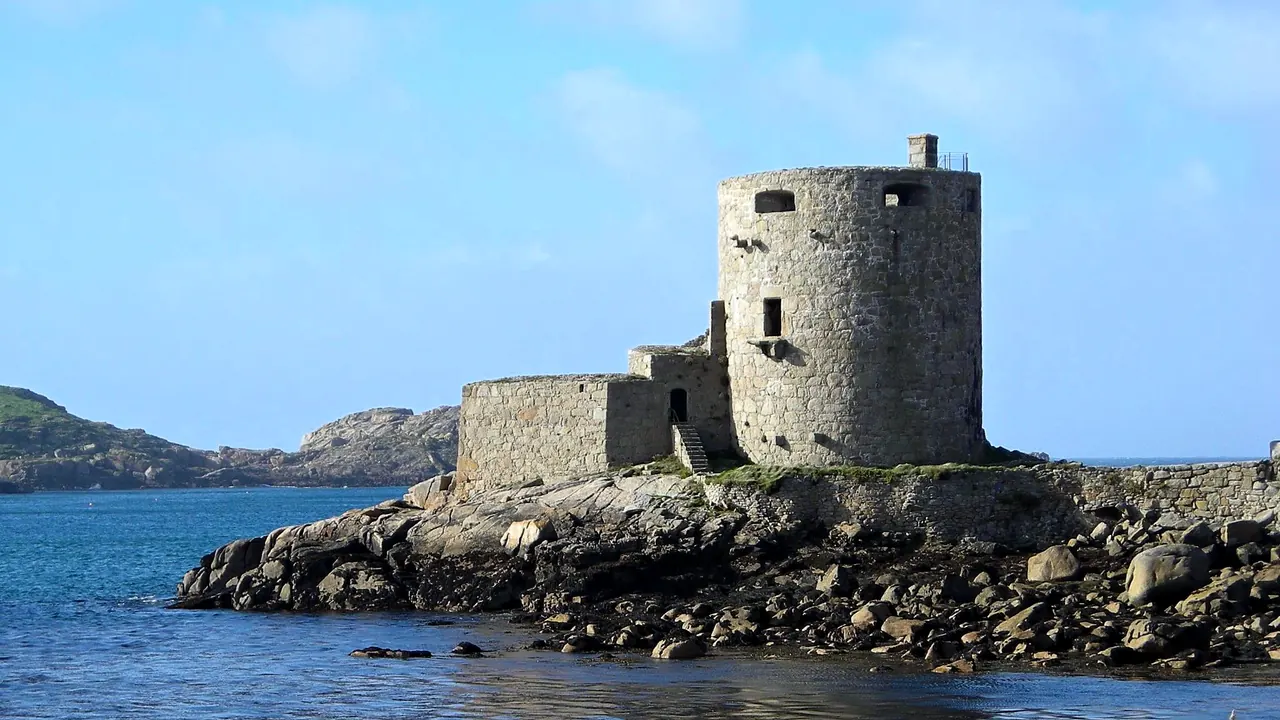
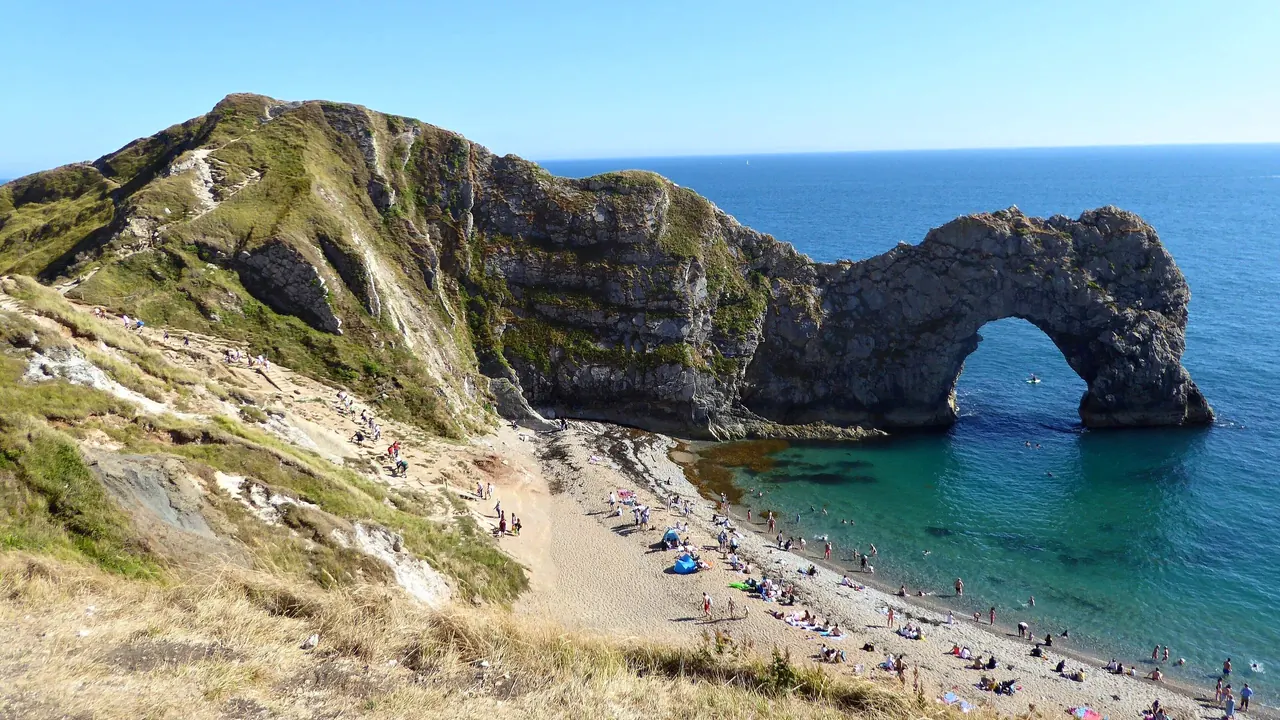
Photos: Isles of Scilly by Mark Percy, CC BY-SA 2.0, cropped; Jurassic Coast by Ethan Doyle White, CC BY-SA 4.0, cropped.
Isles of Scilly or Jurassic Coast?
Our verdict in twelve categories, each scored against the same fixed benchmark cities, and the climate month by month, so you can choose for your trip.
Choose Isles of Scilly for
- getting around
- wellness
- beaches
The Isles of Scilly suit travellers who want to leave the car, the crowds and the timetable of a normal week behind. You get a small archipelago of pale shell-sand bays and seal-watching boat trips, and each day you take a launch to a different island. In return you accept a short list of places to eat, almost nothing to do after dark, and a costly journey out. Choose the islands for quiet days of walking and slow evenings, not for variety.
Choose Jurassic Coast for
- day trips
- prices
- nature and the outdoors
The Jurassic Coast is the better choice if you want more to fill the days. It has a long run of cliffs and fossil beaches, traditional seaside towns where children are well catered for, Bridport and Lyme Regis for food, and cathedral towns and Stonehenge within a drive inland. It is easier on the budget, but it really needs a car, and in high summer the lanes and car parks are busy.
Scoreboard
Twelve categories on one fixed scale from 0 to 100. The shaded stretch is the gap between the two.
Your match
Pick a travel style or drag the sliders, and both match scores follow your weighting.
Wins on getting around and wellness with your weighting.
Wins on day trips and prices with your weighting.
What matters to you?
Category by category
What the scores mean for a trip.
Beaches & swimming
Scilly's beaches are the more beautiful. Par Beach on St Martin's, Pentle Bay on Tresco and Rushy Bay on Bryher have white shell sand and clear turquoise water, and you can usually have a bay almost to yourself, even in August.
The Jurassic Coast has more classic seaside, with Weymouth's wide bay and the dune-backed sands of Studland, but the famous coves in between, Lulworth and Durdle Door, are shingle that drops off steeply, and the sand gets crowded in high summer. The swimming is cold at both, so a wetsuit makes sense either way.
Food & drink
The Jurassic Coast offers more choice. Bridport's street market, the serious seafood kitchens in Lyme Regis, harbour crab shacks at West Bay, Blue Vinny cheese, cider and vineyard tastings on the chalk slopes give you enough to plan days around food.
On Scilly, the island produce is lovely: local lobster, island beef, eggs and fudge from honesty stalls. But most restaurants are in Hugh Town, each off-island has only a pub and a café or two, and many visitors cook for themselves, especially outside the main season.
Culture & sights
Neither is a place for big museums, and they offer roughly the same amount of heritage, but of different kinds. Scilly's is maritime, military and prehistoric, all close together: the Garrison walls round Star Castle, Bronze Age burial chambers on St Mary's, and the shipwreck figureheads displayed in Tresco Abbey Garden. You can see it all in two or three days on foot and by boat.
The Jurassic Coast's history is spread out and comes back to fossils and books. There is Mary Anning's Lyme Regis, the ruin of Corfe Castle, Hardy's Dorchester and the great ramparts of Maiden Castle, and you will need a car to link them up.
Nightlife
Both are places for a pint and an early night, but the Jurassic Coast has slightly more going on. Weymouth's seafront has a strip of bars and a couple of late venues, busy on summer weekends. On Scilly, an evening means watching the gig boats race in the harbour, a drink on the quay, and keeping an eye on the last boat back to your island.
Nature & outdoors
The Jurassic Coast is the bigger landscape. Some 150km of cliffs show 185 million years of rock, and Old Harry Rocks, Chesil Beach and Durdle Door are among Britain's best-known coastal sights. The coast path climbs over Golden Cap, and you can hunt for fossils, climb sea cliffs on Portland or go coasteering.
Scilly is gentler and lower. Its granite islands can each be walked round in a few hours, and the wildlife is what stands out: grey seals around the Western Rocks, puffins on Annet, and birdwatchers arriving in October for rare migrant birds.
Day trips
The Jurassic Coast is far better placed for days out. Exeter's cathedral, abbey-town Sherborne, Brownsea Island across Poole Harbour and the Swanage steam railway are all easy, and Salisbury and Stonehenge make a longer drive from the Purbeck end.
On Scilly, a day trip means taking a boat to another island, from manicured Tresco to remote St Agnes. These are pleasant days, but they follow the same pattern each time, and the Cornish mainland is too far away for a return trip in a day.
Good for families
For a family trip, the Jurassic Coast is the stronger choice because it gives children more to do. There are donkey rides and a sea-life centre in Weymouth, guided fossil walks at Charmouth, the tank museum at Bovington and the steam railway, which also helps on wet days.
Scilly gives children more freedom. With almost no traffic, they can explore rock pools, quays and gently shelving bays on their own. But there are no attractions at all, so a week of Atlantic rain can drag.
Getting around
Once you have arrived, Scilly is the easier place to get around. You do not need a car, every off-island can be walked end to end, and launches leave St Mary's several times a day in season. The hard part is getting there, by a long ferry crossing or by small planes that are often grounded by fog, and in rough weather boats can be cancelled.
The Jurassic Coast is simple to reach but tiring to get around. The drive from one end to the other is long, the lanes clog up in summer, and the car parks at Lulworth fill early. Buses only cover the coast in stages.
Shopping & style
On Scilly, the shops fit into Hugh Town's couple of short streets: gift shops, a bookshop and outdoor clothing, plus craft studios and galleries on the off-islands. The most characteristic thing to buy is a box of scented narcissi, posted home from the flower farms.
The Jurassic Coast gives you more to browse. Bridport's street market and its antiques and vintage quarter can fill a morning, Lyme Regis and Charmouth sell polished ammonites, and there are galleries and potteries along the coast. You won't find a big-name shopping street anywhere, though.
Affordability
Neither is cheap in summer, but Scilly costs noticeably more. You pay for the flight or ferry out and a boat fare each time you visit another island, food costs more because it all comes by sea, and the few beds book up early. Tresco is the most expensive island. Campsites on four of the islands are the main way to save.
On the Jurassic Coast, Weymouth and the caravan parks offer affordable beds, and most of what you come for costs nothing. The main extras are parking and peak rates in the prettier villages.
Live music & performing arts
The Jurassic Coast has at least some live entertainment: a seafront theatre in Weymouth with comedy and summer shows, small arts venues in Lyme Regis and Bridport, and a season of folk and literary festivals in the market towns. Scilly has no venue at all, only the occasional pub session or church concert, so the sunset is the evening's main event.
Wellness & relaxation
For switching off, Scilly has the edge. A week there shrinks to a few small islands and empty bays, and you spend the evenings watching the light fade over the outer rocks, with nothing on the calendar calling you away. Treatments are limited to a few hotel spas and pools on Tresco and St Mary's.
The Jurassic Coast has slightly more on offer, with spas in country-house hotels, yoga retreats in the Dorset hills and cold-water swimming groups. How calm your stay is depends on when you go and where you stay. Avoid August and choose a quiet village such as Beer or a Purbeck hamlet.
When should you go?
Pick your month. The climate figures are measured averages, not a forecast.
Isles of Scilly in July
Jurassic Coast in July
Daytime high, °C
Rainfall in the month, mm
Where the figures come from
Isles of Scilly has no rain gauge within 25 km of the centre, so its rainfall comes from a gridded climate dataset read at the destination rather than from a gauge further away.
Isles of Scilly's sunshine is measured 78 km from the centre, at Camborne.
Jurassic Coast's temperatures are measured 66 km from the centre, at Bournemouth Airport.
Jurassic Coast has no rain gauge within 25 km of the centre, so its rainfall comes from a gridded climate dataset read at the destination rather than from a gauge further away.
Temperature and rainfall are climate normals, averaged over the years shown. Isles of Scilly: 1991-2020 normals, Scilly, Saint Mary'S (0.7 km from centre). Jurassic Coast: 1991-2020 normals, Bournemouth Airport (65.7 km from centre).
Both places are at their best from June to September, but the Jurassic Coast gets properly warm and the Isles of Scilly do not. In July and August, Dorset and east Devon reach about 22°C by day, warm enough for long beach afternoons, while Scilly stays around 19°C and feels breezy. The sea is cold at both, reaching about 17°C at the end of summer, and the mainland coast keeps that warmth a little further into September. May and June are the brightest months on Scilly. The Jurassic Coast gets more sunshine through high summer.
Winter turns the comparison round. Scilly is milder, rarely much colder by day in January than in March, but it is wetter, with close to 119mm of rain a month from November to January against about 94mm on the Jurassic Coast. On Scilly that is also when rough seas can cancel boats. On both, October is when the rain returns. Spring is good for walking at both, and the mainland warms up sooner.
Which traveller are you?
On a relaxing and wellness trip, choose the Isles of Scilly. Visitors leave the car behind, there is barely any traffic, and the days follow the tides and the boats. The Jurassic Coast has a few more hotel spas, but its lanes and beaches fill in summer.
For a trip on a tight budget, the costs on Scilly add up quickly: the journey out, the boat fares between islands and food shipped in by sea. The Jurassic Coast is the clear choice. Weymouth and the caravan parks keep beds cheaper, and the coast path and fossil beaches are free.
On an outdoors trip, Scilly's strength is close-up wildlife along short island paths: seals at the Western Rocks, puffins on Annet and rare migrant birds in October. The Jurassic Coast offers more, with the coast path over Golden Cap and past Durdle Door, fossil hunting and climbing on Portland.
Before you go
| Measure | Isles of Scilly | Jurassic Coast |
|---|---|---|
| Official language | English | English |
| Currency | Pound Sterling (GBP) | Pound Sterling (GBP) |
| Sockets | G230 V, 50 Hz | G230 V, 50 Hz |
| Driving side | Left | Left |
| Time zone | UTC, UTC+1 in summer | UTC, UTC+1 in summer |
| Emergency number | 112 or 999 | 112 or 999 |
| Main airport | St. Mary's Airport (ISC)2 non-stop destinations | Exeter International Airport (EXT)25 non-stop destinations |
| Public holidays this year | 8 days | 8 days |
By the numbers
| Measure | Isles of Scilly | Jurassic Coast |
|---|---|---|
| Population | 2,281 | - |
| People per km² | 140 | - |
| Swim season, months above 21 °C | None | None |
Where else could you go?
Every comparison below shares a destination with this one, so you can follow Isles of Scilly or Jurassic Coast somewhere new.
- Devonvs Jurassic Coast
- Isle of Wightvs Jurassic Coast
- Cornwallvs Isles of Scilly
- Cotswoldsvs Jurassic Coast
- Cornwallvs Jurassic Coast
- Pembrokeshirevs Jurassic Coast