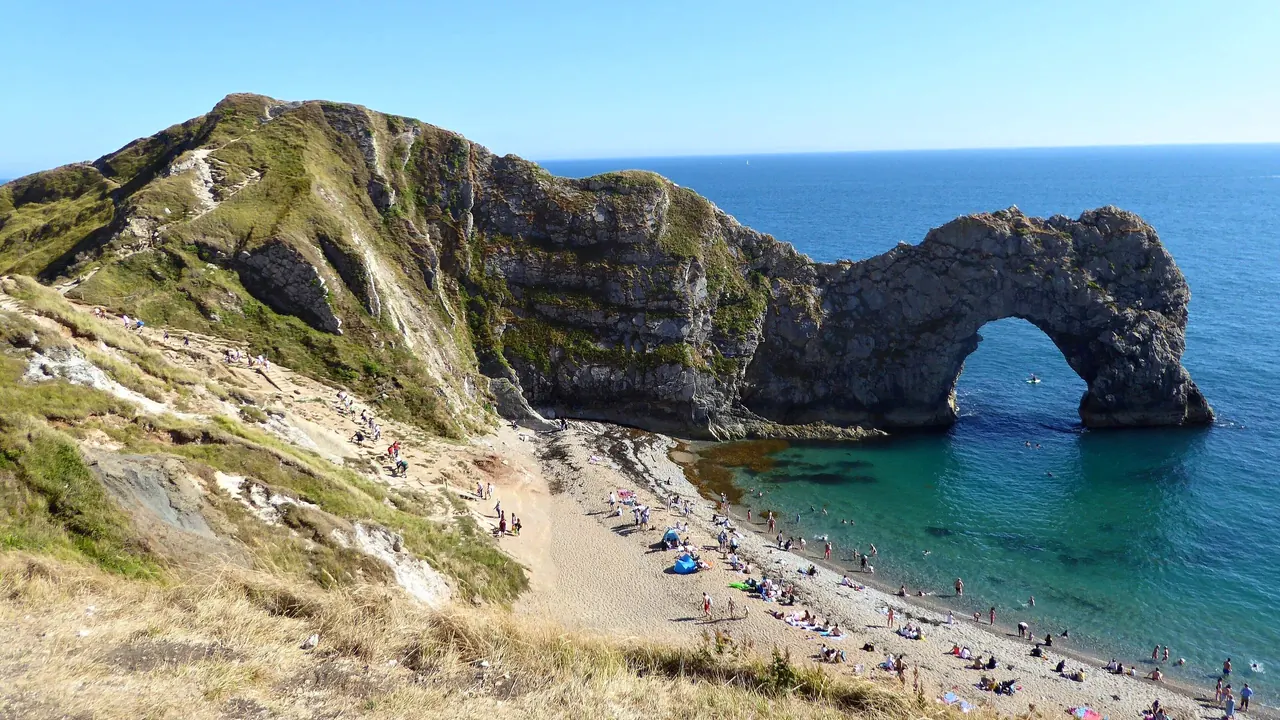
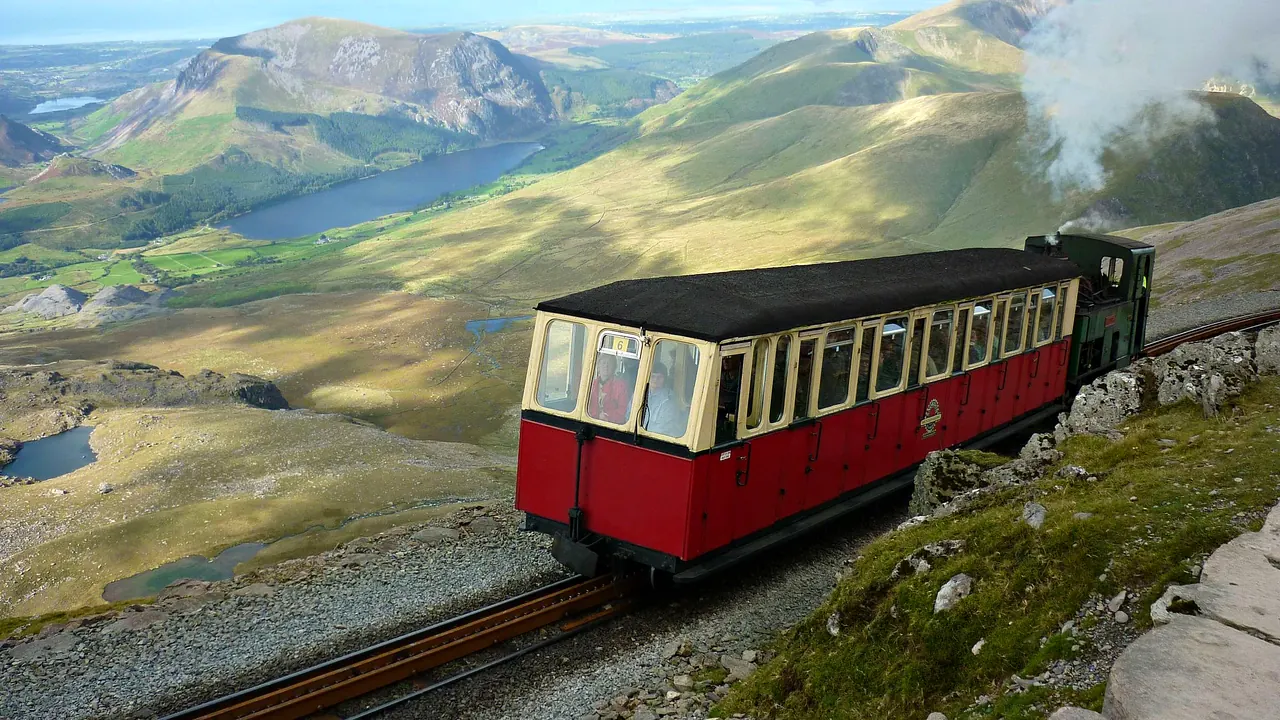
Photos: Jurassic Coast by Ethan Doyle White, CC BY-SA 4.0, cropped; Snowdonia by Porius1, CC BY-SA 3.0, cropped.
Jurassic Coast or Snowdonia?
Our verdict in twelve categories, each scored against the same fixed benchmark cities, and the climate month by month, so you can choose for your trip.
Choose Jurassic Coast for
- food and drink
- beaches
- families
The Jurassic Coast suits a summer seaside trip by car with a mix of ages. You get sandy bays at Weymouth and Studland for small children, fossil hunting at Charmouth and Lyme Regis, cliff walks past Durdle Door and Lulworth, and crab sandwiches on the harbour at West Bay. It is drier and a little warmer than north Wales, and the walking is coastal rather than alpine, so it suits people who want days outdoors without needing mountain gear.
Choose Snowdonia for
- culture and sights
- nature and the outdoors
- day trips
If the hills are the point, Snowdonia is the better pick. Yr Wyddfa, the scrambles on Tryfan and the climbing in the Llanberis Pass give it a bigger, wilder landscape than the Dorset and Devon cliffs. Its castles, slate heritage and Welsh-speaking villages also give it more to see between walks. In return you accept more rain, simpler food and fewer beach days, though hostels and bunkhouses keep a stay a little cheaper.
Scoreboard
Twelve categories on one fixed scale from 0 to 100. The shaded stretch is the gap between the two.
Your match
Pick a travel style or drag the sliders, and both match scores follow your weighting.
Too close to call, 2 points apart
Wins on food and drink and beaches with your weighting.
Wins on culture and sights and nature and the outdoors with your weighting.
What matters to you?
Category by category
What the scores mean for a trip.
Beaches & swimming
The Jurassic Coast has the better beaches, mainly because of the sand at its two ends: the dune-backed shallows at Studland and the wide, gentle bay at Weymouth, plus red-cliffed beaches at Exmouth and Sidmouth. The famous spots in between, such as Durdle Door and Lulworth Cove, are shingle that drops steeply into clear water.
Snowdonia's Cardigan Bay sands at Harlech, Black Rock and Barmouth are broad and handsome. But the Irish Sea is a little colder, the wind blows more often and many swimmers wear a wetsuit. In Wales the beach is a fine-weather afternoon. In Dorset it can be the centre of the week.
Food & drink
Seafood gives the Jurassic Coast the edge: crab, lobster and scallops landed at West Bay, Lyme Regis and Weymouth. Add Bridport's street market, Blue Vinny cheese, cider and sparkling wine from the chalk vineyards. If you stay around Lyme Bay, a few serious kitchens are within easy reach.
Snowdonia eats like a walkers' region: lamb in the pub, cawl, bara brith, and big breakfasts in Llanberis and Betws-y-Coed, with Conwy mussels and Menai oysters on its edges. It satisfies after a day on the hills, but fewer places are worth a detour, and kitchens close early outside summer.
Culture & sights
Snowdonia has more to see. Harlech Castle, the slate landscape with its museum at Llanberis and caverns at Blaenau Ffestiniog, the narrow-gauge railways and the Italianate oddity of Portmeirion make a richer set of stops. Hearing Welsh spoken every day gives the area a character of its own.
The Jurassic Coast's heritage is quieter and leans on the rocks themselves. There is Mary Anning's Lyme Regis, the heritage centre at Charmouth, the ruin of Corfe Castle, and Hardy's Dorchester with Maiden Castle nearby. In both, a visit is a few good stops spread out by car rather than a packed itinerary.
Nightlife
Neither region is the place for a night out. Still, Weymouth's seafront has a strip of bars and a couple of late venues on summer weekends, and Bournemouth is within reach. In Snowdonia the evening ends by the fire in a climbers' inn at Llanberis or Capel Curig, and after closing time nothing else is open.
Nature & outdoors
Both regions are outdoor destinations first, but Snowdonia's landscape is bigger and more demanding. There is Yr Wyddfa at 1,085m, scrambling on Tryfan and the Glyderau, and the crags of the Llanberis Pass. Mountain biking at Coed y Brenin and white water on the Tryweryn make it a place for hard days on foot, on a bike or on a rope.
The Jurassic Coast is about the edge of the land rather than its height. A single coast path runs over Golden Cap and past Durdle Door, Chesil Beach and Old Harry Rocks, and fossil hunting after storms is the signature activity. It is gentler and drier, and the sea brings sailing and coasteering where Snowdonia offers lakes and summits.
Day trips
Snowdonia has the stronger day trips around its edges. The castle towns of Conwy and Caernarfon, Beaumaris on Anglesey, Bodnant Garden and Victorian Llandudno with the Great Orme are all within about an hour of the valleys, and Chester makes a longer outing.
From the Jurassic Coast the trips are to quieter country towns such as Sherborne, Shaftesbury and Exeter. Brownsea Island is a boat ride across Poole Harbour, and Salisbury with Stonehenge is the longer day out. In both regions you need a car to fit several of these together.
Good for families
The Jurassic Coast is the easier family vacation. Weymouth has donkeys and sandcastles, Studland has calm shallow water, Charmouth has guided fossil hunts, and the tank museum and Swanage steam railway cover a wet day. Small children need close watching near falling rock on some beaches.
Snowdonia suits older, energetic children better, with the Snowdon Mountain Railway, cavern adventures and huge zip lines in the old slate workings. More rain and longer drives between attractions make it harder work with toddlers.
Getting around
Both are car country, with narrow lanes and car parks that fill early, but Snowdonia is a little easier without a car. The Conwy Valley and Cambrian Coast lines and the Sherpa'r Wyddfa buses link the villages and the main paths up Yr Wyddfa within a fairly compact area.
The Jurassic Coast is long and strung out. Driving from Exmouth to Studland takes around two and a half hours, and buses run in stages, with changes around Lyme Regis or Axminster. Without a car, the answer is to pick one town and walk the coast path between bus stops.
Shopping & style
Bridport gives the Jurassic Coast a proper town for browsing, with its big street market and its antiques and vintage quarter, and Lyme Regis adds polished ammonites. Snowdonia's shopping is more practical: outdoor gear in Betws-y-Coed, blankets from the woollen mills, slate crafts and Portmeirion pottery. Neither is a place for a shopping trip.
Affordability
Snowdonia is somewhat easier on the budget, mostly because bunkhouses, youth hostels and campsites are plentiful, so walkers can keep costs low. Paid attractions such as the zip lines and railways still add up for a family.
On the Jurassic Coast, cottages in Lyme Regis and Purbeck charge peak rates in summer, and car parking is a steady extra cost, though Weymouth and the caravan parks are cheaper. In both regions the main draws, the paths and the beaches, are free.
Live music & performing arts
The offer is thin in both, but the flavour differs. The Jurassic Coast has a pavilion theatre on Weymouth's seafront with comedy and summer shows, and small folk and literary festivals in the market towns. Snowdonia's offer is Welsh and community-based: male voice choir rehearsals that welcome visitors, and the singing and harp competitions of local eisteddfodau. For bigger stages, Dorset visitors go to Poole or Exeter and Snowdonia visitors to Llandudno or Bangor.
Wellness & relaxation
Neither has a spa culture, and both offer the same kind of rest: a cottage, a long walk and an early night. On the Jurassic Coast the calm comes from seaside villages such as Beer and Charmouth, with cold-water swimming groups in the sea. In Snowdonia it comes from quiet valleys around Beddgelert or the Mawddach, log burners, and swims in mountain lakes.
When should you go?
Pick your month. The climate figures are measured averages, not a forecast.
Jurassic Coast in July
Snowdonia in July
Daytime high, °C
Rainfall in the month, mm
Where the figures come from
Jurassic Coast's temperatures are measured 66 km from the centre, at Bournemouth Airport.
Jurassic Coast has no rain gauge within 25 km of the centre, so its rainfall comes from a gridded climate dataset read at the destination rather than from a gauge further away.
Snowdonia's temperatures are measured 52 km from the centre, at Valley.
Snowdonia has no rain gauge within 25 km of the centre, so its rainfall comes from a gridded climate dataset read at the destination rather than from a gauge further away.
Temperature and rainfall are climate normals, averaged over the years shown. Jurassic Coast: 1991-2020 normals, Bournemouth Airport (65.7 km from centre). Snowdonia: 1991-2020 normals, Valley (51.8 km from centre).
Around the main resorts of the Jurassic Coast, July and August reach about 22°C and the sea warms to 17°C by late summer, so July to early September is the beach window, even if the water stays cool. Rain is moderate from spring through summer and only turns heavy from October. Late spring and summer bring long, sunny days, and winter is mild but grey and short of sunshine.
Snowdonia's winter is just as mild and just as dull, but it is clearly wetter, with late autumn and winter months reaching about 134mm against no more than 94mm on the Dorset and Devon coast. From spring to autumn it runs two or three degrees cooler, with summer highs around 19°C, and even its summer months bring more rain than the Jurassic Coast sees. Its best spell is May, its driest month and as sunny as anything on the Jurassic Coast. Early autumn stays mild enough for the hills, though the rain is already building. Neither region is ever too hot for walking, but winter on the Welsh summits brings real mountain conditions.
Which traveller are you?
On a family trip with young children, the Jurassic Coast asks less of everyone. You can base the week in one seaside town with gentle sand close by, use Purbeck's primate rescue park for a change, and expect fewer washed-out days than in north Wales.
For a culture and arts trip, choose Snowdonia. Valley castles of the Welsh princes such as Dolwyddelan, and the grand houses slate money built at Penrhyn and Plas Newydd, tell a fuller story than Portland's Tudor castle and Georgian Sidmouth on the Dorset side.
On an outdoors trip, let the terrain decide. For summits and long, wild hill days, Snowdonia wins, with quieter ground on Cadair Idris and the Rhinogydd. Travellers who would rather be on the water or on sea cliffs do better on the Jurassic Coast, sailing Weymouth Bay or climbing on Portland.
Before you go
| Measure | Jurassic Coast | Snowdonia |
|---|---|---|
| Official language | English | English |
| Currency | Pound Sterling (GBP) | Pound Sterling (GBP) |
| Sockets | G230 V, 50 Hz | G230 V, 50 Hz |
| Driving side | Left | Left |
| Time zone | UTC, UTC+1 in summer | UTC, UTC+1 in summer |
| Emergency number | 112 or 999 | 112 or 999 |
| Main airport | Exeter International Airport (EXT)25 non-stop destinations | Liverpool John Lennon Airport (LPL)75 non-stop destinations |
| Public holidays this year | 8 days | 8 days |
By the numbers
| Measure | Jurassic Coast | Snowdonia |
|---|---|---|
| Swim season, months above 21 °C | None | None |
Where else could you go?
Every comparison below shares a destination with this one, so you can follow Jurassic Coast or Snowdonia somewhere new.
- Devonvs Jurassic Coast
- Isle of Wightvs Jurassic Coast
- Peak Districtvs Snowdonia
- Cotswoldsvs Jurassic Coast
- Lake Districtvs Snowdonia
- Yorkshire Dalesvs Snowdonia